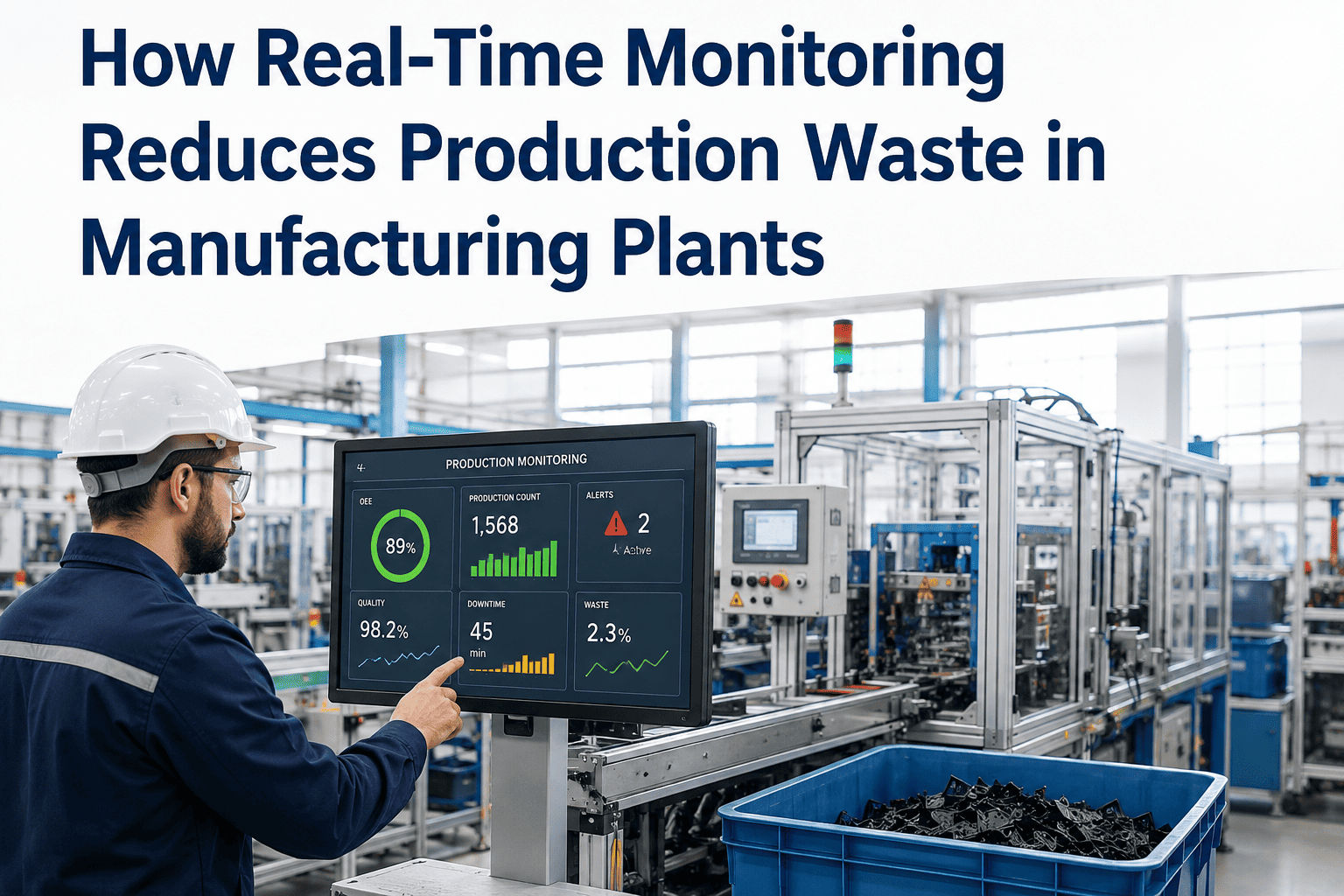
A packaging plant running six production lines paid $4.1 million in electricity last year and could not tell its CFO which line consumed the most. The utility bill arrived as a single number. Twelve weeks after installing machine-level energy submeters and connecting them to OxMaint's energy analytics layer, the plant discovered that Line 4 was consuming 38% more kWh per thousand units than Line 2 — running the same SKU, on the same shift, with the same operators. The root cause was a drifting servo drive no one had flagged. Book a demo to see how submetering transforms energy from a utility bill into a manufacturing performance metric.
Energy & Sustainability / Production Analytics
Energy Monitoring & Submetering for Manufacturing Lines
Without machine-level energy data you cannot improve energy performance — you can only complain about the utility bill. Submetering turns energy into a production KPI that maintenance, operations, and finance can all act on.
17%
Average energy reduction within 12 months of deploying machine-level submetering and analytics
94%
Of manufacturing plants have no visibility below plant-level utility meter today
4.8x
Variance in energy per unit produced between best and worst performing lines in same plant
11mo
Typical payback on a comprehensive machine-level submetering deployment
Why Plant-Level Metering Hides Your Biggest Energy Losses
A single utility meter at the plant boundary tells you what you spent. It cannot tell you what you wasted. Every energy improvement program begins with the same realization: the bill is a symptom, not a diagnosis. Here is what plant-level metering misses.
01
Line-to-line variance
Two identical production lines running the same SKU can differ by 20–40% in energy per unit — invisible at the utility level, obvious with line-level submeters.
02
Idle and standby consumption
Machines drawing 15–25% of running load while "off" between shifts. Across a plant floor this can exceed 8% of annual kWh spend — entirely invisible without metering.
03
Compressed air leakage cost
Air compressor kWh tracked by itself reveals demand growth from leaks, worn seals, and pressure drift — impossible to isolate from utility-bill data alone.
04
Degradation-driven energy drift
A failing motor bearing adds 8–15% to the motor's energy draw months before failure. Submetering catches the signal; plant metering hides it in the noise.
05
Shift, operator, and recipe variance
Third shift consuming 12% more per unit than first shift. Operator A running 9% leaner than operator B. These patterns only exist in the data if the data exists.
06
Peak demand contributors
Demand charges often account for 30–50% of the bill. Without load-level metering you cannot identify which assets are driving your monthly peak kW penalty.
The Submetering Hierarchy: From Utility Meter to Motor
Effective energy monitoring is not one meter — it is a hierarchy of meters, each serving a different decision. The depth of your metering determines the depth of your insight. Here is the four-level structure mature manufacturing plants deploy.
Level 1
Utility / Main Incomer
100% of kWh — 100% of bill
Single revenue meter, utility-owned. Establishes total consumption and demand charges but provides zero operational insight.
Level 2
Building / Area Panels
8–20 submeters — 95% coverage
Distribution panel metering separates production from HVAC, lighting, and office. First level where meaningful optimization decisions become possible.
Level 3
Production Line / Cell
30–120 submeters — 92% coverage
Line-level metering enables energy per unit produced. The threshold where energy becomes a production KPI, not a facilities metric.
Level 4
Machine / Motor / Asset
150–600 submeters — 85% coverage
Asset-level metering drives predictive maintenance energy signatures. Motor kW becomes a leading indicator of bearing wear, misalignment, and load imbalance.
What Machine-Level Energy Data Actually Reveals
Once you have per-machine kWh data at minute-level resolution, a set of patterns emerges that were previously invisible. These are the six highest-value patterns that drive measurable savings within the first 90 days of deployment.
A
Energy per unit produced (EnPI)
kWh divided by units — the single most powerful manufacturing energy metric. Tracked per line, per shift, per SKU, it turns energy into a performance scorecard. Plants routinely find 15–30% variance between nominally identical lines once EnPI is measured.
B
Baseload vs production load split
Separating the fixed energy a plant consumes regardless of production from the variable energy tied to output. Baseload reduction delivers 24/7 savings and is usually the single largest opportunity in the first year.
C
Equipment energy signature
Each machine has a normal kW profile across its cycle. Deviations from the baseline signature reveal bearing wear, clogged filters, misaligned drives, and degrading heaters — days or weeks before conventional vibration or temperature alarms.
D
Peak demand attribution
Submeter data pinpoints which assets contribute most to your monthly billing demand peak. Staggered start-ups, load shedding, and interlock logic can cut demand charges by 12–20% with zero production impact.
E
Idle and standby waste
Quantifies energy consumed when machines are technically idle — heaters holding setpoint, hydraulics pressurized, fans at minimum speed. Targeted idle shutdown policies typically deliver 6–11% plant savings in month one.
F
Power factor and harmonics
Modern submeters capture power quality — reactive power, total harmonic distortion, imbalance. Poor power factor triggers utility penalties; harmonics cause equipment overheating and reduce motor life by 20–30%.
Make Energy a First-Class Production Metric
OxMaint ingests data from every submeter, maps it to your asset hierarchy, and delivers the energy analytics production managers, maintenance leads, and finance teams all need — from one source of truth.
Submeter Technology Choices at a Glance
Submetering technology has matured dramatically. The choice now is less about capability and more about fit — deployment cost, installation disruption, accuracy, and data integration path all vary significantly by meter type.
| Meter Type |
Best Fit For |
Accuracy |
Install Cost / Point |
Data Integration |
| Revenue-grade panel meter |
Building and main distribution level, utility rebate programs |
Class 0.2 (0.2%) |
$800 – $1,800 |
Modbus TCP, BACnet |
| Branch circuit monitor |
Panel-level breakout — 21 to 84 circuits per device |
Class 0.5 (0.5%) |
$45 – $120 / circuit |
Modbus, REST API |
| Clamp-on split-core CT |
Retrofit on individual motors without line shutdown |
Class 1 (1.0%) |
$180 – $450 |
Pulse, Modbus, LoRa |
| Wireless IoT meter |
Distributed machines, remote assets, pilot deployments |
Class 1 (1.0%) |
$250 – $600 |
LoRaWAN, NB-IoT, cellular |
| VFD-embedded metering |
Motors already driven by a variable frequency drive |
Class 1–2 (1–2%) |
Zero — included |
Drive protocol, OPC-UA |
| Non-electrical submeters |
Compressed air CFM, steam mass flow, natural gas, water |
Varies by media |
$900 – $3,500 |
Modbus, 4–20mA, HART |
Scroll horizontally to view all columns
From Raw Meter Data to Operational Action — The Pipeline
Submeters generate data. Data does not save energy — decisions save energy. The critical work is the five-stage pipeline that converts raw electrical readings into maintenance work orders, operator alerts, and management reports.
01
Acquire
Every meter streams kW, kWh, kVAr, power factor, voltage, and current at 1–60 second intervals via Modbus TCP, BACnet, or LoRaWAN gateway.
02
Contextualize
OxMaint tags every reading against the asset record — machine, line, shift, product, operator, work order. Energy becomes structured manufacturing data.
03
Analyze
Engine computes EnPI, baseload, peak contribution, and energy signature deviation against historical baselines. Anomalies flagged in real time.
04
Act
Anomalies convert to work orders, operator alerts, or management escalations with full energy context attached — no manual ticket creation.
05
Verify
Post-intervention energy signature confirmed against pre-intervention baseline. Savings quantified and logged for ISO 50001 and internal reporting.
Building Your Manufacturing Energy Scorecard
The destination of submetering is a scorecard — not a dashboard full of graphs, but a small number of energy KPIs every production, maintenance, and finance stakeholder can interpret and act on. Here are the six that actually drive behavior.
EnPI
kWh / Unit Produced
Operations
Primary energy performance indicator. Tracked per line, shift, and SKU. Production managers own this.
Baseload
kW when plant is idle
Facilities
Fixed overhead consumption. Target is continuous reduction quarter over quarter. Facilities team owns this.
Demand Ratio
Peak kW / Avg kW
Finance
Drives billing demand charges. A lower ratio means flatter load profile and lower cost per kWh delivered.
Signature Drift
% deviation from baseline
Maintenance
Leading indicator of equipment degradation. Maintenance planner owns this; work orders trigger at threshold.
Power Factor
Real / Apparent Power
Electrical
Below 0.9 triggers utility penalties and signals reactive load issues. Electrical engineering owns this.
Cost / Unit
$ / Unit Produced
Finance & Ops
Translates EnPI into dollar terms using current utility rate. The language finance and plant management share.
Frequently Asked Questions
How many submeters do we actually need to start?
Most plants start with 20–40 strategically placed meters covering the top energy consumers — chillers, compressors, major production lines. Full coverage of 85–95% of plant load is typically achievable with 60–120 meters.
Does OxMaint integrate with our existing meters or do we need to replace them?
OxMaint ingests from virtually any meter speaking Modbus, BACnet, OPC-UA, MQTT, or REST API. Existing revenue-grade and branch meters are reused.
Book a demo for your specific meter stack.
Can we install submeters without shutting down production lines?
Yes. Clamp-on split-core current transformers and wireless IoT meters install under live load without line shutdown. Panel-level meters typically only need a brief scheduled outage window during PM cycles.
How quickly do submetering deployments pay back?
Median payback is 9–14 months for machine-level deployments.
Start a free trial to model your plant's specific payback based on current consumption and rates.
What is the difference between energy monitoring and energy management?
Monitoring measures. Management acts on measurements. Submeters provide monitoring data; OxMaint closes the loop by converting anomalies into work orders, alerts, and scorecards that drive operational behavior change.
Does this approach support ISO 50001 and utility rebate programs?
Yes. OxMaint produces the asset-level baselines, measurement and verification records, and documented savings that ISO 50001 auditors and utility incentive programs require. Many customers qualify for metering rebates.
Your Utility Bill Is Not a Diagnosis — It Is a Symptom
Stop debating energy at the utility meter and start managing it at the machine. OxMaint connects every submeter, asset record, and maintenance workflow into a single energy performance platform — built for manufacturing, owned by the people who actually run the plant.



![machine-downtime-tracking-template-for-manufacturing-[excel-dashboard]](./manage-post-2k26/uploads/machine-downtime-tracking-template-for-manufacturing-[excel-dashboard].png)