A chemical plant's monthly energy bill shows $840,000—within budget. Yet asset-level analysis reveals $2.3M annual waste: boilers consuming 18% excess gas, cooling towers drawing 22% extra power, pumps operating at degraded efficiency, compressed air leaks costing $47,000 monthly. All invisible in facility-level monitoring but readily apparent through asset intelligence connecting equipment condition with energy consumption.
Traditional energy management tracks total utility costs while missing equipment-specific degradation silently draining profitability. Asset intelligence transforms optimization by correlating condition data (vibration, temperature, pressure) with real-time power consumption—identifying which assets waste energy, quantifying losses, and prioritizing high-ROI corrective actions. Chemical plants implementing this approach achieve 8-15% energy cost reduction within 12-18 months while preventing efficiency-related failures. Organizations ready to eliminate hidden waste can explore how Oxmaint CMMS enables asset intelligence.
What if your chemical plant is wasting $2-5M annually through equipment degradation invisible in facility-level monitoring?
Asset intelligence reveals equipment-specific waste that aggregate monitoring misses. Join 150+ chemical manufacturers eliminating hidden losses with Oxmaint.
Understanding the Asset-Energy Connection in Chemical Plants
Chemical manufacturing transforms raw materials through energy-intensive processes. Equipment degradation directly increases energy consumption even when production remains constant. Asset intelligence identifies these efficiency losses early.
Four Critical Asset-Energy Relationships
Heat Exchangers & Process Equipment
Energy Impact: Fouling, scale buildup, and tube degradation reduce heat transfer efficiency requiring increased utility consumption to maintain process temperatures.
Example: Reactor cooling exchanger with 3mm scale operates at 68% efficiency. Chiller runs 32% longer consuming extra 240 kW continuously—$175,000 annually in excess electricity.
Pumps, Motors & Rotating Equipment
Energy Impact: Impeller wear, seal leakage, bearing friction, misalignment, and imbalance increase power draw while reducing performance.
Example: Process pump drawing 52 kW gradually increases to 61 kW (17% rise) while flow decreases 8% due to impeller erosion. Excess 9 kW costs $64,800 annually.
Compressed Air & Steam Systems
Energy Impact: Leaks, failed steam traps, pressure drops, and distribution losses waste high-value thermal and pneumatic energy.
Example: Compressed air system with 150 CFM leaks (25% of capacity) requires 2,190 extra compressor hours annually consuming 328,500 kWh—$32,850 waste. Failed steam traps blow 8,500 lbs/hour live steam valued at $420,000 annually.
Cooling Systems & Insulation
Energy Impact: Cooling tower fouling, chiller scaling, damaged insulation reduce efficiency requiring longer runtime or auxiliary systems.
Example: Cooling tower with 30% fill fouling forces chillers to operate at higher temperatures reducing efficiency 18% while consuming additional 125 kW—$90,000 annually. Damaged pipe insulation on steam lines wastes $150K-$500K facility-wide.
The Asset Intelligence Framework for Energy Optimization
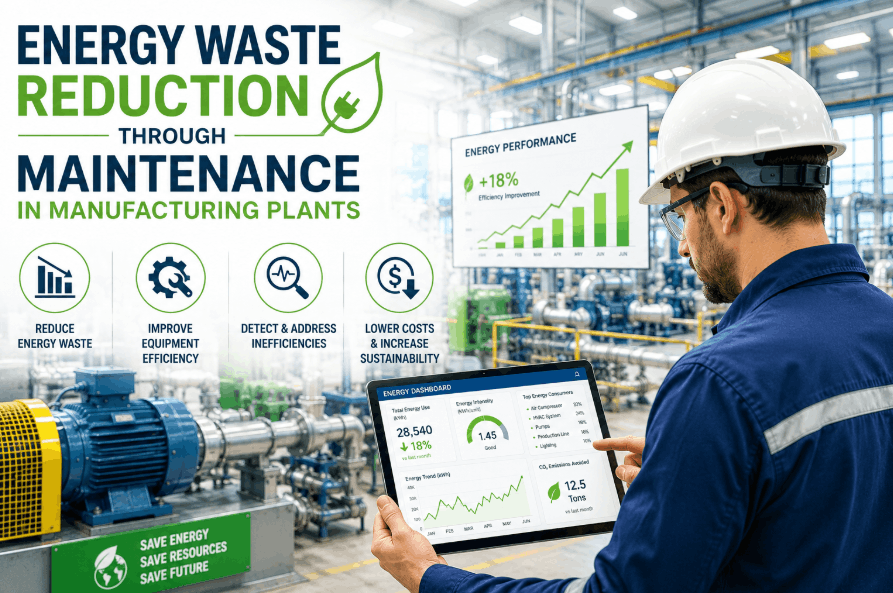
Asset intelligence combines IoT sensors, AI analytics, and systematic data collection identifying equipment-specific energy waste invisible in facility-level monitoring.
Three-Layer Asset Intelligence Architecture
IoT Sensor Deployment & Data Collection
Deploy condition monitoring and power measurement on energy-critical assets:
- Power monitors: Motors >25 HP, pumps, compressors, chillers measuring kW consumption, power factor
- Temperature sensors: Heat exchangers (ΔT efficiency), bearings (friction detection), process equipment
- Vibration sensors: Rotating equipment detecting misalignment, imbalance, mechanical issues
- Pressure/flow sensors: Compressed air (leak identification), steam (trap failures), cooling water
- Ultrasonic sensors: Leak detection, steam trap validation
AI Analytics & Efficiency Trending
Machine learning analyzes sensor data identifying gradual efficiency degradation:
- Baseline establishment: AI learns normal power consumption at various production rates and conditions
- Degradation detection: Flag equipment consuming excess energy relative to baseline
- Multi-variable correlation: Analyze relationships between condition metrics and power (heat exchanger ΔT decline correlating with chiller power increase)
- Predictive modeling: Forecast future waste if degradation trends continue
Automated Work Orders & Prioritization
System generates corrective actions with ROI quantification:
- Energy waste calculation: Excess kW × operating hours × electricity rate = annual cost
- Intervention cost estimation: Repair/replacement cost, downtime, parts/labor
- ROI ranking: (Annual Savings - Maintenance Cost) ÷ Intervention Cost = Priority score
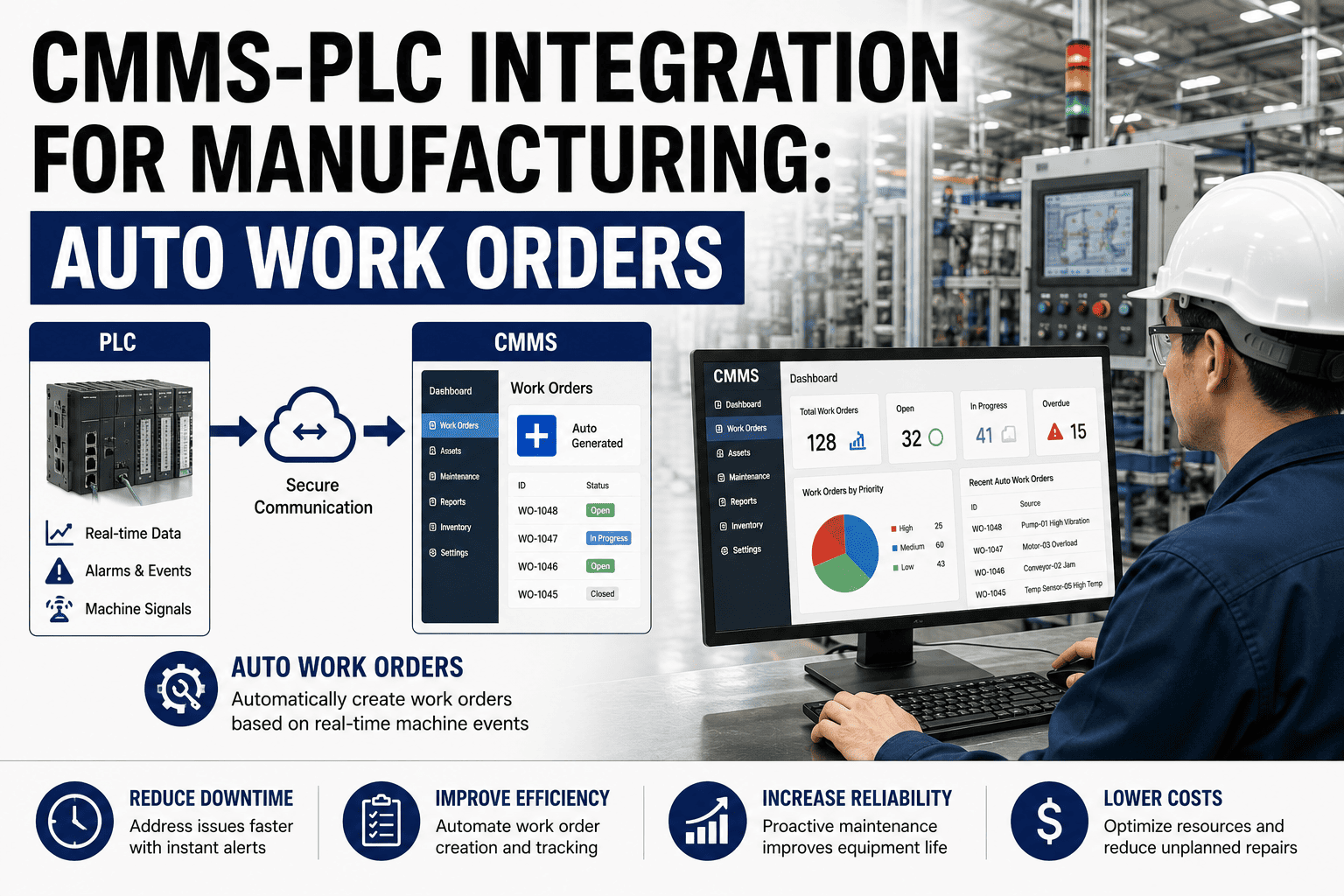
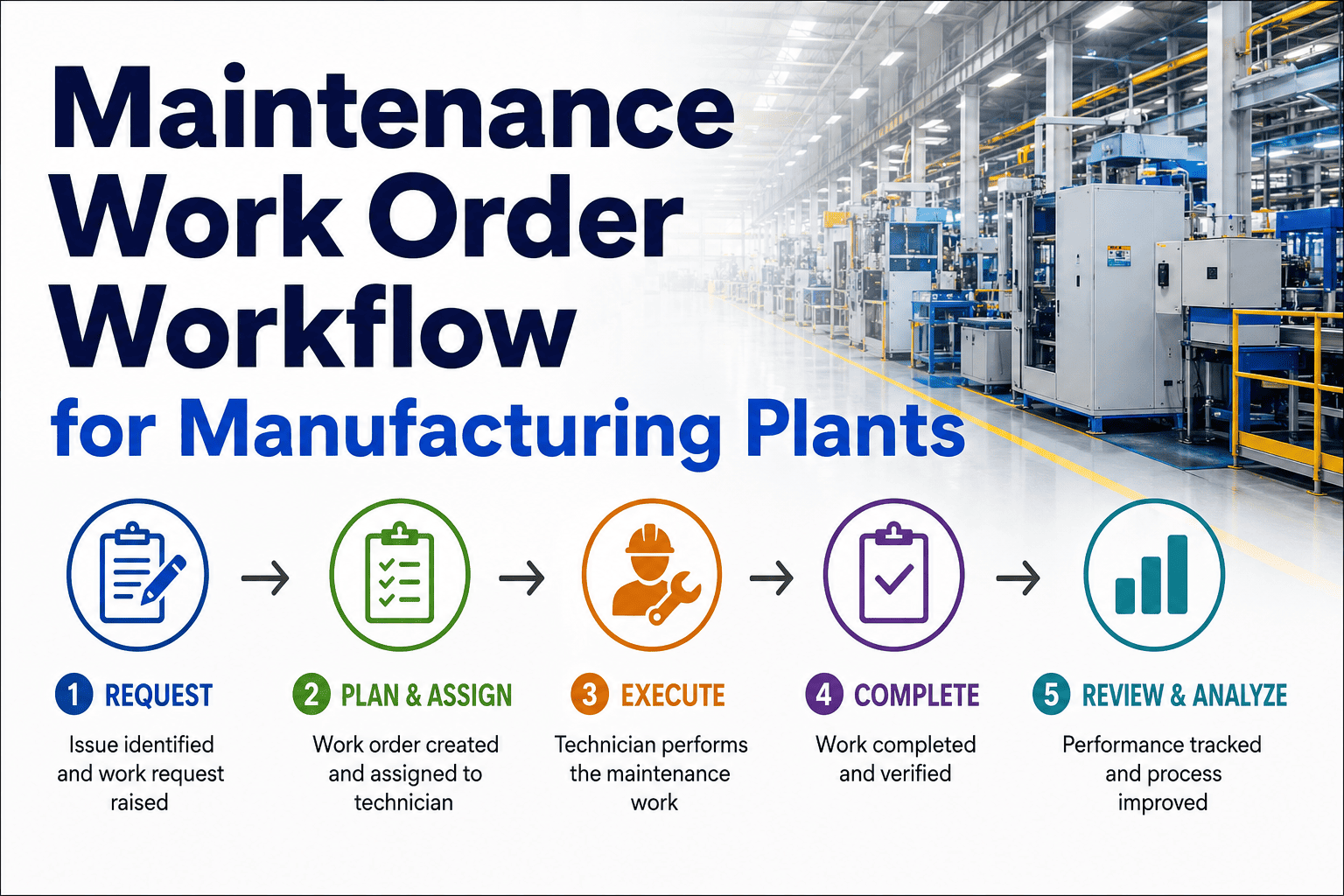
- Auto work order generation: Complete context including equipment specs, OEM manuals, recommended actions, parts requirements
Accelerate Manufacturing & Plants Cost Control Using Mobile Inspections
Asset intelligence identifies energy waste through automated monitoring. Mobile inspections enable systematic verification, human expertise, and comprehensive data collection impossible through sensors alone.
Mobile Inspection Strategies for Energy Cost Control
Equipment-Specific Energy Audits with Real-Time Cost Quantification
Mobile apps guide technicians through systematic inspections with integrated cost calculation:
- Visual checklists: Insulation damage, steam leaks, compressed air leaks, belt slippage, cooling tower condition
- Manual measurements: Ultrasonic leak detection, thermal imaging, vibration analysis
- Photo documentation: Before/after images, mandatory photos of energy waste
- Integrated cost calculations: Measure 25 CFM leak, app calculates $8,213 annual cost automatically
- Barcode/QR verification: Confirm physical inspection at correct equipment
Condition-Based Routing & Exception Workflows
Optimize inspection effort based on equipment energy consumption and AI pre-screening:
- High-energy assets (>100 kW): Monthly detailed efficiency assessment
- Medium-energy assets (25-100 kW): Quarterly inspections focusing on common loss modes
- AI-triggered inspections: Validate flagged equipment with suspected energy waste
- Dynamic scheduling: Increase frequency when AI detects early degradation
Closed-Loop Corrective Action & Verification
Systematic workflow ensuring identified waste gets corrected and savings verified:
- Auto work order generation: Inspection findings with quantified waste create prioritized tasks
- Before/after measurement: Record power, temperatures, metrics pre/post repair validating effectiveness
- Savings verification: Compare actual vs. predicted energy reduction—improve future estimates
- Continuous improvement: Track which categories provide highest ROI focusing future attention
Energy Cost Control ROI Calculator
Chemical Plant Example: 150,000 ton/year capacity
- Average efficiency improvement: 15-25% through systematic cleaning when ΔT declines 20%
- Energy savings per exchanger: $120K-$280K annually
- Total category savings: $960K-$2,240K
- Average efficiency improvement: 8-12% through impeller replacement, alignment, bearing maintenance
- Energy savings per asset: $15K-$45K annually
- Total category savings: $675K-$2,025K
- Leak elimination: 20-35% of total system energy
- Pressure optimization: Additional 5-10% savings
- Total category savings: $95K-$215K
- Failed trap repair: 10-15% of total steam energy
- Distribution improvements: Additional 5-8%
- Total category savings: $280K-$620K
- Efficiency optimization: 12-20% energy reduction
- Total category savings: $180K-$380K
- Oxmaint CMMS + AI analytics: $85,000
- IoT sensors (120-180 units): $145,000
- Mobile devices & training: $25,000
- Integration & commissioning: $35,000
Your chemical plant's equipment is continuously broadcasting its energy efficiency through power consumption patterns—are you listening and acting on the signals?
Asset intelligence transforms hidden equipment degradation into quantified energy savings opportunities. Join 150+ chemical plants using Oxmaint's platform for systematic energy optimization.
Closing the Loop on Maintenance — A Manufacturing & Plants Lifecycle with Analytics
Energy optimization requires closed-loop maintenance where equipment data drives actions, interventions restore efficiency, and analytics validate results—creating continuous improvement rather than one-time projects.
Four-Stage Maintenance Lifecycle for Energy Optimization
Monitoring & Detection
Continuous data collection establishing baselines and identifying degradation:
- Power consumption baselines at different production rates and conditions
- Efficiency metrics: Heat exchanger ΔT, pump specific energy, compressor specific power
- AI anomaly detection flagging excess energy consumption vs. baselines
- Cost quantification calculating annual waste impact
Prioritization & Planning
Systematic ranking and intervention planning:
- ROI calculation: Annual energy savings vs. intervention cost
- Production scheduling: Coordinate during planned shutdowns, changeovers
- Resource allocation: Verify parts, skills, contractor availability
- Compliance logs integration ensuring regulatory documentation
Execution & Verification
Systematic intervention with documentation:
- Mobile execution: Digital work orders with barcode/QR verification, photo requirements
- Before/after measurement: Record degraded performance, verify improvement post-correction
- Quality verification: Ensure actions address root causes not symptoms
- Automated compliance logs for audit trail
Analytics & Continuous Improvement
Validate savings and optimize strategies:
- Post-intervention monitoring: Track power 30-90 days confirming sustained improvement
- Savings calculation: Actual vs. predicted—validate ROI models
- Pattern recognition: Which equipment degrades fastest requiring proactive replacement?
- Benchmarking: Compare energy intensity vs. sister sites identifying additional opportunities
90-Day Implementation Roadmap
- Analyze utility bills identifying total energy costs by category (electricity, natural gas, steam, compressed air)
- Review equipment inventory prioritizing highest energy consumers (motors >25 HP, chillers, boilers, large pumps, heat exchangers)
- Select 20-30 pilot assets representing 40-60% of total energy consumption and prone to efficiency degradation
- Deploy Oxmaint CMMS with asset tracking manufacturing & plants and link OEM manuals digitally
- Establish baseline: current energy consumption, production volume, energy intensity (kWh per unit produced)
- Install IoT sensors on pilot equipment: 60-90 sensors total (power monitors, temperature, vibration, pressure/flow)
- Configure AI baseline learning: 3-4 weeks data collection establishing normal operating signatures
- Deploy mobile inspection workflows: energy-focused checklists with photo documentation and barcode/QR verification
- Train maintenance team: sensor data interpretation, mobile app usage, work order automation, energy waste quantification
- Conduct manual energy audits: compressed air leak surveys, thermal imaging, steam trap testing validating sensor deployment
- Activate AI anomaly detection and efficiency trending algorithms
- Execute first wave of corrective actions: heat exchanger cleaning, pump repairs, compressed air leak elimination, steam trap replacement (target 8-15 interventions)
- Measure before/after energy consumption validating savings predictions
- Calculate pilot ROI: actual savings vs. implementation costs for pilot equipment
- Develop enterprise rollout plan: remaining equipment deployment schedule, resource requirements, projected facility-wide savings
Key Performance Indicators
Energy Performance Metrics
Program Execution Metrics
Financial Performance
Asset Health Metrics
Real-World Energy Optimization Examples
Heat Exchanger Network Optimization
Situation: Four reactor cooling heat exchangers consuming 850 kW chiller capacity. Monitoring revealed 22% efficiency loss—chillers running 28% longer consuming additional 187 kW continuously.
Root Cause: Process-side fouling reducing heat transfer. ΔT declined from 38°F design to 27°F actual.
Intervention: Chemical cleaning during turnaround. Cost: $42,000.
Compressed Air System Leak Elimination
Situation: 400 HP system with 165 CFM leak rate (28% of capacity). Compressor loaded 19 hours daily vs. 13 hours optimal.
Root Cause: 47 leaks identified: quick-disconnects, cylinders, piping through ultrasonic inspection.
Intervention: Systematic leak elimination. Total cost: $15,400.
Steam Trap Program Implementation
Situation: 380 steam traps with no systematic monitoring. Suspected significant waste but couldn't quantify.
Root Cause: Ultrasonic survey identified 68 failed traps (18% failure rate): 42 blowing live steam, 26 plugged causing condensate backup.
Intervention: Prioritized replacement by steam pressure and flow. Cost: $47,000 plus annual mobile inspection program.
Conclusion
Energy optimization in chemical plants requires shifting focus from facility-level utility bill analysis to asset-level performance intelligence. Equipment condition directly determines energy consumption—fouled heat exchangers force chillers to compensate, worn pump impellers increase motor load, compressed air leaks waste compressor power, failed steam traps hemorrhage thermal energy. These efficiency losses accumulate invisibly in total facility energy costs, often representing 15-25% of utility spending yet remaining undetected without systematic asset monitoring.
Asset intelligence combining IoT sensors, AI analytics, and mobile inspections transforms energy management from reactive bill-paying to proactive equipment optimization. Continuous power monitoring detects gradual degradation 30-90 days before operators notice performance loss, AI correlates efficiency decline with specific failure modes (fouling, wear, leaks, misalignment), automated work order generation triggers corrective actions with quantified ROI, and closed-loop analytics validate savings ensuring sustained improvement. Chemical plants implementing this framework consistently achieve 8-15% total energy cost reduction, identify $500K-$3M annual savings opportunities, and improve equipment reliability by preventing efficiency-related failures.
The competitive advantage belongs to chemical manufacturers that systematically eliminate hidden energy waste through intelligence-driven maintenance rather than accepting energy costs as fixed production expenses. The 90-day pilot approach delivers quick wins proving methodology effectiveness while building organizational capability for enterprise deployment—creating sustainable energy optimization culture driving continuous cost reduction and environmental performance improvement. Organizations ready to discover hidden energy waste can begin asset intelligence implementation today before another month of preventable waste erodes profitability.
How much energy is your chemical plant wasting through equipment degradation that facility-level monitoring cannot detect?
Asset-level intelligence reveals the equipment-specific waste hiding in your utility bills. Join 150+ chemical manufacturers using Oxmaint's platform to systematically eliminate hidden energy losses and improve profitability.