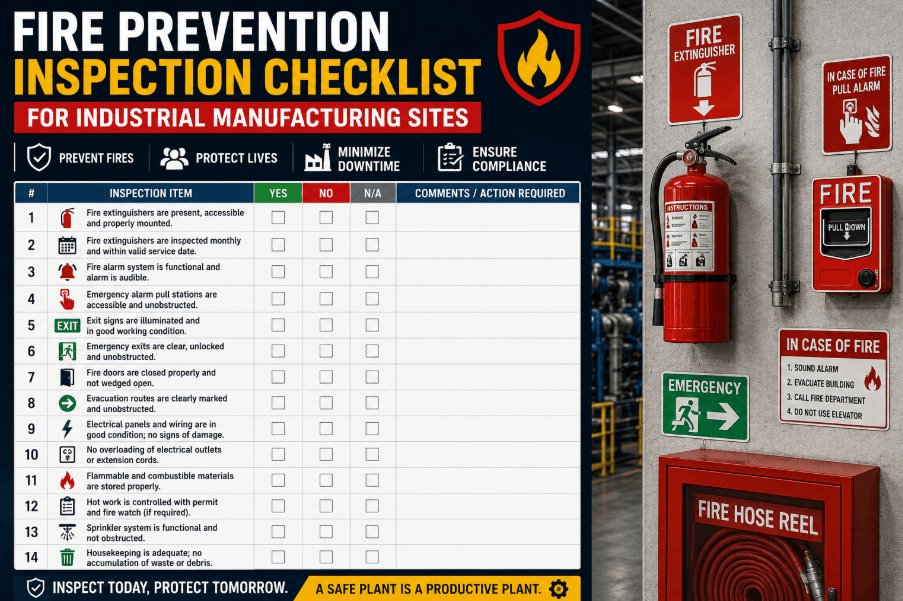
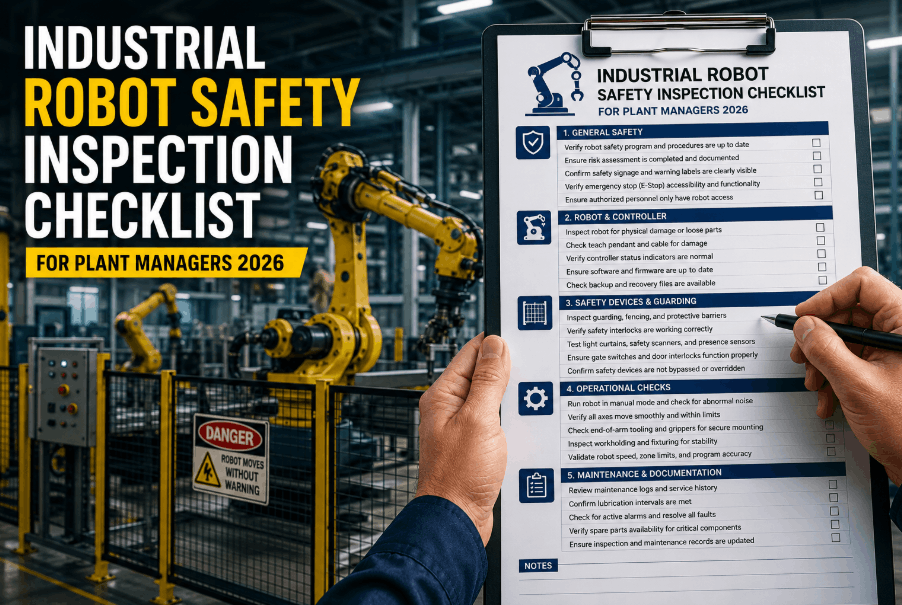
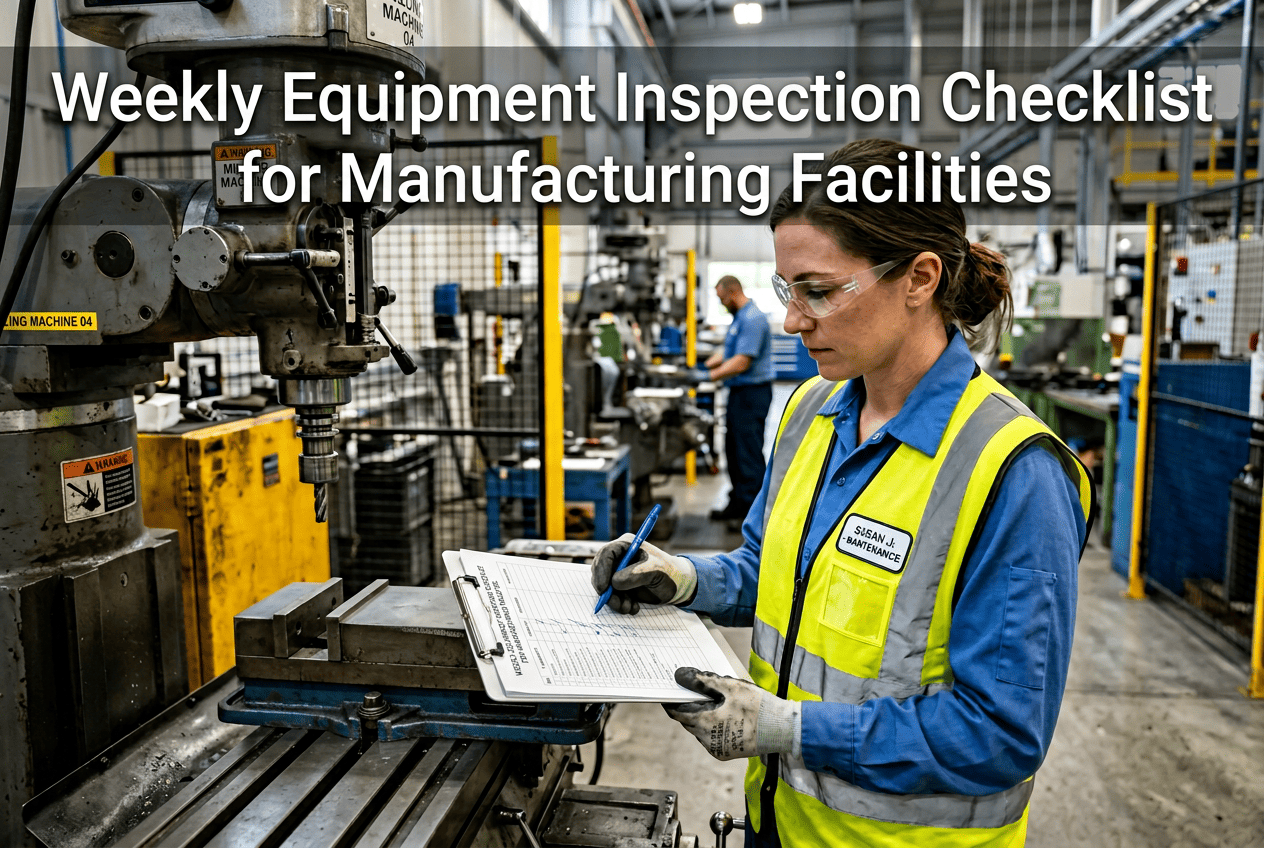
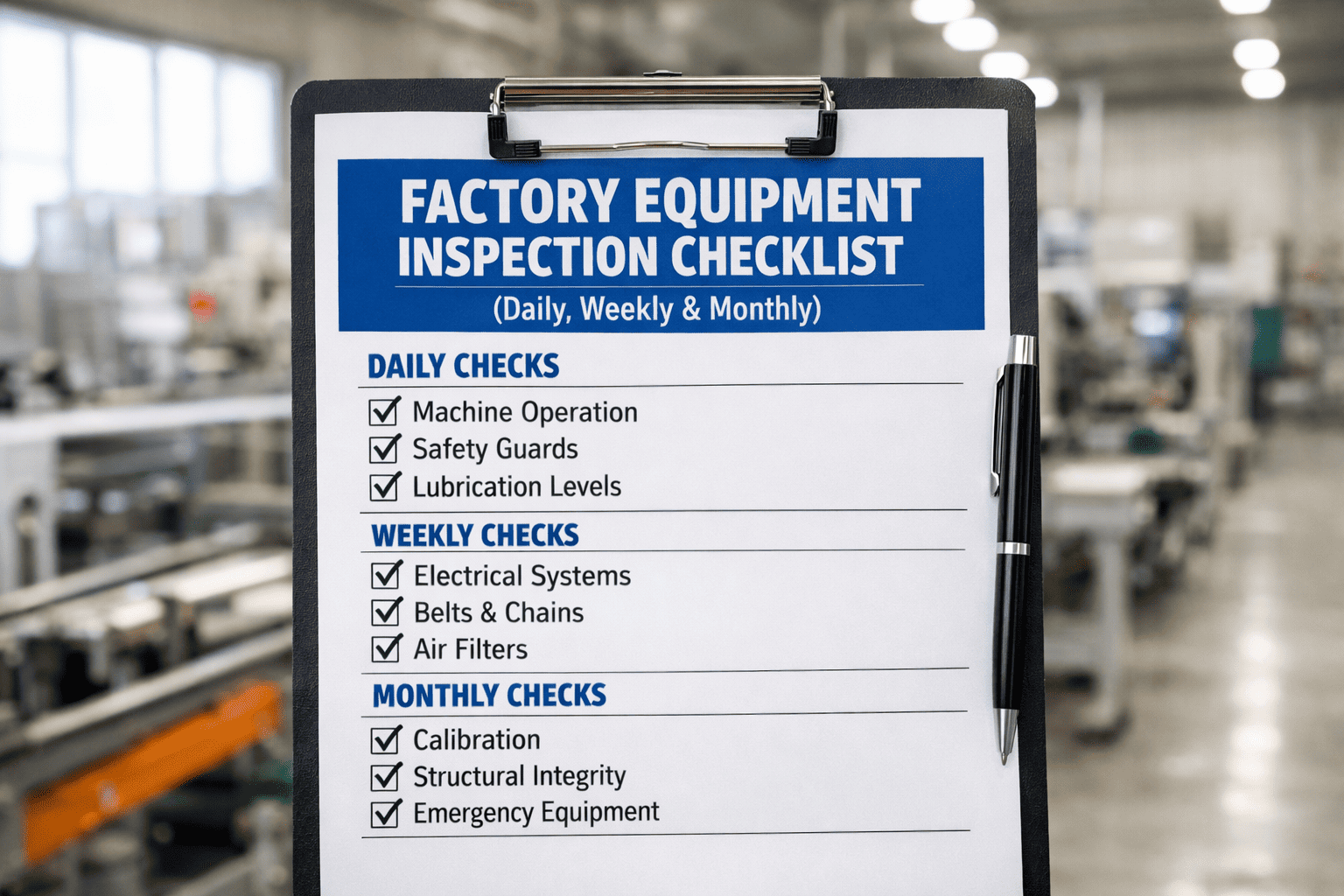
Most factory shutdowns don't start dramatically — they start quietly, with a bearing that wasn't checked, a conveyor belt that wasn't tensioned, and a motor that ran hot for three shifts before anyone noticed. Systematic factory equipment inspection is the difference between a maintenance team that controls their schedule and one that spends every week reacting to emergencies. With a structured digital inspection platform like Oxmaint, every equipment category — motors, pumps, compressors, conveyors, electrical panels, and safety devices — gets inspected on schedule, findings are captured with evidence, and corrective actions are tracked to closure. This complete checklist covers all of them in one place.
Checklist · Factory Maintenance · Complete Inspection Guide
Factory Equipment Inspection: The Complete Checklist
A comprehensive, role-based inspection checklist covering every major equipment category in a manufacturing plant — motors, pumps, compressors, conveyors, electrical systems, and safety devices — with specific inspection criteria, responsible roles, and documentation requirements.
6
equipment categories covered in this checklist
82%
of factory failures are equipment-related and detectable in advance
4x
more failures caught proactively with structured inspection vs. reactive maintenance
30 days
typical advance warning window for most mechanical failures with consistent inspection
Coverage Overview
What This Checklist Covers
Six equipment categories form the operational backbone of most manufacturing facilities. Each carries distinct failure modes, inspection criteria, and documentation requirements.
Electric Motors & Drives
Pumps & Fluid Systems
Air Compressors
Conveyors & Material Handling
Electrical Panels & Distribution
Safety Devices & Systems
Category 1
Electric Motors & Drives
- Bearing temperature and vibration
- Insulation resistance (Megger test)
- VFD cooling and parameter check
- Motor coupling alignment
- Current draw vs. nameplate
Category 2
Pumps & Fluid Systems
- Mechanical seal condition
- Suction and discharge pressure
- Flow rate vs. design curve
- Bearing lubrication levels
- Pump casing vibration
Category 3
Air Compressors
- Oil level and condition
- Discharge temperature logging
- Filter differential pressure
- Auto-drain function test
- Relief valve operation test
Category 4
Conveyors & Material Handling
- Belt tension and tracking
- Roller and idler condition
- Drive chain lubrication
- Emergency stop testing
- Guarding integrity check
Category 5
Electrical Panels & Distribution
- Thermal imaging for hotspots
- Breaker operation test
- Termination torque check
- Panel cleanliness and sealing
- Earth continuity verification
Category 6
Safety Devices & Systems
- Emergency stop function test
- Safety light curtain alignment
- Pressure relief valve test
- Fire suppression system check
- Interlocking device verification
Full Inspection Checklist
Equipment-by-Equipment Inspection Tasks
Each section below provides specific, actionable inspection tasks. Run these on a CMMS to capture timestamped evidence and assign corrective actions automatically when findings are flagged.
1. Electric Motors & Variable Speed Drives
Monthly + Condition-Based
Measure bearing temperature at drive end and non-drive end using contact thermometer — record against baseline and flag any reading more than 10°C above normal
Rising bearing temperature is 4 to 6 weeks ahead of failure in most motor sizes. Trend the data — a single reading means little without historical context.
Responsible: Electrical / Mechanical Technician
Measure vibration at bearing housings in all three axes — compare against ISO 10816 severity zones and record trend against previous readings
Zone A: new equipment normal. Zone B: acceptable for long-term operation. Zone C: investigate within 1 week. Zone D: shutdown immediately.
Responsible: Vibration Analyst / Maintenance Technician
Perform insulation resistance test (Megger test) on motor windings — record phase-to-earth and phase-to-phase resistance and compare against previous annual results
Below 1 MΩ indicates winding insulation breakdown — do not return to service without further investigation and rewind assessment.
Responsible: Electrical Engineer
Inspect VFD cooling fan operation, heatsink cleanliness, and panel temperature — confirm all parameter setpoints match the motor nameplate and process requirements
VFDs generate 2 to 3% of their rated power as heat. A clogged cooling fan raises internal temperature and halves component life within months.
Responsible: Electrical Technician
Check motor coupling alignment using dial indicator or laser aligner — verify misalignment is within coupling manufacturer tolerance
Misalignment above 0.05 mm in any plane increases bearing loading, vibration, and coupling wear — causing failures in all three components simultaneously.
Responsible: Mechanical Technician
2. Pumps & Fluid Transfer Systems
Weekly + Monthly
Inspect mechanical seal area for leakage — classify as none, weeping (acceptable), dripping (monitor), or flowing (replace immediately)
A flowing mechanical seal on a hazardous fluid pump is a safety and environmental incident. Stop the pump and replace the seal before restarting.
Responsible: Mechanical Technician
Record suction and discharge pressure at rated flow — compare against pump design curve to detect impeller wear, cavitation, or system resistance changes
A pump operating off its design curve by more than 10% is either mechanically degraded or the system has changed — both require investigation.
Responsible: Process / Mechanical Technician
Check bearing lubrication — grease-lubricated bearings require correct grease type added on schedule; oil-lubricated bearings require level check and sample for analysis
Over-greasing is as damaging as under-greasing — excess grease causes churning heat that degrades bearing raceway surfaces faster than running dry.
Responsible: Lubrication Technician
Listen for cavitation noise — a crackling or popping sound from the pump casing during operation indicates cavitation from insufficient NPSH margin
Cavitation causes rapid impeller erosion — a pump running cavitating will fail within weeks. Investigate suction conditions immediately.
Responsible: Process / Mechanical Technician
3. Conveyors & Material Handling Equipment
Daily + Weekly
Check belt tension and tracking — confirm belt runs centrally on all idlers without rubbing against structure, and tension is within manufacturer specification
Belt mistracking causes accelerated edge wear, material spillage, and structural damage to idler frames. Correct tracking before any of these become visible.
Responsible: Conveyor Technician
Walk the full conveyor length and physically rotate each idler roller — stiff or non-rotating idlers generate localised belt wear and heat spots that escalate to belt failure
A seized idler costs under $50 to replace. The belt it destroys if missed costs $500 to $5,000 depending on width and length.
Responsible: Mechanical Technician
Test all emergency pull cord stops along the conveyor length — confirm each stop triggers an immediate shutdown and requires manual reset before restart
Emergency stops that fail to trigger or reset automatically without manual action are a serious safety non-compliance. Tag out immediately and repair before returning to service.
Responsible: Safety / Electrical Technician
Inspect all conveyor guarding — check that all nip points, drive sections, and tail pulley areas are completely guarded with no openings wider than 6mm
OSHA 1910.212 machine guarding citations are among the most common in manufacturing. Inspect guarding integrity every week and document findings.
Responsible: Safety Officer / Technician
Lubricate drive chain, sprockets, and all articulating points per lubrication schedule — use correct grade specified for operating temperature and load cycle
Dry chain generates up to 40% more power loss and stretches significantly faster — increasing sprocket pitch wear and shortening the replacement interval for both components.
Responsible: Lubrication Technician
4. Electrical Panels & Distribution Systems
Monthly + Annual Thermal Imaging
Conduct thermal imaging survey of all MCC, switchboard, and distribution panel bus bars, cable terminations, and breaker contacts under loaded conditions
A temperature differential of more than 15°C between similar components in the same panel is a fault condition — high resistance at a loose termination creates heat that can cause arc flash.
Responsible: Electrical Engineer (NFPA 70E qualified)
Verify torque on all main cable terminations — retorque to manufacturer specification using a calibrated torque wrench and record torque values applied
Thermal cycling causes termination bolts to work loose over time — loose terminations are the primary cause of panel fires and arc flash events in manufacturing.
Responsible: Licensed Electrician
Test earth continuity from panel earth bar to equipment earth points — confirm resistance is below 1 ohm and all earth conductors are mechanically secure
Failed earth continuity means fault current has no return path — a ground fault becomes a shock hazard rather than a breaker trip. Test and record every panel annually at minimum.
Responsible: Electrical Engineer
Inspect panel internal condition — confirm no dust accumulation on bus bars, no moisture ingress, no unauthorised cable entries, and all knockout blanks are sealed
Conductive dust on bus bars is an arc flash and fire ignition risk. Panels in grinding, casting, or cement environments require quarterly internal cleaning as a minimum.
Responsible: Electrical Technician
5. Safety Devices & Protection Systems
Weekly — Zero Tolerance for Overdue
Function test all emergency stop buttons on each machine — press E-stop, confirm machine stops immediately, confirm manual reset is required before restart, and confirm E-stop lamp illuminates
An E-stop that allows restart without manual reset is a Category B safety failure under IEC 60204-1. Remove machine from service until rectified.
Responsible: Safety Officer / Electrical Technician
Test safety light curtain alignment and muting function — verify curtain triggers a stop on interruption and muting operates only within defined operational parameters
Misaligned curtains can develop dead zones that allow pass-through without triggering — always test the full curtain length with a test object, not just the beam indicators.
Responsible: Safety Engineer
Inspect all interlocking devices on access doors, guard panels, and safety gates — verify each interlock requires the guard to be closed before power can be applied
Mechanical defeat of interlocks using tape, wire, or cable ties is a wilful safety violation. Inspect for evidence of bypass during every weekly check.
Responsible: Safety Officer
Check fire detection and suppression system — confirm all detectors are in normal status, no alarm isolations are active, suppression agent levels are within specification
An isolated fire detector is not a temporary measure — it is a gap in your fire protection. Every isolation must have an approved workaround and a reinstatement deadline.
Responsible: Fire Safety Officer
Run This Entire Checklist Digitally — One Platform, Every Equipment Category
Oxmaint CMMS manages your full factory inspection schedule — auto-assigning tasks to the right technician, requiring timestamped photo evidence for completion, and tracking corrective actions until closure. No spreadsheet can do this.
Risk Prioritisation
Equipment Inspection Risk Priority Matrix
Not all equipment carries the same failure risk. This matrix helps maintenance teams prioritise inspection frequency and resource allocation based on failure consequence.
Impact Data
Before vs. After Structured Equipment Inspection
Facilities that switch from reactive to structured inspection-based maintenance see measurable improvements across four key performance areas within the first 90 days.
Without Structured Inspection
Failures discovered when equipment stops — production already impacted
Emergency repair costs 3 to 5x higher than planned maintenance
Safety device failures go undetected until an incident occurs
No historical data — repeat failures on the same equipment
Regulatory inspections expose documentation gaps under pressure
Maintenance team constantly reactive — low morale and high overtime
With Structured Inspection (CMMS)
Faults detected 2 to 8 weeks before failure — planned response only
Maintenance costs reduced 25 to 40% through prevention over repair
Safety devices tested weekly — compliance documented automatically
Inspection history identifies repeat fault equipment for root cause review
Inspection records immediately available — inspections become formalities
Maintenance team proactive — predictable schedule and lower overtime
65%
fewer unplanned equipment failures after implementing structured factory inspection programs
38%
average reduction in total maintenance costs within 12 months of CMMS-based inspection
4x
faster regulatory inspection response when digital records replace paper-based documentation
Frequently Asked Questions
How often should factory equipment inspections be conducted?
Safety-critical equipment — emergency stops, interlocks, and guarding — requires weekly function testing at minimum. Mechanical equipment like motors, pumps, and conveyors warrants monthly inspections. Electrical panels need monthly checks with annual thermal imaging. The right answer depends on criticality: use a risk matrix to set frequencies and let
Oxmaint CMMS auto-schedule and track every task automatically.
What is the most commonly missed item in factory equipment inspections?
Emergency stop function testing and electrical panel earth continuity checks are consistently the most skipped items in manufacturing inspections — both because they require deliberate interruption of normal operations and because their failures are only visible during an incident. Make both non-negotiable weekly tasks in your CMMS.
Book a demo to see how Oxmaint enforces completion with photo evidence.
How should inspection findings be documented for regulatory compliance?
Every inspection finding should be recorded with a date, technician name, equipment ID, finding description, and corrective action status. Paper logs do not meet modern regulatory expectations — OSHA and ISO 45001 auditors expect timestamped digital records with evidence. Oxmaint generates inspection reports in this format automatically from every completed checklist task.
Can one CMMS manage inspections across all equipment categories?
Yes — a properly configured CMMS handles every equipment category in this checklist from a single platform.
Oxmaint lets you create equipment-specific inspection checklists, assign them to the correct technician role, set frequency and hour-based triggers, and aggregate all findings into a plant-wide compliance dashboard accessible to management and auditors.
Every Equipment Failure You Prevent Is Hours of Production You Keep
Oxmaint gives factory maintenance teams a complete digital inspection platform — covering every equipment category in this checklist, auto-scheduling tasks, capturing photo evidence, and turning your maintenance history into a competitive advantage. Start free today.