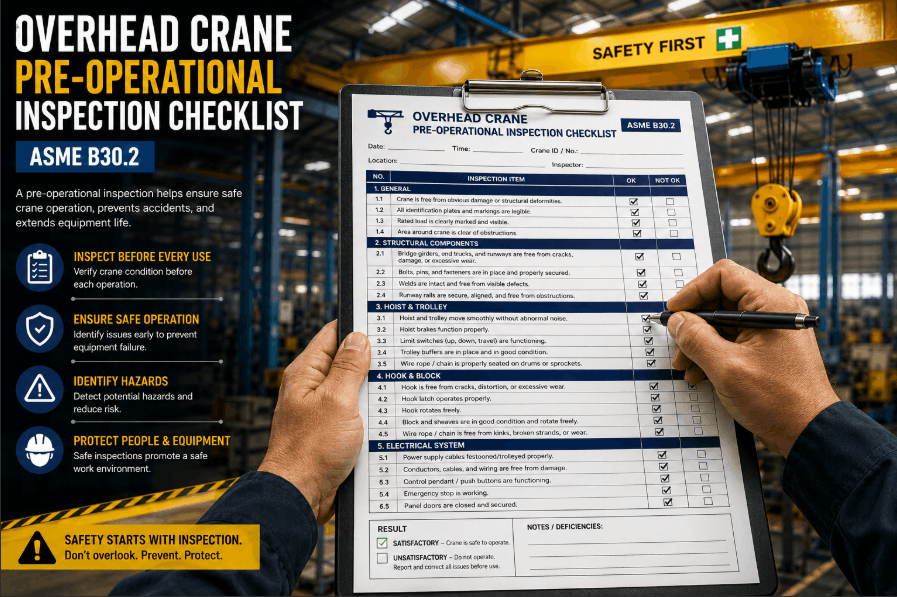
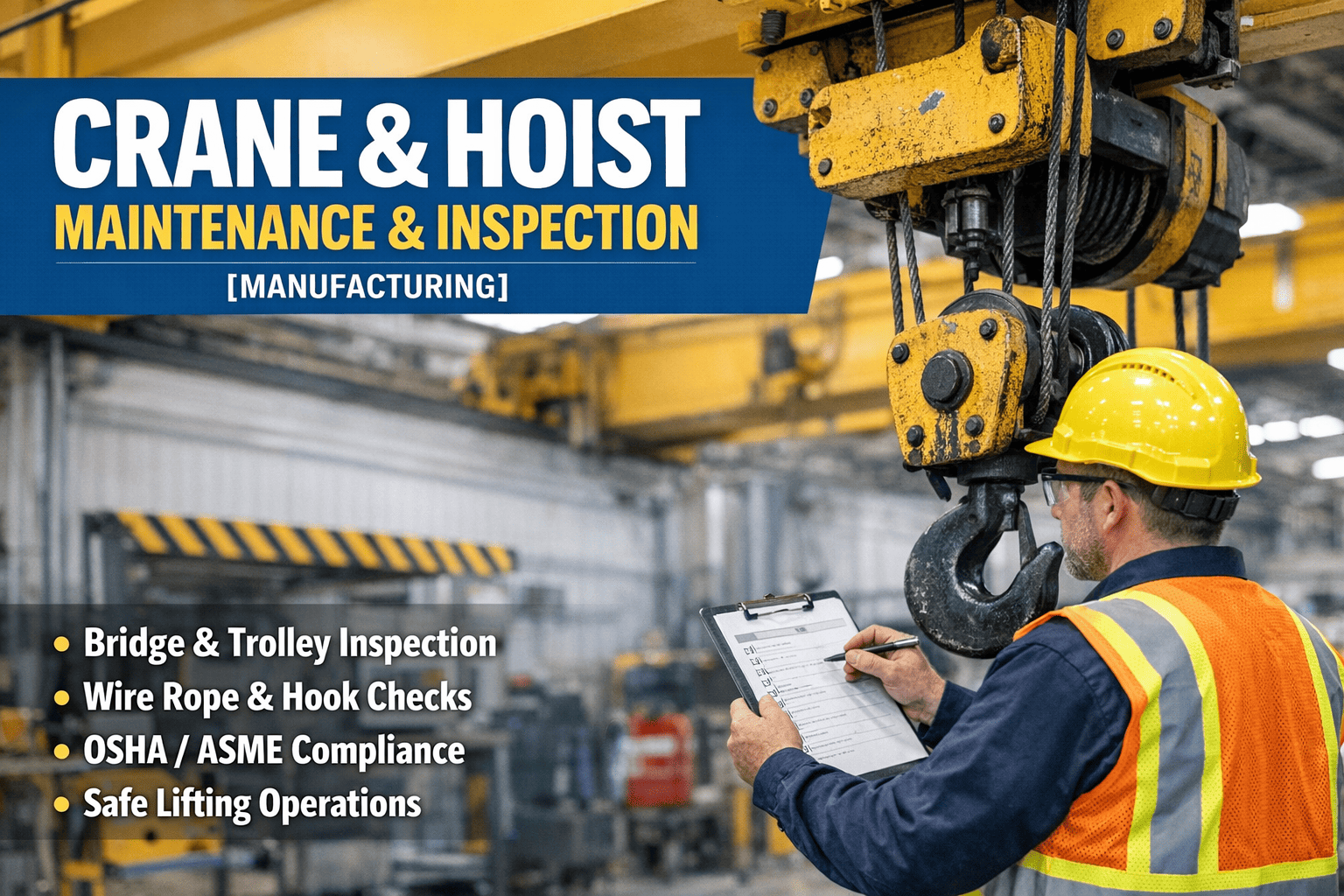
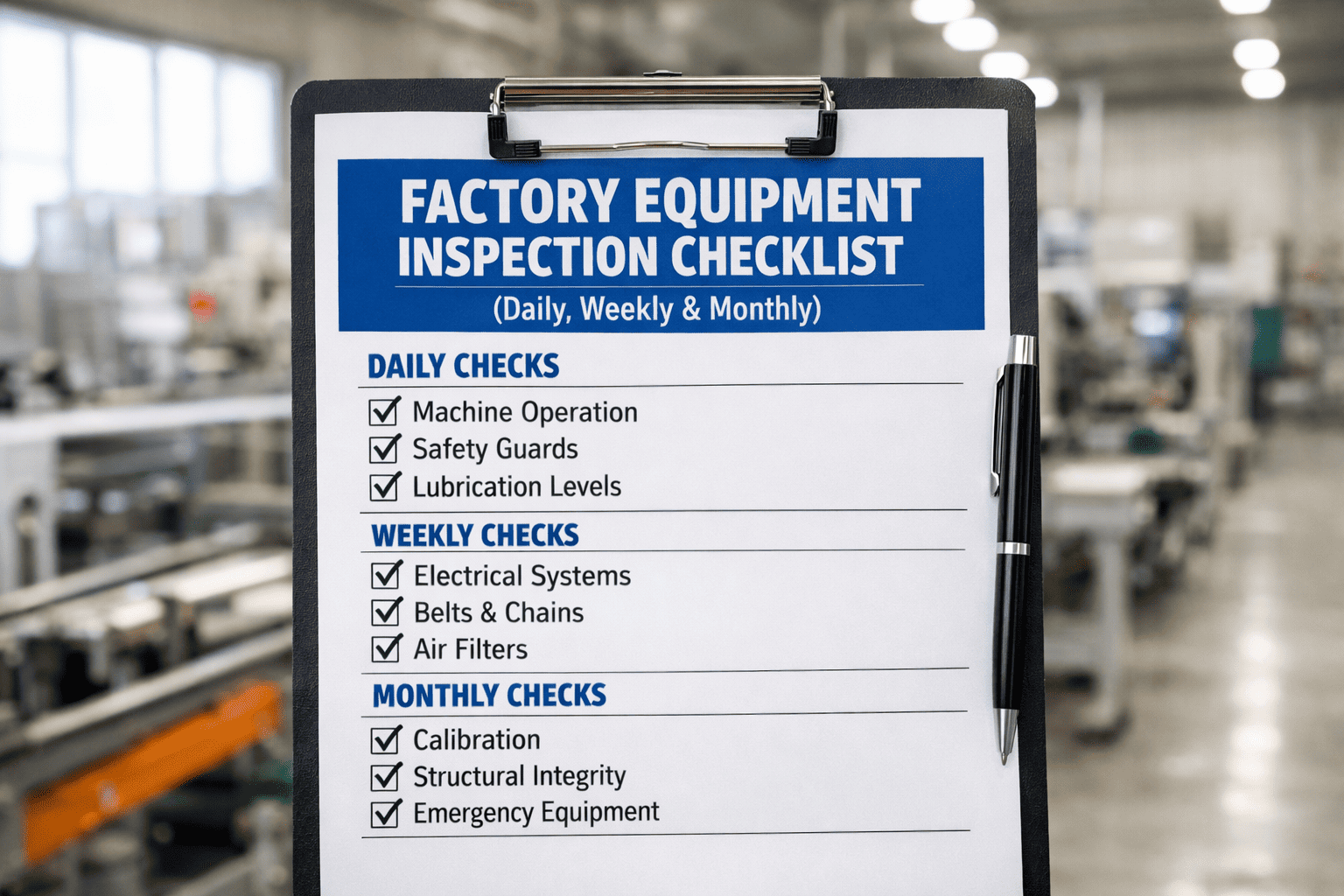
Crane and lifting equipment failures in manufacturing are among the most catastrophic and legally consequential events a plant can face — a dropped load, structural collapse, or wire rope failure can result in fatalities, OSHA shutdown orders, and multi-million dollar civil liability within seconds. OSHA 1910.179, ASME B30.2, and LOLER 1998 impose strict inspection duties on every employer that operates overhead cranes, hoists, and rigging equipment. Plants that run structured crane inspection programs report up to 70% fewer load-handling incidents and significantly faster regulatory audits. This checklist covers every inspection tier — pre-shift, weekly, monthly, and annual — with each item mapped to the specific standard it fulfils, the failure mode it prevents, and the consequence it avoids. Start managing crane inspections digitally with OxMaint's lifting equipment compliance platform, purpose-built for manufacturing environments.
Manufacturing Safety · Overhead Cranes · Lifting Compliance
Crane & Lifting Equipment Inspection Checklist
Pre-shift, weekly, monthly, and annual inspection items covering wire ropes, hooks, brakes, hoists, and structural integrity — compliance-mapped to OSHA 1910.179, ASME B30, and LOLER standards.
Pre-Shift
Weekly
Monthly
Annual
70%
Fewer load-handling incidents with structured crane PM programs
OSHA
1910.179 — the primary federal standard governing overhead crane inspections
ASME
B30.2 — defines inspection intervals and rejection criteria for all lifting gear
4 Tiers
Pre-shift through annual — every required inspection level in one checklist
Pre-Shift
Pre-Shift Crane Operational Checks
Pre-shift inspections are the operator's responsibility before every lift cycle. They take 10 to 15 minutes and are mandated by OSHA 1910.179(j)(1). These checks catch the conditions most likely to change between shifts — hook condition, rope damage, brake response, and limit switch function.
Hook & Rigging Condition
Hook throat opening measured and compared to manufacturer's limit — opening beyond 15% of original dimension is an automatic rejection criterion under ASME B30.10; distorted or cracked hooks must be removed from service immediately
Standard: ASME B30.10 · Record: Hook inspection log · Role: Crane Operator · Frequency: Pre-shift
Safety latch on hook confirmed functional — latch must seat fully and not be bent, corroded, or spring-fatigued; missing or disabled latches are an OSHA citation under 1910.179(f)(1)
Standard: OSHA 1910.179(f)(1) · Record: Pre-shift inspection log · Role: Crane Operator · Frequency: Pre-shift
All slings, shackles, and lifting attachments visually inspected for cuts, kinks, corrosion, or deformation — any damaged rigging removed from service and tagged before use; sling angle must be within rated load tables
Standard: ASME B30.9 / OSHA 1910.184 · Record: Rigging inspection log · Role: Rigger/Operator · Frequency: Pre-shift
Wire Rope & Hoist
Wire rope visually inspected along full running length — check for broken wires, kinking, crushing, corrosion, and bird-caging; rejection threshold is six random broken wires in one rope lay or three in one strand per ASME B30.2
Standard: ASME B30.2 · Record: Wire rope inspection log · Role: Crane Operator · Frequency: Pre-shift
Hoist brake tested under no-load condition — raise and lower hook with no load; brake must hold position when controls are released with no drift or slip; any brake creep requires immediate maintenance hold
Standard: OSHA 1910.179(j)(1) · Record: Pre-shift log · Role: Crane Operator · Frequency: Pre-shift
Controls & Limit Switches
Upper limit switch tested — raise hook slowly until limit switch trips and cuts power; confirm trip occurs before hook block contacts drum or sheave structure; bypassing or defeating limit switches is a willful OSHA violation
Standard: OSHA 1910.179(e)(3) · Record: Pre-shift log · Role: Crane Operator · Frequency: Pre-shift
All travel controls tested — bridge travel left/right, trolley travel in/out, and hoist up/down confirmed responsive with no sticking, drift, or abnormal noise; emergency stop tested and confirmed functional
Standard: OSHA 1910.179(j)(1) · Record: Pre-shift log · Role: Crane Operator · Frequency: Pre-shift
Schedule Every Crane Inspection Automatically
OxMaint assigns pre-shift checks to operators, weekly inspections to technicians, and annual certifications to inspectors — all on schedule, all documented, all audit-ready.
Weekly
Weekly Crane Inspection Items
Weekly inspections cover structural, mechanical, and electrical items that wear over multiple shift cycles. OSHA 1910.179(j)(2) requires these inspections be conducted by a designated person — not simply any operator — and documented with findings recorded.
Structural & Mechanical
Bridge girder and end truck structure visually inspected — look for weld cracks at connection points, deformed members, loose fasteners, and impact damage to runway rail; cracks at girder-to-end-truck welds are a serious structural hazard
Standard: OSHA 1910.179(j)(2) · Record: Weekly structural log · Role: Designated Inspector · Frequency: Weekly
All crane wheels inspected for flange wear, flat spots, and proper rail seating — wheel flange-to-rail clearance verified; worn flanges cause rail climbing, which is a leading cause of crane runway derailment
Standard: ASME B30.2 · Record: Weekly wheel inspection log · Role: Mechanical Technician · Frequency: Weekly
Runway rail alignment checked at intervals — gauge, elevation, and joint gaps measured; rail misalignment exceeding manufacturer tolerances causes accelerated wheel and bearing wear and must be corrected before continued operation
Standard: CMAA Specification 70 · Record: Rail alignment log · Role: Mechanical Technician · Frequency: Weekly
Electrical & Controls
Festoon cable or conductor bar system inspected — cables checked for chafing, connector damage, and strain relief condition; conductor bar cover clips checked for completeness and contact integrity
Standard: OSHA 1910.179(g) · Record: Electrical inspection log · Role: Electrical Technician · Frequency: Weekly
Pendant control station inspected — enclosure integrity, button function, e-stop mushroom head condition, and cable strain relief all checked; pendant must be clearly labelled with rated capacity and load chart attached to crane
Standard: OSHA 1910.179(b)(6) · Record: Controls inspection log · Role: Electrical Technician · Frequency: Weekly
Monthly
Monthly PM Tasks
Monthly inspections require crane downtime and access to mechanical components. They focus on lubrication, brake condition, load block, and wire rope drum — items that degrade over weeks of production use. Assign to a qualified mechanical technician.
Lubrication & Mechanical PM
Wire rope lubrication applied as per OEM specification — use manufacturer-specified penetrating lubricant to protect internal wire strands; over-lubrication attracts contamination; log lubricant type and application date
Standard: ASME B30.2 · Record: Lubrication log · Role: Mechanical Technician · Frequency: Monthly
Hoist gear reducer oil level and condition checked — sample oil for water contamination and metallic particles; change oil if sample is cloudy or shows particles exceeding laboratory threshold; log oil grade and consumption
Standard: OEM Maintenance Manual · Record: Oil analysis log · Role: Mechanical Technician · Frequency: Monthly
All wheel bearings and travel drive motor bearings checked for temperature, noise, and vibration — temperature above 80°C or abnormal rumbling indicates bearing degradation; log thermal readings with IR thermometer
Standard: ASME B30.2 · Record: Bearing inspection log · Role: Mechanical Technician · Frequency: Monthly
Brake System
Hoist brake lining thickness measured and compared to rejection limit — worn lining reduces braking torque and increases stopping distance; lining at 50% of original thickness must be scheduled for replacement at next planned outage
Standard: OSHA 1910.179 / ASME B30.16 · Record: Brake inspection log · Role: Mechanical Technician · Frequency: Monthly
Bridge and trolley travel brake adjustment verified — static brake holding torque tested at 125% of rated motor torque; any brake that slips under rated torque test must be serviced before crane returns to rated load service
Standard: CMAA Specification 70 · Record: Brake torque test log · Role: Mechanical Technician · Frequency: Monthly
Compliance Reference
Crane Inspection Standards at a Glance
Annual
Annual Crane Inspection & Certification
Annual inspections are mandatory under OSHA 1910.179(j)(3) and must be performed by a qualified person with documented findings. They cover every structural, mechanical, and electrical system and result in a certification that must be posted on the crane or in the plant record.
Structural & Load Path Inspection
Full structural inspection of bridge girder, end trucks, trolley frame, and runway rails — magnetic particle or dye penetrant testing at high-stress weld zones; all findings documented with measurements and photographs in inspection report
Standard: ASME B30.2 / AWS D1.1 · Record: Annual structural inspection report · Role: Qualified Inspector · Frequency: Annual
Wire rope diameter measured at multiple points and compared to new-rope diameter — reduction greater than the ASME B30.2 rejection limit (typically 5-7% of original diameter depending on rope type) requires immediate replacement before further lifting
Standard: ASME B30.2 · Record: Wire rope measurement log · Role: Qualified Inspector · Frequency: Annual
Load Testing & Certification
Rated load test performed following any major repair or modification — load tested at 100% of rated capacity with functional checks of all motions; test load held for time period specified by standard and deflection recorded
Standard: OSHA 1910.179(k) / ASME B30.2 · Record: Load test certificate · Role: Qualified Inspector · Frequency: After major repair / modification
Annual inspection certificate issued and posted — certificate must display rated capacity, inspection date, inspector identity, and next inspection due date; LOLER thorough examination report filed with plant asset register and insurance broker
Standard: OSHA 1910.179 / LOLER 1998 · Record: Annual inspection certificate · Role: Qualified Inspector / Duty Holder · Frequency: Annual
What Crane Safety Professionals Say
01
Wire rope is the most frequently neglected inspection item we encounter in plant audits. Operators check the hook and the controls but walk past a wire rope showing kinks and broken wires. Every dropped load investigation we conduct involves a rope that should have been rejected weeks earlier.
Crane Safety Consultant, ASME B30 Committee Member, 22 years
02
The pre-shift inspection is the operator's most important legal protection. When a load incident happens, the first thing OSHA asks for is the inspection log. If there is no pre-shift record, the employer carries full liability. If there is a documented record showing the operator identified the condition, the entire investigation changes.
OSHA Compliance Officer, Heavy Manufacturing, 18 years
03
Digital inspection systems changed how we handle multi-crane facilities. Paper logs across eight cranes in three buildings meant gaps every week. Moving to a platform that auto-assigns the right inspection to the right person by shift cut our compliance gaps to near zero within 60 days.
Maintenance Manager, Automotive Press Shop, 12 cranes across 2 sites
Frequently Asked Questions
How often must a crane be inspected under OSHA?
OSHA 1910.179 requires pre-shift inspections by the operator before every use, frequent inspections (daily to monthly) by a designated person, and periodic annual inspections by a qualified person. All findings must be documented and retained.
Who is qualified to perform a periodic crane inspection?
OSHA defines a qualified person as one with a recognised degree or professional certificate, or by extensive knowledge and experience, who can identify hazardous conditions. ASME B30.2 recommends inspectors hold relevant certification such as Certified Crane Inspector (CCI) from NCCCO.
What is the rejection criterion for a crane hook?
Under ASME B30.10, a hook must be removed from service if throat opening exceeds 15% of original dimension, twist exceeds 10 degrees, or cracks or deformation are detected. Hooks must never be repaired by welding and must be replaced when any rejection criterion is met.
What records must be kept for crane compliance?
Required records include pre-shift inspection logs, weekly inspection findings, monthly PM records, load test certificates, annual inspection reports, and any out-of-service notifications. Most jurisdictions require records to be kept for a minimum of five years and made available to inspectors on demand.
What are the most common crane inspection failures in OSHA audits?
The most cited deficiencies are missing pre-shift logs, undocumented wire rope condition, disabled or bypassed limit switches, hook safety latches removed or bent, and no posted rated capacity. All five are entirely preventable with a consistent daily inspection programme.
Never Miss a Crane Inspection Again
OxMaint auto-schedules every pre-shift, weekly, monthly, and annual crane inspection, assigns it to the right person by role, and generates audit-ready compliance reports — all in one platform built for manufacturing plants.