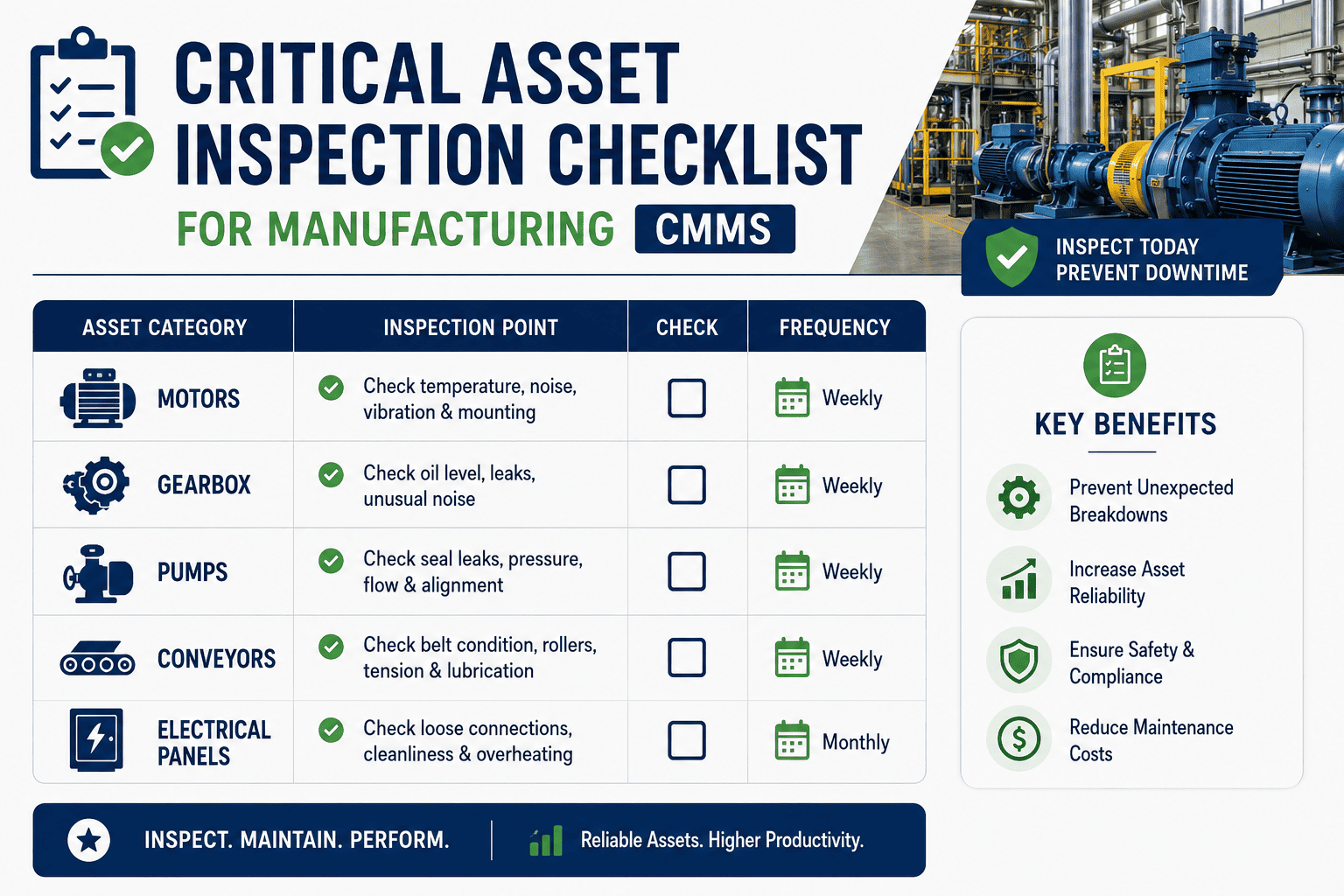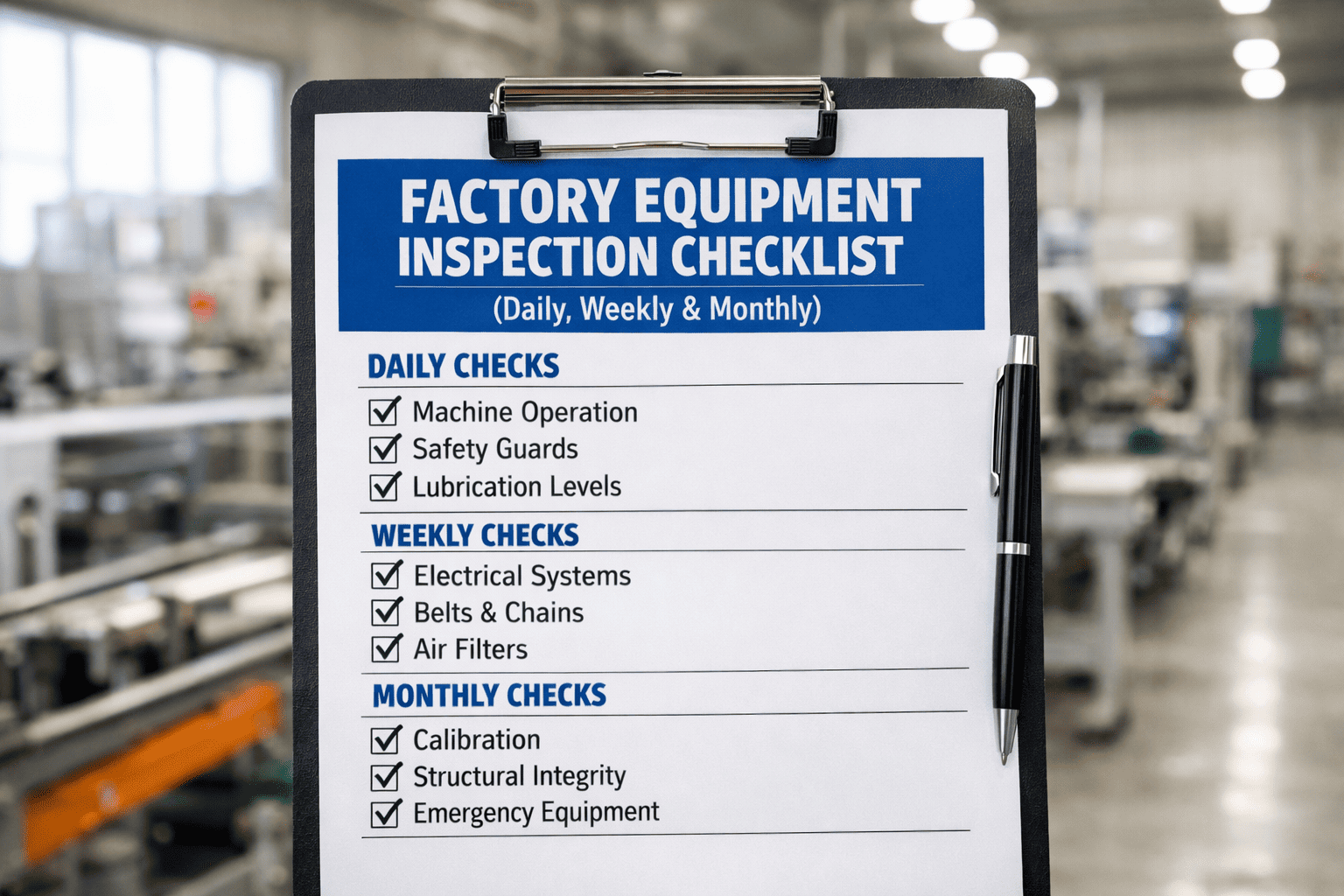
Every hour of unplanned downtime in a manufacturing facility costs between $5,000 and $20,000 depending on the sector — and the majority of those incidents are traceable to equipment problems that were visible days before failure. A structured weekly equipment inspection gives your maintenance team the system they need to see those problems first. Facilities with documented weekly inspection programs report 35% fewer breakdowns and consistently shorter regulatory audits. This checklist is built around the seven equipment categories most cited in OSHA inspections and ISO 55001 audits across manufacturing environments. Start using OxMaint's digital inspection platform to make every round traceable and action-ready from your phone.
Manufacturing · Asset Reliability · Weekly Inspection
Weekly Equipment Inspection Checklist for Manufacturing Facilities
Seven equipment categories. One structured weekly round. Built for maintenance engineers, reliability leads, and plant supervisors who need audit-ready records without paperwork.
35%
Fewer breakdowns in facilities with weekly inspection programs
7
Critical equipment categories covered in this checklist
45 min
Average time to complete all seven categories
ISO 55001
Asset management standard anchored to weekly inspection cycles
Category 01
Rotating Machinery
Rotating equipment failures account for 42% of all manufacturing maintenance costs globally. Weekly checks on vibration, temperature, and alignment catch the early signatures of bearing failure, imbalance, and misalignment — the three dominant failure modes.
Motors & Pumps
Motor operating temperatures checked with infrared or thermocouple — flag any reading more than 10°C above historical baseline; check cooling fan operation
Record: Motor temperature log · Role: Reliability Engineer · Standard: NEMA MG1
Pump casing and impeller condition checked — listen for cavitation, check seal leak-off rate, verify shaft alignment within 0.05mm TIR
Record: Pump inspection form · Role: Mechanical Engineer · Frequency: Weekly
Vibration measurement taken on motor drive-end and non-drive-end bearings — compare against ISO 10816 severity zones; trend data recorded
Record: Vibration trending log · Role: Condition Monitoring Tech · Frequency: Weekly
Gearboxes & Fans
Gearbox oil level, colour, and condition checked — dark or milky oil indicates contamination; schedule oil analysis if any colour change observed
Record: Gearbox inspection card · Role: Lubrication Technician · Frequency: Weekly
Industrial fan blade condition, balance, and inlet guard inspected — check for erosion, cracking at root, or accumulation of process deposits
Record: Fan inspection log · Role: Mechanical Technician · Frequency: Weekly
Category 02
Lifting Equipment & Cranes
OSHA 1910.179 mandates daily inspection of overhead cranes before use, and weekly documented inspections of wire ropes, hooks, and brakes. Non-compliance carries fines of up to $15,625 per violation and unlimited liability in the event of a load drop.
Overhead Cranes & Hoists
Wire rope inspected across full working length — check for broken wires, kinks, crushing, or corrosion; replace at ASME B30.2 discard criteria
Record: Wire rope inspection form · Role: Crane Inspector · Standard: OSHA 1910.179
Hook condition verified — no cracks, no twist beyond 10°, safety latch functional and not bent or sprung open
Record: Hook inspection log · Role: Rigger / Inspector · Frequency: Weekly
Hoist brake tested under no-load condition — drift must not exceed 1 inch per foot of lift per ASME B30.16; adjust or replace brake if drift observed
Record: Brake test log · Role: Crane Maintenance Tech · Frequency: Weekly
Upper and lower limit switches tested — confirm automatic stop at travel limits; never bypass or defeat limit switches under any operating condition
Record: Limit switch test log · Role: Electrical Technician · Frequency: Weekly
Weekly inspections generate findings. OxMaint converts every finding into a timestamped work order — assigned, tracked, and closed in one platform.
Category 03
Pressure Systems & Vessels
Pressure Vessels & Steam Systems
Pressure relief valves visually inspected — no weeping, no corrosion on seat, nameplate visible and readable, test dates current per ASME PCC-3
Record: PRV inspection log · Role: Pressure Systems Inspector · Frequency: Weekly visual
Vessel pressure gauges reading within normal operating band — compare against P&ID design pressure; replace any gauge with cracked glass or stuck needle
Record: Gauge calibration log · Role: Instrumentation Tech · Frequency: Weekly
Steam traps checked for passing or failed-open condition — failed steam traps waste an average of 2,000 lbs of steam per year each; mark defective traps for immediate repair
Record: Steam trap survey log · Role: Utilities Engineer · Frequency: Weekly
Category 04
Electrical Assets & Power Distribution
Switchgear & Transformers
Switchgear cabinets inspected — doors latched, no unusual hum or buzzing, no burnt smell, indicator lamps showing correct status
Record: Switchgear inspection form · Role: HV Technician · Frequency: Weekly
Transformer oil conservator level within operating range — check breather silica gel colour; replace if pink or white indicating moisture saturation
Record: Transformer log · Role: Electrical Engineer · Frequency: Weekly
UPS battery banks visually inspected — no swelling, leakage, or corrosion on terminals; system on-line indicator confirmed green
Record: UPS check log · Role: Electrical Technician · Frequency: Weekly
Category 05
Fluid Systems — Hydraulic & Lubrication
Hydraulic Power Units
Hydraulic fluid level, colour, and temperature at HPU reservoir verified — milky appearance indicates water ingress; schedule fluid change immediately
Record: HPU inspection log · Role: Hydraulics Technician · Frequency: Weekly
High-pressure hydraulic hoses inspected along full length — check for bulging, abrasion damage, fitting corrosion, and chafing against structure
Record: Hose inspection form · Role: Mechanical Technician · Frequency: Weekly
Hydraulic filter differential pressure indicators checked — red indicator or differential above 35 PSI triggers immediate filter change before next production run
Record: Filter status log · Role: Hydraulics Technician · Frequency: Weekly
Category 06
Material Handling Equipment
Conveyors & Automated Systems
Conveyor belt tracking, tension, and splice condition checked across full run — mistracking causes 34% of conveyor-related downtime in manufacturing
Record: Conveyor inspection form · Role: Line Technician · Frequency: Weekly
Roller condition on gravity and powered roller conveyors — replace any seized, bent, or excessively worn rollers before they damage product or belt
Record: Roller inspection log · Role: Mechanical Technician · Frequency: Weekly
Emergency stop pull cords and belt-drift switches on all conveyors tested and confirmed functional — document which conveyor and who performed the test
Record: Safety device test log · Role: Safety Officer · Frequency: Weekly
Category 07
Utilities — Compressed Air, HVAC & Water
Plant Utilities
Compressed air dryer performance checked — dew point at system outlet within spec; drain valves on air receiver functioning automatically
Record: Compressed air log · Role: Utilities Technician · Frequency: Weekly
Cooling tower water treatment chemical levels checked — pH, biocide, and conductivity within programme specification to prevent Legionella risk per HSE ACOP L8
Record: Water treatment log · Role: Water Treatment Technician · Frequency: Weekly
HVAC air handling units — filter pressure drop checked, coil condition inspected, condensate drain tray free of standing water or biological growth
Record: HVAC inspection form · Role: HVAC Technician · Frequency: Weekly
Performance Metrics
Weekly Inspection KPIs for Manufacturing Teams
| KPI | Measurement Method | Target | Review Cadence |
|---|---|---|---|
| Inspection Coverage Rate | Assets inspected / Total registered assets | 100% | Weekly |
| Defect Detection Rate | Defects found per 100 assets inspected | Trend upward (means better inspection) | Monthly |
| Finding-to-WO Time | Minutes from finding logged to work order raised | Under 60 min | Weekly |
| Work Order Closure Rate | WOs closed within 7 days / Total WOs raised | Over 85% | Weekly |
| Repeat Failure Rate | Same asset failing in 2 consecutive inspection cycles | Under 5% | Monthly |
| Overdue Inspection Items | Inspection items past due date | Zero | Daily |
Reliability Expert Views
What Manufacturing Maintenance Professionals Say
01
Weekly inspections are where you separate reactive plants from reliable ones. The data tells you which assets need attention this week — not next month when the bearing finally seizes on a Friday afternoon at peak production.
Reliability Engineer, Heavy Manufacturing, 18 years experience
02
The most common problem with weekly inspections is not the inspection itself — it is that findings never make it into the CMMS within the same shift. Digital checklists that auto-generate work orders eliminate that gap completely.
Maintenance Manager, Chemical Processing Plant, 400 employees
03
Lifting equipment is the category that gets teams into the most serious regulatory trouble. The rules are clear and the documentation requirements are not optional — yet we still see facilities running cranes with inspection logs months out of date.
Lifting Equipment Inspector, LEEA Certified, 22 years
FAQs
Frequently Asked Questions
Daily checks are rapid visual and sensory checks that take 10 to 20 minutes and require no tools. Weekly inspections go deeper — measurements are taken, comparisons are made against historical baselines, and condition-based decisions are triggered. Weekly inspections typically take 30 to 60 minutes per equipment category. Use OxMaint's platform to schedule and track both cycles without doubling your paperwork.
OSHA 1910.179 mandates weekly overhead crane and hoist inspections. OSHA 1910.217 requires weekly mechanical press checks. ASME B30 standards govern lifting equipment inspection intervals. ISO 55001 and PAS 55 recommend documented weekly asset condition checks as part of an asset management program. Book a demo to see how OxMaint maps each standard automatically.
A single technician can typically cover 15 to 25 assets in a focused weekly inspection session of 45 to 60 minutes, depending on asset type and complexity. Digital checklists with route optimisation reduce travel time between assets by 20 to 30%. For facilities with more than 100 assets in one category, split the inspection into two shifts or assign category ownership by discipline. OxMaint's route planner handles this automatically.
A critical defect — one that creates immediate risk of failure or injury — requires immediate escalation and asset isolation before the next production run. The inspection finding must be documented with photo evidence, classified by severity, and converted to a priority work order within the same session. OxMaint's mobile checklist does this in real time, with automatic escalation to the maintenance supervisor when a critical flag is raised. See the escalation workflow in a live demo.
Turn Weekly Inspections Into a Competitive Advantage
OxMaint gives your team digital inspection rounds — findings auto-converted to work orders, trends tracked per asset, and audit-ready reports generated instantly. No more paper logs buried in a drawer.