Running a factory floor without structured equipment inspections is like driving blindfolded — sooner or later, something breaks, someone gets hurt, and production grinds to a halt. Whether you manage CNC machines, conveyor lines, forklifts, or industrial compressors, a well-built factory equipment inspection checklist protects your workforce, keeps OSHA auditors satisfied, and prevents the kind of unplanned downtime that drains budgets fast. This guide breaks down exactly what to inspect daily, weekly, and monthly — and shows you how to turn routine checks into a competitive advantage. Schedule a demo to see how Oxmaint turns paper checklists into automated digital inspections — complete with mobile access, photo capture, and instant work order creation.
The Real Cost of Skipping Factory Inspections
Missed inspections are not just a compliance gap — they are a direct threat to your bottom line and your people. Manufacturing plants that rely on reactive maintenance spend significantly more on emergency repairs, face higher insurance premiums, and lose productive hours that can never be recovered. OSHA penalties alone can exceed $16,000 per serious violation, with willful violations reaching over $165,000 per incident.
What to Check Before Every Shift: Daily Pre-Operation Inspection
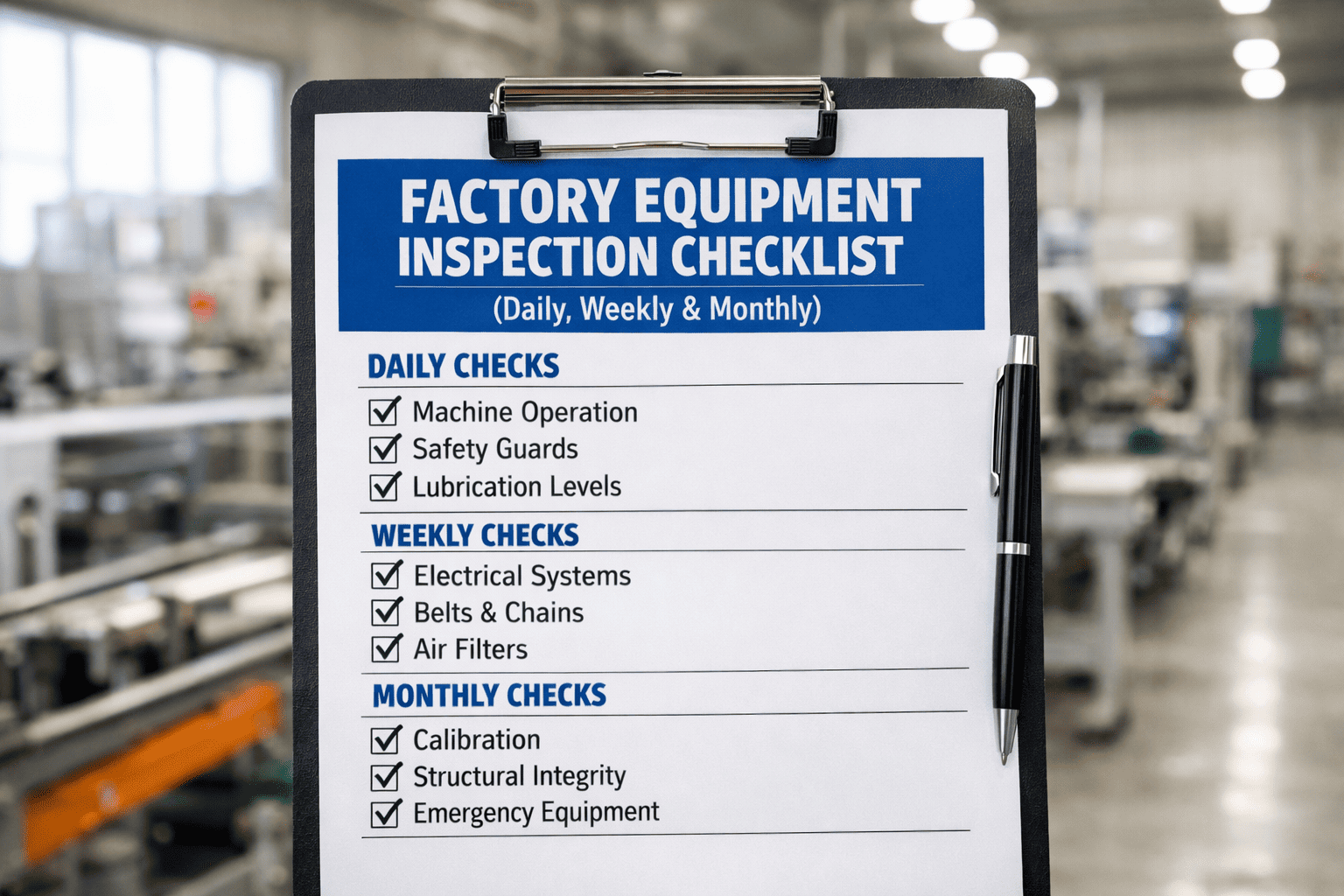
Daily inspections are the foundation of any preventive maintenance program. OSHA requires pre-shift checks for powered industrial trucks and most heavy machinery. These quick walkarounds verify that equipment is safe to operate and catch obvious defects before they escalate into dangerous situations. Every operator should complete these checks — and document them — before starting any machine. Sign up for Oxmaint to auto-assign daily checklists to every operator at shift change — no manual scheduling, no missed machines.
Going Deeper: Weekly Mechanical & Electrical Review
While daily checks catch surface-level problems, weekly inspections identify wear patterns and developing faults that build gradually across multiple shifts. These require trained maintenance technicians — not just operators — and should cover mechanical, electrical, and pneumatic systems in detail. Catching a worn belt or a hot bearing on Monday prevents a full production stoppage on Friday.
The Deep Dive: Monthly Comprehensive Equipment Assessment
Monthly inspections are full-condition assessments that examine components never touched during daily or weekly routines. They validate calibration accuracy, test safety systems under load, and generate the documentation required for OSHA audits and insurance renewals. These checks typically require partial or full equipment shutdown and should be scheduled during planned downtime windows.
Matching Inspection Schedules to Your Equipment
A forklift running three shifts does not need the same inspection cadence as a backup generator that starts once a week. The most effective programs match inspection frequency to equipment criticality, failure consequences, and manufacturer recommendations. Below is a practical reference guide for the most common factory equipment categories.
| Equipment Category | Daily Checks | Weekly Checks | Monthly Checks | Priority Focus |
|---|---|---|---|---|
| CNC Machines & Lathes | Coolant level, chip clearance, spindle warm-up | Tool wear measurement, axis backlash, belt tension | Full geometric calibration, vibration spectrum analysis | Precision drift, thermal stability |
| Forklifts & Pallet Jacks | Brakes, tires, forks, lights, horn, seatbelt | Hydraulic hoses, mast chains, steering play | Load capacity test, frame weld inspection | Operator safety, OSHA 1910.178 |
| Conveyor & Material Handling | Belt tracking, e-stop function, roller noise | Belt tension, idler bearings, drive motor amps | Gearbox oil analysis, structural support welds | Belt alignment, bearing failure |
| Air Compressors & Pumps | Pressure gauge, discharge temp, leak listen | Intake filter, drain condensate, vibration check | Oil sample analysis, valve inspection, safety relief test | Seal integrity, pressure stability |
| Packaging & Labeling Lines | Seal quality, feed jam check, sensor eye clean | Pneumatic cylinder stroke, film tension, date coder | Full servo calibration, mechanical overhaul | Product quality consistency |
| Overhead Cranes & Hoists | Wire rope visual, hook latch, control pendant | Brake test, limit switch function, rope drum | Load test, structural NDT, electrical contactors | OSHA 1910.179 compliance |
Why Paper Forms Fail — and What Replaces Them
Paper inspection forms have been the default in factories for decades, but they come with serious drawbacks that undermine the entire purpose of having a checklist in the first place. Forms go missing, handwriting becomes illegible, there is no way to attach photos of defects, and tracking trends across hundreds of inspections is virtually impossible. The shift to digital inspection platforms is not a luxury — it is a necessity for any plant serious about reliability and compliance.
- Clipboards get lost, wet, or thrown away after the shift
- No visibility for managers until forms are collected and filed
- Failed items sit in a pile — no automatic follow-up
- Impossible to run trend analysis across months of data
- Audit prep means digging through filing cabinets for hours
- Mobile app on every technician's phone — works offline too
- Real-time dashboards show which inspections are done or overdue
- Failed items auto-generate work orders with photos attached
- Built-in analytics surface repeat failures and reliability trends
- One-click audit reports with full digital trail and timestamps
Inspection Focus Areas by Machine Category
Generic checklists miss equipment-specific failure modes. A conveyor belt inspection has almost nothing in common with a welding station check. Below are focused inspection priorities for four critical equipment categories found in most manufacturing plants.
OSHA Standards Every Factory Inspector Must Know
OSHA does not leave equipment inspection to guesswork — specific standards dictate what must be inspected, how often, and by whom. Failing to comply results in citations, fines, and liability exposure that far exceeds the cost of a proper inspection program. Book a demo to see how Oxmaint maps your inspection checklists directly to OSHA standards — so you are always audit-ready.
| OSHA Standard | What It Covers | Inspection Requirement |
|---|---|---|
| 29 CFR 1910.147 | Lockout/Tagout (LOTO) procedures and devices | Annual periodic inspection of every energy control procedure |
| 29 CFR 1910.157 | Portable fire extinguishers | Monthly visual check, annual professional maintenance inspection |
| 29 CFR 1910.178 | Powered industrial trucks (forklifts) | Pre-shift inspection before each use, documented by operator |
| 29 CFR 1910.179 | Overhead and gantry cranes | Daily visual, monthly thorough, annual comprehensive with documentation |
| 29 CFR 1910.134 | Respiratory protection equipment | Before each use, emergency-use respirators inspected monthly minimum |
| 29 CFR 1910.219 | Mechanical power-transmission apparatus | Guards must be inspected regularly; no mandated interval — best practice is weekly |
How to Build an Inspection Program That Sticks
A checklist template is only the starting point. The difference between factories that prevent failures and factories that react to them comes down to how the inspection program is designed, deployed, and continuously improved. Here is a practical framework used by high-performing maintenance teams.
The Most Commonly Missed Inspection Items
Even experienced technicians overlook the same items repeatedly. These blind spots are responsible for a disproportionate number of equipment failures and safety incidents. Make sure your checklists explicitly include these frequently missed checks.
![monthly-manufacturing-plant-safety-audit-checklist-[osha---iso-45001]](./manage-post-2k26/uploads/monthly-manufacturing-plant-safety-audit-checklist-[osha---iso-45001].png)