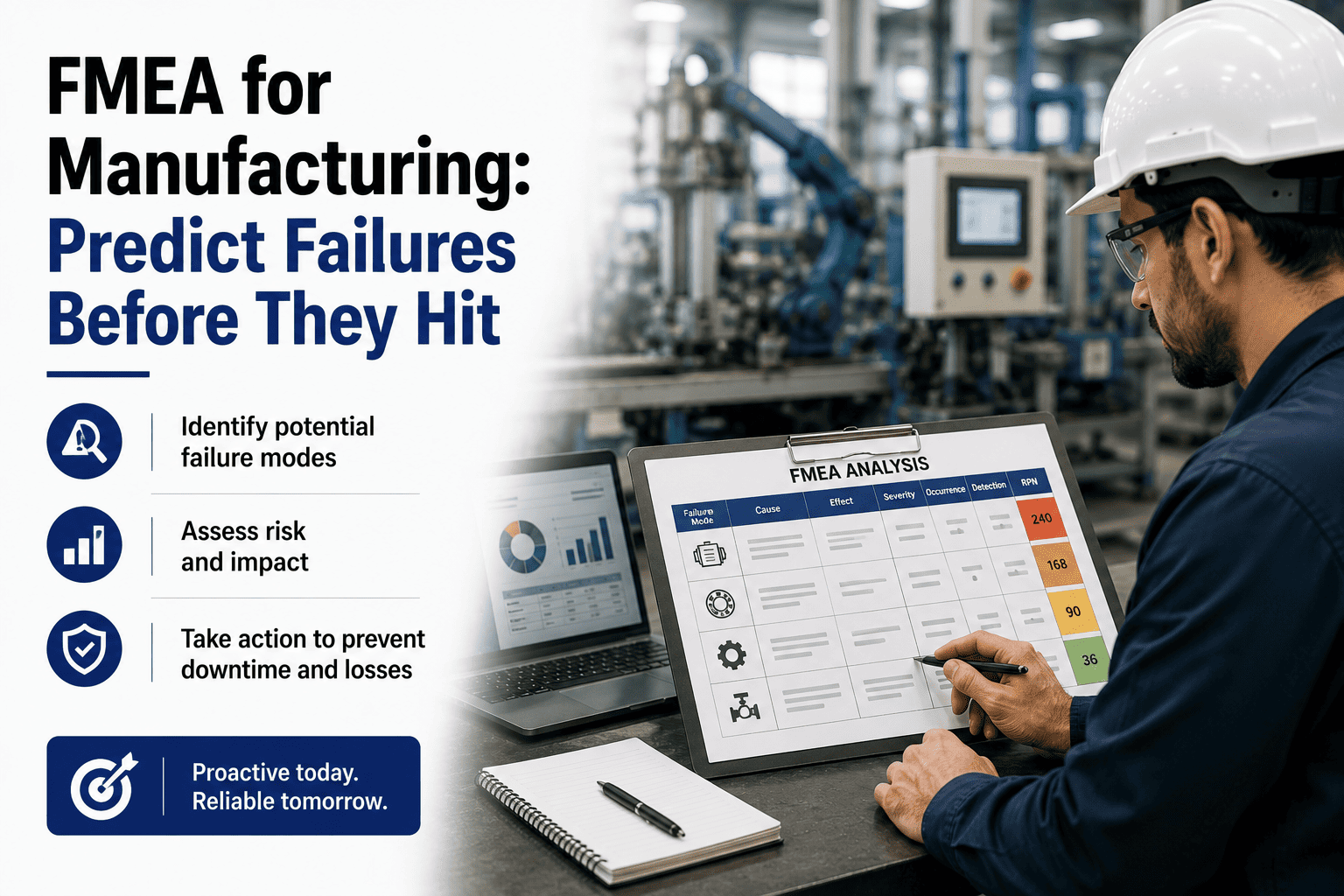
Failure mode and effects analysis (FMEA) is a proactive, systematic method for identifying every way a piece of manufacturing equipment or process can fail—and ranking the impact of those failures before they cause costly unplanned downtime. In a modern plant, applying FMEA to maintenance transforms your strategy from reactive firefighting into predictive prevention, helping you target your limited labor and budget at the highest-risk assets. This guide breaks down the FMEA method, scoring, and implementation, and shows how digitizing your findings in a CMMS like OxMaint turns static spreadsheets into automated, failure-preventing work orders. Ready to stop reacting to breakdowns? Start Free Trial and put your FMEA findings into action today.
What if you could predict your next catastrophic equipment failure—today?
Plants lose an average of 800 hours of production annually to unplanned downtime. Failure mode and effects analysis (FMEA) surfaces the hidden risks in your assets and processes so you can act before production halts, quality drops, or safety is compromised.
Process FMEA vs. Equipment FMEA: Which do you need?
Manufacturing FMEA generally splits into two disciplines. Both use the same scoring logic, but they target entirely different failure vectors. Most world-class reliability programs run both concurrently to cover their assets and their workflows.
Analyzes the manufacturing process steps. It asks: "Where can the production sequence fail?" It targets quality defects, assembly errors, and bottlenecks. Ideal for new product introductions, line balancing, and ISO 9001 compliance.
- Focus: Manufacturing steps and workflow
- Goal: Reduce scrap, rework, and quality defects
- Owners: Process engineers and quality teams
Analyzes physical machinery and assets. It asks: "How can this specific component break down?" It targets mechanical wear, electrical faults, and hydraulic leaks. Essential for TPM programs, criticality rankings, and maintenance scheduling.
- Focus: Asset components and degradation
- Goal: Eliminate unplanned downtime and extend asset life
- Owners: Reliability engineers and maintenance teams
How to calculate Risk Priority Number (RPN)
The FMEA method relies on a quantitative scoring system to prioritize action. You rate each failure mode on a 1–10 scale across three categories, then multiply them together to get the Risk Priority Number (RPN).
A common pitfall in FMEA implementation is chasing only high RPNs. A failure with a Severity of 10 (life-safety) but a low RPN of 50 must still be engineered out, regardless of its total score. Always lock down your S-10s first.
Step-by-step FMEA guide for manufacturing plants
A successful manufacturing FMEA is a living document, not a one-time spreadsheet exercise. Follow this timeline to embed failure analysis into your plant's daily reliability operations.
Define the system and gather your team
Select an asset or process boundary. Pull together a cross-functional team: an operator, a maintenance tech, and a reliability engineer. List every component and function within scope.
Brainstorm failure modes and assign RPN
For each function, ask "How can this fail?" Assign your Severity, Occurrence, and Detection scores. Calculate the RPN for every identified failure mode to establish a baseline risk profile.
Assign mitigation tasks to reduce risk
Target the highest RPNs and critical Sev 10s. Assign specific actions: design changes, added sensors, or new preventive maintenance (PM) tasks. Update the detection and occurrence scores post-mitigation.
Push PMs into your CMMS and monitor
This is where most FMEAs fail. If your mitigations stay on paper, nothing changes. Feed the newly defined PMs and inspection triggers directly into your CMMS to automate work order generation and track results.
Turn your FMEA spreadsheet into automated maintenance
An FMEA template is useless if it sits in a binder. See how OxMaint translates your risk scores into automated PM schedules, predictive alerts, and work orders.
How OxMaint operationalizes your FMEA findings
OxMaint bridges the gap between theoretical risk analysis and daily maintenance execution. By mapping FMEA data directly into an AI-powered CMMS and EAM platform, your team moves from guessing to knowing—cutting unplanned downtime by up to 30–50%.
Automated PM Triggers
Convert high-RPN failure modes directly into recurring preventive maintenance tasks. OxMaint auto-generates work orders based on your occurrence and detection thresholds, so mitigations are never missed.
Predictive Anomaly Detection
Lower your detection scores instantly. OxMaint AI monitors IoT sensor data (vibration, temperature) to catch the early signatures of the exact failure modes you identified, alerting you weeks before a breakdown.
Criticality-Based Spares
Link your equipment FMEA criticality rankings directly to spare-parts inventory. OxMaint automatically flags high-severity assets and ensures their critical replacement parts are always in stock, eliminating repair delays.
Live RPN Dashboarding
Stop relying on outdated spreadsheets. Track your mitigation progress with live maintenance analytics dashboards that show RPN reductions over time, proving your reliability ROI to management.
The cost of inaction: A 180-asset plant example
Consider a mid-sized food packaging plant running 180 critical assets. They spend roughly $42,000 annually on emergency maintenance contractors and lost production due to sudden motor and conveyor failures.
Without FMEA & CMMS
- Reactive maintenance culture (fix-on-failure)
- 14 unplanned downtime events per year
- Average downtime cost: $3,000 per hour
- Total annual loss: $126,000+
With OxMaint FMEA Integration
- Proactive PMs generated from FMEA data
- Downtime events reduced to 4 per year
- Early warning sensors cut repair times by 40%
- Total annual savings: $84,000+
By moving their equipment FMEA findings into OxMaint, this plant pays for the software subscription ten times over in the first year alone—simply by acting on risks before they become failures.
Frequently asked questions about FMEA
What is FMEA in manufacturing maintenance?
FMEA (Failure Mode and Effects Analysis) is a step-by-step approach for identifying all possible failures in a manufacturing process, design, or piece of equipment. In maintenance, it helps teams predict how assets can break down, assess the severity and likelihood of those failures, and implement preventive measures before downtime occurs.
What is a good Risk Priority Number (RPN) threshold?
There is no universal RPN threshold, but most plants flag any score above 100–150 for immediate action. However, RPN alone is not enough; any failure mode with a Severity of 9 or 10 (indicating a safety risk or total shutdown) must be addressed regardless of its overall RPN score.
How often should an FMEA be updated?
An FMEA should be a living document. You should review and update it whenever a new asset is installed, a process changes, a major failure occurs, or at least annually. Integrating it with a CMMS ensures your FMEA data is continuously validated by real-world work order history. You can Book a Demo to see how OxMaint keeps your risk data synced with your maintenance operations.
What is the difference between FMEA and FMECA?
FMECA (Failure Mode, Effects, and Criticality Analysis) is an extension of FMEA. While FMEA identifies and ranks risks using the RPN scoring system, FMECA adds an extra layer of criticality analysis—usually mapping failures against a criticality matrix to determine the absolute priority of mitigation efforts based on safety and environmental impact.
Can a CMMS help with FMEA implementation?
Yes, a CMMS is essential for operationalizing FMEA. While the analysis itself might start in a spreadsheet, a CMMS like OxMaint turns those findings into automated preventive maintenance schedules, tracks completion, and provides analytics to prove that your risk mitigation efforts are actually reducing downtime. Start Free Trial to see it in action.
Stop predicting failures with guesswork
Put your failure mode and effects analysis into motion. Let OxMaint automate your PMs, predict equipment degradation, and eliminate unplanned downtime.
Free 14-day trial · No credit card required

-in-manufacturing.png)


