Unplanned equipment failures drain manufacturing plants of an estimated $50 billion annually worldwide. For every hour a critical production line sits idle, costs cascade through lost output, expedited repairs, scrapped materials, and missed delivery commitments. Yet the majority of these failures are preventable. Plants that adopt systematic equipment reliability improvement methods consistently achieve 50 to 60 percent longer mean time between failures, slash reactive maintenance by more than half, and unlock production capacity that was always there — hidden behind avoidable breakdowns. Not sure where your plant stands? Schedule a free reliability assessment and our engineers will pinpoint your biggest downtime drivers and map a clear improvement path.
What Drives Equipment Failures in Manufacturing Plants
Before applying solutions, reliability programs must first understand why equipment fails. Research consistently shows that the vast majority of industrial failures trace back to a small set of root causes — most of which are controllable through better processes, training, and technology.
Annual cost of unplanned downtime per Fortune 500 manufacturer
70%
Of plants still relying on reactive or basic preventive maintenance only
10:1
Typical ROI ratio from predictive maintenance within 12-18 months
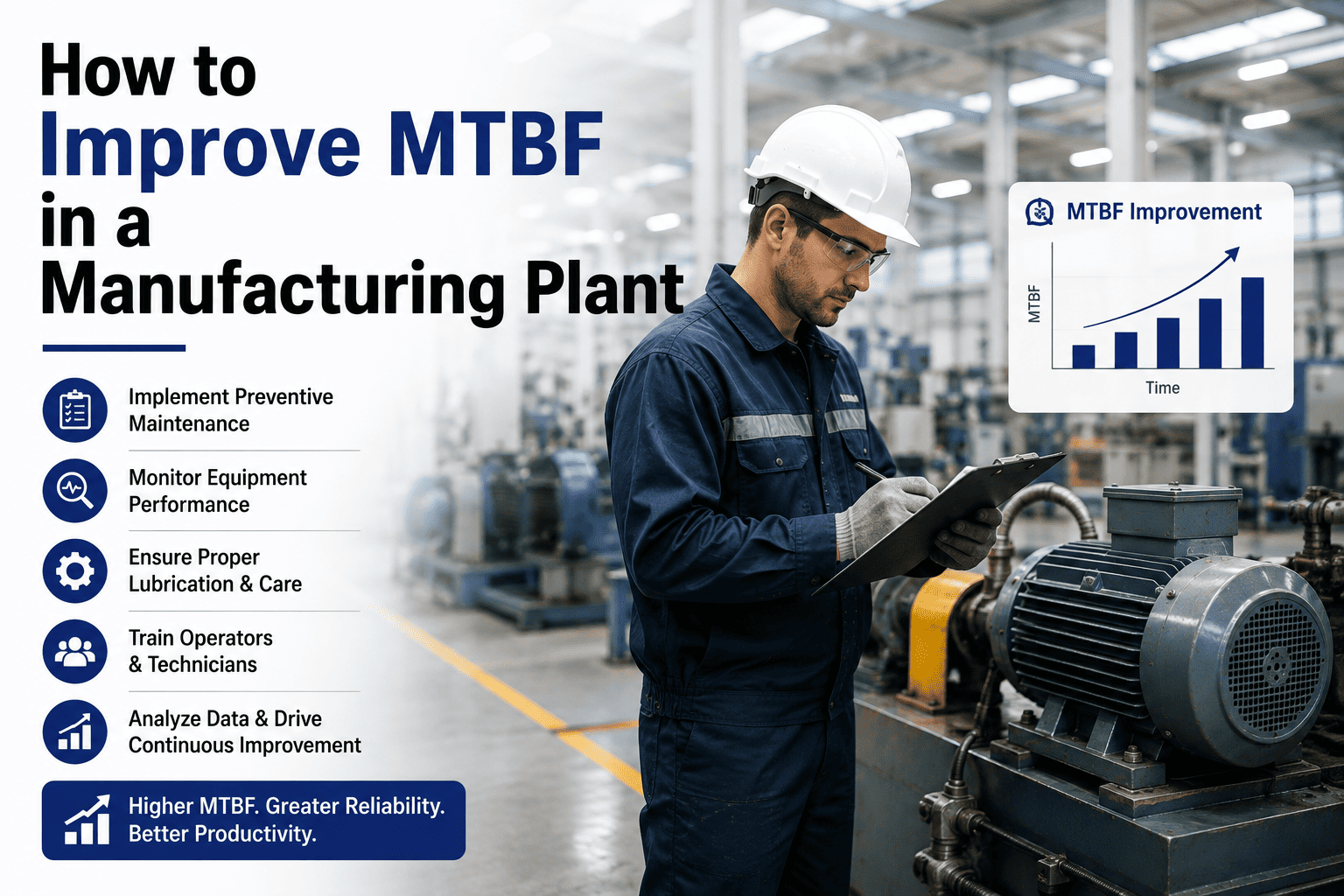
Six Proven Methods to Systematically Increase MTBF
World-class reliability programs do not depend on a single technique. They layer complementary methods that address different failure mechanisms and stages of the equipment lifecycle. Together, these six approaches create a self-reinforcing system that drives continuous improvement in mean time between failures.
Method 1
Failure Mode and Effects Analysis
Map every potential failure in critical assets, score each by severity, occurrence, and detectability, then prioritize actions using Risk Priority Numbers. FMEA converts tribal knowledge into a structured action plan that targets the failures with the greatest operational impact first.
Typical outcome: 30-50% reduction in repeat failure modes within six months
Method 2
Root Cause Analysis and Defect Elimination
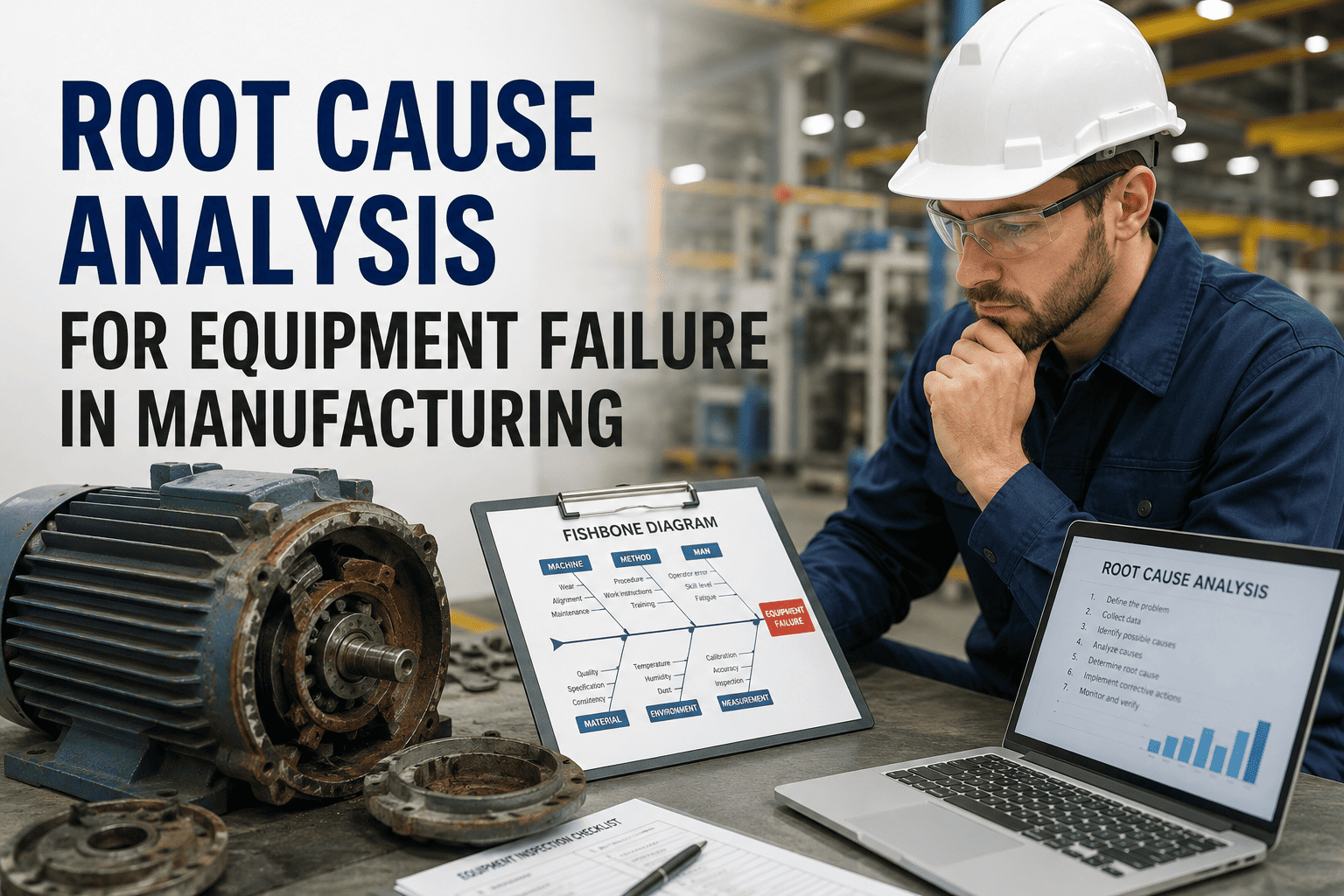
Investigate beyond surface symptoms using 5-Why analysis, fishbone diagrams, and fault tree analysis. The goal is not just to fix what broke, but to permanently eliminate the condition that caused the failure. Defect elimination is the single most effective way to prevent recurring breakdowns.
Typical outcome: 60% fewer recurring failures on targeted equipment
Method 3
Reliability-Centered Maintenance Planning
Evaluate the function and criticality of every asset, then assign the optimal maintenance strategy — whether preventive, predictive, condition-based, or run-to-failure. RCM ensures your maintenance resources focus where they deliver the greatest return. Ready to build data-driven maintenance plans? Create your free Oxmaint account and start assigning the right strategy to every asset in your plant.
Typical outcome: 25-40% reduction in total maintenance costs
Method 4
Precision Maintenance Standards
Enforce exact specifications for shaft alignment, dynamic balancing, fastener torque, and lubrication. Precision installation and servicing eliminates the "installed defects" that account for a significant portion of premature mechanical failures. This method costs almost nothing extra but delivers outsized reliability gains.
Typical outcome: 2-3x longer bearing and coupling life
Method 5
Condition Monitoring and Predictive Analytics
Deploy vibration analysis, infrared thermography, oil analysis, ultrasonic testing, and IoT sensors to detect degradation weeks or months before functional failure. Predictive technologies allow your team to schedule repairs during planned windows, eliminating the chaos of emergency breakdowns.
Typical outcome: 50% reduction in unplanned downtime events
Method 6
Operator-Driven Reliability and TPM
Train operators to perform daily inspections, basic lubrication, minor adjustments, and anomaly reporting. Operators interact with equipment more than anyone else — making them the earliest possible detection system for developing problems when properly trained and empowered.
Typical outcome: 20-30% improvement in Overall Equipment Effectiveness
Turn these methods into daily practice. Oxmaint gives your team the digital platform to manage FMEA findings, automate PM schedules, track predictive results, and measure reliability KPIs — all from one place.
Condition monitoring is the technology layer that transforms reliability from calendar-based guesswork into data-driven precision. Each technique targets specific failure signatures, and together they provide near-complete coverage of the degradation mechanisms found in manufacturing equipment.
Vibration Analysis
Detects imbalance, misalignment, bearing defects, gear mesh problems, and structural looseness in rotating machinery. Portable and online systems provide 1-3 months advance warning of developing mechanical faults across motors, pumps, fans, compressors, and gearboxes.
Best for: Rotating equipment
Infrared Thermography
Identifies hot spots in electrical panels, overheating bearings, refractory degradation, and insulation failures without contact or shutdown. Thermal cameras scan entire switchgear lineups in minutes.
Best for: Electrical and thermal assets
Oil Analysis
Evaluates lubricant condition, wear metal content, contamination levels, and viscosity breakdown. Trending oil sample results reveals internal equipment wear patterns long before external symptoms appear.
Best for: Gearboxes, hydraulics, engines
Ultrasonic Detection
Locates compressed air leaks, steam trap failures, electrical arcing, and early-stage bearing degradation through high-frequency sound. Many plants recover tens of thousands in energy waste from leak detection alone.
Best for: Leaks, steam traps, bearings
IoT Sensor Networks and AI-Powered Analytics
Permanently installed wireless sensors continuously stream temperature, vibration, current, and pressure data to cloud-based analytics platforms. Machine learning models trained on your equipment's operating history identify anomalies and forecast remaining useful life — enabling truly predictive maintenance at scale. Want to see how sensor data triggers automatic work orders? Book a live demo of Oxmaint's predictive maintenance workflow and see it in action with your equipment types.
Best for: Plant-wide continuous monitoring
Measuring What Matters: Reliability KPIs for Plant Managers
You cannot improve what you do not measure. Without consistent tracking, improvement efforts lack direction, accountability, and the ability to demonstrate ROI to leadership. These are the metrics that separate reactive plants from reliability-led operations.
Key Performance Indicators for Equipment Reliability
MTBF
Mean Time Between Failures
Average operating hours between breakdowns — the primary measure of equipment reliability
Target: Increase 10-15% year over year
MTTR
Mean Time To Repair
Average duration from failure to equipment restored — measures maintenance execution speed
Target: Under 4 hours for critical assets
OEE
Overall Equipment Effectiveness
Availability x Performance x Quality — the single score capturing total productive performance
Target: 85%+ is world-class
%PM
Planned Maintenance Percentage
Ratio of scheduled work to total maintenance activity — reflects program maturity
Target: 80% planned, under 20% reactive
Start tracking reliability KPIs today. Create a free Oxmaint account and get instant dashboards for MTBF, MTTR, OEE, and maintenance backlog across every asset in your plant.
Reactive Maintenance vs. Proactive Reliability: The Real-World Gap
Many plants believe their maintenance programs are adequate — until they benchmark against reliability-focused operations. The performance gap between reactive and proactive plants compounds over time, widening competitive advantage for those who invest in structured reliability methods.
Reactive Approach
Run equipment until breakdown, then repair
No failure history tracking or pattern recognition
Spare parts shortages cause extended downtime
Maintenance budget unpredictable quarter to quarter
Safety incidents increase as equipment degrades
35-65%
of maintenance budget spent on emergency work
Reliability-Centered Approach
Predict and prevent failures using data-driven methods
FMEA and RCA eliminate root causes permanently
Inventory optimized by failure pattern analysis
Costs planned, predictable, and declining over time
Safety improves as proactive culture takes hold
Under 10%
of maintenance budget spent on emergency work
Building Your Reliability Roadmap: Phased Implementation
Sustainable reliability improvement follows a phased approach. Rushing to deploy advanced sensor technology before addressing foundational issues like data capture, PM compliance, and precision standards leads to poor adoption and wasted investment. This roadmap reflects the sequence followed by top-performing manufacturing plants.
Month 1-2
Assess and Baseline
Conduct equipment criticality ranking across all production assets. Audit current failure history and maintenance practices. Establish MTBF, MTTR, and OEE baselines. Deploy or configure a CMMS to capture every work order, failure code, and repair action going forward.
Month 3-5
Eliminate Top Failure Modes
Perform FMEA on the top 20 percent most critical and failure-prone assets. Execute root cause analysis on the five most costly recurring failures. Implement precision maintenance standards for alignment, balancing, and lubrication. Optimize PM task lists and frequencies based on actual failure data.
Month 6-9
Layer Predictive Capabilities
Deploy condition monitoring on critical rotating equipment — vibration, thermography, and oil analysis. Integrate sensor data with your CMMS to auto-generate work orders from predictive findings. Standardize the RCA process and train frontline teams on defect identification and escalation.
Month 10+
Scale and Sustain
Expand TPM and operator-driven reliability to all production areas. Implement reliability modeling for capital planning and lifecycle decisions. Conduct monthly reliability review meetings with plant leadership. Share learnings across shifts, departments, and facilities through standardized practices.
Get a customized reliability roadmap for your plant. Our specialists will evaluate your equipment, failure patterns, and team readiness to build a phased implementation plan designed for fast, measurable results.
How CMMS Software Accelerates Every Reliability Method
A Computerized Maintenance Management System is the digital foundation that makes reliability programs scalable, measurable, and sustainable. Without a CMMS, reliability efforts depend on tribal knowledge and paper-based processes that cannot survive staff turnover or scale beyond a single shift.
Failure Data Capture
Every work order captures failure codes, root causes, parts used, and repair time. This data fuels FMEA, RCA, and MTBF tracking with zero extra effort from your team.
Automated PM Scheduling
Calendar-based, meter-based, and condition-based triggers ensure preventive tasks execute on time. Automated notifications eliminate the missed PMs that lead to avoidable failures.
Predictive Integration
Connect IoT sensors and condition monitoring results directly into your work order workflow. Predictive findings automatically generate prioritized maintenance tasks with full context.
Reliability Dashboards
Real-time visibility into MTBF trends, MTTR performance, PM compliance, backlog aging, and planned-vs-reactive ratios. Data-driven decisions replace gut-feel maintenance management.
Your spreadsheet cannot power a reliability program. Oxmaint captures every failure, automates every PM, tracks every predictive finding, and measures every KPI — giving your team the system they need to make reliability improvement stick.
How quickly can we expect to see MTBF improvement after starting a reliability program?
Most plants see measurable MTBF gains within 60 to 90 days by tackling the highest-impact failure modes first. Quick wins from precision maintenance, lubrication improvements, and eliminating the top five recurring failures often deliver 15 to 25 percent MTBF improvement in the first quarter. Sustained, compounding improvement requires 12 to 18 months of consistent execution across all six reliability methods. Want to know what timeline is realistic for your facility? Schedule a 30-minute reliability assessment call and we will map out your fastest path to measurable MTBF gains.
Do we need to invest in expensive sensors before we can improve equipment reliability?
No. The highest-ROI reliability improvements come from low-cost methods: proper alignment, correct lubrication, structured operator rounds, and root cause analysis of existing failures. Many plants achieve 30 to 40 percent reduction in reactive maintenance before spending anything on sensors. Predictive technology amplifies these gains but should be layered on after the foundation is solid.
What role does a CMMS play in reliability improvement?
A CMMS is the digital backbone of every reliability program. It captures the failure data needed for FMEA and RCA, automates preventive and predictive maintenance scheduling, manages spare parts inventory, and provides dashboards that track MTBF, MTTR, OEE, and program compliance. Without a CMMS, reliability programs remain dependent on tribal knowledge and cannot scale. See the difference a purpose-built system makes — start your free Oxmaint account in under 2 minutes and explore how it connects failure tracking, PM automation, and reliability dashboards in one platform.
How should we prioritize which equipment to focus on first?
Begin with a criticality assessment that scores each asset on its impact to safety, production throughput, product quality, and repair cost. Concentrate your initial FMEA, RCA, and condition monitoring on the top 20 percent of assets that generate 80 percent of your downtime and maintenance expense. This Pareto-driven approach delivers the fastest payback and builds organizational momentum for expanding the program plant-wide.
Can small and mid-sized manufacturing plants benefit from these reliability methods?
Absolutely. Reliability improvement methods scale to any plant size. Smaller facilities often achieve faster results because they have fewer assets to assess and shorter communication paths for implementing changes. The core methods — FMEA, precision maintenance, structured PM programs, and root cause analysis — are equally effective whether you operate 50 assets or 5,000. Running a smaller operation? Book a personalized demo and we will show you exactly how Oxmaint scales to fit your plant size and budget.


-for-manufacturing-plants-a-2026-guide.png)


