Medical device manufacturers face FDA inspections with little to no advance notice — and a single Form 483 observation can trigger warning letters, product holds, or costly corrective action cycles. Oxmaint's compliance and audit trail management gives quality and maintenance teams the documented, timestamped evidence FDA investigators expect to see — so your next inspection ends with zero findings, not a stack of 483s.
The Compliance Gap That Most Device Manufacturers Don't See Coming
Regulatory teams track SOPs, change controls, and CAPA logs. Maintenance teams track work orders, calibrations, and PM schedules. In most facilities, these two worlds operate in complete silos — and that gap is exactly where FDA 483 observations are born. Investigators don't just check whether procedures exist. They check whether those procedures were executed, on schedule, by qualified people, with evidence that proves it. Paper logs, disconnected spreadsheets, and email-based approvals don't survive that scrutiny.
01
Documentation Gaps
Calibration certificates exist but aren't linked to the equipment record. Maintenance was done but the technician's sign-off is on a paper form in a binder no one can find during inspection day.
FDA Citation Risk: High
02
Missed PM Windows
Preventive maintenance falls overdue because no system escalates it. Equipment runs past its validated PM interval — creating a compliance deviation that may invalidate all production runs in that window.
FDA Citation Risk: Critical
03
No Audit Trail
Changes to maintenance records, calibration results, or equipment status have no electronic version history. Under 21 CFR Part 11, this alone disqualifies electronic records from regulatory acceptance.
FDA Citation Risk: Critical
The Case: How a Mid-Size Device Manufacturer Went from 9 Annual 483 Observations to Zero
A Class II medical device manufacturer with 340 employees and three production lines had been through five consecutive FDA inspections — each resulting in multiple Form 483 observations related to maintenance documentation, calibration overdue items, and incomplete CAPA evidence. The quality team spent an estimated 1,200 hours annually preparing for inspections and responding to observations. The moment they integrated Oxmaint's CMMS into their maintenance and compliance workflow, the trajectory changed.
Month 1–2
Asset Registry & Calibration Migration
All 214 regulated equipment items migrated into Oxmaint with calibration due dates, PM schedules, and responsible technician assignments. Previous paper records digitized and attached to asset profiles.
Month 3–4
Electronic Signatures & 21 CFR Part 11 Alignment
Every work order closure required a timestamped technician sign-off through mobile app. Supervisory review workflows configured for calibration records. Audit trail on all record modifications activated system-wide.
Month 5–7
PM Compliance Monitoring Deployed
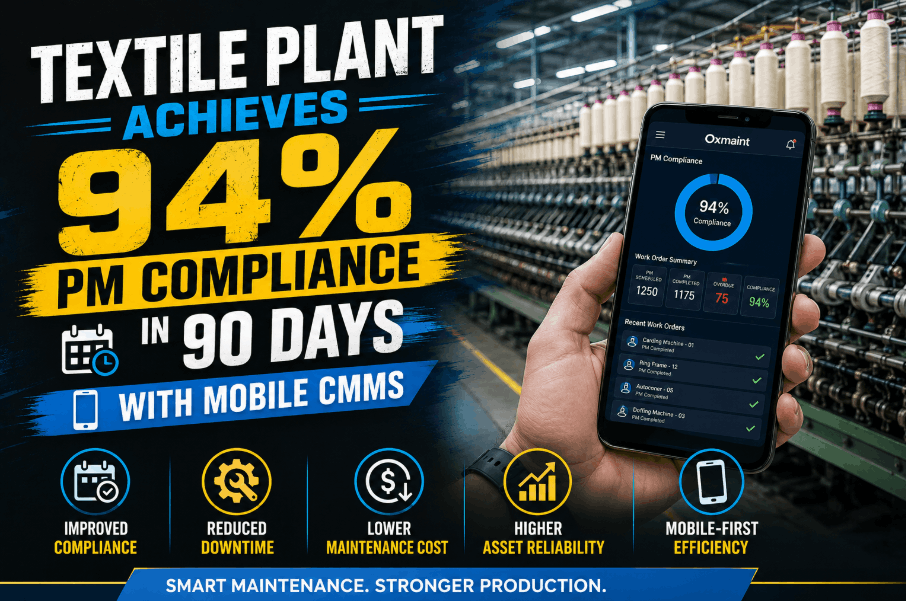
Automated escalation configured: PMs approaching overdue status trigger alerts at 72 hours, 24 hours, and at breach. Compliance rate for scheduled maintenance rose from 61% to 94% within this window.
Month 8–10
CAPA Integration & Deviation Tracking
Equipment failures and out-of-tolerance calibrations automatically generated linked CAPA records in Oxmaint. Root cause documentation, corrective action plans, and closure evidence stored within the same asset record thread.
Month 12
FDA Inspection — Zero Observations
The FDA investigator requested full calibration history for 28 instruments and 3 years of PM records for critical production equipment. Oxmaint produced every record in under 4 minutes. Zero 483 observations issued.
The Numbers Behind Zero Findings
94%
PM On-Time Compliance Rate
Up from 61% before CMMS deployment
214
Regulated Assets Tracked
All with full calibration & maintenance history
< 4 min
Audit Record Retrieval Time
Down from 3–5 days of manual search
1,200 hrs
Annual Prep Hours Eliminated
Quality team time redirected to product work
0
Form 483 Observations
First clean inspection in 6 years
100%
Electronic Audit Trail Coverage
Every record change logged with user & timestamp
Your Next FDA Inspection Is Closer Than You Think
Class II and III device manufacturers are inspected every two years — often with no advance notice. Start building your audit-ready compliance baseline in Oxmaint today, not the week before the investigator walks in.
Five Compliance Requirements CMMS Directly Controls
FDA investigators working under the updated QMSR (effective February 2026) now evaluate quality systems against ISO 13485:2016 in addition to 21 CFR Part 820. That means maintenance records, calibration trails, and equipment qualification data are no longer peripheral — they are core audit targets. Here is exactly what Oxmaint manages for each requirement.
FDA Requirement → What Fails Without CMMS → What Oxmaint Delivers
What Makes Oxmaint Different for Regulated Manufacturers
01
Immutable Audit Trail on Every Action
Every record creation, modification, approval, and closure is logged with user identity, timestamp, and the previous value. This is the core of 21 CFR Part 11 compliance — and it happens automatically without any technician action beyond doing their job.
02
Calibration Due Date Enforcement
Set calibration intervals per instrument. Oxmaint alerts responsible parties at configurable lead times, escalates to supervisors if unactioned, and flags any production equipment whose calibration has lapsed — before the FDA does.
03
Mobile Work Order Execution
Technicians complete maintenance tasks, attach photos, record measurements, and sign off electronically from the production floor. No paper. No transcription. No documentation lag. The record exists the moment the work is done.
04
Inspection-Ready Report Generation
When an FDA investigator requests three years of calibration history for a specific instrument, Oxmaint generates it in seconds — filtered by asset, date range, or technician. Inspection prep that used to take days takes minutes.
Build the Audit Trail That Ends Your 483 Streak
Every unrecorded PM, every paper calibration log, and every disconnected CAPA is a potential observation on your next inspection report.
See a live demo of Oxmaint's compliance workflow built for your device class and facility size, or start your free account and begin building your audit-ready baseline today.
Frequently Asked Questions
Does Oxmaint meet 21 CFR Part 11 requirements for electronic records?
Yes.
Oxmaint generates a system-enforced audit trail on every record — capturing who created or modified it, when, and what the previous value was. Electronic signatures on work order completions and calibration approvals meet the identity verification and signature linking requirements under 21 CFR Part 11. This makes your CMMS records legally equivalent to paper records for FDA inspection purposes, without any manual documentation effort from your team.
How quickly can we get our calibration and PM records into Oxmaint?
Most regulated manufacturers complete their initial asset migration in two to four weeks, depending on the number of equipment items and the format of existing records.
Oxmaint supports bulk import of asset data and allows scanned calibration certificates to be attached directly to equipment profiles. Your team can begin capturing new records from day one while historical data is migrated in parallel — so compliance coverage starts immediately, not after a months-long implementation.
What happens when calibration comes due or a PM is overdue in Oxmaint?
Oxmaint sends automated alerts to the assigned technician and supervisor at configurable lead times before a calibration or PM due date. If the task is not completed by the due date, escalation notifications go up the chain and the asset is flagged in your compliance dashboard. This prevents the silent overdue situations that generate 483 observations — equipment running past its validated maintenance interval without anyone noticing until the audit.
Book a demo to see the escalation workflow in action.
Can Oxmaint help us respond faster to FDA 483 observations we've already received?
Absolutely. If you have existing 483 observations related to maintenance documentation, calibration gaps, or CAPA evidence,
Oxmaint gives you the structured corrective action framework to address each one with documented proof. Work orders, calibration records, and CAPA closure evidence all become audit-ready the moment they're created in the system — giving you concrete evidence of systemic improvement to present in your FDA response within the required 15-business-day window.
Does the new QMSR (effective February 2026) change what maintenance records FDA can review?
Yes — significantly. Under the updated QMSR, FDA investigators now formally evaluate management reviews, internal quality audits, and supplier audit records as part of inspection model elements.
Oxmaint centralizes all of these documentation types in one place, making it easier to demonstrate a compliant quality system holistically rather than scrambling to pull records from multiple disconnected systems when the investigator arrives.
Schedule a call to understand how the QMSR changes affect your specific device class.