Regulatory audits in manufacturing plants are not random inspections — they are scheduled evaluations where non-compliance can result in production shutdowns, financial penalties, or loss of certification. The challenge is not whether your plant is compliant on paper, but whether you can prove it in real time when an auditor asks for documentation. 73% of manufacturing plants fail at least one audit finding annually, and the majority of failures trace back to missing documentation, incomplete audit trails, or outdated records that should have been updated months ago. The gap between actual compliance and documented compliance is where most plants lose ground. Book a 30-minute demo to see how OxMaint automates compliance documentation and turns audit preparation from a scramble into a system.
Regulatory Compliance · Manufacturing Audits · Audit-Ready Documentation
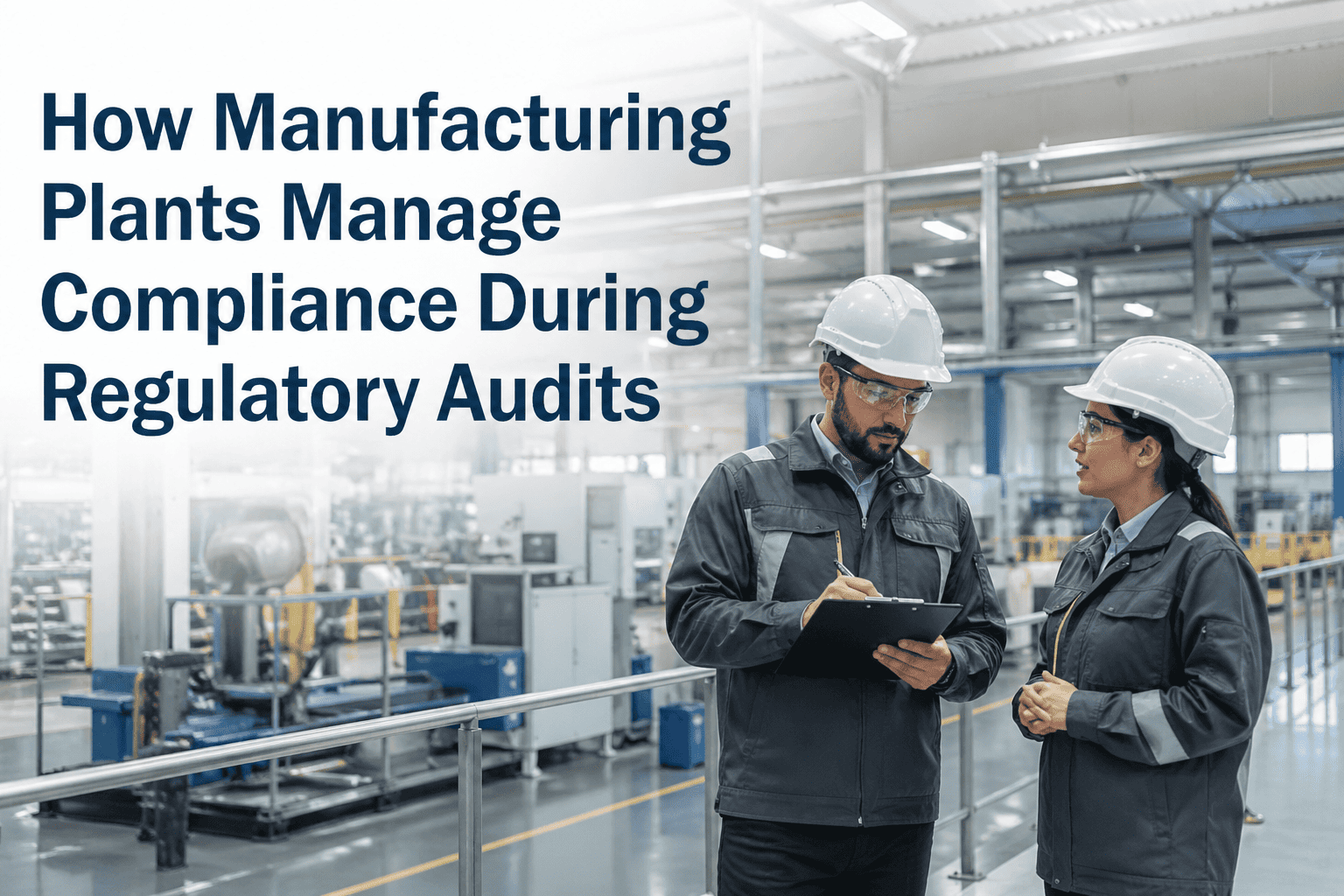
How Manufacturing Plants Manage Compliance During Regulatory Audits
73% of plants fail at least one audit finding each year — most failures trace to missing documentation, not actual non-compliance. This guide shows how to close the gap between being compliant and proving it.
The State of Manufacturing Compliance — 2025 Audit Data
73%
Plants with at least one audit finding per year
42%
Audit failures due to documentation gaps
68%
Plants that scramble 48 hours before audit
$284K
Average cost of failed compliance audit
Sources: Plant Engineering 2024, Manufacturing Compliance Institute, Deloitte Audit Survey 2025
The Compliance Gap
Why Being Compliant and Proving Compliance Are Two Different Problems
Most manufacturing plants perform the maintenance work required by regulatory standards — equipment is calibrated, safety checks are completed, preventive tasks are executed on schedule. The problem surfaces when an auditor asks to see the records. Documentation lives in three different spreadsheets. Calibration certificates are filed in a cabinet no one can locate. The PM completion log shows dates but no technician signatures. Work orders exist but lack root cause coding or closure timestamps. The plant is compliant in practice but cannot prove it in documentation — and in an audit, documentation is the only truth that matters.
The Four Phases of Audit-Ready Compliance
Phase 1
Pre-Audit Foundation
Establish asset register with regulatory classification. Define PM schedules aligned to audit requirements. Set up automatic audit trail logging for every maintenance transaction. Configure compliance checklists for critical assets. Assign responsibility ownership per asset category.
Phase 2
Ongoing Documentation
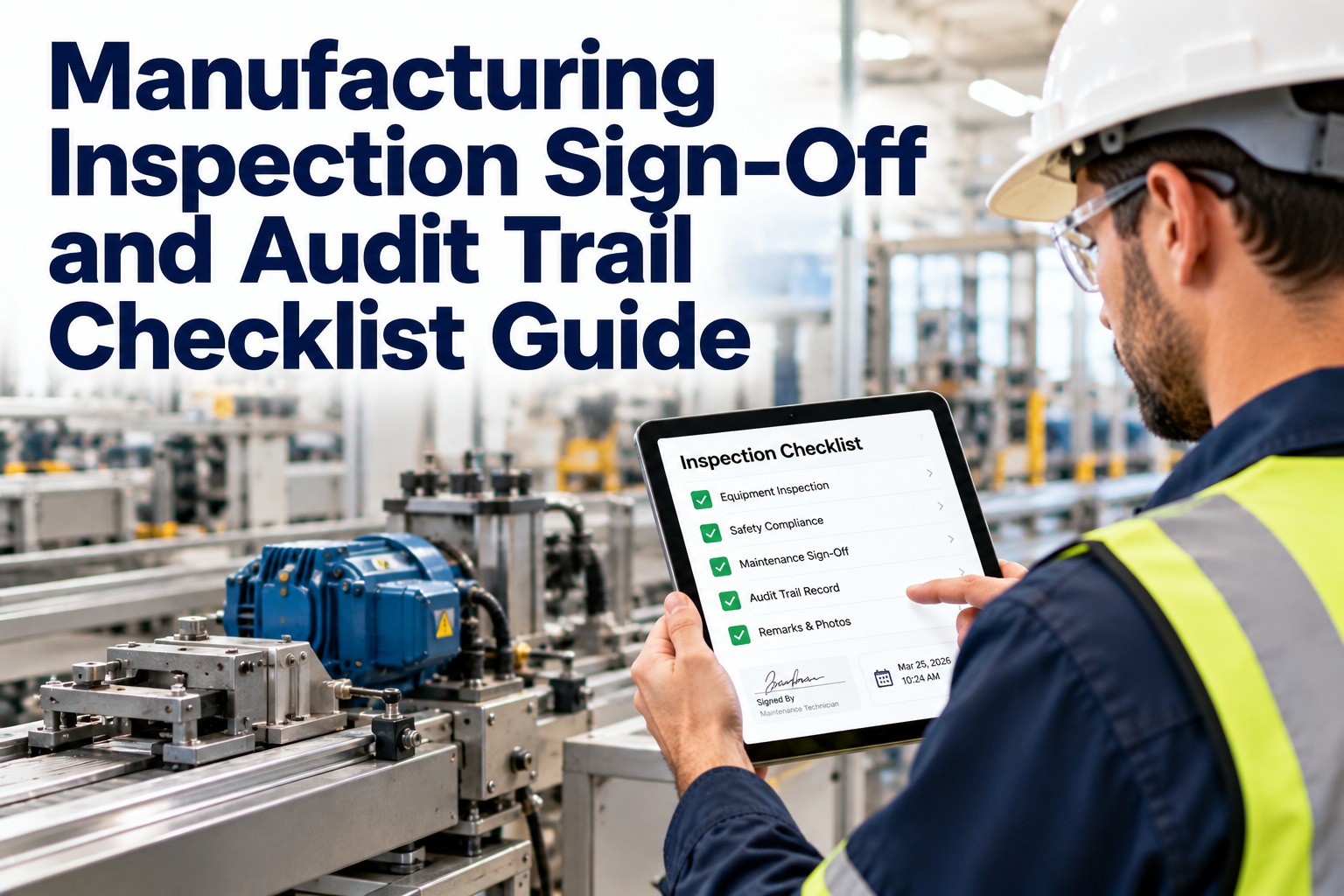
Every work order captures completion timestamp, technician ID, parts used, and closure notes. PM tasks include checklist sign-off with digital signature. Calibration records auto-attach to asset history. Non-conformance reports link directly to corrective actions. All changes trigger automatic audit log entries.
Phase 3
Pre-Audit Preparation
Run compliance gap report 30 days before audit. Identify missing documentation or overdue tasks. Generate pre-audit summary showing PM completion rate, calibration status, and work order closure metrics. Export audit-ready documentation packet organized by asset category and regulatory requirement.
Phase 4
Audit Execution
Auditor requests calibration records for Asset X — retrieve complete history in 15 seconds via CMMS search. Auditor asks for PM completion proof — export signed checklists with timestamps. Auditor flags discrepancy — trace full audit trail showing who made each change and when. Zero scrambling, zero missing records.
Audit Readiness Starts Here
Stop Scrambling 48 Hours Before Every Audit
Every compliance failure is a documentation failure — the work was done, but the proof was lost in spreadsheets, email threads, or paper files. OxMaint closes that gap by capturing structured compliance data from day one, so when the auditor asks for records, you retrieve them in seconds instead of hours.
Common Audit Findings
The Seven Most Common Compliance Failures in Manufacturing Audits
Incomplete Preventive Maintenance Records
PM schedules exist but completion records are missing technician signatures, actual completion timestamps, or checklist sign-off. Auditors cannot verify that scheduled maintenance was actually performed as documented.
OxMaint requires digital signature and timestamp on PM closure, with photo evidence optional. Every PM completion becomes a permanent, auditable record tied to the asset.
Missing Calibration Certificates
Equipment calibration was performed but certificates are filed somewhere offline or lost. Auditor cannot verify calibration frequency, result values, or certification authority without the document.
Calibration records attach directly to the asset in OxMaint as PDFs or images, with expiration date flagged. Overdue calibrations trigger automatic alerts 30 days before expiry.
No Audit Trail for Configuration Changes
Asset settings or PM intervals were modified but there is no log showing who made the change, when, or why. Auditors flag this as a traceability gap and potential compliance risk.
Every edit in OxMaint generates an automatic audit log entry with user ID, timestamp, field changed, old value, and new value. Full change history is retrievable per asset.
Untracked Non-Conformance Reports
Quality issues or equipment failures occurred but NCRs were not formally logged or linked to corrective actions. Auditor sees recurring issues with no documented root cause or preventive fix.
OxMaint links NCRs directly to work orders and assets, with mandatory root cause coding and corrective action tracking. Every NCR closure includes verification sign-off.
Expired Safety Inspection Documentation
Safety inspections were performed but records are outdated, filed incorrectly, or missing inspector credentials. Auditor cannot verify that inspections met regulatory frequency or qualification standards.
Safety inspection tasks in OxMaint include inspector certification field and photo upload. Overdue inspections appear on compliance dashboard with escalation alerts.
Incomplete Spare Parts Traceability
Critical spare parts were installed but batch numbers, supplier certifications, or material traceability documents are unavailable. Auditor flags this as a supply chain compliance gap.
OxMaint tracks parts by batch number, supplier, and certification document. Every part transaction links to the work order and asset, creating full traceability from purchase to installation.
No Evidence of Corrective Action Closure
Audit findings from previous year were documented but corrective actions show no closure verification or effectiveness review. Auditor sees open loops and recurring issues.
Corrective actions in OxMaint require closure verification with photo evidence and effectiveness review field. Overdue CAPAs escalate automatically until verified closed.
30-Day Pre-Audit Readiness Checklist
Run this checklist 30 days before any regulatory audit to identify and close documentation gaps before the auditor arrives.
Asset Documentation
✓
All critical assets have up-to-date records in CMMS
✓
Asset regulatory classification assigned and current
✓
Calibration certificates attached and not expired
✓
Equipment manuals and SOPs linked to assets
Maintenance Records
✓
PM completion rate above 90% for audit period
✓
All closed work orders have technician signatures
✓
No overdue PMs on critical regulatory assets
✓
Root cause coding completed on unplanned work orders
Compliance Trails
✓
Audit log enabled and capturing all transactions
✓
NCRs closed with corrective action verification
✓
Safety inspection documentation current and signed
✓
Spare parts traceability records complete
Documentation Requirements by Regulatory Standard
Different regulatory frameworks require different documentation depth. This table maps the most common manufacturing standards to their core documentation requirements.
| Regulatory Standard |
Core Documentation Required |
Audit Frequency |
Typical Findings |
| ISO 9001 Quality Management |
PM schedules, work order history, calibration records, NCRs with CAPA |
Annual surveillance, triennial recertification |
Incomplete CAPA closure, missing calibration certs |
| FDA 21 CFR Part 11 Pharma |
Electronic signature validation, audit trails, change control logs, access control records |
Unannounced, typically 18-24 month cycle |
Missing audit trails, unsigned electronic records |
| OSHA Safety Compliance |
Safety inspection logs, lockout/tagout records, incident reports, training certifications |
Complaint-driven or random |
Expired safety inspections, incomplete LOTO logs |
| ISO 14001 Environmental |
Environmental monitoring records, waste disposal logs, emission reports, compliance schedules |
Annual surveillance |
Missing environmental monitoring data, overdue reports |
| IATF 16949 Automotive |
FMEA documentation, process control plans, preventive maintenance evidence, supplier quality records |
Annual with unannounced audits |
Incomplete FMEA, missing PM sign-off |
Frequently Asked Questions About Compliance Audits
How far back do auditors typically request maintenance records?
Most regulatory audits request 12 to 24 months of maintenance history, depending on the standard. FDA audits may request up to 3 years for critical equipment. OxMaint maintains unlimited searchable history so you can retrieve records from any time period instantly.
Can a CMMS system itself be audited for compliance?
Yes — especially under FDA 21 CFR Part 11, the CMMS must demonstrate audit trail integrity, electronic signature validation, and access control. OxMaint is designed with compliance-grade audit logging and role-based permissions that meet these requirements out of the box.
What happens if we fail a compliance audit?
Minor findings require corrective action plans with verification deadlines. Major findings can result in production holds, financial penalties, or loss of certification. The cost of a failed audit averages $284K when downtime and remediation are included.
How do we prove that preventive maintenance was actually completed?
Digital signature, timestamp, and photo evidence attached to the work order. OxMaint captures all three automatically on PM closure, creating an auditable record that proves not just scheduling but actual execution.
Can OxMaint generate pre-audit documentation packets automatically?
Yes — run a compliance report filtered by date range, asset category, or regulatory standard, and export a complete documentation packet with PM records, calibration certificates, work order history, and audit trails ready for auditor review.
OxMaint Compliance Management
Turn Audit Preparation from a Scramble into a System
The gap between being compliant and proving compliance is where most manufacturing plants fail audits. OxMaint closes that gap by capturing structured, auditable documentation from every maintenance transaction — so when the auditor asks for proof, you retrieve it in seconds, not hours. Pre-audit readiness becomes a report you run, not a crisis you manage.