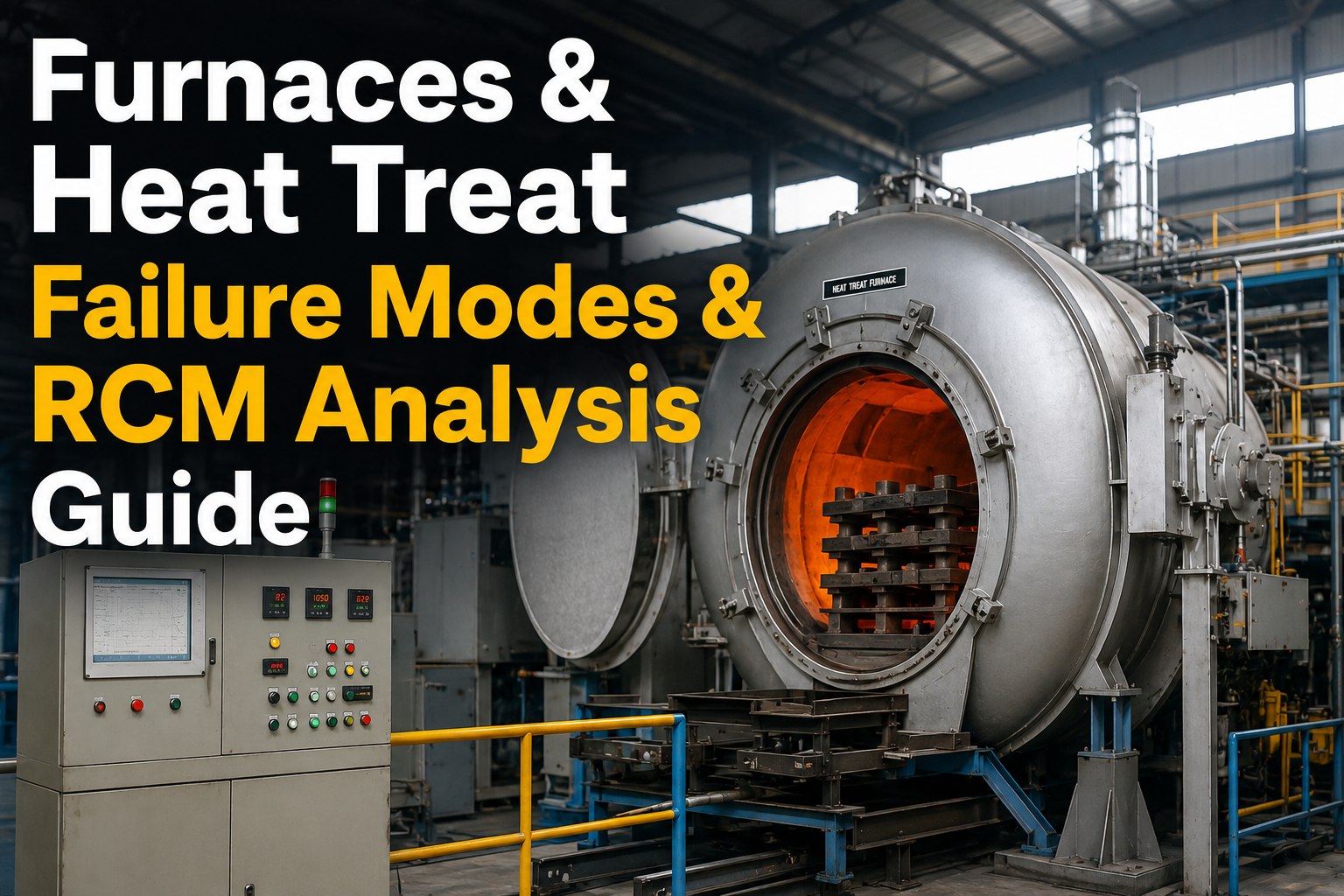
Furnaces and heat-treat lines punish a badly targeted maintenance program in a way few assets do — because they fail two completely different ways. There's the visible structural failure, where refractory erodes until a hot spot burns through the shell, and the invisible metrological one, where a drifted thermocouple lets an entire load process at the wrong temperature and every gauge still reads normal. FMEA is the tool that separates these, ranks them, and points maintenance effort at the ones that matter — and RCM turns that ranking into the right task for each. Done well, it stops a plant from over-maintaining low-consequence components while under-maintaining the modes that scrap product or breach the shell. This guide walks the complete FMEA and RCM analysis for furnaces and heat-treat: the dominant failure modes, their root causes and detection tactics, how RPN ranks them, the four task strategies, criticality, and how a CMMS keeps the analysis live. Book a live RCM demo against your own furnaces.
A Furnace Fails Two Ways — FMEA Tells You Which to Fight First
Refractory burns through visibly; a drifted thermocouple scraps a load silently. FMEA ranks both by real risk.
S×O×D
RPN — the score that ranks every failure mode 1 to 1000
>200
RPN threshold that flags a mode for priority action
9–10
Severity — safety or scrap — acted on regardless of total
4 tasks
RCM strategies each mode routes to after the FMEA
The Dominant Failure Modes
FMEA begins by naming how the furnace actually fails. Heat-treat failures split into structural degradation, heating-system decline, and the metrological drift unique to thermal processing — and the highest-severity mode is the one that leaves no visible symptom.
Refractory Degradation
High severity, slow onset. Erosion, cracking, and spalling thin the lining, driving heat toward the shell — hot spots and, at worst, burn-through. Thinned lining also loses 15–25% more heat.
Thermocouple & Sensor Drift
The highest-risk mode — low detectability. Sensors drift with cycling, so the furnace controls to a false reading. No alarm, no downtime — just a full load processed off-temperature and scrapped.
Burner & Element Decline
Moderate severity, gradual. Burner-tip erosion enlarges the orifice; electric elements drift and open. Both create zone non-uniformity that operators mask by over-firing, driving fuel up.
Uniformity & Atmosphere Loss
Quality-critical. Damaged insulation or burner imbalance breaks temperature uniformity across the work zone — the exact condition a uniformity survey is designed to catch before parts go out of spec.
The FMEA Worksheet · Ranking by RPN
The heart of the analysis is scoring each mode by Severity, Occurrence, and Detection — each 1 to 10 — and multiplying them into a Risk Priority Number. RPN ranks where effort goes, and the pattern for furnaces is revealing: the worst risks are driven by low detectability, not high frequency.
Failure Mode
System Effect
Risk Driver
Detection Tactic
Thermocouple drift
Whole load scrapped, quality escape
High severity, very low detection
System accuracy test (SAT)
Refractory burn-through
Shell breach, forced outage
High severity, moderate detection
Gradient monitoring + IR scan
Uniformity loss
Out-of-spec parts across the zone
High severity, low detection
Temperature uniformity survey
Burner-tip erosion
Fuel rise, zone imbalance
Moderate severity, good detection
Combustion + energy trending
Element failure
Zone cold spot, cycle delay
Moderate severity, good detection
Resistance + current monitoring
The insight FMEA surfaces here: for furnaces, the biggest risk reduction usually comes from improving detection, not adding more frequent PM. A thermocouple that drifts rarely but is nearly undetectable scores higher than a burner tip that erodes often but is easy to catch — so scheduled accuracy testing beats calendar overhaul. Severity of 9–10 (safety or scrap) gets acted on regardless of the total.
Run the FMEA on Your Furnaces in 30 Minutes
Working session with our reliability team — bring your furnace list. We'll score the dominant modes by severity, occurrence, and detection, rank them by RPN, and show how OxMaint turns the worksheet into scheduled tasks and live condition triggers.
The Four RCM Task Strategies
FMEA is step one; RCM adds the task-selection logic on top. The worksheet output — severity, occurrence, detection, and whether a P-F interval exists — decides which of four strategies each mode gets. Misassigning them is how plants over-maintain cheap parts and under-maintain critical ones.
On-Condition
Predictive / Condition-Based
For modes with a measurable P-F interval. Refractory gradient monitoring, IR shell thermography, and energy trending catch degradation weeks out — the dominant furnace strategy.
Scheduled Restoration
Life-Based Overhaul
Refractory relining, element replacement, and burner refurbishment at intervals set by thermal exposure and fired hours — for wear-out modes without a usable warning signal.
Failure-Finding
Accuracy & Uniformity Testing
The critical one for heat-treat. Scheduled system accuracy tests and temperature uniformity surveys prove the sensors and work zone before a hidden drift ruins a load.
Run-to-Failure
Deliberate Acceptance
A conscious choice for low-consequence, non-safety, non-quality components — never a thermocouple, refractory, or a safety interlock on a furnace.
Criticality Ranking · Where the Analysis Goes
RCM analysis is time-intensive, so it's spent where consequences justify it. For furnaces, consequence spans safety, product quality, and cost — and quality-critical modes rank near the top because a scrapped heat-treat load can be as costly as a breakdown.
CRITICAL
Sensors, Refractory & Safety Systems
Thermocouples and uniformity, refractory integrity, and safety interlocks. Failure means scrapped loads, a shell breach, or a hazard — full FMEA, condition monitoring, and non-negotiable accuracy testing.
IMPORTANT
Burners, Elements & Atmosphere
Heating system and atmosphere control. Failure drives fuel cost, zone imbalance, and cycle delay — targeted FMEA, condition-based tasks, and scheduled restoration on wear parts.
SUPPORTING
Non-Critical Auxiliaries
Low-consequence auxiliaries with redundancy or a tolerable outage. Simple inspection or planned restoration — no exhaustive analysis needed.
How OxMaint Runs Furnace FMEA & RCM
OxMaint embeds the analysis into execution — live FMEA libraries in the asset record, RPN-based criticality, condition triggers, life-limited tracking, and auto-generated work at RCM-defined intervals, replacing spreadsheet RCM, from one dashboard on desktop or mobile.
FMEA
Live Failure-Mode Libraries
Furnace failure modes with root causes and effects in each asset record, linked to work-order templates and condition triggers — the worksheet made live, not shelved.
RPN
Severity-Weighted Scoring
Score and rank modes by severity, occurrence, and detection, re-scoring after every real failure — so priority follows real risk, not habit.
Detect
Gradient & Drift Triggers
Refractory-gradient, shell-temperature, and energy-trend data convert threshold breaches into work orders — targeting the low-detectability modes FMEA flags.
Test
SAT & Uniformity Cadence
Auto-generate system accuracy tests and temperature uniformity surveys on cadence and after any element, refractory, or sensor change — the failure-finding backbone.
Life
Thermal-Exposure Tracking
Track fired hours and thermal exposure against life-limited refractory and elements, triggering scheduled restoration on real usage.
Report
Reliability & Compliance
Reliability dashboards plus pyrometry, ISO 55000, and AMS2750/CQI-9-ready records, with SAP and Maximo overlay across one plant or a fleet.
Rank Furnace Risk, Then Maintain to It
Replace spreadsheet FMEA with a live program that scores every mode by RPN, routes it to the right task, and targets the low-detectability risks that scrap loads. See OxMaint on your own furnaces. Free forever plan available.
Frequently Asked Questions
What is FMEA for furnaces and heat-treat?
FMEA — Failure Mode and Effects Analysis — is the structured process of identifying every way a furnace can fail, rating each mode's severity, occurrence, and detectability, and using that to prioritize maintenance. For heat-treat it's especially valuable because the asset fails two very different ways: structurally, through refractory, burner, and element degradation, and metrologically, through sensor drift and uniformity loss that ruins product quality with no visible symptom. FMEA separates these, ranks them by risk, and forms step one of an RCM analysis, which then assigns the right task to each mode.
Book a demo.
How is the Risk Priority Number (RPN) calculated?
RPN = Severity × Occurrence × Detection, each scored 1 to 10, giving a range of 1 to 1000. Severity rates the system effect if the mode occurs, occurrence rates how often, and detection rates how likely current controls are to catch it before it causes harm — a higher detection score means harder to detect. Modes above roughly 200 get priority action, and any mode with a severity of 9 or 10 — a safety or scrap consequence — is acted on regardless of the total. For furnaces, low-detectability modes like thermocouple drift often top the ranking even when they occur rarely.
Which furnace failure mode carries the highest risk?
Usually thermocouple and sensor drift, because it combines a high-severity effect with very low detectability. A drifted sensor makes the furnace control to a false temperature, so an entire heat-treat load can process out of specification with no alarm and no downtime — the parts may pass visual inspection and fail in service. Refractory burn-through is also high-severity but more detectable through gradient monitoring and IR scanning. FMEA's value is showing that the rarely-occurring but nearly-invisible mode can outrank a frequent but obvious one.
Start free.
How does FMEA connect to RCM task selection?
The FMEA worksheet is step one of every RCM analysis; RCM adds the task-selection logic on top. The worksheet's outputs — severity, occurrence, detection, and whether a measurable P-F interval exists — determine which of four task types applies to each mode: condition-based (a warning signal exists), time-based or scheduled restoration (predictable wear-out, no warning), failure-finding (hidden functions like sensor accuracy and uniformity), or run-to-failure (low consequence only). Matching the task to the FMEA output is what prevents over-maintaining cheap components and under-maintaining critical ones.
How does OxMaint support furnace FMEA and RCM?
OxMaint holds live FMEA libraries in each furnace asset record — modes, root causes, and effects linked to work-order templates and condition triggers; scores and re-scores RPN by severity, occurrence, and detection after every real failure; and converts refractory-gradient, shell-temperature, and energy-trend breaches into work orders aimed at the low-detectability modes. It auto-generates system accuracy tests and uniformity surveys on cadence and after any element, refractory, or sensor change, tracks thermal exposure against life-limited parts, and delivers reliability plus pyrometry, ISO 55000, and AMS2750/CQI-9-ready reporting, with SAP and Maximo overlay. A free forever plan is available.


-in-manufacturing.png)

