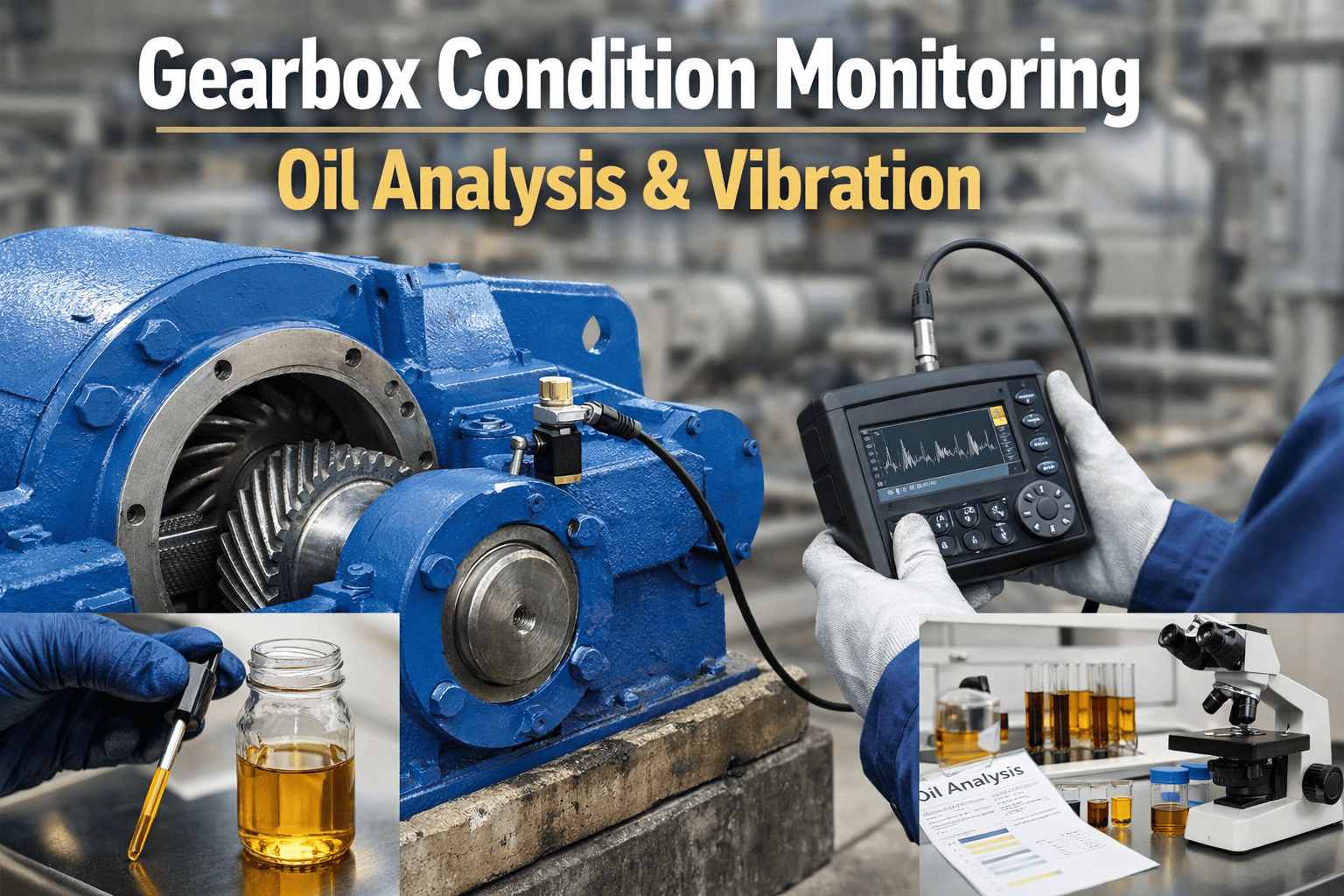
Gearbox Maintenance and Reliability in Manufacturing

By William Jerry on September 9, 2026

gearbox-maintenance-reliability-manufacturing

A gearbox rarely dies suddenly. It sends warnings for weeks — the oil darkens, a bearing runs a few degrees hot, a sideband climbs on the vibration spectrum — and then one afternoon a tooth fractures and a $50K rebuild and a line stoppage land on your desk together. The cruelty is that gear tooth fractures alone account for roughly 38% of unplanned gearbox replacements, bearings are the second driver, seals the third, and lubrication is the accelerant under all of them — every one detectable weeks ahead with the right monitoring. The catch: no single technique sees everything. Oil analysis, vibration, and temperature each go blind to failure modes the others catch, so reliability comes from reading all three together. This guide walks the three-channel method, the exact thresholds that matter, and how OxMaint's maintenance management software turns readings into work orders.

Manufacturing · Reliability · Gearbox Condition Monitoring · 2026

Gearbox Maintenance & Reliability in Manufacturing

Oil, vibration, and temperature — three channels, each blind to what the others see. Read them together and you catch the failure weeks out, extend critical-drive life 2–3×, and turn a $50K surprise into a planned repair.

Where gearboxes actually fail
Gear tooth fractures
38% of replacements
Bearing failure
2nd driver
Seal failure
3rd driver
Lubrication
the accelerant under all of them
Distribution per Power Transmission Engineering benchmark data · lube failure compounds every other mode

One Channel Is Blindness. Three Is a Picture.

This is the core of gearbox reliability, and it's why single-technique programs miss failures. A gear tooth fracture screams in vibration data but shows almost nothing in oil until it's already cracked. Slow additive depletion shows in oil weeks before it moves any vibration channel. A bearing running hot from marginal lube shows in temperature before either oil or vibration registers. Rely on one and you accept blindness to whatever that one doesn't detect. Sign up free and OxMaint logs all three against the same asset so the picture is complete.

OIL
Oil Analysis
Sees first: additive depletion, contamination ingress, bronze-bushing wear, water
Blind to: a sudden tooth crack until debris appears
VIB
Vibration
Sees first: tooth cracks, spalling, bearing defects, misalignment, unbalance
Blind to: oil chemistry and slow contamination
TMP
Temperature
Sees first: marginal lubrication, cooler faults, early bearing heat rise
Blind to: which specific component is degrading

Channel 1 — Oil Analysis: The Four Numbers That Decide

"Oil condition: satisfactory" tells you nothing. Oil analysis has four quantifiable dimensions, each with a hard threshold — and here's the one that catches teams off guard: new oil is not clean oil. Since 82% of machine wear is particle-induced, cleanliness is the number that quietly governs how long your gears and bearings last. Book a demo to see thresholds auto-flagged on every sample.

Viscosity
Drop >15% of new-oil spec
Below that, film is too thin to protect tooth flanks under load. The foundation of everything else.
TAN (acid number)
Above 2× new-oil baseline
Signals oxidation and additive depletion — replace regardless of how the oil looks to the eye.
Water content
Above 0.1%
Causes hydrogen embrittlement in bearing steel and collapses oil-film strength — early-failure risk.
Cleanliness (ISO 4406)
Target 18/16/13 or cleaner
Across 4/6/14µm particles. Most gearboxes need this or better for rated bearing life.
And watch the wear metals — the tell-tale trend
Fe Iron — rising = gear-tooth or bearing wear
Cu Copper — bearing wear or bronze-component corrosion
PQ Particle quantifier — bulk ferrous debris trend
Alert on any single-month jump exceeding 30% over the 12-month average — the trend matters more than the absolute number.

Every Lube-Traced Failure Costs More Than a Decade of Correct Lubrication.

The cheapest reliability wins on a gearbox are the ones nobody photographs: a clean breather, a good seal, oil at the right level and cleanliness. Miss them and contamination accelerates every other failure mode at once. OxMaint schedules breather, seal, and oil tasks by runtime and condition — and auto-flags a sample the moment a threshold trips.

Channel 2 — Vibration: Read the Signature, Name the Fault

Vibration is the most reliable early detector for developing gear and bearing faults — because each fault leaves a distinct fingerprint on the spectrum, catchable 1–3 weeks before functional failure. The gap between a healthy gearbox and one about to fail is measured in sideband amplitudes. Here's how to read the dominant signatures. Sign up free to trend velocity against the ISO 20816 alert line.

Fault
Vibration Signature
Confirm With
Cracked tooth
High-energy impact in the time waveform at shaft-rotation period + broadband burst
Large wear particles in oil; inspection
Macropitting / spalling
Multiple gear-mesh-frequency harmonics with dense sidebands at shaft speed
Ferrous debris trend; PQ index
Micropitting
Subtle high-frequency band rise — best caught with envelope demodulation
Fine ferrous particles in oil
Bearing defect
BPFO / BPFI defect frequencies + harmonics; HFE rise in the 5–20 kHz band
Localized temp rise; thermography
Misalignment
Dominant 2× shaft-speed peak with an elevated axial component
Laser alignment; soft-foot check
Unbalance
Dominant 1× shaft-speed peak, radial-dominant, no sidebands
Field balancing; trim weights

Two practical rules: capture bandwidth to 10 kHz (you can't see bearing and gear-mesh detail without it), and always confirm alignment first — misalignment compounds readings and masks the true gear-mesh signature. A bearing failure on a loaded gearbox almost always takes a gear with it if it isn't caught early.

Channel 3 — Temperature & the Reliability Cadence

Temperature is the cheapest channel and the earliest warning for lubrication trouble — a bearing starting to starve runs hot before oil or vibration says a word. Wrap all three channels in a fixed rhythm and the program runs itself. Let operating temperature stabilize (30–45 minutes loaded) before recording any baseline. Book a demo to automate this cadence per drive.

Daily
Sensory checks — noise, leaks, temperature by hand or IR spot. Catches the obvious before it escalates.
Weekly
Oil level and visible condition; breather state; sight-glass check; any weeping at shaft seals.
Monthly
Vibration velocity at input and output shafts; compare to baseline ±20%; log the trend.
Quarterly
Lab oil analysis — the full four-number panel plus wear-metal spectrometry and trend review.
Annual
Internal inspection at planned shutdown; backlash measurement; alignment to OEM tolerance.
Continuous
Critical production drives — IIoT vibration and temperature sensors feeding live alerts.

Reactive / Spreadsheet vs. OxMaint Gearbox Program

Most gearbox "programs" are a lab report in an inbox and a vibration file on someone's laptop — three channels that never meet, so nobody connects the rising iron to the climbing sideband to the hot bearing until the tooth breaks. Here's what changes when all three live on the asset. Start free and put one critical drive on a real program this week.

Element
Reactive / Spreadsheet
OxMaint Gearbox Program
Three channels
Live in three separate places
Oil, vibration & temp on one asset record
Thresholds
Judged by eye, "looks fine"
Auto-flag on viscosity, TAN, water, ISO code
Wear-metal trend
Noticed only when someone looks back
Alert on 30% jump over 12-mo average
Reading → action
Report read, then forgotten
Threshold trip opens a work order
Cadence
Slips when the floor gets busy
Scheduled by runtime & condition, never skipped
Outcome
$50K rebuild, unplanned line stop
Planned repair, 2–3× life on critical drives

What OxMaint Gives the Reliability Team

OxMaint unifies the three channels on the asset and turns any threshold breach into a work order — so the rising iron, the climbing sideband, and the hot bearing finally get read as one story before the tooth breaks. Here's the concrete mapping. Book a demo to see it on your drives.

Oil-Sample Logging & Auto-Flag
Every result stored on the gearbox record; viscosity, TAN, water and ISO cleanliness auto-flagged the moment a threshold trips.
Vibration Trend & Alerts
Velocity trended against baseline and the ISO 20816 line, with wear-metal and sideband trends beside it on the same asset.
Temperature Monitoring
Bearing and sump temperature tracked as the earliest lube-trouble signal — the third channel most programs ignore.
Condition-Based Work Orders
Any channel crossing its threshold opens a pre-populated work order — reading becomes action, not a report that gets filed.
Cadence Automation
Daily, weekly, monthly, quarterly and annual tasks scheduled by runtime and condition, plus IIoT for critical drives.
Reliability Reporting
MTBF, MRO cost and life-extension trends per gearbox — the evidence that a program is adding years to critical assets.

Use this three-channel method plus OxMaint to build a gearbox reliability program that catches failures weeks early, extends critical-drive life 2–3×, and converts the $50K surprise rebuild into a scheduled job at planned downtime. Try OxMaint free or book a demo to see it on your plant.

"

We had oil reports going to the lab, vibration files on a contractor's laptop, and temperature nobody logged at all — three channels that never talked. Classic result: iron had been climbing on a main drive for four months, the sidebands were building, and we didn't connect them until the gearbox took a tooth and the line went down for three days. In OxMaint all three now sit on the same asset, thresholds flag themselves, and a bad sample opens a work order automatically. Last quarter it caught a bearing on temperature alone, weeks before vibration would have — we swapped it at a planned stop for a few hundred dollars instead of losing the gearbox. Our critical drives are lasting far longer than they used to.

Reliability Engineer · Heavy Manufacturing Plant

Frequently Asked Questions

Why monitor oil, vibration and temperature instead of just one?
Each channel is blind to failures the others catch — a tooth crack shows in vibration but not oil, additive depletion shows in oil but not vibration, and marginal lubrication shows in temperature first. Reliability comes from reading all three together.
What are the key oil-analysis thresholds for a gearbox?
Viscosity drop over 15% of spec, TAN above 2× the new-oil baseline, water over 0.1%, and ISO 4406 cleanliness of 18/16/13 or better. Also alert on any wear-metal jump exceeding 30% over the 12-month average.
How early can vibration analysis catch a gearbox fault?
Typically 1–3 weeks before functional failure, because each fault leaves a distinct signature — gear-mesh harmonics with sidebands for spalling, BPFO/BPFI for bearings, a 2× peak for misalignment. Capture bandwidth to 10 kHz and confirm alignment first.
Why do breathers and seals matter so much?
They're the cheapest reliability wins. A failed breather or seal lets contamination and water in, and since most machine wear is particle-induced, that contamination accelerates every other failure mode at once.
How does OxMaint help extend gearbox life?
It unifies all three channels on the asset, auto-flags any threshold breach, and turns it into a work order before a warning becomes a failure — scheduling the cadence so nothing slips. Sign up free to start.

Catch the Warning. Skip the $50K Surprise.

OxMaint unifies oil, vibration and temperature on every gearbox, auto-flags the thresholds that matter, and opens a work order the moment a channel crosses the line — so failures are caught weeks early and critical drives last 2–3× longer. Start free — no credit card, unlimited users, forever. Or book a demo.



Share This Story, Choose Your Platform!