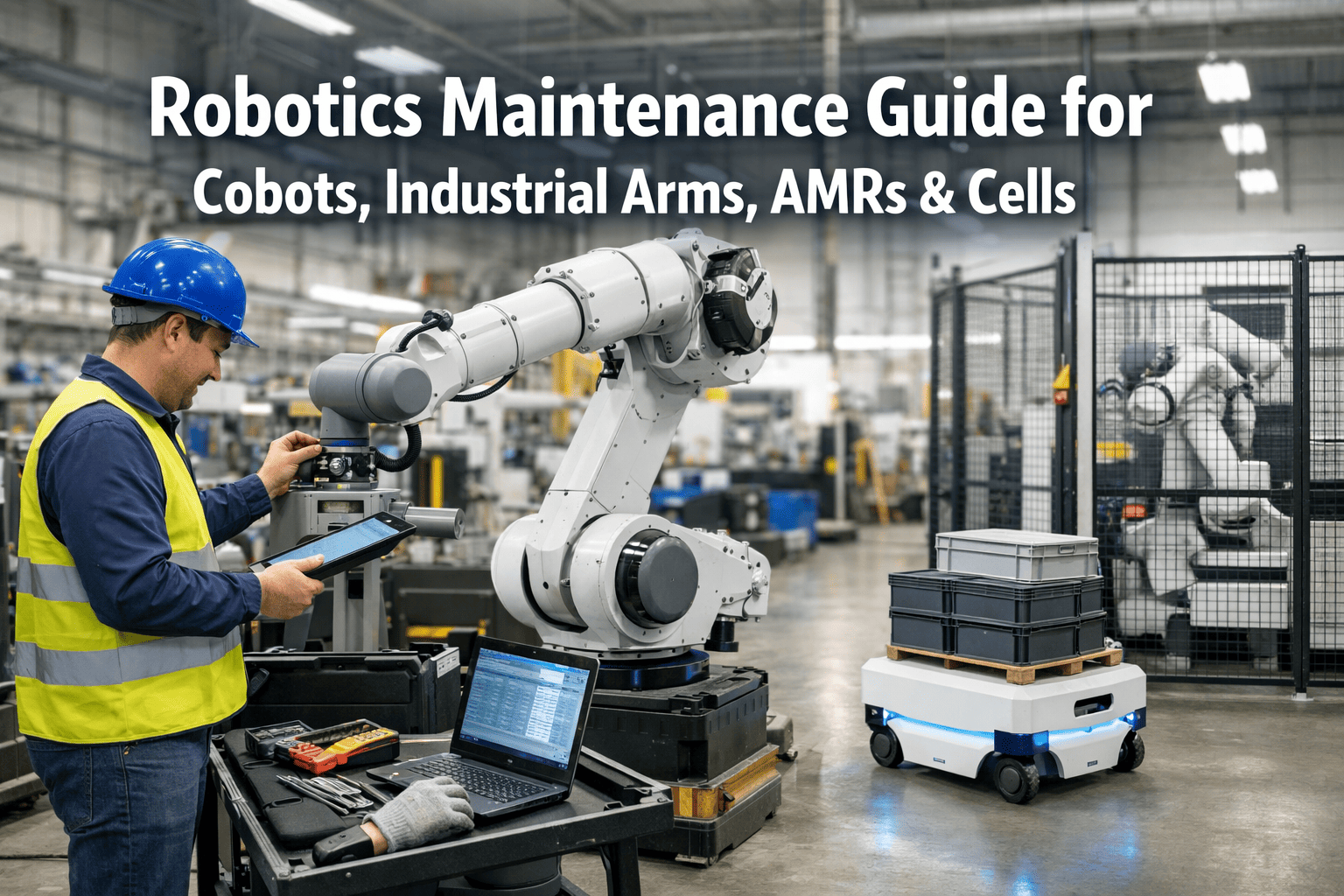
When a mid-sized heavy equipment manufacturer decided to deploy 35 collaborative robots across its welding, machine tending, and assembly stations, leadership knew the cobots were only half the equation. Without a structured robotics maintenance tracking system, even the best cobots would become expensive liabilities the moment a joint failure or end-of-arm tooling issue went undetected mid-shift. Partnering with Oxmaint to track every cobot's health in real time, the company achieved 99.3% robot uptime, cut changeover time by 42%, and pushed OEE from 61% to 83% — all within 11 months of full fleet deployment. Here is exactly how they got there.
Robotics Maintenance Case Study
35 Cobots. 99.3% Uptime.
One Maintenance Platform.
A heavy equipment manufacturer's playbook for deploying collaborative robots and keeping them running — with Oxmaint tracking every cobot from day one.
Why This Manufacturer Chose Cobots — And Why Maintenance Was the Hardest Part
The company produces heavy industrial machinery components — hydraulic cylinders, structural frames, and precision-machined drive assemblies. Before automation, six welding stations and four machine-tending cells ran on skilled manual labor. Two problems were compounding each year: rising labor costs and growing inconsistency in weld quality across shifts. The decision to deploy 35 cobots was strategic and well-researched. What caught leadership off guard was what happened after deployment started.
38%
Of cobot downtime in manufacturing is caused by end-of-arm tooling failures that go untracked
28.7%
Of total OEE losses in make-to-order manufacturing come from setup and changeover time
60%
Average OEE for discrete manufacturers — 25 points below the 85% world-class benchmark
12–18 mo
Typical cobot ROI window — compressed to 11 months when paired with structured maintenance tracking
The Real Problem
Cobots Were Deployed. Maintenance Tracking Was Not.
By month three of deployment, the manufacturer had 22 cobots live across welding and machine-tending cells. Two had already gone offline due to undetected joint torque drift. A third had been causing subtle weld inconsistencies for 11 days before a quality audit caught it — by which time a batch of substandard frame assemblies had already moved downstream. The maintenance team was managing cobot service schedules on spreadsheets, with no connection to actual operating hours, no automated alerts for wear thresholds, and no visibility into which cobots were approaching service windows. Each robot was essentially its own island.
22
Cobots live at failure point
11 days
Weld drift went undetected
0
Automated maintenance alerts active
How Oxmaint Was Integrated Into the Cobot Fleet
Oxmaint was brought in at month four — not to replace the cobots' native monitoring interfaces, but to create a unified maintenance intelligence layer above them. The integration connected all 35 cobots to a single platform that tracked operating hours per joint, end-of-arm tooling wear cycles, calibration schedules, and torque deviation patterns. For the first time, the maintenance team could see the entire robot fleet's health from one dashboard rather than checking each cobot's controller individually.
01
Fleet-Level Health Dashboard
All 35 cobots reported real-time health scores to a central Oxmaint dashboard. Joint temperature, torque load, cycle count, and calibration status were visible in a single view — color-coded by risk level. Maintenance managers could instantly identify which cobots needed attention without physically visiting each cell or opening individual controller interfaces.
02
Operating-Hour Based Service Triggers
Service intervals were tied to actual operating hours, not calendar dates. When a cobot reached 80% of its joint lubrication threshold, Oxmaint automatically generated a work order — giving the maintenance team a 48-hour window to schedule service during a planned production gap rather than reacting to failure.
03
End-of-Arm Tooling (EOAT) Wear Tracking
EOAT components — grippers, welding torches, fixture tools — were tracked by cycle count per unit. Replacement was scheduled before grip force degradation could cause part misalignment or weld inconsistency, eliminating the quality drift episodes that had cost the company batches in month three.
04
Changeover Workflow Standardization
Oxmaint digitized and standardized all 35 cobot changeover procedures — tool swaps, program changes, fixture repositioning. Technicians followed structured digital checklists rather than relying on memory or paper SOPs, cutting average changeover time from 67 minutes to 39 minutes across all cells.
Deploying cobots without maintenance tracking is like buying a car without a service plan.
Oxmaint connects to your entire robot fleet and gives your maintenance team the visibility to keep every cobot productive — before problems surface on the production floor.
The Numbers: What 11 Months of Tracked Cobot Maintenance Delivered
Every metric below was measured against the 6-month baseline period when the cobots were operating without structured maintenance tracking through Oxmaint. The improvement figures reflect verified operational data from the manufacturer's production floor, tracked from the date Oxmaint integration was completed through month 11.
Primary Outcome
99.3%
Robot Fleet Uptime
Up from 91.4% during the untracked period. The 7.9-point uptime gain translates to 847 additional productive robot-hours per month across the 35-cobot fleet — the equivalent of adding 3.5 full-time production shifts without hiring or capital investment.
42%
Changeover Time Reduction
From 67 min average to 39 min. Standardized digital workflows eliminated the inconsistency between technicians and shifts.
61% → 83%
OEE Score Improvement
22-point OEE gain driven by availability, performance, and quality improvements across all automated cells.
78%
Fewer Emergency Repairs
From an average of 9 emergency cobot interventions per month to just 2 — driven by proactive service scheduling.
31%
Parts Cost Reduction
EOAT components ordered based on actual cycle counts, eliminating emergency sourcing and excess inventory.
OEE Breakdown: Where Each Point Was Gained
Moving from 61% to 83% OEE is not a single lever — it is the compounding result of improvements across all three OEE factors. The table below breaks down exactly where the 22-point gain came from across the manufacturer's automated production cells, and which Oxmaint capability drove each improvement area.
OEE Factor Analysis — Before vs. After Oxmaint Integration
The Changeover Story: From 67 Minutes to 39 Minutes
Changeover time is one of the most underestimated OEE killers in automated manufacturing. Setup and changeover losses account for nearly 29% of total OEE losses in make-to-order environments — and in heavy equipment production, where product variants are frequent and tooling swaps are complex, this problem is amplified. Before Oxmaint, the manufacturer's cobot changeovers were inconsistent between technicians, undocumented in real time, and carried no accountability trail. A changeover that took one technician 45 minutes took another 90 minutes on the same cell.
"Before Oxmaint, a changeover was whatever the technician remembered from the last time. Now every cell has a structured digital checklist, every step is logged, and our fastest and slowest technicians are within 4 minutes of each other. That consistency alone changed how we plan production."
Plant Automation Manager, Heavy Equipment Division
Your Cobots Are Only as Good as Your Maintenance System
Whether you have 5 cobots or 50, Oxmaint gives your team a single platform to track operating hours, schedule service proactively, standardize changeovers, and keep every robot at peak performance. See it live — tailored to your robot fleet and production environment.
Frequently Asked Questions
Can Oxmaint track cobots from any manufacturer — UR, FANUC, ABB, Yaskawa?
Yes. Oxmaint integrates with cobots from all major manufacturers including Universal Robots, FANUC, ABB, Yaskawa, and others through standard industrial protocols and API connections. The platform creates a unified maintenance layer above each robot's native controller interface, so your team sees all cobots in one place regardless of brand.
Sign up to explore the full integration library and verify compatibility with your specific cobot models. Mixed-brand fleets are supported without any additional configuration complexity.
How is cobot maintenance tracking different from the built-in monitoring on the robot controller?
Native robot controllers monitor individual unit parameters but do not provide fleet-level visibility, automated work order generation, or integration with your broader maintenance and ERP systems. Oxmaint sits above the controller layer to aggregate data across all cobots, trigger service workflows based on actual operating hours, and connect robot health data to your existing CMMS and parts inventory.
Book a demo to see how Oxmaint extends your cobots' native monitoring into a complete maintenance management system. The result is a system that prevents failures rather than just reporting them.
What is the typical OEE improvement manufacturers see after deploying cobot maintenance tracking?
Does Oxmaint support changeover standardization for cobot cells?
How long does it take to get ROI on cobot maintenance tracking with Oxmaint?