Servo motor signature monitoring for assembly robots closes the gap between scheduled maintenance intervals and actual drive health — a gap that conventional PM calendars cannot see. Teams that Sign Up Free on OxMaint can structure work orders around current draw anomalies, torque deviation patterns, and vibration baseline shifts, giving maintenance a data-driven trigger for robot servicing before cells miss production targets. Catching a rising current signature or asymmetric torque profile one shift early avoids the unplanned downtime that stops an entire assembly line. Book a Demo to see how OxMaint organizes servo motor health data across a full assembly robot fleet into structured, actionable maintenance records.
Maintenance · Blog · Robotic Assembly Operations
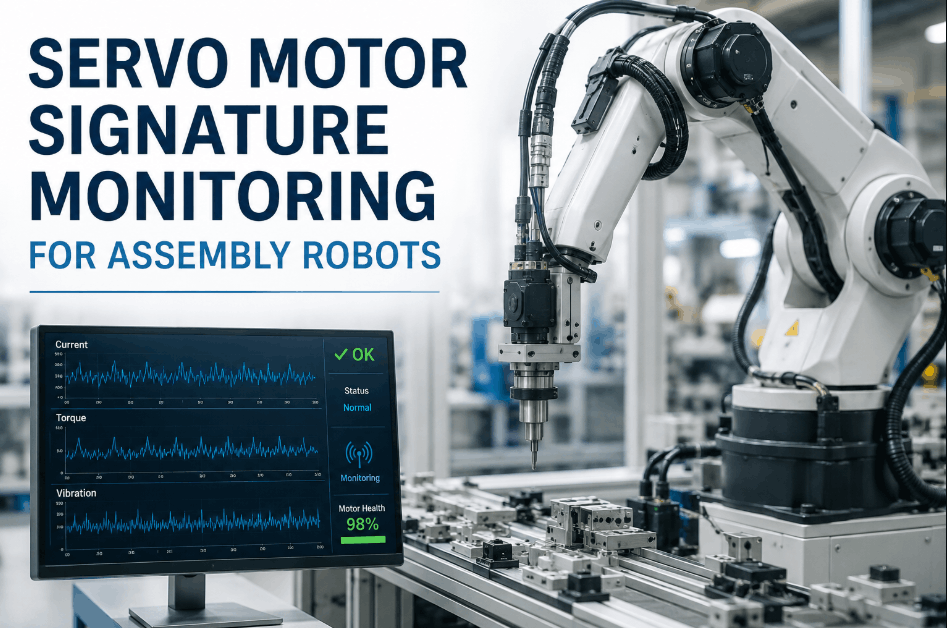
Servo Motor Signature Monitoring for Assembly Robots
Compare current, torque, and vibration signatures on servo motors to catch robot wear early and keep assembly cells running cleanly — before a drive failure stops the line.
3Primary signature types to monitor: current draw, torque profile, and vibration baseline
68%Of assembly robot drive failures show detectable signature deviation 2–5 shifts before failure
3.1×Longer mean time between unplanned stops when servo health is tracked per axis in a CMMS
$18K+Average cost of an unplanned assembly cell stoppage from servo drive failure per event
The Three Servo Motor Signatures That Predict Assembly Robot Wear
Servo motor health degrades along three measurable dimensions before mechanical failure occurs. Book a Demo to see how OxMaint structures servo signature data alongside PM records and work order history for each robot axis in your assembly cells.
Signature 1
Current Draw Pattern
Rising or irregular current draw on a servo axis indicates increasing mechanical resistance — from bearing wear, joint friction, or gearbox degradation — before torque output is affected.
Primary Indicator
Signature 2
Torque Profile Deviation
Torque demand shifting outside the established baseline for a given move profile signals load-path obstruction, coupling wear, or servo gain misconfiguration developing over production cycles.
Drive Health
Signature 3
Vibration Baseline Shift
Amplitude or frequency changes at known structural modes in the robot arm indicate fastener loosening, counterbalance degradation, or end-effector balance drift.
Structural
Signature 4
Position Error Accumulation
Encoder position error growing over repeated cycles flags resolver wear, backlash increase, or feedback cable degradation — leading to assembly accuracy loss before hard fault.
Accuracy Risk
Signature 5
Thermal Rise Pattern
Servo drive or motor temperature trending above established baseline during standard duty cycles indicates cooling path restriction or winding insulation degradation.
Thermal
Signature 6
Cycle Time Variance
Assembly cycle time drifting beyond tolerance — without program change — reflects servo response degradation, often the earliest observable production-level signal of drive wear.
Production
How Undetected Servo Wear Escalates — The Assembly Cell Cost Cascade
Servo motor wear in assembly robots does not fail catastrophically without warning — it degrades through five identifiable stages, each more expensive than the last to address. Sign Up Free to implement structured servo signature monitoring in OxMaint and catch wear at Stage 1 or 2 — before line-stopping failure costs accumulate.
Servo Motor Wear Escalation — 5 Stages from Signature Shift to Assembly Cell Stoppage
Stage 1
Current or Torque Signature Begins to Shift
Servo axis shows elevated current draw or minor torque deviation during standard move profiles — within fault tolerance but diverging from established baseline.
$0
Cost if flagged and work order raised here
↓
Stage 2
Vibration Baseline Rises
Structural vibration increases at known arm modes — still within alarm limits but indicating bearing or joint degradation progressing under production load.
$600
Planned bearing replacement cost
↓
Stage 3
Cycle Time Drift and Assembly Accuracy Loss
Robot cycle time extends beyond tolerance and position repeatability degrades — assembly quality begins to slip, rework events increase.
$4,100
Rework and quality loss per shift
↓
Stage 4
Drive Fault Events Begin
Servo drive begins triggering recoverable fault codes — cell stops and restarts multiple times per shift, disrupting throughput and increasing operator intervention.
$9,500
Throughput loss and fault response cost
↓
Stage 5
Hard Drive Failure — Assembly Cell Down
Servo motor or drive fails to recover — cell stops completely pending emergency part sourcing, technician dispatch, and unplanned robot repair.
$18,000+
Downtime + emergency repair event
OxMaint CMMS Capabilities for Servo Motor Health Management
Effective servo signature monitoring requires a maintenance platform that connects robot health data, PM schedules, and work order history in one structured view. Book a Demo to see OxMaint's asset monitoring and condition-based PM tools applied to assembly robot servo systems.
Signature Log per Axis
Per Axis
Current, torque, vibration tied to each robot joint
Health observations and anomaly records attached to each servo axis as a distinct asset — enabling per-joint trend tracking across the full robot arm.
Condition-Based PM
Auto
Work orders triggered on signature deviation
OxMaint PM rules raise inspection or replacement work orders when current draw, torque, or vibration readings breach established baseline thresholds per robot.
Fleet Health Dashboard
Live
All assembly robots visible in one maintenance view
Open work orders, PM compliance status, and health observations for every robot in the assembly cell portfolio visible from a single OxMaint dashboard.
Failure History Tracing
Full
Work order history linked to each servo asset
Complete repair and observation history attached to each servo motor — enabling pattern recognition across recurring failure modes per robot model or cell type.
"
We were running calendar-based PM on our assembly robots and still taking unplanned stops from servo failures that should have been visible in the data for days before they occurred. Once we started logging signature observations as structured work order triggers in OxMaint, our unplanned robot downtime dropped significantly within the first quarter.
Automation Maintenance Lead — Tier 1 Automotive Assembly Supplier
Root Causes of Servo Motor Failure in Assembly Robot Applications
Assembly robot servo failures concentrate around a consistent set of mechanical and electrical degradation modes — most of which produce detectable signature changes before hard failure. Sign Up Free to build PM programs in OxMaint that target the failure modes most relevant to your robot fleet duty cycle and cell configuration.
Servo Motor Failure Root Causes in Assembly Robot Applications (%)
Bearing wear from continuous duty cycle
76%
Gearbox backlash and lubricant degradation
68%
Encoder or resolver feedback degradation
59%
Winding insulation deterioration from heat cycles
51%
Drive parameter drift or firmware instability
43%
Cable and connector fatigue at articulation points
35%
Servo Motor Monitoring Maturity Score
Score 5 = live signature monitoring with condition-based PM · Score 1 = no servo health tracking in place
5
Live Signature Monitoring — Condition-Based PM per Axis
Current, torque, and vibration signatures tracked continuously per servo axis; PM work orders auto-triggered on baseline deviation.
Action: Review baseline thresholds as robot programs or payload configurations change.
4
Structured Inspection — Periodic Signature Checks Logged
Servo health observations recorded at defined intervals but PM triggers rely on manual review rather than automated threshold detection.
Action: Define threshold limits per axis and configure automatic PM triggers in the CMMS.
3
Calendar PM Only — No Signature Tracking Between Services
Robots maintained on fixed schedules without monitoring current, torque, or vibration between PM intervals.
Action: Add per-axis signature observation to PM checklists and log findings in a CMMS.
2
Alarm-Reactive — No Trending Between Fault Events
Drive fault codes trigger corrective action but no baseline data exists between fault events to identify gradual servo degradation.
Action: Implement periodic signature logging to build trend baselines per robot axis.
1
No Programme — Robot Maintained After Stoppage Only
No servo health monitoring or PM program in place — maintenance action only taken after assembly cell stops.
Action: Implement core servo health tracking in a CMMS immediately to build baseline data.
Catch Servo Wear Before It Stops Your Assembly Cell.
OxMaint connects servo health observations, PM schedules, and work order history for every robot axis in your facility — structured, searchable, and live.
Frequently Asked Questions
What servo motor signatures indicate early wear in assembly robots?
Rising current draw, torque profile deviation, and vibration baseline shift are the three primary early-warning signatures — typically detectable 2–5 shifts before a hard fault occurs.
How does current analysis differ from torque monitoring for servo motors?
Current draw reflects total electrical demand on the drive and rises with mechanical resistance; torque monitoring tracks the actual output force profile per move — both are needed for a complete picture of servo health.
Can OxMaint manage servo health data for multi-robot assembly cells?
Yes — OxMaint tracks each servo axis as a distinct asset, with health observations, PM records, and work order history maintained per joint across every robot in the facility.
How often should assembly robot servo signatures be reviewed?
High-duty-cycle assembly robots benefit from signature checks at least weekly, with automated alerts configured in the CMMS to flag deviation between scheduled reviews.
What is the cost difference between planned and unplanned servo replacement?
Planned servo bearing or drive replacement typically costs $400–$800 in parts and scheduled labor; an unplanned assembly cell stoppage from servo failure averages $18,000 or more including downtime, emergency parts, and recovery labor.
Start Monitoring Assembly Robot Servo Health Today.
OxMaint gives every servo axis a structured maintenance record — signature observations, PM history, and work order triggers in one platform. Free to start.