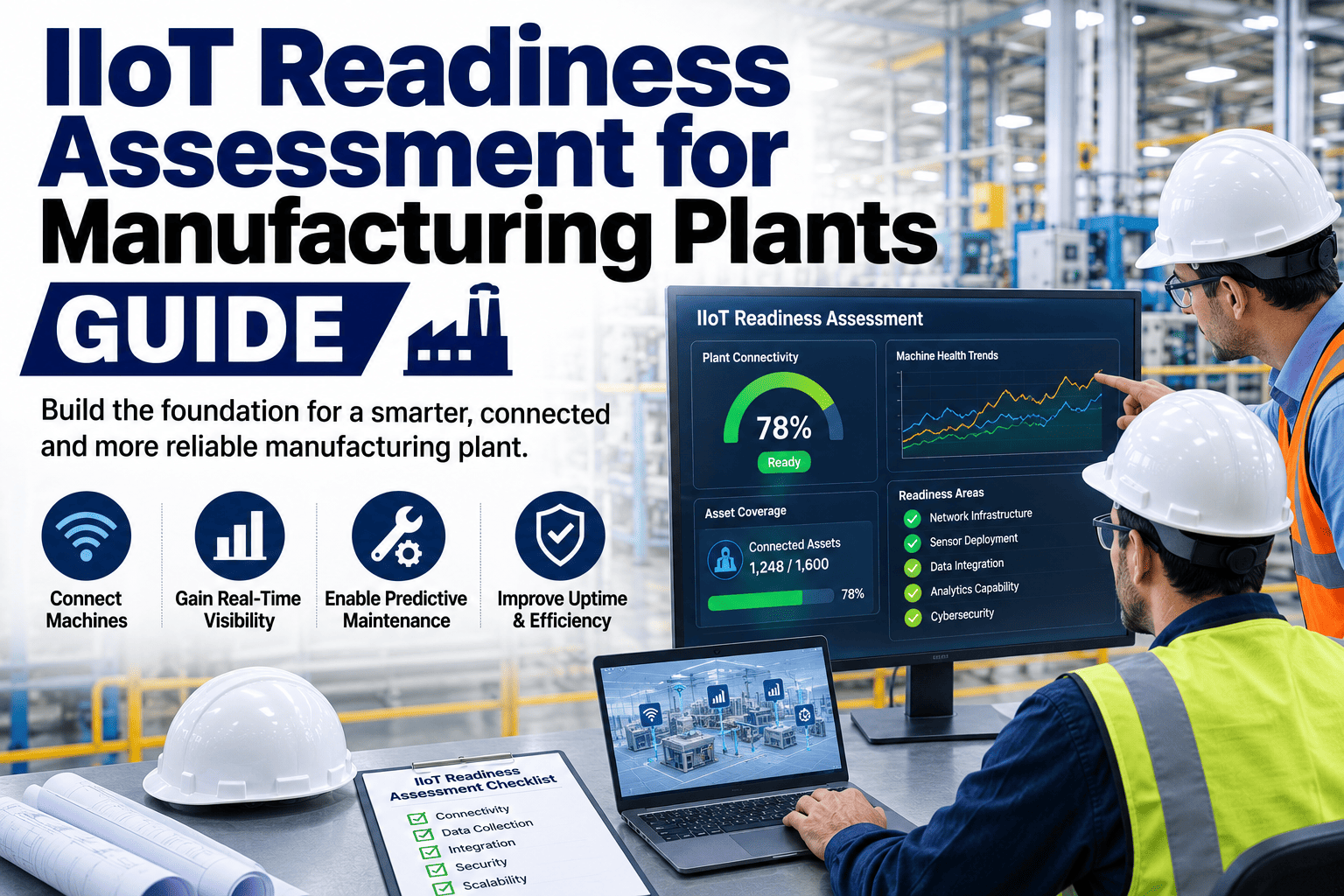
An IIoT readiness assessment for manufacturing plants is the structured evaluation of your network infrastructure, data architecture, cybersecurity baseline, CMMS integration capability, and workforce skills before you deploy a single industrial sensor. Most manufacturing IIoT initiatives stall in proof-of-concept purgatory for 18 to 36 months because teams skip this assessment and bolt sensors onto fragile OT networks that cannot handle the data volume. A formal plant IIoT assessment reveals exactly where to invest — from edge connectivity to maintenance platform APIs — so your predictive maintenance program delivers ROI instead of shelfware. This guide gives you a scoring rubric and deployment framework to benchmark your facility; when you are ready to close the gaps, you can Start Free Trial of OxMaint to connect your assets, work orders, and analytics in one AI-powered CMMS.
Are you adding sensors to a plant that is not ready for them?
70% of manufacturing IIoT projects never scale past the pilot stage. The reason is rarely the technology — it is unresolved gaps in OT network capacity, data governance, cybersecurity, and CMMS integration. Run a structured readiness assessment first and deploy with confidence.
The 5-Phase IIoT Readiness Assessment Timeline
A manufacturing IIoT readiness assessment takes 4 to 8 weeks for a mid-sized plant (200 to 800 assets). Follow this phased timeline to evaluate every layer — from physical sensors to workforce skills — before committing capital budget.
OT Network & Infrastructure Audit
Map every PLC, SCADA panel, and edge gateway. Benchmark available bandwidth on the plant floor — most legacy OT networks run at 100 Mbps and cannot sustain high-frequency vibration data streams. Identify dead zones where wireless sensors will need mesh repeaters.
Data Architecture & Historian Review
Evaluate whether your data historian can ingest tag data at 1-second granularity. Check if your CMMS exposes REST APIs for bidirectional data flow. Plants without an integrated historian spend 40% more on custom integration middleware.
Cybersecurity Baseline Assessment
Run an IEC 62443 gap analysis. Verify network segmentation between IT and OT zones, check for unmanaged remote-access paths, and confirm that edge devices support certificate-based authentication. Unsegmented plants face 3x higher ransomware risk.
Sensor Power & Connectivity Plan
Determine whether critical assets have line power for continuous monitoring or require battery-powered wireless sensors. Calculate the total cost of wiring vs. wireless mesh for each zone. Battery sensors last 3 to 5 years but may not support high-frequency data.
Workforce Readiness & Skills Gap
Assess whether your maintenance team can interpret anomaly alerts and act on predictive insights. 60% of plants lack a dedicated reliability engineer. Plan for 40 to 60 hours of CMMS and analytics training per technician before go-live.
IIoT Readiness Scoring Matrix for Manufacturing Plants
Score each dimension from 0 (absent) to 4 (optimized). A total score below 16 means your plant is not deployment-ready — invest in the lowest-scoring areas first. Use this matrix to prioritize capital allocation before purchasing sensors.
| Readiness Dimension | Score 0-1 (Not Ready) | Score 2-3 (Pilot Ready) | Score 4 (Scale Ready) |
|---|---|---|---|
| OT Network Capacity | Flat network, no segmentation, 100 Mbps shared | VLAN segmentation exists, 1 Gbps backbone, limited edge gateways | Redundant 10 Gbps fiber, full segmentation, edge computing at every line |
| Data Governance | No historian, manual data entry, no naming standard | Historian deployed, inconsistent tag naming, partial API access | Unified data model, ISA-95 naming, bidirectional CMMS APIs, automated quality checks |
| Cybersecurity Posture | No IEC 62443 compliance, shared credentials, no OT monitoring | Basic firewall rules, some segmentation, quarterly patches | Zero-trust OT architecture, continuous monitoring, certificate-based device auth |
| CMMS Integration | Spreadsheets or paper work orders, no asset hierarchy | CMMS deployed, manual sensor data entry, no automated work-order triggers | AI-driven CMMS with automated work-order generation from sensor anomalies |
| Workforce Skills | Reactive maintenance culture, no reliability engineer | Preventive maintenance in place, one trained analyst, limited dashboard use | Predictive-first culture, certified reliability team, daily analytics huddles |
What IIoT Readiness Gaps Actually Cost Your Plant
A 180-asset plant spending $42K per year on reactive maintenance loses an additional $180K to $260K in unplanned downtime when IIoT pilots fail to scale. Quantify the gap before you buy hardware.
Current state: Reactive maintenance, spreadsheet work orders, no historian, flat OT network.
Annual downtime cost: 14 unplanned events x 6.5 hours x $850/hr = $77,350
Post-readiness with OxMaint: Predictive alerts cut unplanned events by 45%, average repair time drops 30% with auto-generated work orders
Projected annual savings: $42,542 — payback in 7 months on a $25K IIoT sensor + CMMS investment
See OxMaint on your assets — book a 30-minute demo
Walk through a live IIoT readiness audit with our reliability engineers. We will map your asset hierarchy, show you how sensor data flows into automated work orders, and project your downtime savings before you deploy anything.
How OxMaint Closes Your IIoT Readiness Gaps
OxMaint is an AI-powered CMMS and EAM platform that serves as the integration layer between your IIoT sensors and your maintenance workflow. Instead of bolting sensors onto spreadsheets, OxMaint turns raw tag data into automated work orders, predictive alerts, and reliability analytics — out of the box.
Open REST API & Native Integrations
Bidirectional APIs connect your data historian, PLCs, and edge gateways directly to OxMaint. No custom middleware required — sensor anomalies automatically generate prioritized work orders with the correct asset, spare parts, and procedure attached.
Predictive Maintenance Engine
AI models analyze vibration, temperature, and pressure trends in real time. OxMaint flags bearing degradation and valve wear 7 to 21 days before failure, giving your team time to schedule repairs during planned downtime instead of reacting to breakdowns.
Unified Asset Hierarchy & Data Model
Build your ISA-95 asset tree inside OxMaint before deploying sensors. Every tag maps to a specific asset, location, and criticality rating. This eliminates the data governance gap that stalls 60% of IIoT rollouts and ensures every alert is actionable from day one.
Reliability Analytics Dashboards
Real-time OEE, MTBF, and MTTR dashboards give your maintenance team the visibility they need to act on predictive insights. Automated KPI reports prove ROI to leadership and highlight remaining readiness gaps as you scale from pilot to full plant deployment.
IIoT Deployment Readiness Checklist for Plant Managers
Before you issue a purchase order for sensors, gateways, or analytics software, confirm every item on this checklist. Each unchecked box is a gap that will extend your pilot timeline by 4 to 8 weeks.
Infrastructure
Data & Integration
Security & People
IIoT Readiness Assessment — What Plant Managers Ask
What is an IIoT readiness assessment for manufacturing plants?
An IIoT readiness assessment is a structured evaluation of your plant's OT network capacity, data historian architecture, CMMS API integration capability, cybersecurity posture, and workforce skills before deploying industrial sensors. It typically takes 4 to 8 weeks and produces a scored gap analysis that tells you exactly where to invest capital for a successful deployment. You can run this assessment using the scoring matrix above, or book a demo and our reliability engineers will walk you through it on your live asset data.
How much does an IIoT readiness assessment cost?
A third-party IIoT readiness assessment for a mid-sized manufacturing plant (200 to 800 assets) costs $15,000 to $45,000 depending on facility complexity and number of sites. However, you can run a basic internal assessment in 4 to 6 weeks using the scoring rubric in this guide at no cost beyond staff time — typically 60 to 80 hours across your maintenance, IT, and OT teams.
How long does it take to make a manufacturing plant IIoT-ready?
Most plants need 3 to 9 months to close readiness gaps after the initial assessment, depending on starting maturity. Network upgrades and cybersecurity segmentation take the longest (8 to 16 weeks), while CMMS integration and workforce training can happen in parallel (4 to 8 weeks). Plants that score above 16 on the readiness matrix can begin sensor deployment in 4 to 6 weeks.
What is the most common reason IIoT projects fail in manufacturing?
The most common failure cause is deploying sensors before the CMMS can act on the data. Plants invest in edge devices and dashboards but have no automated work-order workflow, so anomaly alerts go unread and failures still occur. OxMaint solves this by generating prioritized work orders automatically from sensor thresholds — Start Free Trial to see it in action.
Does OxMaint integrate with existing PLCs and data historians?
Yes. OxMaint exposes open REST APIs and supports OPC-UA, MQTT, and Modbus protocols to connect directly with major PLC brands (Siemens, Allen-Bradley, Mitsubishi) and industry-standard historians (PI System, Ignition, GE Proficy). Bidirectional sync means sensor data flows into OxMaint for predictive analysis, and work-order status flows back to your historian for full traceability.
Stop guessing. Start your IIoT readiness assessment today.
Join hundreds of maintenance and reliability teams using OxMaint to connect assets, automate work orders, and predict failures before they happen. Deploy in days, not months — no rip-and-replace required.
Free 14-day trial · No credit card