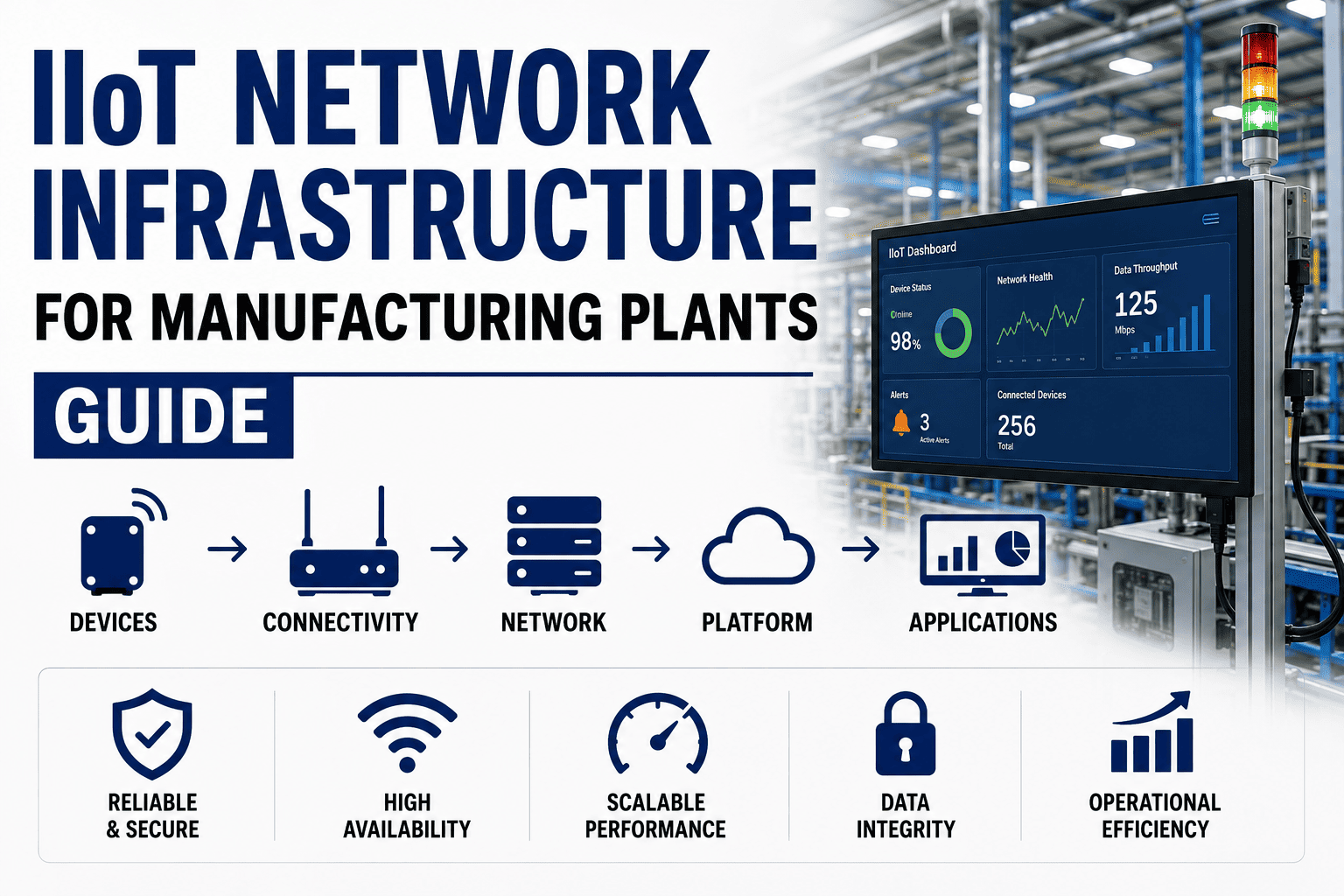
IIoT network infrastructure for manufacturing plants is the backbone that determines whether your predictive maintenance program scales to thousands of sensors or collapses at fifty. A well-designed manufacturing IIoT network connects industrial Ethernet, wireless protocols, edge gateways, and CMMS platforms so that real-time asset data flows reliably from the plant floor to maintenance teams. Without proper plant IIoT network design, organizations face dropped connections, cybersecurity risks, and disconnected work orders that keep maintenance reactive. OxMaint integrates directly with your IIoT infrastructure to turn that sensor data into automated work orders, predictive alerts, and downtime-cutting analytics — you can Start Free Trial today or book a demo to see the full pipeline in action.
IIoT Infrastructure Guide
Is your plant network ready to scale beyond 50 sensors — or will it break first?
Most predictive maintenance pilots stall because the underlying IIoT network infrastructure cannot handle thousands of concurrent device connections, edge-to-cloud data volumes, or OT/IT segmentation. The result: dropped packets, blind assets, and reactive maintenance that costs $50B+ annually across U.S. manufacturing. Build it right the first time.
Network Architecture
OT/IT network segmentation: the foundation of manufacturing IoT infrastructure
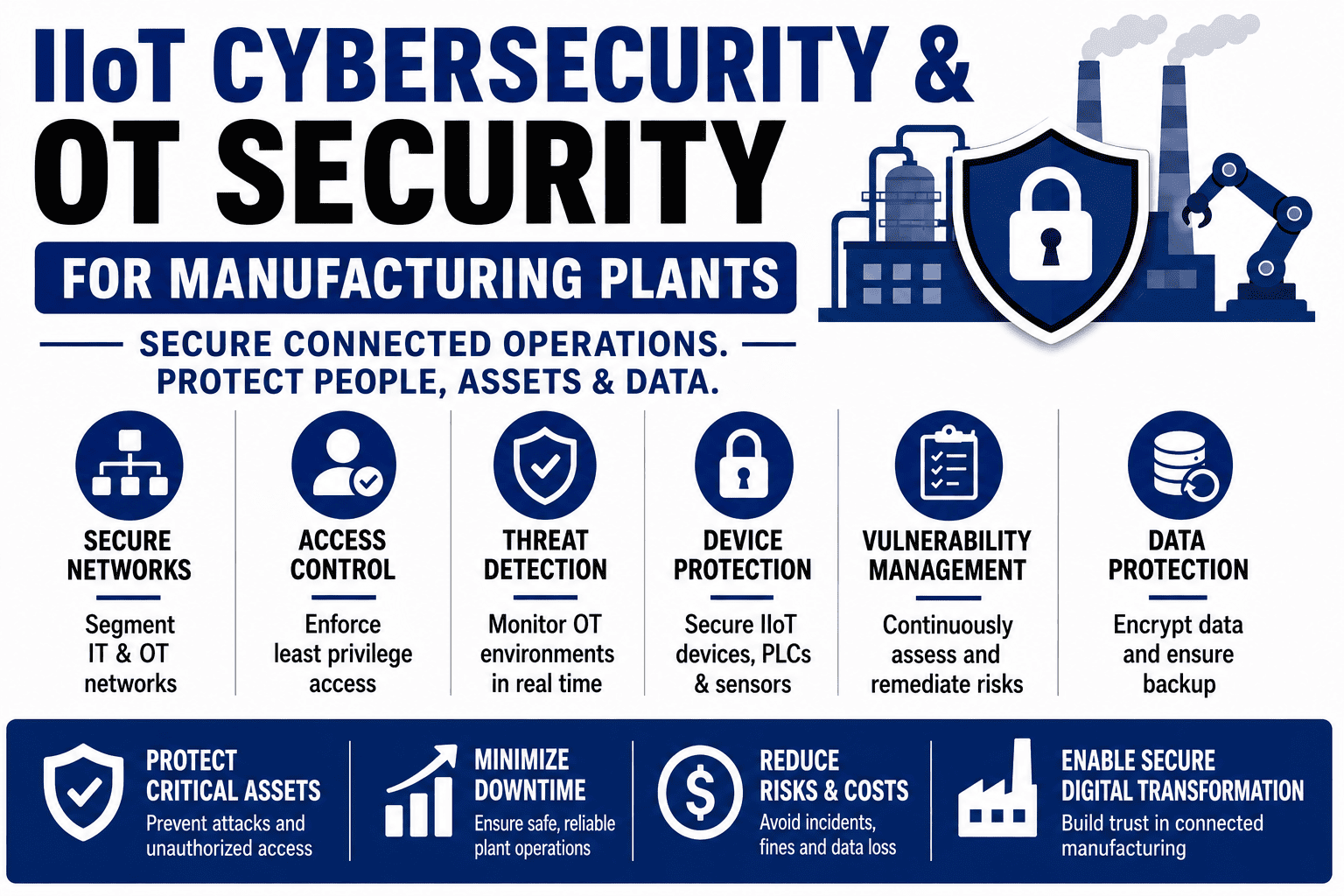
The Purdue Reference Model still governs best practice for IIoT network infrastructure in manufacturing plants. Separating Operational Technology (Levels 0–3) from enterprise IT (Levels 4–5) through a DMZ reduces lateral attack surface by up to 80% and prevents a ransomware outbreak on business systems from halting production lines. Yet over 40% of mid-sized plants still run flat networks where a single compromised PC can reach PLCs and safety controllers.
Industrial Ethernet Backbone
PROFINET, EtherNet/IP and Modbus TCP over hardened, managed switches with IGMP snooping and VLAN tagging deliver sub-millisecond latency for time-critical control loops and deterministic sensor polling at 10K+ tags per second.
DMZ & One-Way Data Diodes
A Purdue Level 3.5 DMZ with firewalls or unidirectional gateways lets maintenance analytics platforms read sensor data without exposing PLCs to enterprise-side threats — the same architecture NIST SP 800-82 recommends for critical infrastructure.
VLAN Segmentation by Cell
Grouping assets into cell-level VLANs (e.g., one per production line or skid) contains broadcast traffic and lets reliability teams isolate faults faster — mean-time-to-detect drops 40–60% when each cell is independently monitored.
Edge Gateway Aggregation
Edge gateways at Level 2–3 translate proprietary fieldbus protocols into MQTT or OPC UA, buffer data during outages, and push normalized payloads to your CMMS — eliminating the need to open inbound firewall rules to every sensor.
Connectivity Options
Wi-Fi 6 vs private 5G vs LoRaWAN: choosing the right industrial IoT network
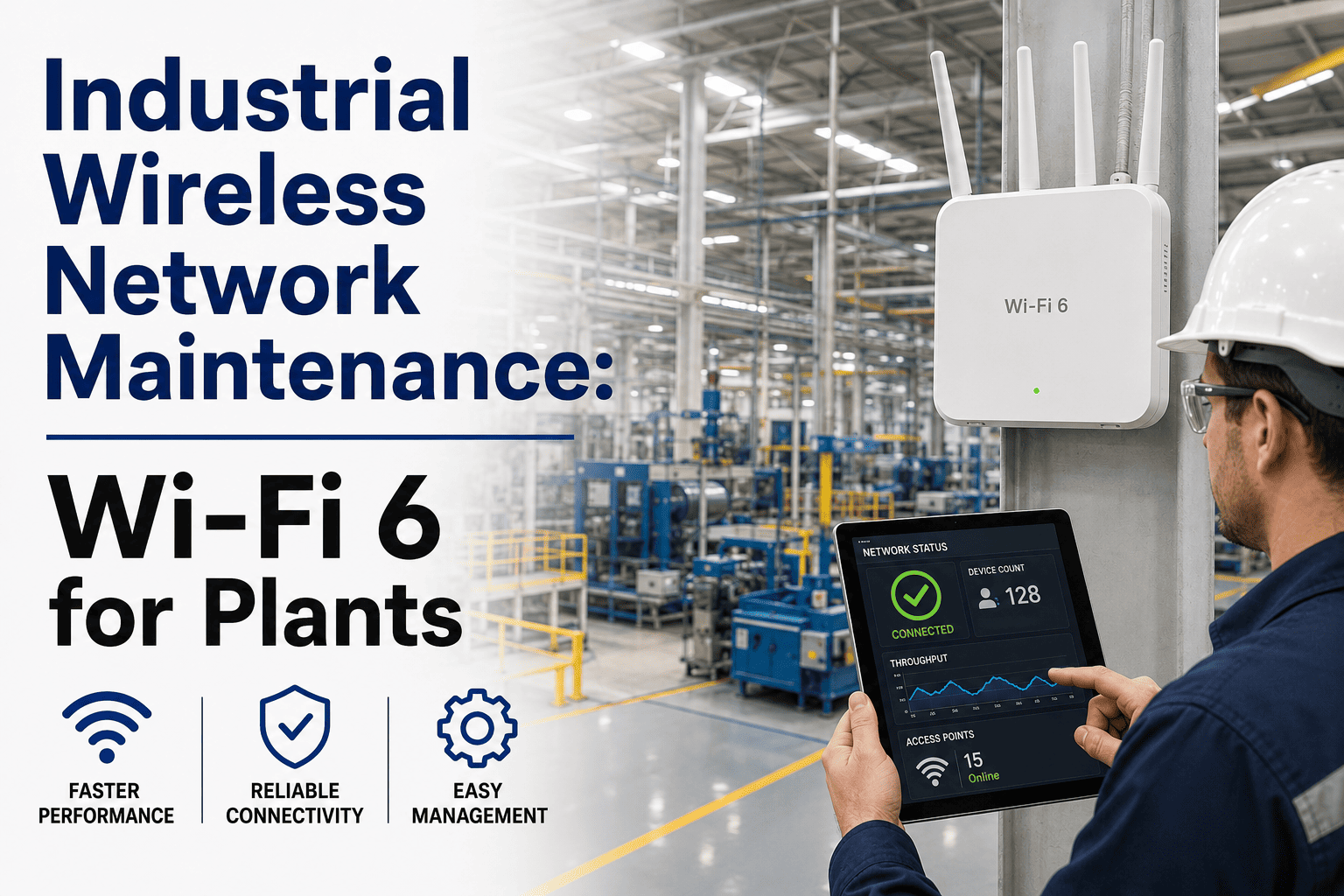
No single wireless technology fits every manufacturing IIoT network. A 200,000-sq-ft machining plant spending $42K/yr on unplanned downtime recently combined three protocols — Wi-Fi 6 for high-bandwidth vibration analyzers, private 5G for AGVs and robotics, and LoRaWAN for low-power temperature and humidity sensors — cutting connectivity cost per asset by 35% while doubling sensor coverage. The comparison below maps the trade-offs.
| Protocol | Range & Bandwidth | Best Use Case | Power Draw | Typical Cost / Node |
|---|---|---|---|---|
| Wi-Fi 6 (802.11ax) | ~30 m indoor, up to 1.2 Gbps | Vibration analysis, machine vision, high-frequency condition monitoring | Moderate — needs powered APs | $80–150 + AP infra |
| Private 5G | ~1 km cell, 100–900 Mbps, <10 ms latency | AGVs, mobile robotics, large campus roaming assets | Higher (base station + SIMs) | $200–500 + core network |
| LoRaWAN | 2–15 km, 0.3–50 kbps | Temperature, humidity, tank level, energy sub-metering | Ultra-low — 5–10 yr battery | $25–60 per sensor |
| Industrial Ethernet | 100 m segment, up to 10 Gbps | Fixed high-speed assets, PLCs, safety-critical loops | Wired — no wireless battery | $40–120 + cabling |
| BLE 5.2 Mesh | ~30 m mesh, 1–2 Mbps | Tool tracking, indoor positioning, handheld scanner backhaul | Low — coin-cell | $15–40 per beacon |
Design Timeline
IIoT network design roadmap: from pilot to plant-wide rollout
Scaling a plant IIoT network from a 50-sensor pilot to a 2,500-point enterprise deployment without re-architecting requires a phased timeline. The five-phase plan below has been used across food processing, automotive, and discrete manufacturing to achieve full predictive maintenance coverage in 9–14 months.
Assessment & Topology Mapping
Inventory every PLC, sensor, and asset. Map current VLANs, firewall rules, and protocol mix. Identify the 20% of assets causing 80% of downtime and prioritize them for Phase 1 sensor deployment. Deliverable: single-line network topology + gap analysis.
OT/IT Segmentation & DMZ Build
Deploy Level 3.5 DMZ firewalls, configure VLANs per production cell, and establish outbound-only MQTT or OPC UA tunnels from edge gateways. Validate that no inbound enterprise traffic can reach Level 2 controllers. Penetration test before connecting sensors.
Pilot: 50–100 Critical Assets
Instrument high-criticality assets with vibration, temperature, and current sensors. Connect edge gateways to OxMaint via REST API or MQTT. Validate end-to-end latency, data completeness, and automated work-order generation on threshold breach.
Scale to 500–1,000 Sensors
Add Wi-Fi 6 coverage in zones with dense high-bandwidth sensors; deploy LoRaWAN gateways for low-power ambient monitoring. Implement QoS policies to prioritize control traffic over telemetry. Load-test edge gateways at 2x expected tag count.
Full Plant Rollout & Predictive Tuning
Complete sensor coverage across all Tier-1 and Tier-2 assets. Enable OxMaint's AI predictive models on 12+ months of accumulated data. Target: 30–50% reduction in unplanned downtime, 15–25% drop in MRO inventory, and full audit trail for ISO 55000 compliance.
Edge & Cybersecurity
Edge gateway placement and cybersecurity architecture that scales
Edge gateways are the critical bridge in any manufacturing network IoT strategy — they translate fieldbus protocols, buffer during network interruptions, and apply first-pass filtering so your CMMS receives clean, normalized data. Poor gateway placement creates bottlenecks that cap your IIoT network design at a few hundred sensors regardless of wireless bandwidth. A 300-asset CNC shop learned this the hard way: a single gateway serving three production cells was dropping 12% of vibration packets during peak polling cycles. After distributing three gateways — one per cell — packet loss fell to under 0.3% and predictive model accuracy improved by 22%.
CMMS Integration
How OxMaint turns IIoT data into automated maintenance action
A manufacturing IoT infrastructure is only as valuable as the maintenance decisions it triggers. OxMaint connects directly to your edge gateways and plant IIoT network via MQTT, OPC UA, or REST API — ingesting vibration, temperature, pressure, and current data in real time and converting threshold breaches and AI-detected anomaly patterns into prioritized work orders automatically. No more clipboard rounds, no more sensor alerts lost in a spreadsheet. Here is what that integration delivers:
Automated Work-Order Generation
When a vibration sensor on a critical pump crosses ISO 10816 threshold or OxMaint's AI model detects a bearing-fault signature, a work order is created instantly — assigned to the right technician with parts, safety procedures, and priority pre-filled. Plants report cutting unplanned downtime 30–50% within six months.
Predictive Maintenance at Scale
OxMaint's AI models trained on your historical sensor and work-order data predict failures 7–21 days in advance, letting reliability teams schedule interventions during planned downtime instead of reacting to breakdowns — typically reducing emergency work orders by 40–60%.
Real-Time Asset Health Dashboard
Every sensor reading flows into a unified asset health view — OEE, condition status, MTBF, and upcoming PMs in one screen. Maintenance managers see which of 2,500 assets need attention today without walking the floor or querying three different systems.
Spare-Parts Auto-Reservation
When a predictive alert fires, OxMaint checks spare-parts inventory, reserves the required bearing or motor automatically, and flags reorder if stock is below safety minimum — eliminating the "part not available" delay that extends downtime by an average of 4.7 hours per event.
See It On Your Assets
Book a 30-minute demo and watch live sensor data trigger work orders in OxMaint
Bring your top three asset names and your current protocol mix — we will show you exactly how OxMaint ingests your IIoT data, predicts failures, and auto-generates work orders in under 30 minutes.
FAQ
IIoT network infrastructure for manufacturing: frequently asked questions
What is IIoT network infrastructure in a manufacturing plant?
IIoT network infrastructure is the combination of industrial Ethernet, wireless protocols (Wi-Fi 6, private 5G, LoRaWAN), edge gateways, firewalls, and segmentation architecture that connects sensors and assets on the plant floor to maintenance and analytics platforms like a CMMS. It includes OT/IT segmentation per the Purdue Model, protocol translation at the edge, and cybersecurity controls such as TLS encryption and VLAN isolation to ensure reliable, secure data flow from thousands of sensors to the systems that act on it.
How much does it cost to deploy a manufacturing IIoT network?
A typical mid-sized plant (200–500 assets) investing in IIoT network infrastructure spends $75K–$250K on switches, wireless access points, edge gateways, sensors, and installation, depending on protocol mix and coverage area. LoRaWAN sensors at $25–60 each keep low-power monitoring costs down, while private 5G adds $50K–$200K for core network infrastructure. Most plants achieve ROI in 12–18 months through reduced unplanned downtime — OxMaint customers typically see 30–50% fewer breakdowns. Book a demo to get a tailored ROI estimate for your facility.
Should we use Wi-Fi 6 or private 5G for our plant IIoT network?
Wi-Fi 6 is sufficient for most fixed-asset condition monitoring — vibration, temperature, and current sensors on stationary equipment — offering up to 1.2 Gbps at roughly one-third the infrastructure cost of private 5G. Choose private 5G when you need seamless roaming for mobile assets like AGVs, autonomous forklifts, or robotics across a large campus, or when you need sub-10 ms latency for safety-critical control loops. Many plants deploy both: Wi-Fi 6 for fixed sensors, 5G for mobile assets, and LoRaWAN for low-power ambient monitoring.
How does a CMMS connect to IIoT sensors on the plant floor?
A CMMS like OxMaint connects to IIoT sensors through edge gateways that translate industrial protocols (Modbus, PROFINET, EtherNet/IP) into standard formats like MQTT, OPC UA, or REST API. The gateway pushes normalized data outbound through a DMZ firewall to the CMMS, which evaluates thresholds and AI anomaly models in real time. When a breach or predicted failure is detected, OxMaint automatically generates a prioritized work order with parts and procedures — no manual data entry required. Start a free trial to test the integration with your existing gateways.
What cybersecurity standards apply to industrial IoT networks?
The primary frameworks are NIST SP 800-82 (Guide to Industrial Control Systems Security), IEC 62443 (Industrial Communication Networks Security), and ISA/IEC 62443 zones-and-conduits methodology. Key requirements include OT/IT network segmentation via a Level 3.5 DMZ, 256-bit TLS encryption for data in transit, role-based access control with least-privilege principles, continuous vulnerability monitoring, and 72-hour edge data buffering to prevent loss during outages. Compliance with these standards is also a prerequisite for ISO 55000 asset-management certification and most cyber-insurance policies.
Start Your IIoT-Connected Maintenance Journey
Turn your sensor data into downtime you never see coming
OxMaint connects to your existing IIoT network in days, not months — auto-generating work orders from real-time sensor data, predicting failures before they happen, and giving your reliability team one dashboard for every asset. Join the maintenance teams cutting unplanned downtime by 30–50%.
Free 14-day trial · No credit card