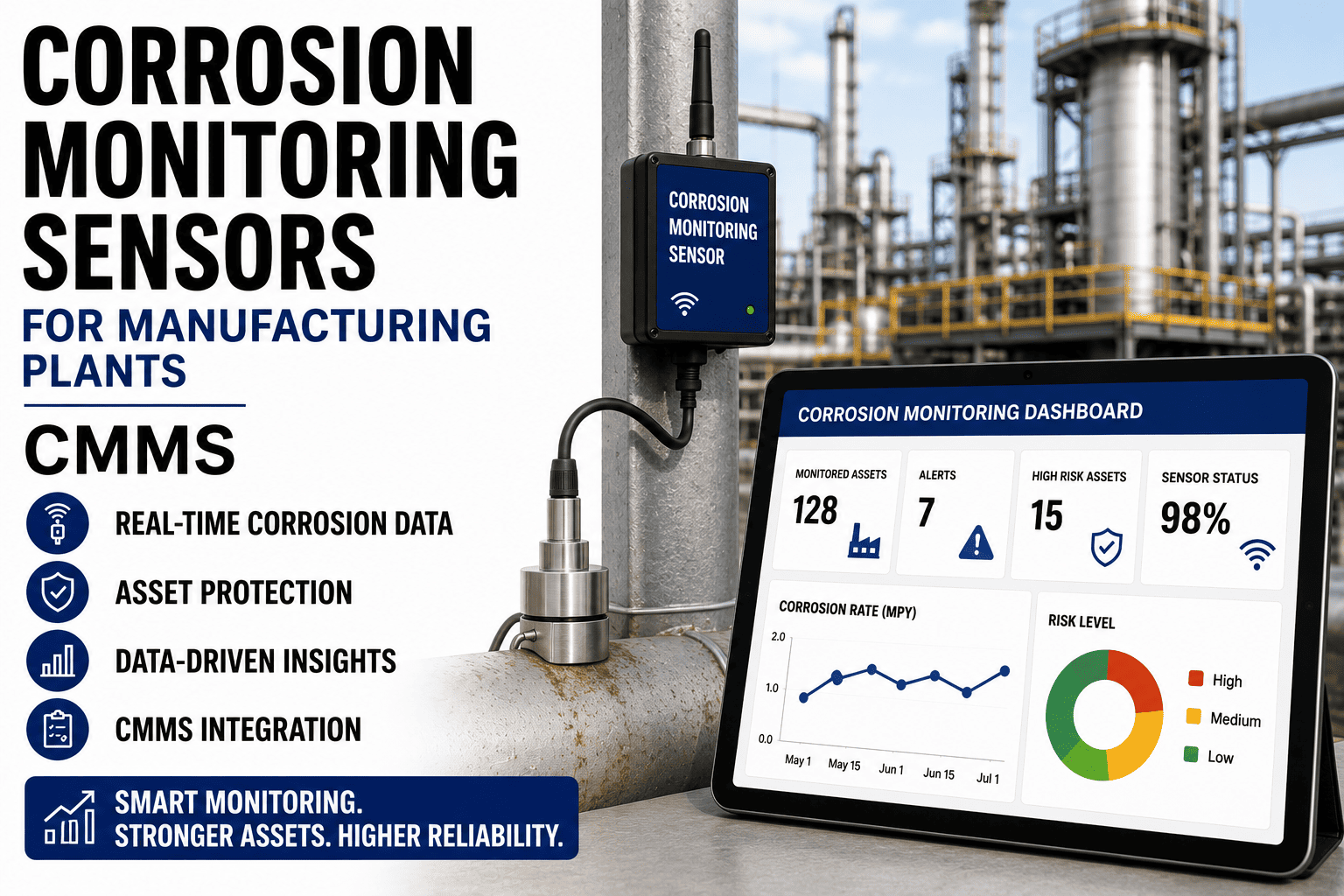
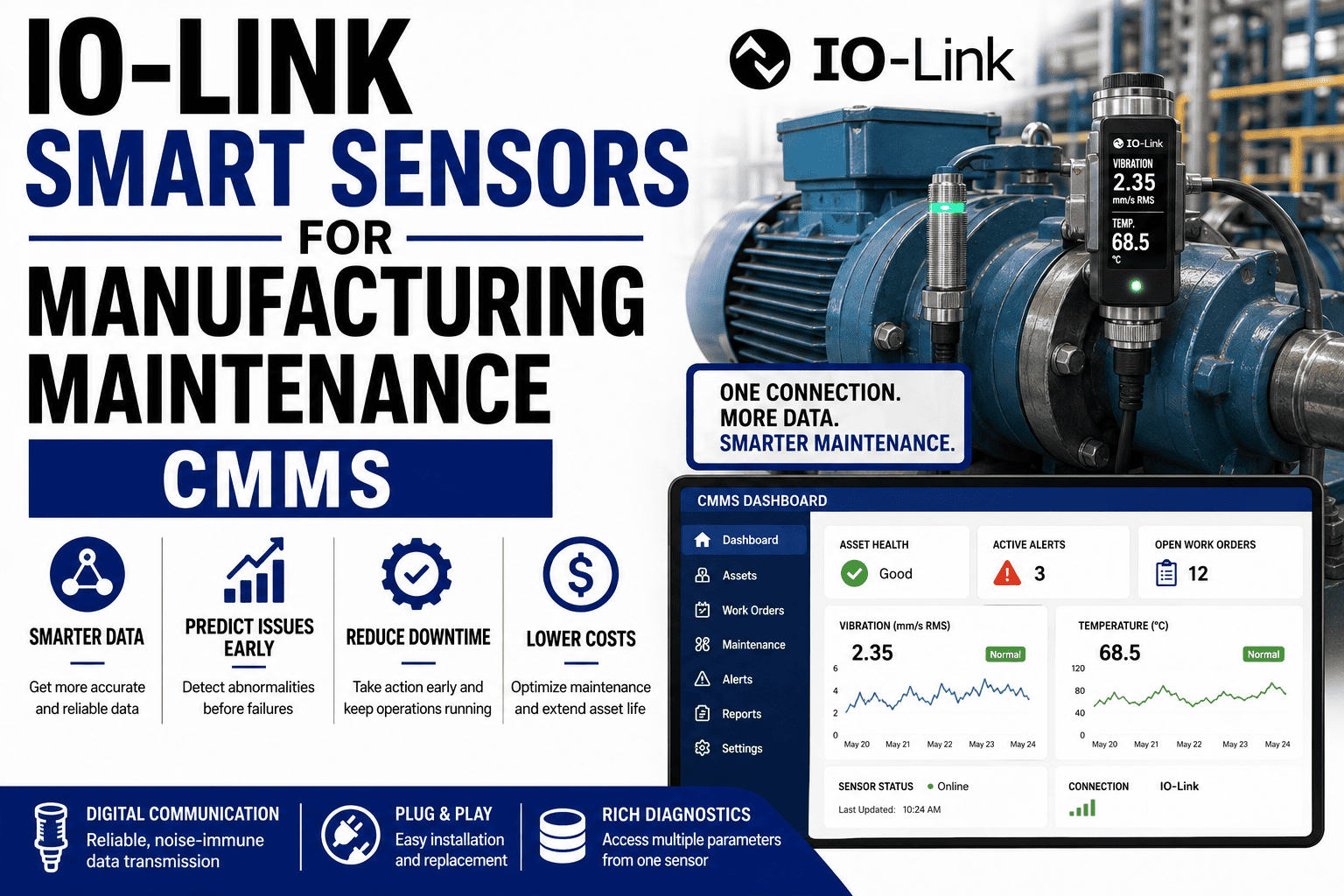
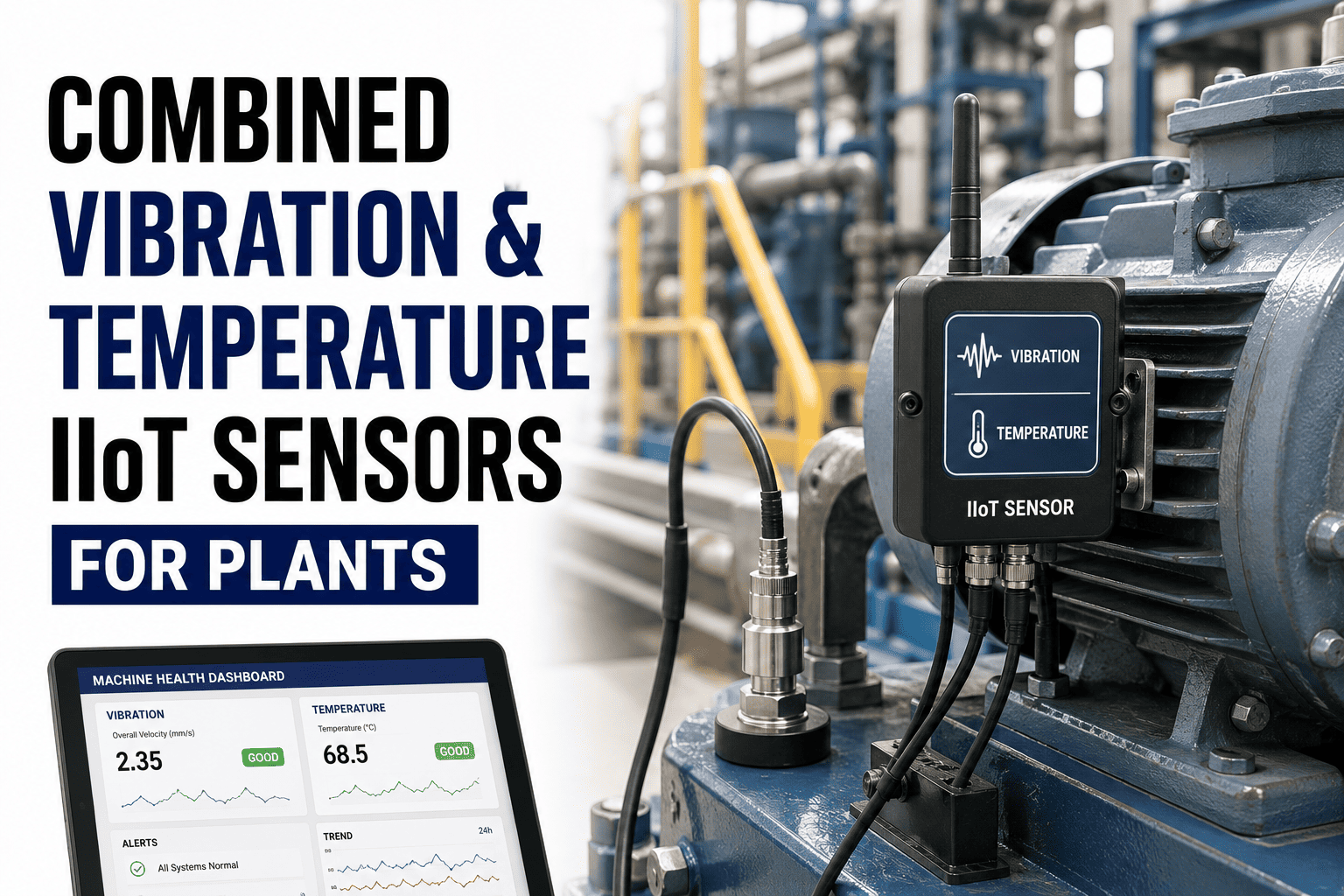
The price of an industrial IoT sensor has dropped over 60% since 2020 — yet the value those sensors unlock has never been higher. The global IoT sensors market sits at $23.9 billion in 2025 and is forecast to reach $99.2 billion by 2030 at a 36% CAGR. More than 60% of all smart manufacturing implementations now run on sensor data, and the average wireless vibration-and-temperature sensor costs around $215 per rotating asset — a number small enough that one prevented bearing failure can pay back an entire pilot. Plants deploying sensors across production lines report 30–50% productivity gains, defect rates below 200 PPM, and maintenance costs down by a third. The technology gap between leaders and laggards is widening fast, and the difference is rarely budget — it is whether a plant has built the connective tissue between its sensors, its CMMS, and its work orders. That is exactly what Oxmaint's IoT integration layer is built to do.
The Sensor Stack: Six Workhorses of the Smart Plant
Every smart manufacturing program rests on six core sensor categories. Each one captures a different physics of failure — and each one feeds a different decision back to the maintenance and production teams. Knowing what each sensor can and cannot see is the first step toward designing a deployment that actually pays back.
10 Hz – 10 kHz, ±5% amplitude
Triaxial accelerometers detect bearing wear, misalignment, imbalance, and looseness on motors, pumps, fans, and compressors weeks before audible failure.
±0.5°C accuracy
Surface and embedded probes catch bearing overheating, motor winding stress, lubrication breakdown, and electrical hotspots — the most universal early-warning signal in any plant.
±0.25% full-scale
Hydraulic, pneumatic, and process-fluid transducers spot cavitation, blocked filters, valve faults, and leaks long before they cascade into shutdowns or quality losses.
Live load & harmonics
Clamp-on current transformers and power-quality meters expose motor degradation, overload, and harmonic distortion that silently destroys VFDs and drives utility penalty bills.
20–100 kHz acoustic
Airborne and structure-borne ultrasonic sensors hear compressed-air leaks, steam-trap failures, and electrical arcing — all sources humans cannot detect by ear.
Liquid, gas, granular
Magnetic, ultrasonic, and Coriolis flow meters track consumption, mass balance, and tank levels — turning utility cost into a metric production teams can actually move.
From Sensor Reading to Work Order — The Four-Layer Pipeline
Sensors do not deliver value. Sensors connected to a system that turns readings into action deliver value. Smart manufacturing runs on a four-layer pipeline — and a break in any layer collapses the entire return on investment.
Layer 01
Sense
Wireless or wired sensors stream readings at the right frequency — 1 kHz vibration on rotating assets, hourly temperature on slow thermal systems. Each datapoint tagged with asset ID and timestamp.
Layer 02
Transmit
Edge gateways aggregate raw readings, apply FFT and statistical filters, and send only meaningful signals upstream — 87% of manufacturers now process at the edge to cut latency and cloud costs.
Layer 03
Analyze
Machine-learning models compare live readings against the asset's healthy baseline. Anomaly scoring flags drift weeks before failure — moving maintenance from "when did it break" to "when will it break."
Layer 04
Act
Threshold breaches auto-create work orders in the CMMS, route to the right technician, attach asset history, and pre-stage parts. The loop closes — every alert becomes a tracked, costed, completed task.
Sensor-to-CMMS Integration, Built In
Stop Drowning in Sensor Data You Cannot Act On
Oxmaint connects directly to vibration, temperature, pressure, and current sensors from any vendor — converting threshold breaches into routed work orders with full asset context. No middleware, no spreadsheets, no manual triage.
Where IoT Sensors Pay Back Hardest — Use Cases by Department
Maintenance
Predictive Failure Detection
Vibration on motors, pumps, fans — bearing failure 7–14 days ahead
Thermal imaging on switchgear and bus bars — IR scans on schedule
Oil quality sensors on gearboxes — wear-particle and viscosity drift
Auto-generated work orders with full sensor context and trend graphs
Production
Throughput & Cycle Time
Cycle-time sensors on every workstation — bottleneck visibility live
Spindle vibration on CNC machines — tool wear monitored continuously
Conveyor speed and load sensors — flow imbalance flagged immediately
Real-time OEE tracking against shift, line, and SKU targets
Quality
In-Process Defect Catch
Cavity pressure on injection molds — short-shot and flash prevention
Temperature and humidity in clean rooms — environmental compliance
Vision-system data fused with machine sensors — defect root cause
Process variation flagged before parts reach final inspection
Energy
Cost & Sustainability
Sub-meters on every line — kWh per unit produced visible per shift
Compressed-air ultrasonic leak surveys — 20–30% recovery typical
Power-quality monitoring — harmonics and power-factor penalty avoidance
Auto-throttling of non-critical loads during peak-demand windows
The Investment Math — What It Costs vs. What It Returns
Investment
What a Realistic Pilot Costs
Wireless sensor (per asset)
~$215
Edge gateway & networking
$2K–$8K
10–20 asset retrofit pilot
$50K–$500K
CMMS integration (Oxmaint)
Free to start
Time to first deployment
4–8 weeks
Return
What Plants Actually Recover
Maintenance cost reduction
~33%
Unplanned downtime cut
25–45%
Pilot payback window
First failure prevented
Defect rate (PPM)
Below 200
The Five-Stage Deployment Roadmap
The plants getting real ROI did not buy a thousand sensors and hope for the best. They followed a sequenced roadmap — narrow scope, fast wins, expand from proven value. Here is the path that works.
Stage 01
Pick the Pilot Asset Class
Start with rotating equipment whose failure stops production. 10–20 motors, pumps, or compressors is the right scope — big enough to prove value, small enough to stay focused.
Stage 02
Capture the Healthy Baseline
Mount sensors and let them watch for 1–2 weeks under normal load. The baseline is what every future anomaly is measured against — skipping this step ruins detection accuracy from day one.
Stage 03
Wire the Alerts to a CMMS
Sensor alerts that land in someone's email get ignored. Alerts that auto-generate work orders, route to the technician's mobile, and log against the asset get acted on. This is where 70% of pilots fail.
Stage 04
Tune Thresholds & Cut False Positives
First-month false-alarm rates run high. Refine baselines, adjust seasonality, and apply edge-side filtering — by month three, alert-to-action conversion typically passes 80% on most asset classes.
Stage 05
Document & Expand
Capture the OEE delta, downtime saved, and prevented failures. Use the dollar number to fund phase two — typically expanding to compressed air, electrical assets, and process-critical instrumentation.
Why Most IoT Pilots Stall — And How to Avoid It
Pitfall 01
Treating It as an IT Project
When IoT lands on the IT roadmap with no maintenance ownership, alerts pile up unread and dashboards go dark. Successful programs are owned by reliability and supported by IT — not the other way around.
Pitfall 02
Sensors Without a CMMS
A sensor alert with nowhere to go is just noise. Without a CMMS to convert breaches into routed work orders, the entire pipeline collapses at Layer 4 — and the pilot delivers data without a single prevented failure.
Pitfall 03
Buying Hardware Before Strategy
Plants that buy sensors first and figure out asset coverage later end up over-instrumenting low-value equipment and missing the critical assets. Criticality ranking comes before purchasing — always.
Pitfall 04
Ignoring Cybersecurity
The average manufacturing organization absorbs 49 targeted IoT cyberattacks per week. Network segmentation, encrypted gateways, and firmware update discipline are non-negotiable — not optional add-ons after deployment.
Frequently Asked Questions
Connect Every Sensor. Close Every Loop.
From Sensor Reading to Closed Work Order — In One Platform
Oxmaint is the operational core of a smart plant. Sensors stream in, anomalies turn into work orders, technicians close them on mobile, and live KPI dashboards show leadership the OEE delta — all without a single manual data entry.