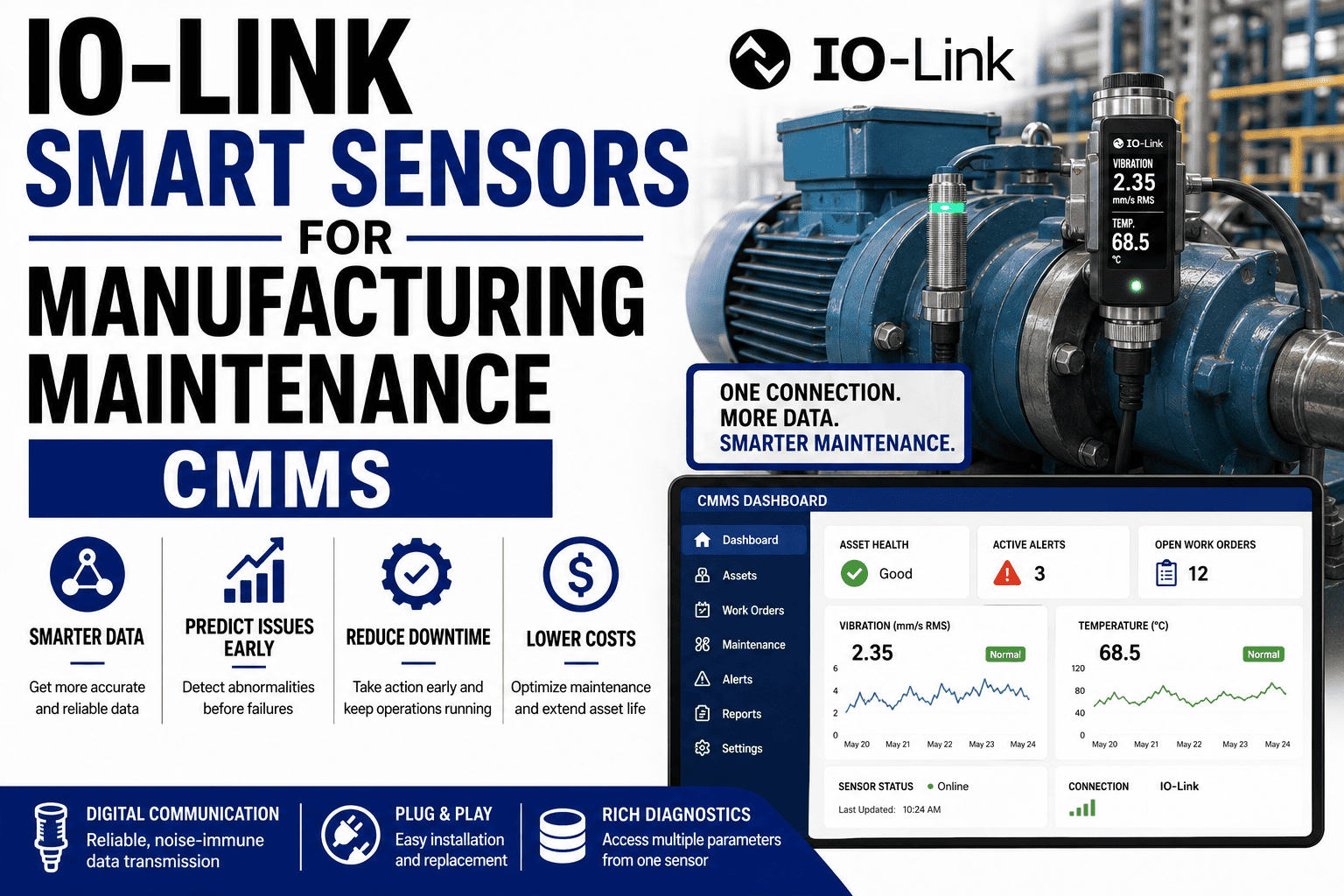
IO-Link smart sensors for manufacturing maintenance transform ordinary field devices into intelligent data sources without requiring you to rip out existing wiring, making them the fastest pathway to condition-based monitoring in brownfield plants. By pairing these sensors with a modern CMMS, maintenance and reliability teams gain real-time visibility into vibration, temperature, and cycle counts—catching failures days or weeks before they escalate. This guide covers IO-Link master architecture, sensor selection, diagnostic data streams, and how to feed that intelligence directly into your maintenance software. Ready to turn sensor data into automated work orders? Start Free Trial and see how OxMaint makes it effortless.
What if every sensor on your floor could tell you it was about to fail — before it did?
IO-Link smart sensors for manufacturing maintenance unlock real-time diagnostics, automatic parameterization, and predictive condition data from the field devices you already own. No rewiring. No rip-and-replace. Just actionable intelligence flowing straight into your CMMS.
How IO-Link Smart Sensors Work in a Manufacturing Plant
IO-Link (IEC 61131-9) is a point-to-point serial communication protocol that turns standard 3-wire sensor wiring into a bidirectional digital data channel. It is the foundation of smart sensor manufacturing integration.
Field-Level Smart Sensors
IO-Link smart sensors detect temperature, vibration, pressure, flow, and position. Unlike discrete on/off devices, they transmit process values, device health, and configuration data over the same 3-wire cable.
IO-Link Master Gateway
The IO-Link master connects up to 8 or 16 sensors per port block to your industrial network (EtherNet/IP, PROFINET, Modbus TCP). It acts as the bridge between the field layer and your PLC or SCADA system.
Edge & PLC Data Aggregation
Sensor data is tagged, time-stamped, and pushed to an edge server or middleware layer. OPC UA or MQTT transports the event streams to higher-level systems without burdening the PLC scan cycle.
CMMS Integration & Work Orders
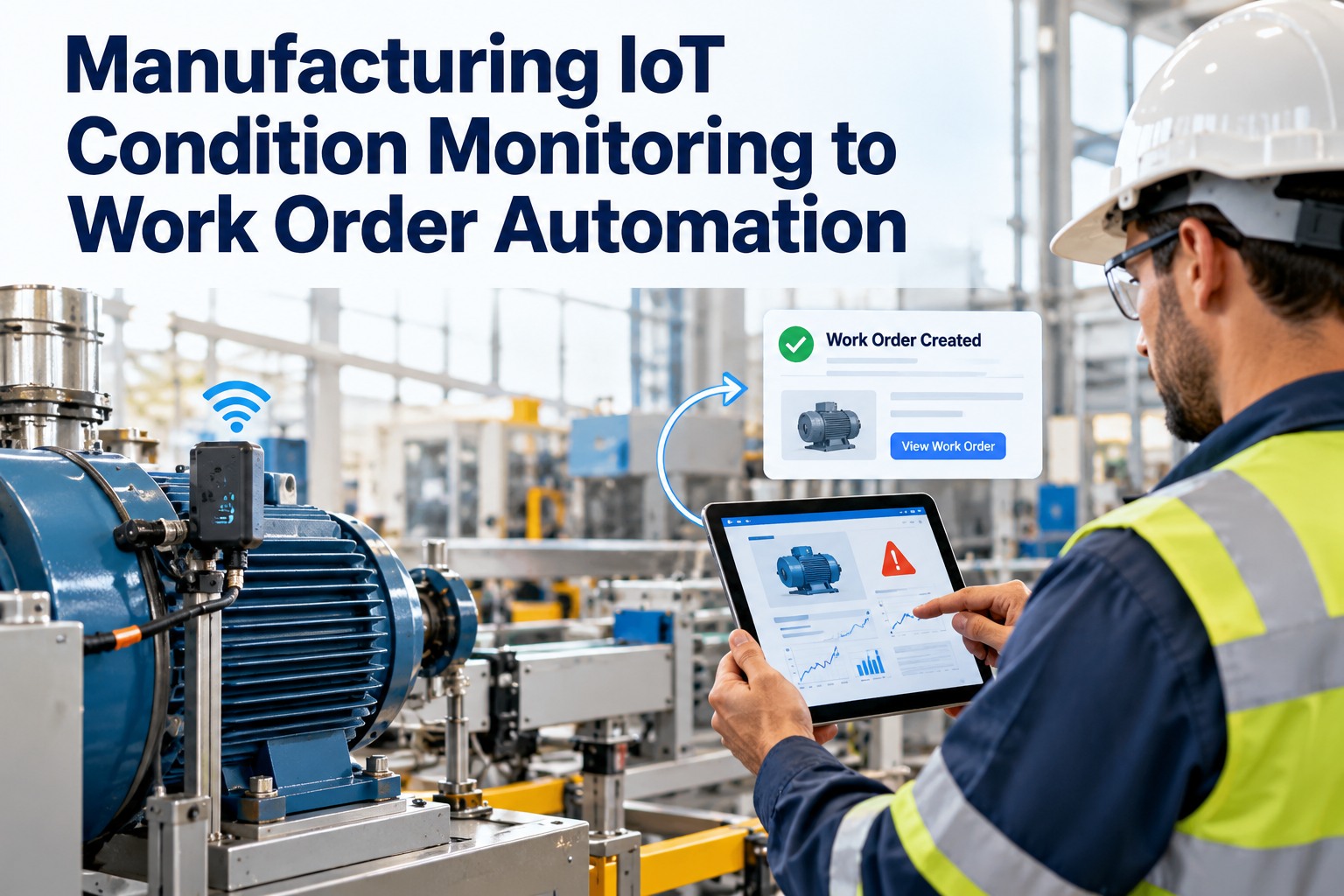
The IO-Link CMMS connection ingests the data stream. When a diagnostic threshold is breached, OxMaint automatically generates a conditional work order, assigns a technician, and logs the event to the asset history.
What IO-Link Condition Monitoring Data Tells Your Maintenance Team
An IO-Link sensor plant generates four distinct categories of diagnostic data. Each stream maps to a specific maintenance decision, and each one can be automated inside OxMaint.
Process Data (Cyclic)
Continuous measurement values — bearing temperature, motor vibration RMS, hydraulic pressure, tank level. Sampled every 1–10 ms, this is the backbone of IO-Link condition monitoring and trend analysis. OxMaint stores this as time-series asset data for predictive analytics.
Device Health & Diagnostics (Acyclic)
Internal sensor status: short circuits, wire breaks, supply voltage drops, dirty optics, and electronics temperature. When a smart sensor reports a fault, OxMaint can auto-generate a corrective work order before the device fails completely.
Parameter & Configuration Data
All sensor settings — switch points, filtering, teach-in values — are stored digitally. Swap a damaged sensor, and the IO-Link master automatically downloads the last-known configuration to the replacement in under 2 seconds. Zero manual parameterization.
Identification & Asset Tracking
Vendor ID, serial number, firmware version, and product code. This data auto-populates the asset registry in your CMMS, ensuring spare-parts inventory accuracy and eliminating manual data-entry errors.
IO-Link Maintenance Integration: Cost Savings & Payback Formula
A 180-asset plant spending $42,000 annually on unplanned downtime and sensor replacement can recover costs in under 9 months by integrating IO-Link smart sensors with a CMMS. Here is the math.
| Scenario | Annual Downtime Cost | IO-Link + CMMS Savings | Net Year-1 Benefit | Payback Period |
|---|---|---|---|---|
| 180-asset plant (brownfield retrofit) | $42,000 | $28,700 | $14,700 | 5.8 months |
| 500-asset facility (multi-line) | $118,000 | $79,400 | $58,400 | 4.2 months |
| 1,200-asset enterprise site | $285,000 | $192,100 | $148,100 | 3.1 months |
How OxMaint Turns IO-Link Data Into Maintenance Action
OxMaint is an AI-powered CMMS and EAM platform that ingests IO-Link event streams and converts them into automated work orders, predictive alerts, and compliance-ready audit trails — no manual data entry required.
Automated Conditional Work Orders
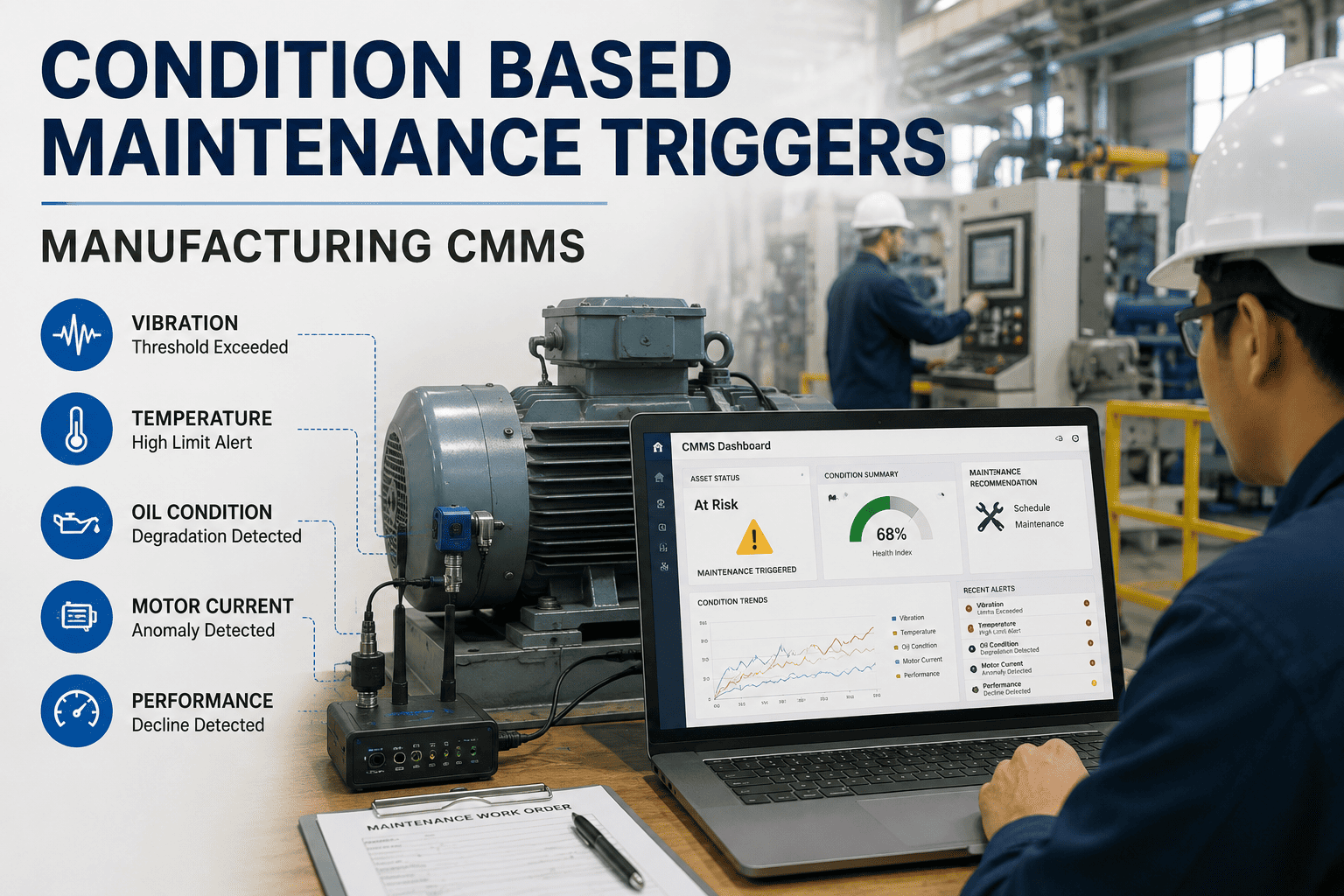
When an IO-Link sensor breaches a vibration or temperature threshold, OxMaint instantly generates a work order, assigns the nearest qualified technician, and reserves the required spare part. Result: 30–50% less unplanned downtime.
Predictive Analytics Engine
OxMaint's AI models analyze cyclic IO-Link process data trends to forecast bearing failure, seal degradation, and motor exhaustion 7–21 days in advance. Shift from reactive firefighting to predictive scheduling.
Automatic Asset Registry Sync
IO-Link identification data (vendor, serial, firmware) auto-populates OxMaint's asset registry. When a sensor is swapped, the asset record updates instantly — eliminating spreadsheet drift and ensuring 99% spare-parts accuracy.
Compliance & Audit Trail
Every IO-Link event, work order trigger, and sensor swap is time-stamped and logged to ISO 55000 / TPM audit standards. Pass compliance reviews in minutes, not days, with tamper-proof maintenance records.
IO-Link Sensor Guide: Choosing the Right Smart Sensors for Maintenance
Not all IO-Link sensors are equal for maintenance purposes. Selecting the right device class determines whether you get simple on/off diagnostics or full condition-based monitoring data.
| Sensor Type | Maintenance Data Provided | Best For | CMMS Integration Value |
|---|---|---|---|
| Vibration (IEPE / MEMS) | RMS velocity, crest factor, frequency spectrum | Bearings, motors, gearboxes, pumps | High — feeds predictive failure models |
| Temperature (RTD / thermocouple) | Continuous surface & ambient temperature | Motor windings, hydraulic systems, reactors | High — threshold alerts & trend analysis |
| Pressure (piezoresistive) | Real-time pressure, spikes, leak detection | Pneumatics, hydraulics, compressed air | Medium — leak cost & energy tracking |
| Flow (electromagnetic) | Volumetric flow rate, totalizer, empty-pipe detection | Cooling lines, lubrication, CIP systems | Medium — flow-loss conditional work orders |
| Position / proximity | Cycle count, signal quality, wire-break diagnostics | Cylinders, actuators, end-of-stroke detection | Medium — PM trigger by cycle count |
| Photoelectric / optical | Signal strength, dirty-lens warning, margin % | Conveyors, packaging, labeling stations | Low–Medium — cleaning schedule triggers |
A mid-size food & beverage plant retrofitted 64 proximity sensors with IO-Link on two packaging lines. Within 4 months, dirty-lens warnings auto-triggered cleaning work orders in OxMaint — cutting line stoppages by 38% and recovering $31,200 in lost production.
See OxMaint on your assets — book a 30-minute demo
Watch how IO-Link sensor data flows into automated work orders, predictive alerts, and real-time dashboards. Bring your asset list — we'll map it live.
IO-Link Maintenance CMMS — Frequently Asked Questions
Can IO-Link smart sensors be retrofitted in existing manufacturing plants?
Yes. IO-Link uses the same standard 3-wire cabling as conventional sensors, so you only swap the sensor and add an IO-Link master module. Most brownfield retrofits take 1–2 hours per line with zero control-panel rewiring, making it the fastest IIoT upgrade path for existing plants.
How does IO-Link integrate with a CMMS like OxMaint?
The IO-Link master pushes diagnostic and process data via OPC UA, MQTT, or REST API to OxMaint's integration layer. OxMaint maps each sensor to an asset record, monitors thresholds, and automatically generates work orders when conditions breach. You can Start Free Trial to test the integration with your existing master.
What is the difference between IO-Link and traditional IIoT sensor networks?
IO-Link is deterministic, point-to-point, and based on the IEC 61131-9 standard — meaning it integrates natively with PLCs and industrial networks without IT-grade Ethernet at every device. Traditional IIoT networks (like LoRaWAN or wireless sensor meshes) are better for distant assets but lack the deterministic scan times and automatic parameterization that IO-Link provides for machine-level maintenance.
How much does an IO-Link maintenance integration cost?
A typical brownfield retrofit costs $200–$450 per sensor point (sensor + master port share + cabling). For a 64-sensor line, expect $14K–$22K including integration labor. Most plants achieve payback in 3–6 months through reduced downtime and eliminated manual parameterization. Book a Demo and we'll model the exact ROI for your facility.
Does IO-Link support predictive maintenance or only preventive?
IO-Link supports both. Cyclic process data (vibration, temperature, pressure trends) feeds predictive maintenance algorithms that forecast failures 7–21 days out. Cycle-count and device-health data supports condition-based preventive triggers. Combined with OxMaint's AI analytics, IO-Link enables a full shift from time-based PMs to condition-based and predictive maintenance.
Turn every sensor into a maintenance intelligence source
OxMaint connects your IO-Link smart sensors to automated work orders, predictive alerts, and audit-ready compliance logs — all in one AI-powered CMMS platform.
Free 14-day trial · No credit card