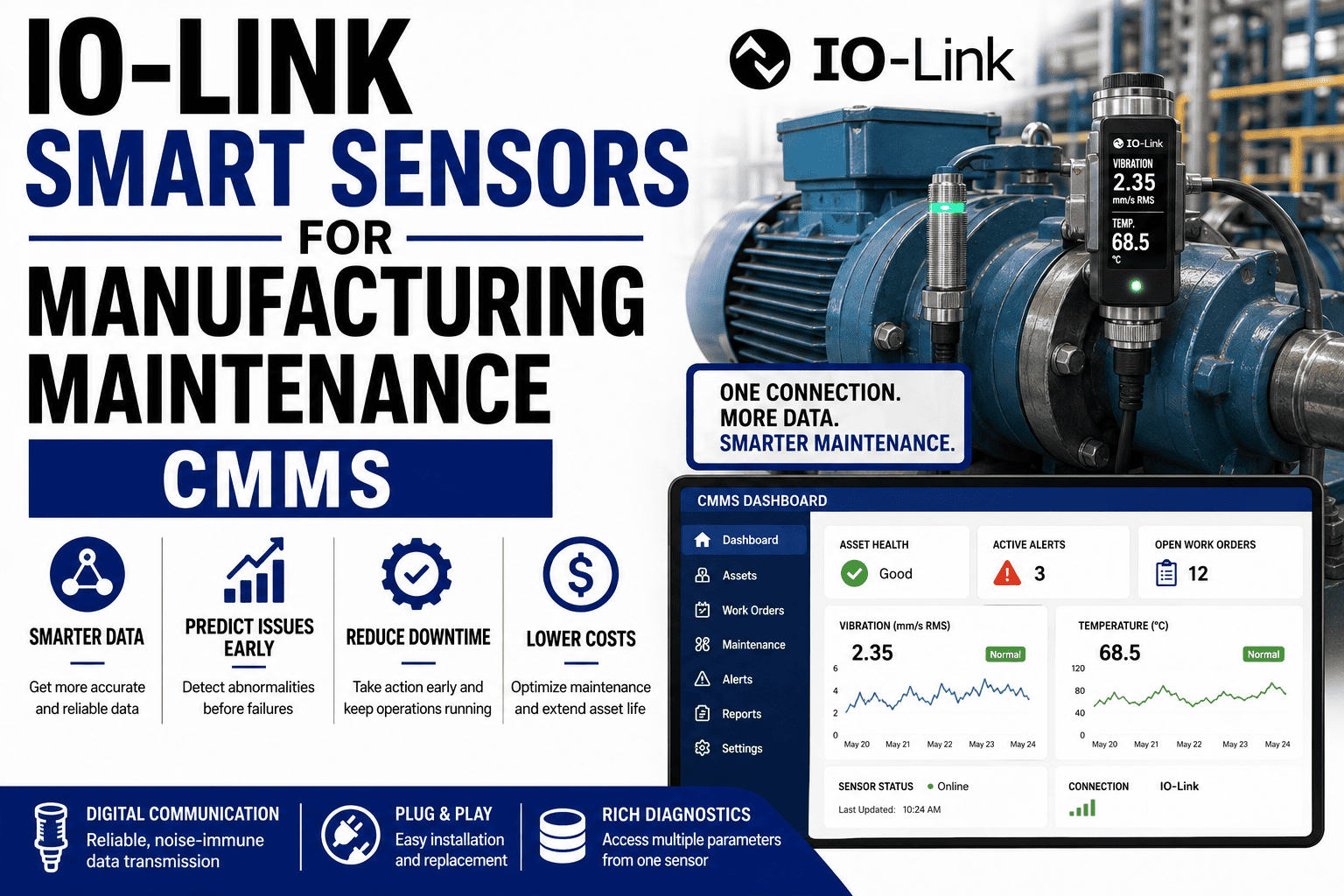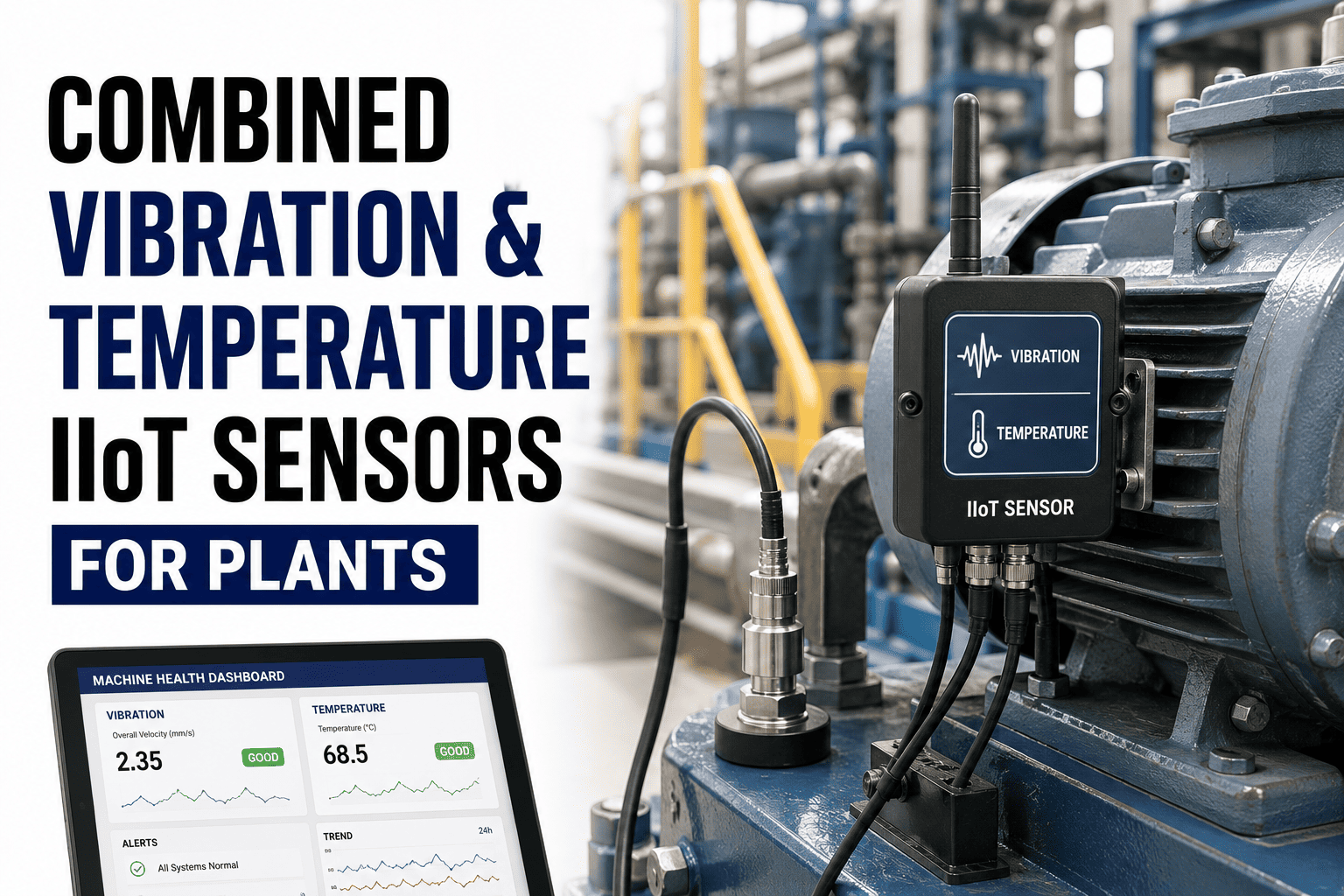
Combined vibration and temperature IIoT sensors let manufacturing plants blanket hundreds of rotating assets with continuous condition monitoring for a fraction of what a single route-based analyst cost five years ago. A multi-parameter sensor manufacturing strategy captures the two most predictive failure signatures simultaneously, feeding real-time vibration temperature monitoring data straight into your CMMS so alerts become scheduled work orders. This guide walks through combined sensor CMMS integration end to end, from device selection and mounting to alarm thresholds and the workflow that turns a spike into a completed repair before the bearing seizes. If you want to skip straight to implementation, Start Free Trial and connect your first sensor in minutes.
IIoT CONDITION MONITORING
How much does an undetected bearing failure cost your plant?
A single missed failure on a critical motor can cost $15K–$50K in lost production, emergency parts and overtime. Combined IIoT sensors catch the signature 30–90 days before failure — but only if alerts flow into your CMMS as actionable work orders.
$18K
Average avoided cost per detected failure when vibration + temperature alerts reach your CMMS within minutes
SENSOR SELECTION
How to choose a combined vibration temperature IIoT sensor for manufacturing
Not every multi-parameter sensor manufacturing deployment is created equal. The right combined IIoT sensor balances sampling rate, battery life and CMMS data compatibility — and the wrong choice can flood your system with noise or miss the very failure it was installed to catch.
01
Sampling Rate & Bandwidth
Select sensors that capture at least 1–6.4 kHz for vibration RMS, crest factor and FFT spectra. Anything below 1 kHz misses high-frequency bearing fault signatures (BPFI, BPFO) that precede 80% of spall-type failures by 3–12 weeks.
02
Temperature Range & Accuracy
Verify a range of −40°C to +125°C with ±0.5°C accuracy. Thermal rise of 10–15°C above baseline often correlates with lubrication degradation or overload — a secondary confirmation that vibration alone cannot provide.
03
Connectivity & Power
Prefer LoRaWAN (3–5 year battery, 500m range) or BLE 5.0 for dense indoor plants. WiFi sensors (2.4 GHz) work for fewer than 50 nodes; beyond that, interference collapses data throughput and battery life by 40%.
04
Data Pipeline & CMMS API
Ensure the sensor gateway exposes REST or MQTT endpoints. Without a structured combined sensor CMMS data path, your team is left manually checking dashboards — defeating the purpose of continuous monitoring.
05
Mounting & IP Rating
Use stud mounts for motors above 50 HP (best frequency transfer above 5 kHz) and epoxy/magnetic mounts for sub-50 HP walk-down assets. Minimum IP65 for indoor clean environments, IP67 for washdown zones.
06
Firmware & OTA Updates
Over-the-air firmware updates are essential for ISO 10816 / 20816 threshold recalibration as assets age. Sensors without OTA eventually drift 5–12% from baseline, generating false alarms that erode technician trust.
DEPLOYMENT ARCHITECTURE
Multi-sensor deployment: gateway architecture and data flow into the CMMS
A robust IIoT sensor deployment uses a layered architecture — edge sensors, gateways, cloud ingestion and CMMS integration. Each layer must preserve data integrity and alarm latency under 30 seconds, or condition alerts lose their value.
| Layer | Components | Key Benchmark | CMMS Action |
|---|---|---|---|
| Edge Layer | Combined vibration temperature sensor nodes (battery-powered, IP65+) | Sample every 15 min; event-trigger burst at 5 kHz | None — raw data only |
| Gateway Layer | LoRaWAN / BLE concentrator, MQTT broker, local edge buffer | Buffer 72 hours offline; retransmit on reconnect | Edge alert if cloud link drops |
| Ingestion Layer | Cloud IoT hub, data lake, FFT processing engine | Process < 5 sec from gateway receipt | Push normalized JSON to CMMS REST API |
| CMMS Layer | OxMaint work-order engine, asset registry, PM scheduler | Auto-generate WO within 30 sec of threshold breach | Assign priority, technician, parts check |
WORKED EXAMPLE
A 180-asset food processing plant deploying 120 combined IIoT sensors via a single LoRaWAN gateway reduced unplanned downtime by 34% in the first 6 months. The gateway forwards alerts to OxMaint, which auto-generates a priority-2 work order tagged to the exact asset ID with pre-loaded spare-part kit numbers — cutting mean time to repair (MTTR) from 4.2 hours to 1.8 hours.
ALARM THRESHOLDS
Setting vibration temperature monitoring thresholds that prevent false alarms
False alarms destroy a condition monitoring program faster than missed failures. ISO 10816 / 20816 velocity thresholds provide a baseline, but manufacturing combined sensor strategies must layer statistical baselines and dual-parameter confirmation to achieve <5% false-positive rates.
BASELINE FORMULA
Alarm Threshold = (14-day rolling mean) + (2.5 × rolling σ)
Trigger a CMMS work order when RMS velocity exceeds this value AND temperature rises > 8°C above the 14-day thermal baseline for the same asset. Dual-parameter confirmation reduces false positives by up to 73%.
<5%
Target false-positive rate with dual-parameter confirmation
30–90d
Typical lead time between first detection and functional failure
73%
Reduction in false alarms when vibration + temperature are cross-confirmed
HOW OXMAINT HELPS
How OxMaint turns combined sensor data into completed work orders
Sensors collect data; OxMaint converts it into action. Without a CMMS multi-parameter sensor pipeline, dashboards are just charts. OxMaint closes the loop — from threshold breach to assigned technician, picked parts and verified repair — so condition monitoring actually prevents downtime.
Auto-Generated Work Orders
When a combined vibration temperature IIoT sensor breaches threshold, OxMaint generates a priority-ranked work order in under 30 seconds — pre-tagged to the asset, with repair history, manuals and spare-part kits attached. Cut MTTR by 40–60%.
Predictive PM Scheduling
OxMaint's AI engine analyzes sensor trend curves and dynamically adjusts preventive maintenance intervals — extending PMs on healthy assets and pulling them forward on degrading ones. Plants report 25–35% fewer unnecessary PM tasks.
Spare-Parts Auto-Reservation
When OxMaint creates a sensor-triggered work order, it automatically checks inventory and reserves the required bearing, seal or belt — alerting the storeroom to stage parts before the technician is dispatched. Eliminate 90% of parts-related repair delays.
Maintenance Analytics & OEE
OxMaint correlates sensor alerts with work-order completion data and downtime events, giving reliability engineers a unified dashboard for MTBF, MTTR and OEE. Identify the 20% of assets causing 80% of unplanned stops in a single view.
SEE IT ON YOUR ASSETS
Book a 30-minute demo and watch a sensor alert become a work order in OxMaint
We will connect a live combined IIoT sensor to a demo asset, trigger a threshold breach and show you exactly how OxMaint generates, routes and closes the resulting work order — complete with parts reservation and PM rescheduling.
FAQ
Common questions about combined vibration temperature IIoT sensors
What is a combined vibration temperature sensor and why use one?
A combined IIoT sensor is a single wireless node that simultaneously measures vibration (RMS velocity, crest factor, FFT spectra) and surface temperature. Using one device for both parameters cuts hardware costs by 35–50%, halves installation time and ensures the two most predictive failure indicators are always correlated — which is critical for bearing, gearbox and motor health monitoring across a manufacturing plant.
How does a combined sensor CMMS pipeline work?
The sensor transmits data to a LoRaWAN or BLE gateway, which forwards it to a cloud ingestion layer. That layer processes the signal, compares it against ISO 10816 thresholds and your statistical baselines, and pushes a normalized alert to OxMaint via REST API. OxMaint then auto-generates a work order tagged to the exact asset with priority, parts and technician assignment — all within 30 seconds of detection.
How much does IIoT sensor deployment cost for a manufacturing plant?
A typical combined vibration temperature IIoT sensor costs $120–$350 per node, plus $800–$2,500 for a gateway covering 100–500 nodes. For a 180-asset plant, total hardware runs $25K–$60K. Most plants recover that within 6–9 months by avoiding a single major failure. You can Start Free Trial of OxMaint to model the exact payback for your asset count.
Can OxMaint connect to sensors I already have installed?
Yes. OxMaint accepts data via REST API, MQTT webhooks and CSV ingestion, so it integrates with most commercially available IIoT sensor platforms — including custom edge gateways. If your sensors push JSON payloads, OxMaint can map them to assets and start generating work orders within a single configuration session.
What alarm thresholds should I set for vibration temperature monitoring?
Start with ISO 10816/20816 velocity zones (Zone A–B = normal, Zone C = alert, Zone D = danger) and layer a statistical baseline: alarm = 14-day rolling mean + 2.5σ. Require dual confirmation — vibration breach AND temperature rise >8°C above baseline — before generating a CMMS work order. This approach typically achieves a false-positive rate below 5%.
READY TO START?
Stop reacting to failures — start predicting them
Deploy combined vibration temperature IIoT sensors, pipe the data into OxMaint and let AI-driven work orders close the loop from detection to repair. Your first 14 days are free — connect sensors, import assets and generate your first predictive work order today.
Free 14-day trial · No credit card