Choosing between machine vision vs deep learning for inspection comes down to one question: is your defect predictable enough to describe with rules, or variable enough that it needs to be learned? Rule-based machine vision excels at high-speed, deterministic checks like dimensional measurement, barcode reading, and presence/absence detection. Deep learning inspection handles subjective, variable defects — scratches, texture anomalies, surface contamination — that defeat traditional algorithms. Most modern plants need both, and the wrong choice wastes 3–6 months of engineering time. This guide breaks down exactly which technology wins for which defect category, what each costs, and how to connect either one to your maintenance workflow through Start Free Trial.
Machine Vision vs Deep Learning: Which Inspection Approach Fits Your Defect?
Rule-based systems catch 99%+ of defined defects at 1,000+ parts/minute. Deep learning catches the defects you can't define. Here's how to pick the right one — and avoid a $150K mistake.
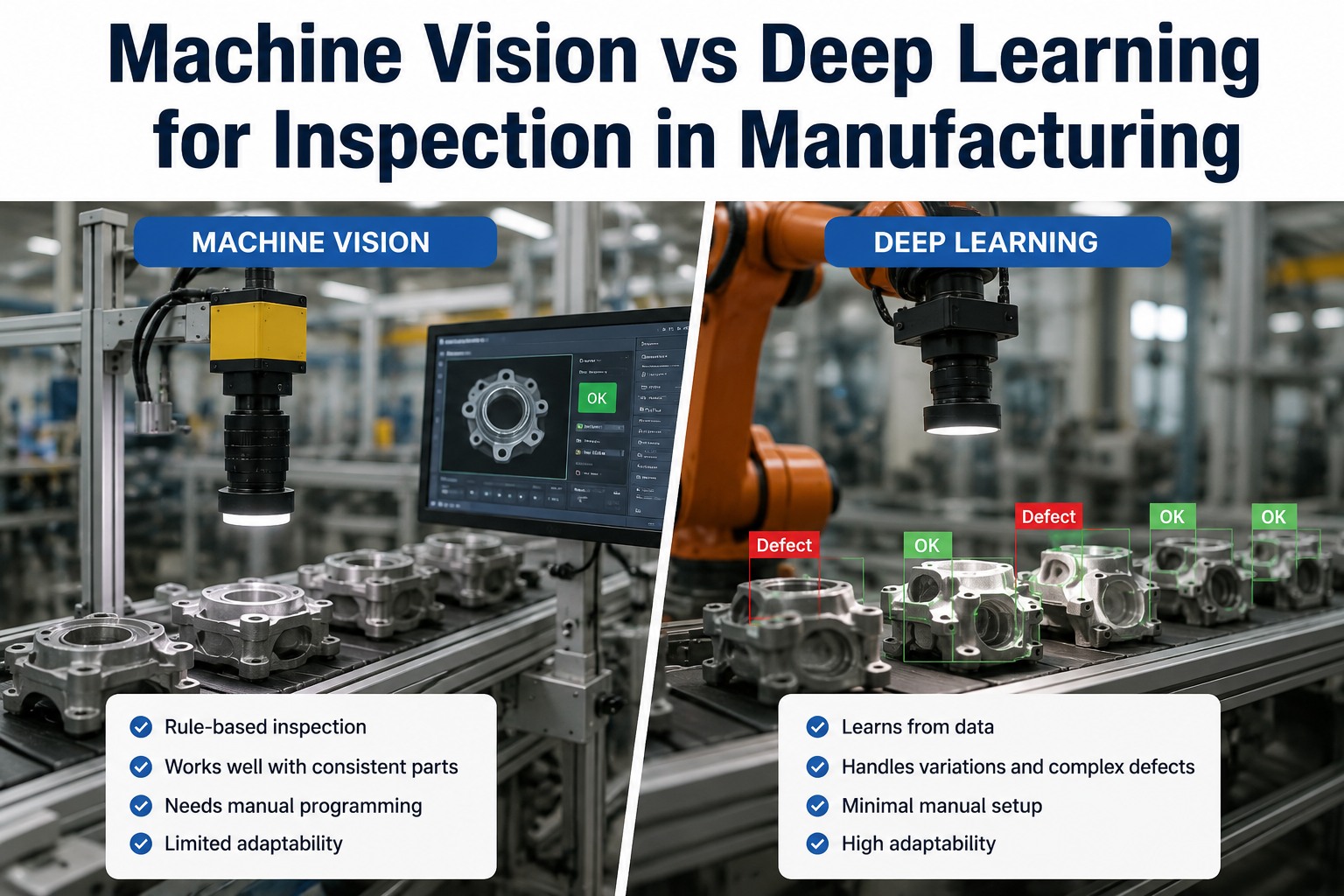
- Deterministic pass/fail logic
- Deploys in 2–6 weeks
- Needs 50–200 sample images
- Best for measurement & presence checks
- Learns from examples, not rules
- Deploys in 8–16 weeks
- Needs 500–5,000+ labeled images
- Best for surface, texture & anomaly detection
Machine Vision vs Deep Learning Inspection: Head-to-Head Comparison Table
The global machine vision market hit $12.9B in 2024, with deep learning inspection growing at 32% CAGR — nearly 3x faster than traditional vision. But faster-growing doesn't mean better for every application. This table shows where each technology wins.
| Factor | Rule-Based Machine Vision | Deep Learning Inspection |
|---|---|---|
| Defect Type | Dimensional, positional, presence/absence, color match | Surface scratches, texture, contamination, weld quality, cosmetic flaws |
| Accuracy | 99.5%+ on defined criteria | 95–99% on variable defects (improves with more data) |
| Training Data Needed | 50–200 good/bad reference images | 500–5,000+ labeled images per defect class |
| Deployment Time | 2–6 weeks | 8–16 weeks (including data collection & training) |
| Inspection Speed | 1,000–10,000+ parts/minute | 100–1,000 parts/minute (GPU-dependent) |
| Typical System Cost | $15K–$60K per station | $40K–$150K per station (includes GPU hardware) |
| Handles New Defect Types | No — requires reprogramming | Yes — retrain with new examples |
| Lighting Sensitivity | High — needs controlled, consistent lighting | Moderate — more tolerant of lighting variation |
| False Reject Rate | 0.1–2% (tunable) | 1–5% initially, drops to <1% with retraining |
| Best Industries | Electronics, pharma packaging, automotive assembly | Metals, textiles, food processing, casting, welding |
Which Defects Should Each Technology Handle? A 4-Category Breakdown
A Tier 1 automotive supplier spent $85K on a deep learning system to check bolt torque marks — a job a $20K rule-based system handles at 99.9% accuracy. Don't over-engineer. Match the technology to the defect category.
Dimensional & Positional — Use Rule-Based
Measuring gap widths, verifying hole positions, checking component alignment, reading gauges. Rule-based vision measures to sub-pixel accuracy (±0.01mm) at line speed. Deep learning adds nothing here — it's slower and less precise for measurement tasks.
Winner: Machine VisionPresence/Absence & Verification — Use Rule-Based
Is the label applied? Is the cap on? Are all 12 screws present? Is the barcode readable? These are binary checks with clear pass/fail criteria. Rule-based systems handle these at 10,000+ parts/minute with near-zero false rejects.
Winner: Machine VisionSurface & Cosmetic Defects — Use Deep Learning
Scratches on brushed metal, dents on castings, discoloration on plastics, texture irregularities on fabric. These defects vary in size, shape, orientation and severity — no rule set captures them all. Deep learning achieves 95–99% detection where rule-based systems hit 60–80%.
Winner: Deep LearningComplex Assembly & Anomaly — Use Deep Learning
Weld bead quality, solder joint inspection, wire routing verification, foreign object detection. When "correct" has hundreds of valid variations and "wrong" has thousands, deep learning's ability to learn from examples outperforms any rule set.
Winner: Deep LearningWhat Does Vision Inspection Actually Cost? Real Numbers for Budget Planning
A single escaped defect in automotive can trigger a $500K recall. In pharma, a mislabeled bottle means a $1M+ FDA action. Vision inspection pays for itself by catching what human inspectors miss — and humans miss 15–30% of defects on repetitive tasks after just 2 hours.
A 200-employee metal stamping plant running 3 shifts deployed a $48K rule-based vision station to check hole positions on brake brackets. Before: 2 full-time inspectors per shift ($186K/yr loaded), 0.8% escape rate costing $310K/yr in customer chargebacks. After: 1 inspector per shift doing spot audits ($93K/yr), escape rate dropped to 0.02% ($8K/yr). Annual savings: $395K. Payback: 1.5 months. The system caught a die-wear drift in week 3 that would have scrapped 12,000 parts.
The Hybrid Play: Why 60% of New Installations Combine Both Technologies
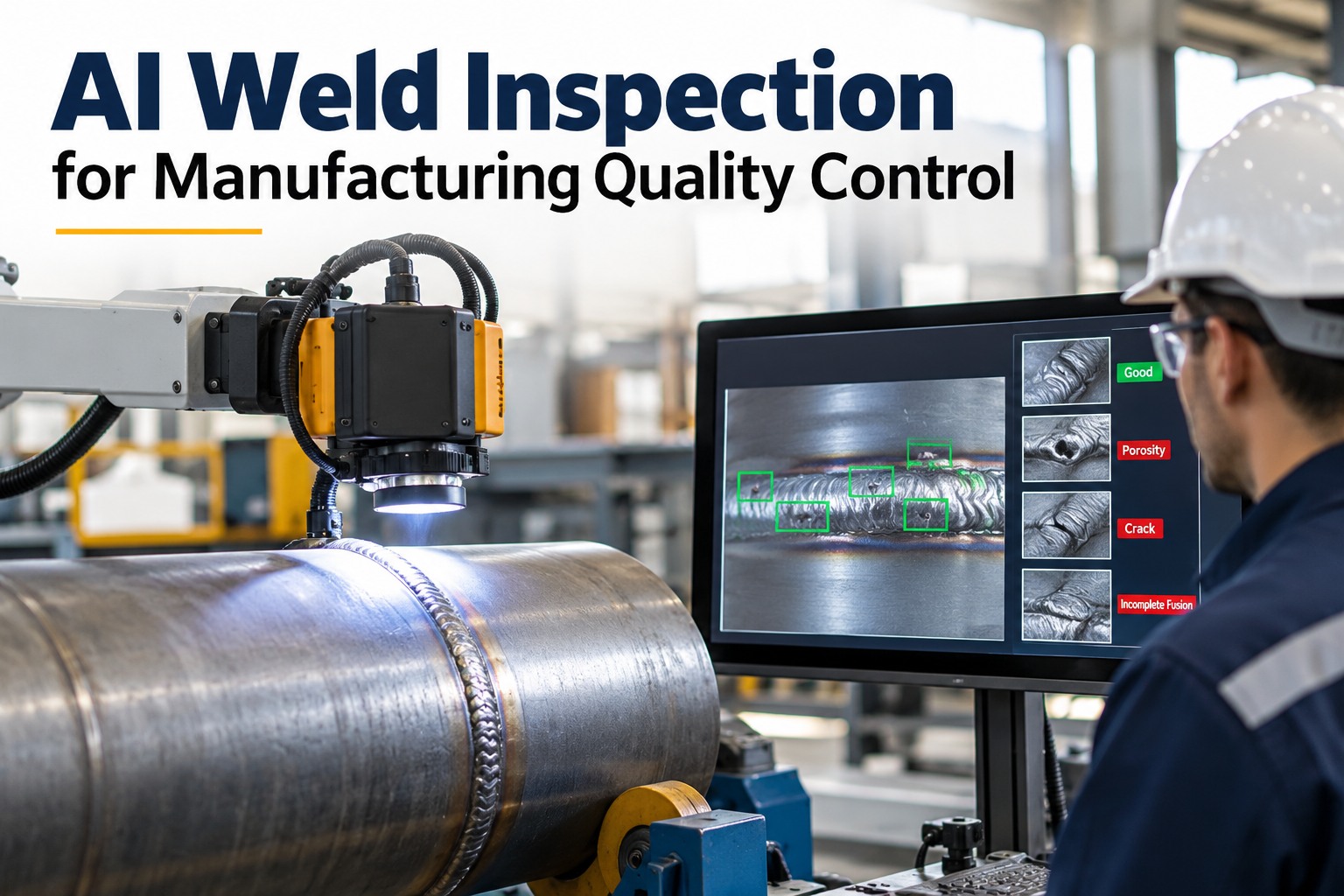
The most effective vision inspection systems in 2025 aren't rule-based OR deep learning — they're both, running in sequence on the same production line. Rule-based handles the fast, deterministic checks. Deep learning handles the subjective calls. This hybrid approach delivers the highest overall equipment effectiveness.
Rule-Based Pre-Filter
High-speed camera checks dimensions, orientation, presence/absence and barcode/label reading at full line speed (1,000+ parts/min). Rejects obvious failures instantly. Passes "borderline" parts to Stage 2.
Deep Learning Classification
Borderline parts get a second look from a deep learning model trained on 2,000+ labeled images. It classifies surface quality, detects anomalies, and grades severity (pass / rework / scrap) with a confidence score.
Data Feeds Maintenance
Inspection results flow into your CMMS. Rising defect rates trigger automatic work orders — a 15% spike in surface scratches means tooling wear; a drift in dimensional data means fixture misalignment. This is where inspection becomes predictive maintenance.
Turn Inspection Data Into Maintenance Action With OxMaint
Vision systems detect defects — but detection without action is waste. OxMaint closes the loop by converting inspection trends into maintenance work orders, asset health scores, and spare parts forecasts. Here's how:
Automated Work Order Triggers
When defect rates exceed thresholds — say, surface scratches jump 20% week-over-week — OxMaint auto-generates a work order for tooling inspection. No manual data transfer, no delays. Plants using automated triggers cut response time from 4.2 hours to 11 minutes.
Asset Health Trending
Correlate vision inspection data with specific assets, dies, molds and fixtures. OxMaint tracks defect patterns per asset over time, flagging degradation trends 2–4 weeks before failure. This turns quality data into predictive maintenance intelligence.
Spare Parts Forecasting
When inspection data shows a die wearing 30% faster than expected, OxMaint automatically adjusts the spare parts reorder point. No more emergency $8K overnight shipments for a $400 die insert. Plants reduce emergency parts orders by 60–75%.
Audit-Ready Compliance Reports
Every inspection result, every triggered work order, every corrective action — logged with timestamps and technician sign-off. ISO 9001, IATF 16949 and FDA 21 CFR Part 11 audits go from 3-day scrambles to one-click report generation.
See How OxMaint Connects Inspection to Maintenance
Book a 30-minute demo and we'll show you exactly how defect data from your vision systems becomes automated work orders, asset health scores and predictive alerts.
Machine Vision vs Deep Learning Inspection: FAQ
Can deep learning replace traditional machine vision entirely?
No — and it shouldn't. Rule-based vision is faster (10,000+ parts/min vs 100–1,000), cheaper ($15K–$60K vs $40K–$150K per station), and more precise for measurement tasks. Deep learning complements rule-based systems by handling subjective defects that rules can't define. The best installations use both.
How many images do I need to train a deep learning inspection model?
Plan for 500–5,000 labeled images per defect class, with a minimum of 200–300 "bad" examples. Rare defects are the challenge — if a defect occurs 1 in 10,000 parts, you may need weeks of production data or synthetic image augmentation. Transfer learning from pre-trained models can reduce requirements by 40–60%.
What's the biggest mistake plants make when choosing vision inspection?
Choosing deep learning when rule-based would work — or vice versa. A food packaging plant spent $120K on deep learning to check date codes (a $25K OCR job). Another tried rule-based for fabric defect detection and got 62% accuracy. Match the technology to the defect type, not the hype. Book a Demo and we'll help you scope the right approach.
How does vision inspection data connect to maintenance management?
Defect trends are leading indicators of equipment degradation. Rising surface scratches signal tooling wear; dimensional drift signals fixture misalignment; increasing contamination signals seal or filter failure. OxMaint ingests this data and auto-generates work orders when thresholds are breached — turning quality inspection into predictive maintenance. Start Free Trial to see the integration.
What ROI should I expect from a vision inspection system?
Most single-station deployments pay back in 8–14 months through reduced scrap (30–50% reduction), lower labor costs (1–2 inspectors redeployed per shift), and fewer customer escapes (85%+ reduction). The biggest ROI comes from connecting inspection data to maintenance — plants that do this report 25–40% less unplanned downtime on inspected lines.
Stop Inspecting. Start Predicting.
Your vision systems generate the data. OxMaint turns it into maintenance action — automated work orders, asset health scores, and failure predictions. See it on your assets in 30 minutes.
Free 14-day trial · No credit card required · Set up in under 1 hour