Maintenance teams rarely run out of work — they run out of time spent on the right work. When technician hours disappear into unplanned reactive repairs, administrative overhead, and travel between jobs, planned maintenance falls behind and asset reliability deteriorates. Benchmarking maintenance labor utilization across planned, reactive, and support work categories gives plant managers and reliability engineers a clear view of how technician capacity is actually being consumed — and where structural changes can recover lost wrench time without adding headcount. Sign Up Free with Oxmaint and connect your work order execution to technician time tracking — so every hour logged is categorized, measurable, and improvable.
Maintenance Labor · Technician Utilization · Workforce Efficiency · Wrench Time
Benchmark Technician Time and Recover Hidden Maintenance Capacity
Oxmaint gives maintenance managers structured work order records, technician time logging, and labor category analytics — so planned work gets executed on schedule and reactive demand doesn't drain the team.
Why Labor Utilization Benchmarking Matters for Maintenance Teams
Industry benchmarks suggest that high-performing maintenance organizations achieve 55–65% wrench time — the percentage of technician hours spent on hands-on maintenance tasks. Most industrial plants measure far below this, with significant time absorbed by waiting for parts, traveling between sites, attending unplanned breakdowns, and completing administrative paperwork. Without visibility into how labor hours are distributed across work categories, managers can't distinguish a capacity problem from an efficiency problem. Book a Demo to see how Oxmaint's mobile work order platform captures technician time by task type — building the labor utilization data set needed for meaningful benchmarking and workforce planning.
Planned vs. Reactive Work Ratio
The ratio of planned preventive maintenance hours to reactive breakdown hours is the single most telling indicator of maintenance program maturity. High reactive ratios signal that PM is falling behind — and the backlog is compounding.
Support Work Overhead
Technician hours spent on parts sourcing, travel, permit acquisition, and documentation often consume 25–35% of total shift time. Quantifying support overhead exposes reduction opportunities through better job preparation and parts staging.
Crew Workload Imbalance
Labor utilization imbalances across crews and shifts create reliability gaps and technician burnout. Benchmarking by individual and team reveals distribution inequities that managers can address through scheduling and assignment adjustments.
Backlog Growth and Capacity Signal
Rising work order backlogs combined with high labor utilization indicate genuine capacity constraints. Falling utilization with a growing backlog points to scheduling, prioritization, or skill-matching inefficiencies — not a headcount need.
Skill Utilization Mismatch
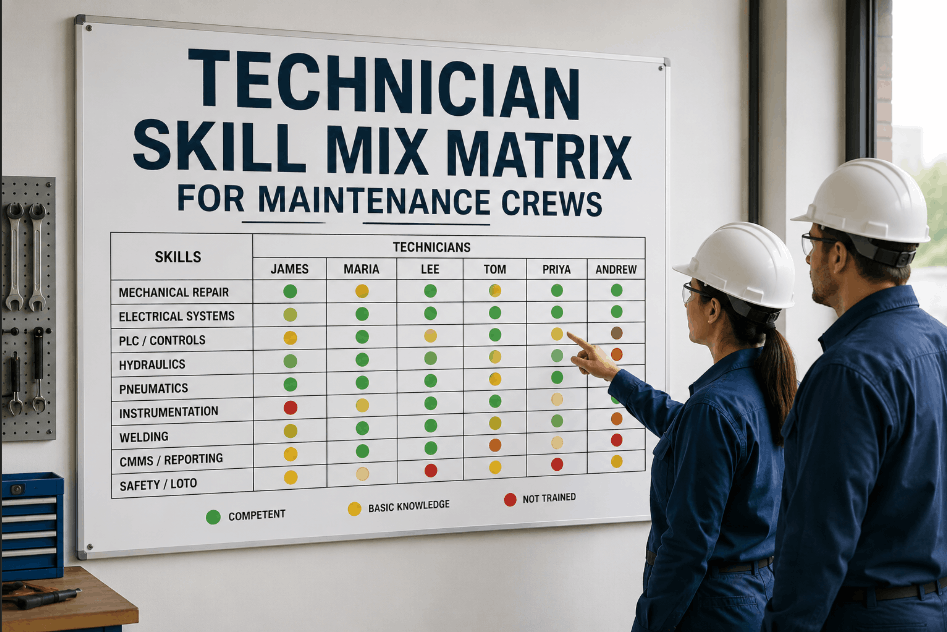
When senior technicians spend significant time on low-complexity tasks and junior staff are underdeployed, overall team output drops below capacity. Labor category analysis by skill level identifies where task allocation can be optimized.
Shift Pattern and Coverage Gaps
Uneven distribution of planned work across shifts causes reactive spikes when off-shift breakdowns occur without maintenance coverage. Utilization benchmarking by shift reveals structural coverage gaps that drive unnecessary overtime.
Labor Utilization Benchmark Framework for Maintenance Organizations
Effective labor utilization benchmarking requires consistent time tracking across work categories, clear definitions of what counts as wrench time versus support overhead, and a comparison baseline — either internal historical trends or industry benchmark ranges. The framework below reflects best practices for maintenance teams managing multi-technician, multi-shift plant environments. Book a Demo to see how Oxmaint digitizes work order execution and technician time logging to produce the labor utilization data that makes this framework operational.
Work Category Definition and Time Logging Standards
Benchmarking requires consistent categorization of technician time: planned PM, corrective repair, emergency breakdown, inspection, administrative tasks, parts sourcing, and travel. Oxmaint's mobile work orders capture time by task type at job completion — without requiring manual timesheet reconciliation at the end of the shift.
Wrench Time Calculation and Trend Analysis
Wrench time is the percentage of total available shift hours spent on direct maintenance tasks. Tracking wrench time by technician, crew, and shift over rolling periods reveals whether utilization is improving, static, or declining — and surfaces which teams or time windows drive the most variation.
Planned-to-Reactive Ratio Monitoring
A planned-to-reactive ratio below 70:30 signals that PM compliance is insufficient to prevent breakdown escalation. Monitoring this ratio monthly by asset group and crew identifies where reactive demand is crowding out planned work — enabling targeted PM schedule adjustments in Oxmaint before the ratio deteriorates further.
Backlog Age and Capacity Matching
Work order backlog age by priority tier — critical, high, routine — combined with available technician hours provides a capacity-demand matching view. When backlog age rises in specific priority tiers, the data distinguishes between a volume problem and a scheduling problem, pointing to the correct management response.
Labor Efficiency Improvement Targeting
Once utilization baselines are established, specific efficiency interventions — pre-kitted parts bins, mobile work orders eliminating paperwork, geofenced job routing — can be tested against the benchmark. Oxmaint's work order completion data makes the labor impact of each operational improvement measurable and attributable.
How Oxmaint Enables Maintenance Labor Utilization Tracking
Oxmaint is a cloud CMMS platform that digitizes work order creation, assignment, execution, and time logging across technician teams on mobile devices. By capturing labor hours at the task level — categorized by work type and linked to specific assets — Oxmaint builds the time-series labor dataset that powers meaningful utilization benchmarking. Sign Up Free and start building the labor utilization record that turns shift time into operational intelligence for your maintenance management team.
| Labor Utilization Challenge |
Without Structured Tracking |
With Oxmaint Work Orders |
| Technician time visibility |
Estimated from shift logs, unreliable |
Actual task time captured on mobile at job completion |
| Work category analysis |
No breakdown by planned vs. reactive vs. support |
Time logged by work type per technician and asset |
| Backlog management |
Spreadsheet tracking, no priority visibility |
Work order backlog by priority tier with age tracking |
| Crew workload balance |
Manager-estimated, no data foundation |
Assignment history by technician with completion rates |
| Efficiency improvement measurement |
No baseline to measure against |
Rolling utilization trends by crew, shift, and work type |
Most Common Labor Utilization Failures in Maintenance Programs
Maintenance labor inefficiency is usually invisible until it shows up as missed PM deadlines, rising backlogs, or budget overruns. The failure modes below are consistent across maintenance programs that lack structured time tracking and work categorization discipline. Sign Up Free to deploy Oxmaint's work order and time logging platform and eliminate these inefficiencies across your team.
01
No Time Tracking at the Task Level
When technician hours are recorded only at the shift level, there's no visibility into how time is distributed across work types. Task-level time logging in Oxmaint is captured at job completion on mobile — adding no administrative burden to field teams.
02
Reactive Work Crowding Out Planned PM
When emergency breakdowns regularly preempt scheduled preventive maintenance, PM compliance falls and failure rates rise — creating a self-reinforcing reactive cycle. Planned-to-reactive ratio monitoring in Oxmaint surfaces this trend before it becomes a reliability crisis.
03
Undefined Work Category Standards
Without agreed definitions of what constitutes planned, reactive, and support work, labor utilization data from different crews is incomparable. Oxmaint's work order type classification enforces consistent categorization across all technicians.
04
Utilization Benchmarks Without Baselines
Comparing current utilization to industry benchmarks without establishing an internal historical baseline makes it impossible to measure actual improvement. Oxmaint builds the rolling time-series data that makes trend measurement meaningful.
05
Skill Misallocation Invisible to Management
Without task complexity and technician skill logging, managers can't identify when senior staff are routinely assigned to low-complexity work. Task type and completion data in Oxmaint supports skill-matched assignment decisions.
06
Improvement Without Accountability
Labor efficiency initiatives that aren't tied to measurable work order outcomes are unaccountable. Oxmaint's work order completion, time logging, and utilization reporting creates the accountability loop that makes improvement programs stick.
Labor Utilization · Workforce Efficiency · Maintenance CMMS · Technician Analytics
See Where Technician Time Is Going — And Get It Back
Oxmaint captures work order time by task type, technician, and asset — giving maintenance managers the labor utilization data needed to benchmark efficiency, balance workloads, and recover capacity without adding headcount.
Frequently Asked Questions — Maintenance Labor Utilization Benchmark
What is maintenance labor utilization and how is it measured?
Maintenance labor utilization measures how technician hours are distributed across planned, reactive, and support work categories. It is calculated by logging task time at job completion and comparing actual category breakdowns against targets or benchmarks.
What is a good wrench time benchmark for industrial maintenance teams?
High-performing maintenance organizations typically achieve 55–65% wrench time. Most plants start below 40%, with significant time lost to parts waiting, travel, and unplanned breakdown response. Structured PM programs and mobile work orders are the primary levers for improvement.
How does Oxmaint support labor utilization tracking?
Oxmaint captures technician time at task completion on mobile devices, categorized by work type. This builds a rolling labor utilization dataset by technician, crew, shift, and work category — without requiring separate timesheet systems.
What is the ideal planned-to-reactive maintenance ratio?
World-class maintenance programs target 80:20 or better — 80% planned work, 20% reactive. A ratio below 70:30 indicates PM compliance issues that are driving reactive demand higher, compounding backlog, and reducing workforce efficiency.
How quickly can maintenance teams start tracking labor utilization in Oxmaint?
Most teams are fully operational within one to two days. Technicians log task time on mobile during or after each job — no new hardware or separate time systems needed.
Sign Up Free and start your first work orders today.
Maintenance Labor Utilization · CMMS Platform · Workforce Efficiency
Build the Labor Data Foundation Your Maintenance Program Needs
Oxmaint connects work order execution to technician time logging — giving maintenance managers a live view of planned versus reactive labor, crew utilization, and backlog age across every shift and asset group.