Maintenance crews that rely on a handful of specialists for the most demanding work carry a structural vulnerability that doesn't surface until demand spikes. When the one technician qualified for high-voltage switchgear or PLC programming is unavailable, response times collapse — not because the crew lacks headcount, but because the skill coverage map has a gap no one has formally identified. Facilities using Sign Up Free with Oxmaint connect technician qualification records, work order task histories, and job demand data into a unified crew capability view — making skill gaps visible before they cause coverage failures. Book a Demo to see how Oxmaint supports technician skill mix analysis for maintenance crews in manufacturing, utilities, and industrial operations. Teams that map skill coverage against actual job demand uncover training priorities, reduce overreliance on a few experts, and hold response times steady when workloads surge. Sign Up Free and start building a crew capability matrix grounded in your real work order data.
SKILL MATRIX · CREW CAPACITY · WORKFORCE ANALYTICS · TRAINING NEEDS · 2026
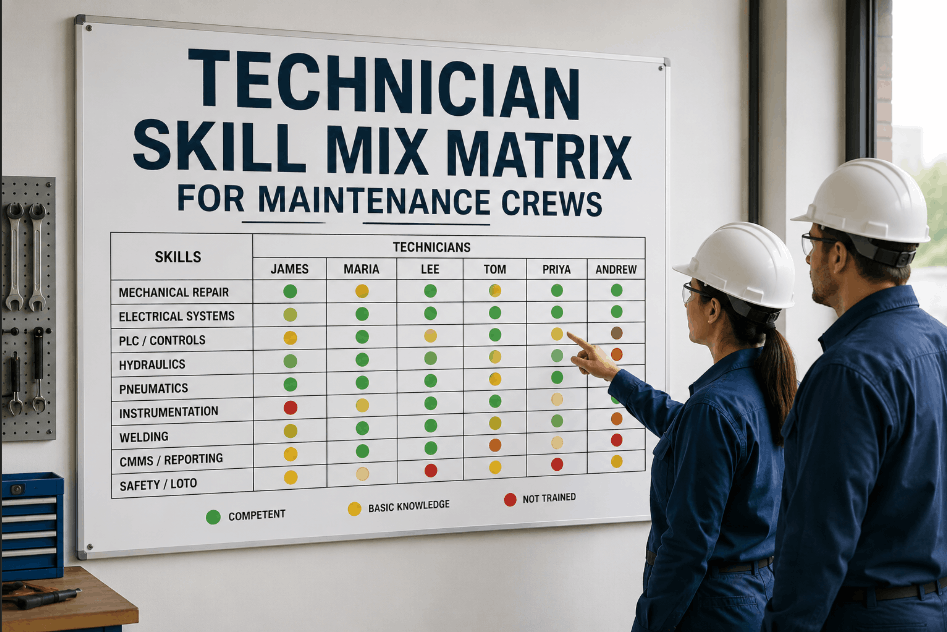
Technician Skill Mix Matrix for Maintenance Crews
Plot technician skill coverage against actual job demand to uncover qualification gaps, reduce overreliance on key personnel, and hold response times steady when workload spikes — using Oxmaint's CMMS to build a data-driven crew capability map.
61%Of maintenance response time failures trace back to skill availability gaps rather than total crew headcount shortages
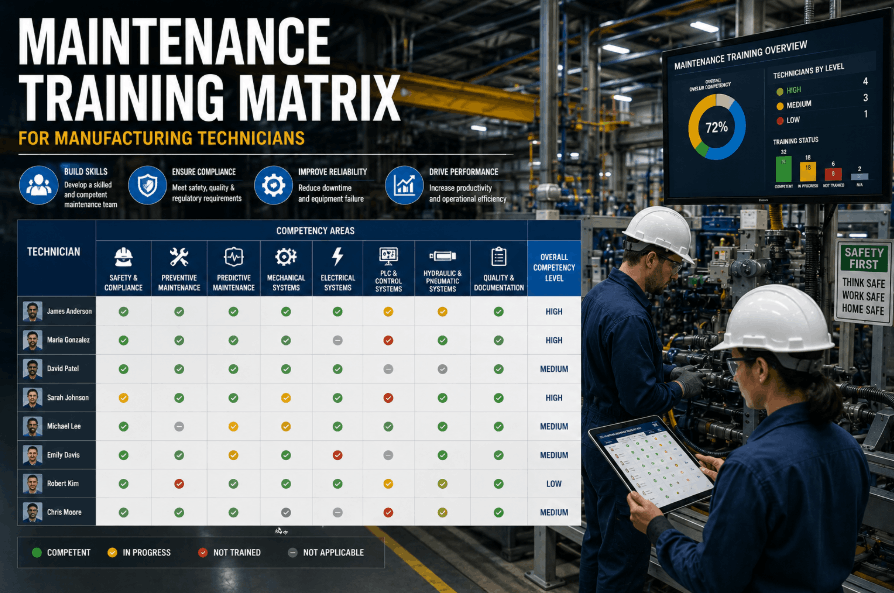
MatrixA skill mix matrix converts individual qualifications into a crew-level capability view — exposing coverage risk that headcount numbers hide
2–4xWrench time improvement potential when task assignments match technician qualification instead of defaulting to available headcount
GapTraining investment without a skill gap map is guesswork — demand-linked matrices make training priorities objective and defensible
Why Maintenance Crew Skill Gaps Stay Hidden Without a Structured Matrix
Headcount looks adequate on paper until the work order queue contains tasks that only two technicians are qualified to perform. Without a skill mix matrix that plots qualification coverage against job demand frequency, maintenance managers cannot see which skill categories are at risk — or where cross-training investment would have the highest operational impact. Book a Demo to see how Oxmaint connects technician qualification records to work order demand data for structured crew capability analysis.
Overreliance Risk
Single Points of Failure in Skill Coverage
When only one or two technicians hold qualification for a high-demand task category, their absence creates an immediate response gap. Oxmaint tracks task completion by technician qualification — making it possible to identify single-point coverage risks before an absence turns into a production delay.
Training Alignment
Investment Directed at the Wrong Skills
Training programs built on manager preference rather than demand analysis invest in skills that are already covered while leaving high-frequency gaps unaddressed. Oxmaint's work order history reveals which task categories drive the most demand, giving training planners an objective ranking of qualification gaps by operational impact.
The 4 Steps to Building a Technician Skill Mix Matrix
1
Qualification Inventory
Document every technician's current qualifications — trade certifications, OEM training completions, and task category authorizations. Oxmaint stores technician qualification records linked to work order task history, giving a current and verifiable qualification baseline for each crew member.
2
Job Demand Mapping
Classify work orders by required skill category and measure demand frequency per category over a rolling 90-day period. Oxmaint work order data captures task type, assigned technician, and completion time — enabling demand frequency analysis by skill category without manual extraction.
3
Coverage Gap Identification
Plot qualification coverage against demand frequency to surface high-demand skill categories with low crew coverage.
Book a Demo to see how Oxmaint structures the qualification-to-demand mapping that reveals crew coverage gaps by shift and asset category.
4
Training Priority Ranking
Rank identified gaps by demand frequency and response time impact to produce a defensible training investment priority list. Oxmaint's work order data provides the objective demand evidence that training justifications require — replacing gut-feel prioritization with measured operational need.
Skill Mix Matrix Reference — Maintenance Skill Categories
| Skill Category |
Typical Demand Frequency |
Min. Crew Coverage |
Response Time Target |
Cross-Train Priority |
Qualification Type |
| Electrical — low voltage |
High (daily) |
≥ 3 per shift |
≤ 30 min |
Critical |
Licensed / certified |
| Electrical — high voltage |
Medium (weekly) |
≥ 2 per facility |
≤ 2 hours |
High |
Licensed specialist |
| PLC / controls programming |
Medium (weekly) |
≥ 2 per facility |
≤ 4 hours |
High |
OEM or vendor cert |
| Mechanical — rotating equipment |
High (daily) |
≥ 3 per shift |
≤ 1 hour |
Critical |
Trade qualification |
| Hydraulic / pneumatic systems |
Medium (weekly) |
≥ 2 per shift |
≤ 2 hours |
Medium |
Practical assessment |
| Welding / fabrication |
Low (monthly) |
≥ 1 per facility |
≤ 24 hours |
Low |
Trade cert or external |
How Oxmaint Supports Technician Skill Mix Analysis for Maintenance Programs
Oxmaint connects technician records, work order assignment history, and task completion data into a single platform — giving maintenance managers the structured data foundation that crew capability analysis requires. Qualification records stored in Oxmaint are linked to the work orders technicians complete, making demand-to-qualification mapping a reportable output rather than a manual exercise. Sign Up Free to connect Oxmaint's workforce and work order modules and start building a skill mix matrix grounded in your actual job demand history.
Technician Qualification Records
Certifications, OEM training, and task authorizations stored per technician — linked to work order task history for demand-based analysis.
Work Order Demand Data
Work order task types and completion records provide the demand frequency baseline for skill coverage gap identification by category.
Shift Coverage Visibility
Qualification coverage mapped by shift — surfacing time-of-day coverage gaps that aggregate crew lists hide from management review.
Training Gap Reporting
Demand-linked skill gap reports generated from Oxmaint data — giving training planners objective priority rankings for cross-training investment.
Task Assignment Optimization
Work order assignments matched to technician qualifications in Oxmaint — reducing misassignment rates and improving first-time fix performance.
Utilization Tracking
Technician wrench time and utilization tracked by skill category — identifying underutilized qualifications and overloaded specialists for workload balancing.
Map Skill Coverage to Job Demand. Eliminate Response Time Gaps Before They Happen.
Oxmaint connects technician qualification records to work order demand data — giving maintenance managers the crew capability map they need to close skill gaps, reduce overreliance, and hold response performance steady under pressure.
Frequently Asked Questions — Technician Skill Mix Matrix
What is a technician skill mix matrix?
A skill mix matrix plots each technician's qualifications against the skill categories demanded by the work order queue — revealing where crew coverage is adequate and where gaps create response risk.
How does Oxmaint support skill gap identification?
Oxmaint links technician qualification records to work order task data — enabling demand-to-qualification mapping without manual spreadsheet analysis.
How often should a skill mix matrix be reviewed?
Quarterly reviews align with typical training cycles. Immediate review is warranted when crew composition changes or when a high-demand skill category falls below minimum coverage threshold.
What is the minimum coverage standard for critical skill categories?
High-demand categories should have at least three qualified technicians per shift to absorb absence, leave, and concurrent demand without a response gap.
Can Oxmaint track technician utilization by skill category?
Yes. Oxmaint work order completion records capture task type and assigned technician — enabling utilization analysis by qualification and demand category.
Build a Skill Mix Matrix That Protects Crew Response Performance.
Oxmaint connects qualification records, work order demand data, and crew coverage analysis — giving maintenance teams the capability map they need to close skill gaps, direct training investment, and hold response times steady when demand spikes.