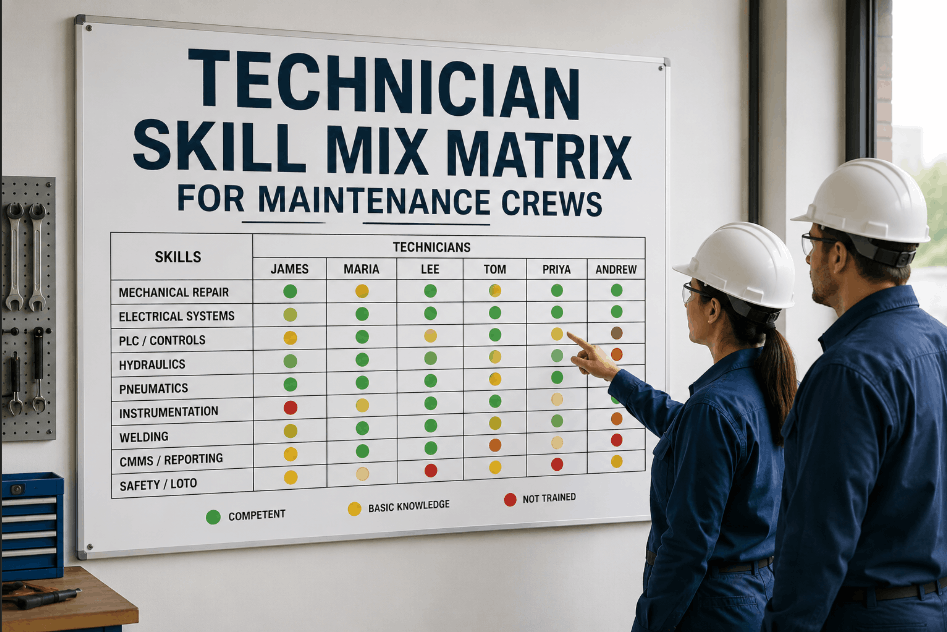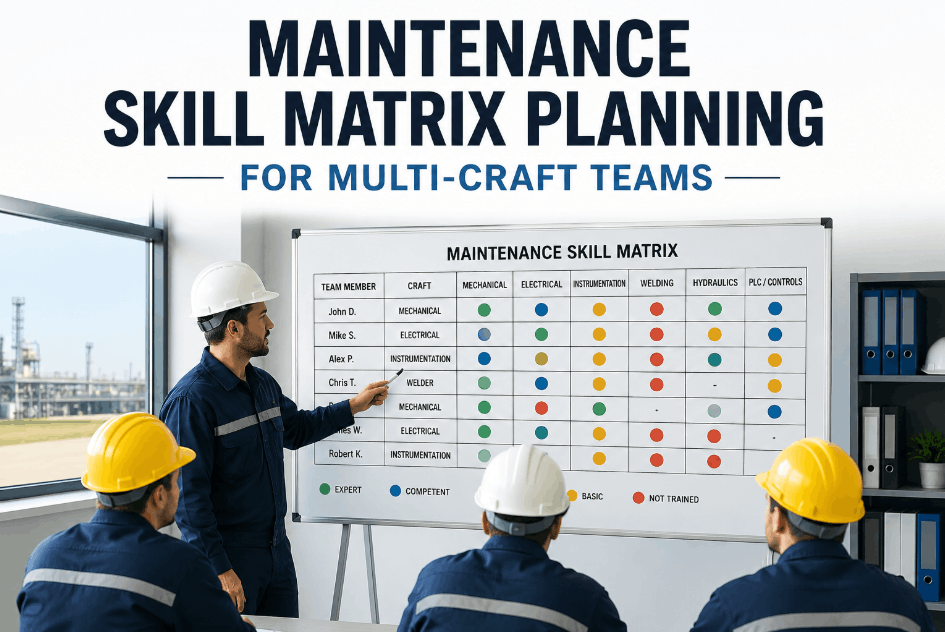
Skill gaps in multi-craft maintenance teams are rarely visible until a shift starts short-handed and the wrong technician is dispatched to the wrong asset. A maintenance skill matrix changes that — it maps each technician's verified capabilities against the task types your facility actually generates, so supervisors can plan coverage, identify training gaps, and allocate labor based on documented competency rather than assumption. Sign Up Free on Oxmaint and connect your workforce capability data directly to your work order and asset management system so skill coverage decisions are grounded in operational reality, not memory. Facilities that maintain structured skill matrices reduce unplanned overtime, improve first-time fix rates, and give maintenance leaders a clear foundation for workforce development planning. Book a Demo to see how Oxmaint supports multi-craft team planning across complex facility environments.
What a Maintenance Skill Matrix Actually Measures
A useful skill matrix goes beyond listing job titles. It documents verified competency levels by craft, task category, and asset type — and it is actively maintained as technicians complete training, earn certifications, or demonstrate new capabilities in the field. Sign Up Free on Oxmaint to structure capability tracking alongside your work order history so skill records reflect actual field performance, not just training completion.
Organize technicians by primary craft: electrical, mechanical, instrumentation, HVAC, plumbing, or multi-craft generalist. Each craft maps to specific asset categories and work order types within your CMMS so dispatch decisions align with documented competency, not assumed capability.
Rate each technician per task type across a defined scale — trainee, proficient, independent, and qualified to train others. Competency levels determine whether a technician can be dispatched solo, paired with a senior resource, or must be excluded from specific work order types without supervision.
Certain task types — electrical lockout/tagout, pressure vessel inspection, refrigerant handling — require active certifications. A skill matrix that tracks certification expiry dates prevents non-compliant dispatch and flags renewal needs before they create a coverage gap during a shift.
Skill data only has operational value when it's cross-referenced with shift schedules and site assignments. Mapping coverage by shift identifies whether critical asset categories have qualified coverage on nights, weekends, and planned leave periods — before a coverage gap becomes an emergency.
Skill Coverage Benchmarks by Facility Type and Craft Category
Setting minimum coverage thresholds for each craft category ensures that shift planning decisions are made against a defined standard, not left to supervisor judgment in the moment. Book a Demo to see how Oxmaint's workforce and work order data integrates to support coverage threshold planning across multi-site teams.
| Facility Type | Critical Craft | Minimum Coverage Per Shift | Certification Required | Gap Risk |
|---|---|---|---|---|
| Heavy Industrial / Plant | Electrical (HV) | 2 qualified per shift | HV switching authorization | Equipment shutdown risk |
| Healthcare Facility | HVAC / Mechanical | 1 per shift + on-call | EPA 608 refrigerant | Regulatory / patient safety |
| Commercial Office | Multi-craft generalist | 1 per shift | OSHA LOTO | Occupant comfort impact |
| Food & Beverage | Instrumentation | 1 per shift | Calibration certification | Production quality risk |
| Multi-Unit Residential | Plumbing / Electrical | 1 per site + on-call | Trade license (state) | Habitability compliance |
| Data Center | Electrical / Controls | 2 per shift minimum | DC power / UPS cert | Uptime / SLA breach |
Building a Functional Skill Matrix for Multi-Craft Teams
Audit Current Task Types Against Work Order History
Before documenting skills, pull your work order history by task category and asset type for the last 12 months. The task types your facility actually generates — not the ones in your job descriptions — define what capabilities your skill matrix must cover. Oxmaint's work order reporting gives you this breakdown without manual data extraction.
Define a Consistent Competency Rating Scale
Establish a four-level scale applied consistently across every technician and task type: Observer, Assisted, Independent, and Qualified to Train. Consistency in the rating definition matters more than the labels — vague scales produce skill matrices that supervisors distrust and stop using.
Record Skills in a System Linked to Work Orders
A skill matrix stored in a spreadsheet is disconnected from the operational decisions it should inform. Linking technician capability records to your CMMS means that work order routing, shift coverage checks, and training gap identification all draw from the same verified data source without manual cross-referencing.
Review Coverage Gaps by Shift and Site
Map verified skill coverage against your shift schedule and site portfolio. Identify which shifts carry risk — where a single absence removes the only qualified technician for a critical asset type. These are your highest-priority gaps for cross-training investment or external support arrangements.
Update the Matrix After Every Training Event and Field Milestone
A skill matrix is only reliable if it reflects current competency. Establish a process for updating ratings after completed training programs, certification renewals, and observed field performance milestones. Oxmaint's technician records allow supervisors to log training events directly against individual profiles so the matrix stays current without administrative overhead.