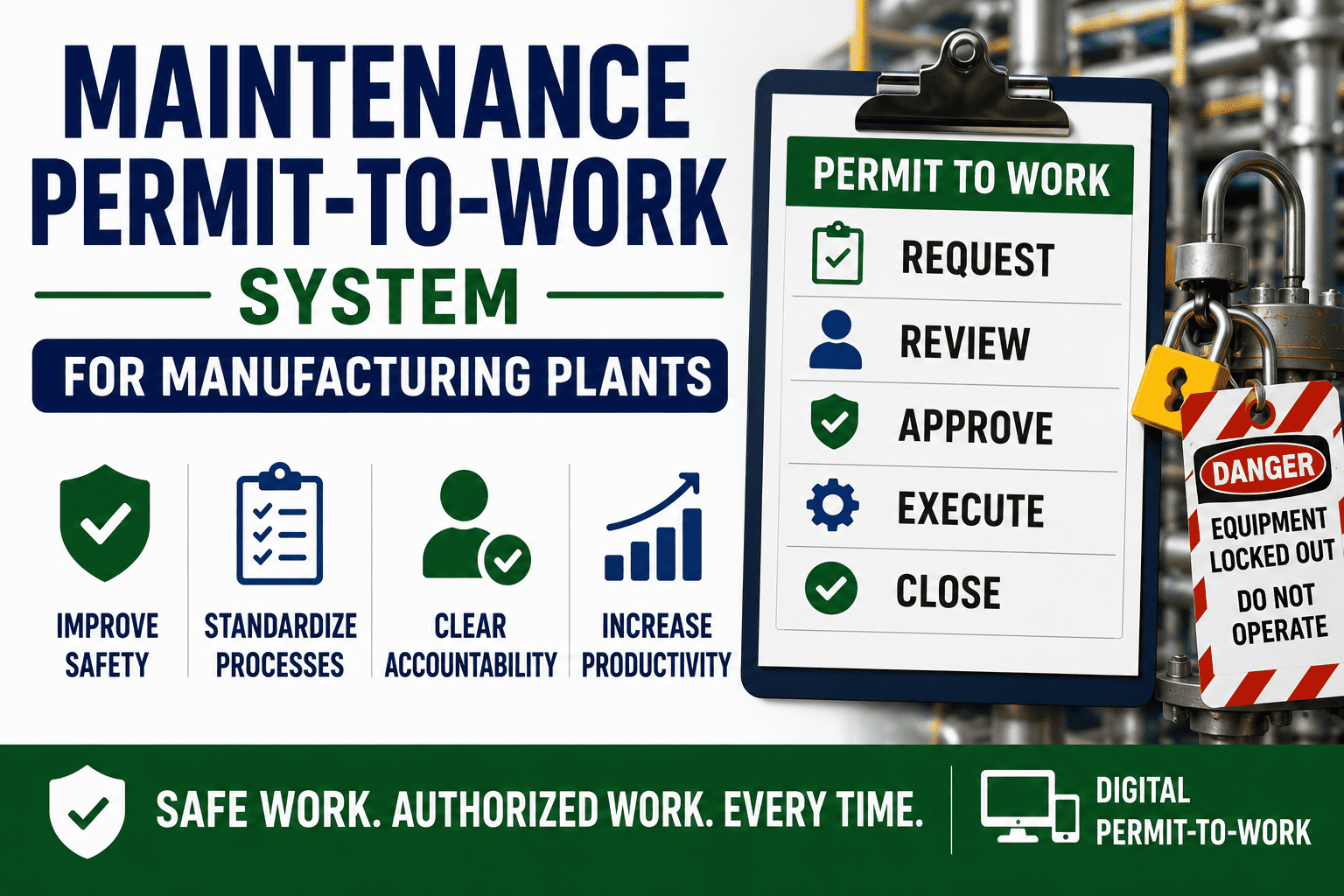
A permit-to-work system for manufacturing plants is the formal, documented authorization process that controls high-risk maintenance activities — hot work, confined-space entry, energized systems, working at height — so that no hazardous task begins until isolation, gas testing, and competent supervision are verified. For a manufacturing permit system to be defensible in an audit and genuinely protective on the plant floor, it must tie every permit directly to the underlying work order, asset, and isolation checklist inside your CMMS. This guide walks maintenance and reliability leaders through the permit types, authorization hierarchy, LOTO verification, and CMMS integration needed to deploy a digital plant permit-to-work system — and shows how OxMaint keeps permits and work orders from drifting apart. You can explore the full platform with a Start Free Trial or skip ahead and book a personalized walkthrough.
PERMIT-TO-WORK SYSTEM GUIDE
Is a paper permit the last barrier between your crew and a catastrophic maintenance incident?
Hot work fires, confined-space fatalities, and energized-system injuries rarely happen without warning — they happen when a permit-to-work system lives in a binder, gets signed in advance, and drifts from the actual work order. A digital manufacturing work permit system closes that gap by tying every authorization to the asset, the isolation checklist, and real-time gas-test results.
PERMIT TYPES
Six manufacturing work permit categories every plant must control
A robust plant permit-to-work system covers at least six high-risk activity classes. Each permit type carries its own isolation, testing, and authorization requirements — and each must be linked to the specific work order and asset in your CMMS so nothing gets approved in the abstract.
Hot Work Permit
Welding, cutting, grinding, or any spark-producing task near combustibles. Requires 35-ft clearance, fire watch for the duration plus 30 min after, and combustible-gas screening. The permit should auto-block if the linked work order's asset is in a classified area.
Confined Space Entry
Tanks, vessels, silos, and pits. Demands atmospheric testing (O₂ 19.5–23.5%, LEL below 10%), a dedicated attendant, rescue plan, and continuous monitoring. Time-boxed permits expire in 4–8 hours and require revalidation on shift change.
Electrical / Energized Work
Live work above 50V or near exposed conductors. Requires LOTO verification, arc-flash boundary checks, PPE category matching, and a qualified person's sign-off. A permit system CMMS should cross-reference the asset's single-line diagram and isolation points.
Working at Height
Tasks above 1.8 m requiring fall protection. Anchorage inspection, harness log, rescue plan, and exclusion zone setup are mandatory. The permit ties to scaffold tags and MEWP inspection records inside the CMMS asset register.
Ground Disturbance
Excavation or trenching deeper than 300 mm. Utility locates, shoring for trenches over 1.2 m, spoil setback, and a competent-person inspection are required before entry. Permits must reference utility drawings stored against the location in the CMMS.
Chemical / Line Break
Opening piping or vessels with hazardous contents. Demands double block-and-bleed isolation, drain-and-vent verification, SDS review, PPE selection, and contingency for residual product. The permit system should block line-break work until the linked isolation checklist is signed complete.
AUTHORIZATION HIERARCHY
How to structure a manufacturing permit authorization hierarchy
Permit authorization in manufacturing should follow a four-tier chain of accountability. Each tier can only sign off after the prior tier's checklist is electronically verified inside the CMMS permit system — no verbal approvals, no backdated signatures, no rubber-stamping.
Permit Applicant — Performing Technician
Initiates the permit request from the linked work order inside the CMMS, completes the task-specific risk assessment, confirms isolations required, and signs that the scope, tools, and PPE are understood. Cannot self-approve.
Isolation Verifier — Area Supervisor or Control Room
Physically applies and tests LOTO devices, confirms zero-energy state, witnesses gas-test readings, and signs the isolation register. The permit system CMMS blocks progression until the verifier's electronic signature and test readings are attached.
Permit Authorizer — Maintenance or Production Manager
Reviews the completed checklist, confirms no conflicting simultaneous permits on the same asset or isolation boundary, validates crew competency records, and authorizes the permit. Time-limited — typically 8 or 12 hours, auto-expiring.
Permit Closer — Applicant or Shift Handover
Confirms tools removed, isolations removed in reverse LIFO order, area inspected, and the work order closed in the CMMS. Shift handover requires a fresh authorization if the permit is extended. No open permits at end of shift — the system escalates overdue closures.
PERMIT SYSTEM vs CMMS
Paper permit-to-work vs CMMS-integrated permit tracking
Most plants still run permits on carbon-copy forms stored in a safety office. The gap between that paper and the actual work order is where incidents live. Here is what changes when permit management manufacturing operations move into a work permit CMMS.
| Capability | Paper / Spreadsheet Permit | CMMS-Integrated Permit System |
|---|---|---|
| Permit-to-work order linkage | Manual reference number, often mismatched or missing | 1:1 auto-link; permit cannot open without an active work order |
| Authorization audit trail | Wet signatures, hard to verify in real time, lost in filing | Time-stamped electronic signatures with role-based access |
| Isolation / LOTO verification | Checklist on paper, self-attested, no validation | CMMS blocks permit approval until isolation register is signed and zero-energy confirmed |
| Gas-test and atmospheric data | Handwritten readings, rarely trended or stored | Digital readings attached to permit and asset history; auto-flag if out of range |
| Simultaneous-permit conflict detection | Impossible — permits live in separate binders | System auto-detects overlapping permits on the same asset or isolation boundary |
| Permit expiry and shift handover | Relies on memory; permits left open overnight | Auto-expiry alerts; re-authorization required for extension or shift change |
| Audit and compliance reporting | Days of manual gathering; gaps and legibility issues | Instant filterable export by date, type, asset, authorizer, or status |
HOW OXMAINT HELPS
How OxMaint's CMMS permit system closes the permit-to-work gap
OxMaint embeds permit-to-work controls directly inside the work-order workflow — so authorization, isolation verification, and real-time permit tracking never drift apart from the maintenance task itself. Here is what that looks like in practice for a manufacturing plant managing 200–2,000 assets.
Permit-Linked Work Orders
Every high-risk work order can require a permit before the technician can change status to "In Progress." The permit auto-populates asset, location, and isolation points from the CMMS asset register — eliminating manual data entry and the mismatches that cause incidents. Plants typically cut permit preparation time by 40–60%.
Electronic LOTO & Isolation Verification
Digital isolation checklists with mandatory sign-off by the verifier role. The permit cannot advance to "Authorized" until every isolation point is confirmed applied and zero-energy tested. Eliminates the self-attested paper checklist — the single most common failure mode in permit systems.
Real-Time Permit Tracking & Auto-Expiry
Live dashboard of all open permits by type, area, and status. Permits auto-expire at the configured interval (4, 8, or 12 hours) and escalate to the shift manager if not closed or re-authorized. No open permits left unattended overnight — the root cause of roughly 1 in 4 permit-related incidents.
Conflict Detection & Audit-Ready Reporting
OxMaint automatically flags when two permits overlap on the same asset or shared isolation boundary — preventing the classic scenario where one crew de-energizes while another is working downstream. One-click compliance reports by date, permit type, authorizer, or asset for OSHA, ISO 45001, or corporate audit readiness.
WORKED EXAMPLE
A 180-asset food-processing plant eliminating paper permits
A mid-size plant running 12–15 permits per week on paper was spending roughly 4.5 hours per permit in preparation, chasing signatures, and filing — about 30 hours/week of supervisor time, or $62K/year in loaded labor. After deploying OxMaint's CMMS permit system, permit prep dropped to under 90 minutes, simultaneous-permit conflicts were caught before authorization (3 near-misses prevented in the first quarter), and the plant passed its ISO 45001 surveillance audit with zero nonconformities on permit-to-work documentation. Payback on the OxMaint subscription was under 4 months on labor savings alone — before counting the avoided incident cost.
See OxMaint's permit-to-work system on your assets
Book a 30-minute demo and we'll show you how permits link to work orders, LOTO verification, and real-time tracking — configured for your plant's permit types and authorization hierarchy.
FAQ
Permit-to-work system for manufacturing plants — common questions
What is a permit-to-work system in a manufacturing plant?
A permit-to-work system is a formal, documented authorization process that controls high-risk maintenance tasks — hot work, confined-space entry, energized electrical work, working at height — by requiring isolation verification, gas testing, competent-person sign-off, and time-limited approval before work begins. In a modern plant permit management setup, the permit is digitally linked to the work order and asset inside the CMMS so the authorization and the actual task never drift apart.
How does a CMMS integrate with a permit-to-work system?
A work permit CMMS like OxMaint ties each permit directly to the underlying work order, asset record, and isolation checklist. When a technician opens a high-risk work order, the system can require a permit before status changes to "In Progress"; the permit auto-populates asset and isolation data, blocks approval until LOTO is verified, and auto-expires if not closed or re-authorized. You can see this in action — book a demo and we'll walk through your permit types.
What are the most common permit types in manufacturing?
The six core permit categories are hot work, confined-space entry, electrical/energized work, working at height, ground disturbance, and chemical/line-break. Each carries distinct isolation, testing, PPE, and authorization requirements. A robust manufacturing safety permit system should template all six so technicians and authorizers follow the same checklist every time, with no field-modifiable shortcuts.
Who should authorize a permit to work in a manufacturing plant?
Authorization should follow a tiered hierarchy: the performing technician applies, an isolation verifier confirms LOTO and gas testing, and a maintenance or production manager authorizes — with the permit closer (or shift handover) confirming safe completion. No single person should both apply and authorize the same permit. The CMMS permit system enforces this separation through role-based electronic signatures.
How long should a manufacturing work permit remain valid?
Most permits are time-boxed to a single shift — typically 8 or 12 hours — and expire automatically at end of shift unless explicitly re-authorized. Confined-space permits often carry shorter windows (4–6 hours) with mandatory atmospheric re-testing. OxMaint's permit tracking CMMS auto-expires permits and escalates to the shift manager if they remain open, preventing the common failure of permits left active overnight. Start Free Trial to configure your expiry rules today.
Stop running your permits on paper
Deploy a digital permit-to-work system that links every authorization to the work order, the asset, and the isolation checklist — in days, not months.
Free 14-day trial · No credit card