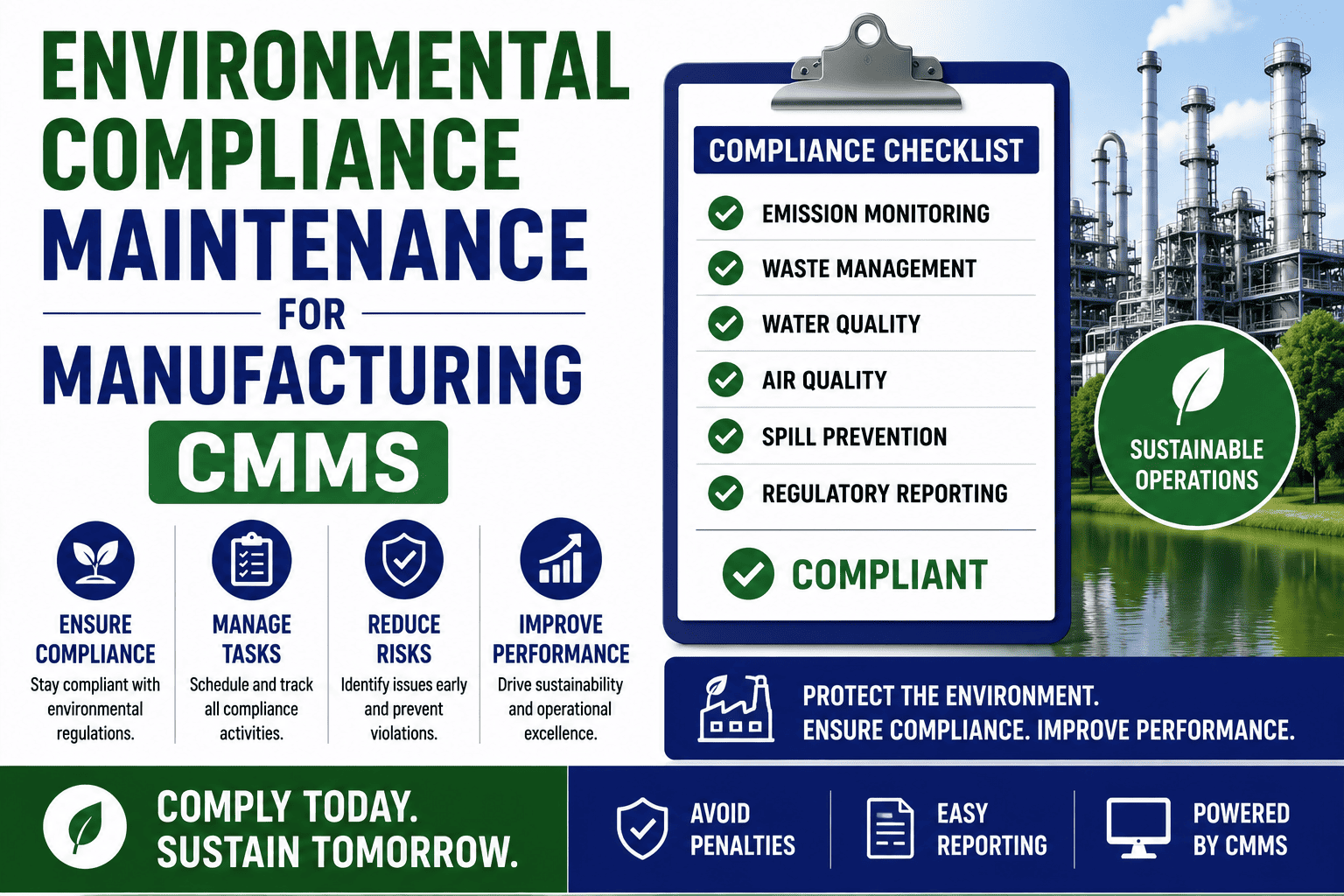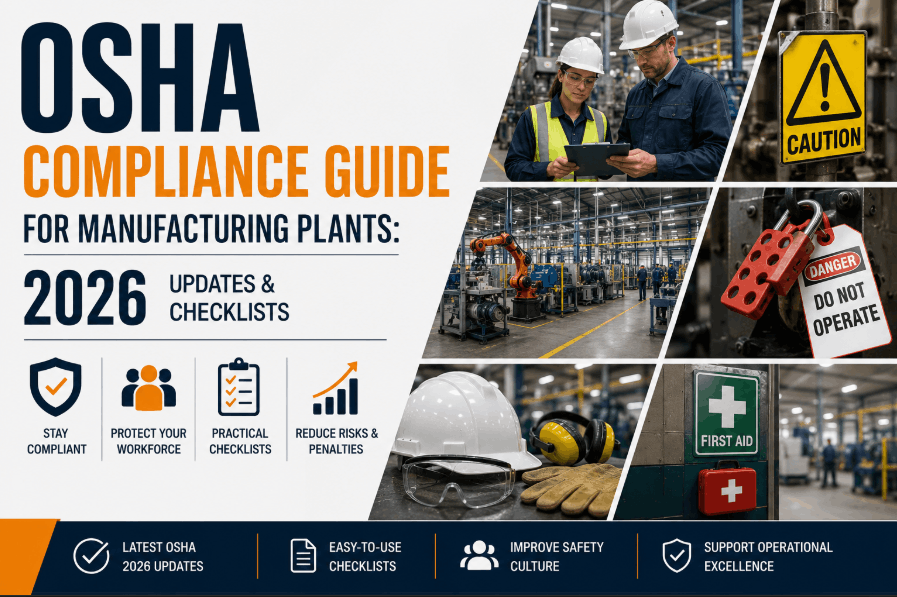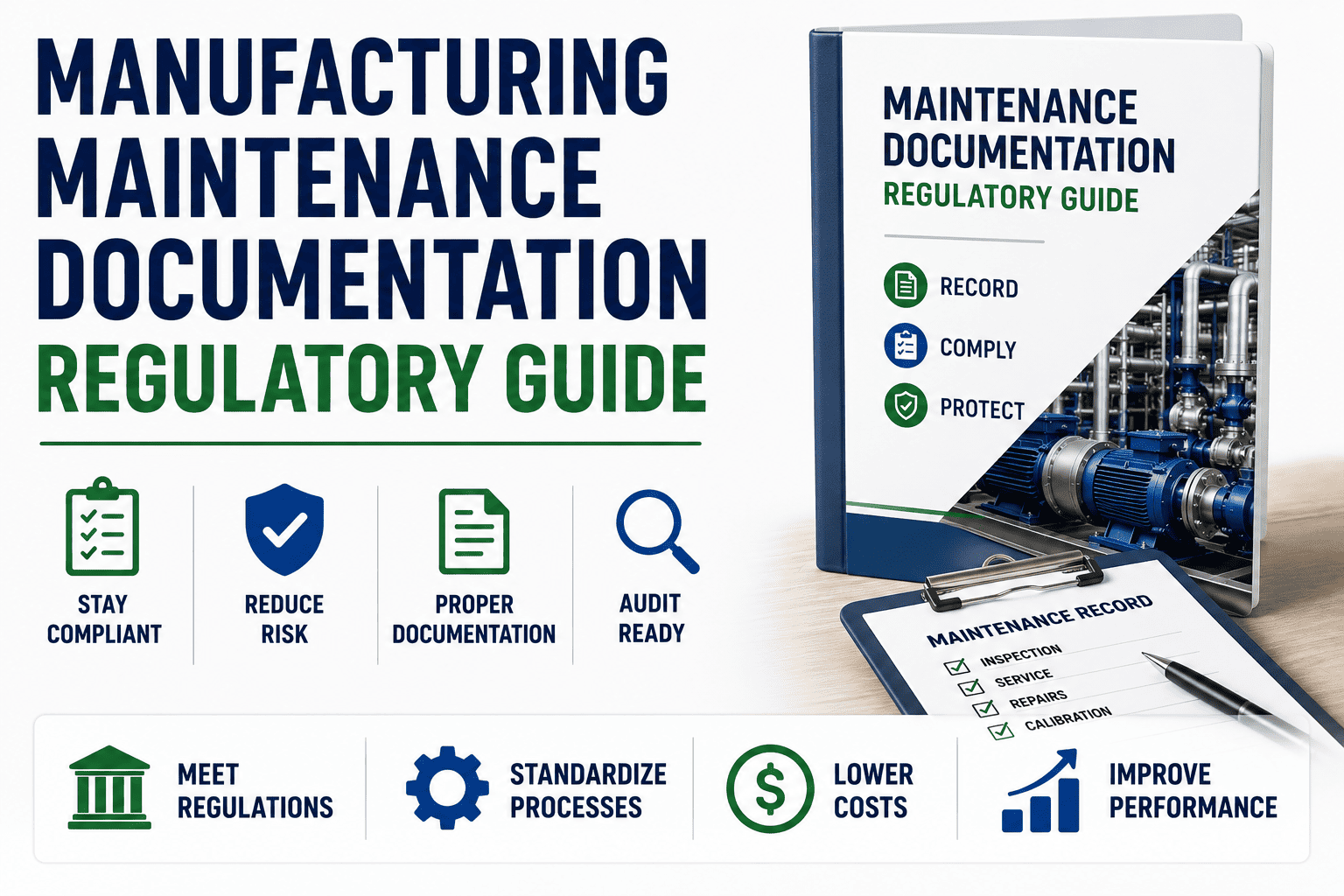
Regulatory audits in manufacturing maintenance no longer reward effort — they reward evidence. FDA, OSHA, EPA, and ISO auditors all want the same thing: a defensible chain of records showing that every asset was inspected, serviced, and signed off by the right person, at the right interval, with the right parts. Paper logs, shared spreadsheets, and after-the-fact data entry turn that evidence into a liability, with single non-conformance findings routinely costing $14,000–$80,000 in remediation plus days of lost production. This guide breaks down what auditors actually look for in maintenance documentation, how 21 CFR Part 11 and ISO 9001 reshape recordkeeping, and how to configure your CMMS so it is audit-ready on any Tuesday — not just the week an inspector shows up. Start Free Trial and turn documentation from a fire drill into a finished workflow.
MAINTENANCE DOCUMENTATION
What will your maintenance records look like the morning an auditor walks in?
FDA, OSHA, EPA, and ISO audits rise or fall on the quality of your maintenance documentation — and binders of paper won't survive the first hour. Make every work order, signature, and retention rule audit-ready by default.
THE FOUR REGULATORY LENSES
What each agency actually expects from your maintenance records
Different regulators inspect maintenance documentation through different lenses — but the records they request overlap by roughly 70%. Knowing each lens lets you build one documentation set that satisfies all of them.
Worker safety & equipment readiness
OSHA 1910.147 (lockout/tagout) and 1910.1200 (hazcom) demand that every energized service event be documented with the authorized employee, the energy sources isolated, and the verification step. Missing LOTO logs are among the top 10 most cited violations, with penalties starting at $16,131 per occurrence.
Emissions, refrigerants & hazardous waste
SPCC plans, refrigerant leak-repair records under Section 608, and Tier II chemical inventories all depend on maintenance logs. A single undocumented refrigerant top-off above the 30% annual threshold can trigger a $44,539-per-day EPA penalty under the Clean Air Act.
Electronic records & signatures
For food, drug, and medical-device plants, Part 11 requires that electronic maintenance records be secure, time-stamped, attributable, and audit-trailed. A "closed system" must prove who changed what, when, and why — handwritten initials on a printout no longer qualify.
Quality & asset management systems
ISO 9001:2015 clause 7.5 and ISO 55001 both demand documented evidence that maintenance was planned, executed, and reviewed. Auditors sample 5–10 work orders per asset class and trace them end-to-end — gaps here trigger major non-conformities that can suspend certification.
PART 11 DEEP DIVE
Five 21 CFR Part 11 controls your CMMS must prove on demand
If you operate in any FDA-regulated space, Part 11 is the gatekeeper. Auditors will test each of the five controls below with a live demonstration — not a slideshow.
Validated electronic signatures
Every signature must be linked to a unique user ID, a meaning ("approved," "reviewed," "executed"), and a tamper-evident timestamp. Shared logins fail this control on the first screen.
Immutable audit trail
Any change to a work order, meter reading, or failure code must record the old value, the new value, the user, and the reason — and the trail cannot be editable by the original user or any administrator.
Secure, role-based access
Roles must enforce least privilege: a technician can close a work order but not approve it; a supervisor can approve but not delete. Password complexity, lockout after 3 attempts, and 90-day rotation are baseline.
Device time synchronization
All timestamps must derive from a single NTP-synced server, not a technician's phone. Out-of-sequence timestamps are the most common Part 11 observation and invalidate the record.
Record retention & retrieval
Records must be retained for the life of the asset plus 2 years (FDA) or per OSHA's 3-year minimum for LOTO. Retrieval of any random work order must take under 5 minutes during an audit.
RETENTION REFERENCE
How long must each record survive?
Retention rules vary by agency and record type — but the longest applicable rule always wins. Use this table to set your CMMS retention policy once, then let automation enforce it.
| Record type | Primary regulator | Minimum retention | Format requirement |
|---|---|---|---|
| Lockout/tagout (LOTO) inspections | OSHA 1910.147 | 3 years | Signed certification + each energization log |
| Preventive maintenance work orders | ISO 9001 / FDA | Asset life + 2 years | Electronic, Part 11-compliant |
| Refrigerant service logs | EPA Section 608 | 3 years | Quantity, type, technician ID, leak check |
| SPCC inspections & integrity tests | EPA 40 CFR 112 | 3 years (routine) / life of tank (integrity) | Inspector signature + corrective actions |
| Calibration records | ISO 9001 / FDA QSR | Asset life + 2 years | Before/after readings, standard used, pass/fail |
| Hazardous waste manifests | EPA RCRA | 3 years from shipment date | Signed manifest, electronic preferred |
| Mechanical integrity (PSM) records | OSHA 1910.119 | Life of equipment | Inspection date, inspector, deficiencies, fixes |
WORKED EXAMPLE
A 180-asset food plant turns $42K of audit risk into $0
Numbers make the cost of paper versus a CMMS tangible. Here is a real-world scenario drawn from a mid-size food-processing operation that moved from binders to an audit-ready CMMS.
BEFORE — PAPER & SPREADSHEETS
42 hrs/audit × $85/hr + 2 findings × $18,500 avg = $71,700 / audit
Plus 11 production hours lost pulling records and 6 missing PM signatures flagged as major non-conformities.
AFTER — CMMS AUDIT-READY
3.5 hrs/audit × $85/hr + 0 findings × $18,500 = $298 / audit
Full audit trail exported in one click. Payback on the CMMS subscription: under 4 months.
CMMS CONFIGURATION
Seven settings that make your CMMS audit-ready by default
Audit-readiness is a configuration problem, not a discipline problem. Flip these seven settings once and the evidence builds itself every shift.
Mandatory electronic signatures
Require a re-authenticated signature (username + password) at work-order close, not a checkbox click.
Mandatory reason-for-change fields
Any edit to a closed record forces a free-text reason that is written to the audit trail and cannot be blank.
Automated PM scheduling with proof
Every PM generates a work order 7 days before due date and escalates to the maintenance manager if missed by 24 hours.
Parts traceability on every work order
Tie each part issued to a lot number and supplier so a recall can be traced to the asset and technician in minutes.
Role-based approval workflows
Configure a two-step approval for any PM over $500 or any corrective work order on a critical-to-quality asset.
One-click audit export bundles
Save a pre-built filter that exports every work order, signature, and audit-trail entry for a date range as a single PDF.
Retention policy enforcement
Set per-record-type retention so old records archive automatically — but never before the regulatory minimum elapses.
DON'T WAIT FOR THE AUDIT NOTICE
Turn your CMMS into an audit-grade evidence machine
Configure signatures, audit trails, and retention policies in one afternoon — then sleep through every inspection.
FREQUENTLY ASKED
Maintenance documentation compliance, answered
Does 21 CFR Part 11 apply if we only keep paper records?
Part 11 applies only to electronic records used to fulfill a regulatory requirement. However, FDA has clarified that if you maintain a paper system as the official record, that system must still meet the underlying predicate rules (e.g., cGMP). Most plants now use a CMMS as the system of record, which triggers Part 11 — and paper printouts become secondary copies, not the source of truth.
How long must we retain OSHA lockout/tagout records?
OSHA 1910.147 requires that periodic LOTO inspections be certified at least annually and the certification retained for at least 3 years. The certification must include the machine, the date, the employees involved, and the person performing the inspection. A CMMS that auto-generates and stores these certifications eliminates the binder-hunt entirely.
What is the single most common maintenance documentation failure during ISO audits?
Incomplete corrective-action closure. ISO 9001 auditors consistently flag work orders that mark a problem "fixed" without documenting the root cause, the corrective action taken, and the verification of effectiveness. Configuring your CMMS to require these three fields before close reduces this finding by an estimated 80%. Book a Demo to see the workflow live.
Can a CMMS audit trail satisfy EPA inspectors too?
Yes, provided the CMMS captures the data elements EPA specifically requires — refrigerant type and quantity for Section 608, tank integrity test results for SPCC, and waste manifest numbers for RCRA. The audit trail itself satisfies the evidentiary standard; the fields you configure determine whether the right data is captured in the first place.
How fast can we get from paper logs to an audit-ready CMMS?
A focused implementation takes 4–6 weeks: week 1–2 for asset hierarchy and PM templates, week 3 for signature workflows and role setup, week 4 for retention policies and audit export bundles, and week 5–6 for team training and a mock audit. Most plants see full payback within the first quarterly inspection cycle. Start Free Trial to begin the configuration today.
YOUR NEXT AUDIT STARTS NOW
Be audit-ready every day, not just inspection week
Join the plants that cut audit prep from 42 hours to 3.5 — and zero findings — with an audit-grade CMMS.
Free 14-day trial · No credit card