
Your electronics assembly line stops unexpectedly. The SMT machine throws a cryptic error code. Production halts. Technicians scramble through paper logs trying to understand what happened. Meanwhile, the PLC has been collecting thousands of data points—cycle counts, temperature deviations, pressure anomalies—but nobody's looking at it until after the failure.
Here's the costly disconnect: Your PLCs know exactly what's happening with every machine in real-time. Your CMMS tracks maintenance schedules and compliance records. But they don't talk to each other. The result? You're blind to developing problems until catastrophic failures occur, costing $85K-$250K per incident in emergency repairs and lost production. Regulatory auditors demand proof of equipment monitoring—but you're manually piecing together data from multiple disconnected systems taking days to generate reports that should take minutes.
Modern PLC-CMMS integration changes everything. Smart systems like Oxmaint CMMS connect directly to PLCs and industrial controllers, automatically capturing machine performance data, triggering maintenance work orders when parameters exceed thresholds, creating audit-ready compliance logs without manual data entry, and displaying real-time equipment health on unified dashboards. Electronics manufacturers implementing integrated systems achieve 70-85% reduction in unplanned downtime, 100% automated compliance documentation meeting FDA/ISO/IPC requirements, and $1.2M-$3.5M annual savings through prevented failures and operational efficiency.
Tired of blind spots between your PLCs and maintenance system?
PLC-CMMS integration delivers real-time equipment visibility, automated compliance, and predictive maintenance. See how 100+ electronics manufacturers transformed operations.
Why PLC Data Integration Is Critical for Electronics Assembly
Electronics assembly operates under intense regulatory scrutiny—FDA for medical devices, ISO 9001/13485 for quality management, IPC standards for electronics manufacturing. Regulators demand documented proof that equipment operates within specification and receives proper maintenance. Traditional approaches fail spectacularly:
The 5 Compliance Nightmares of Disconnected Systems
1. Manual Data Collection Disasters
Operators record PLC readings on paper clipboards hourly. Data gets transcribed into spreadsheets weekly. Maintenance records live separately in CMMS. When auditors ask "prove this reflow oven maintained 235°C ± 3°C specification during production of Lot #4582," you spend 3 days manually correlating handwritten logs, Excel files, and CMMS records.
The cost: 120-180 hours monthly in manual documentation (3-4 FTEs worth $180K-$280K annually). Audit findings for incomplete records ($50K-$150K citations). Production delays waiting for manual verification (avg 4-8 hours per incident = $120K-$280K annually).
2. Reactive Maintenance From Blind Spots
PLCs detect early warning signs—slight temperature drift, cycle time creep, pressure variations—weeks before failures occur. But without integration, nobody sees these signals until catastrophic breakdown forces emergency response.
The cost: Emergency downtime averaging 8-16 hours per incident (15-25 incidents annually = $900K-$2.4M lost production). Expedited parts and overtime labor (additional $250K-$600K annually). Quality rejections from out-of-spec production before failure detection ($150K-$450K).
3. Compliance Exposure From Data Gaps
FDA investigators demand complete equipment qualification records including: installation qualification (IQ), operational qualification (OQ), performance qualification (PQ), and ongoing performance monitoring. Disconnected systems create documentation gaps where manual processes failed to capture critical data.
The cost: Warning letters requiring comprehensive remediation ($500K-$2M corrective action programs). Product holds while validation gaps resolved ($1M-$5M revenue impact). Repeat inspection scrutiny increasing audit frequency and intensity.
4. Impossible Real-Time Visibility
Plant managers need to know: Which machines are overdue for PM? Which equipment is showing early degradation signs? What's the overall equipment effectiveness (OEE) across production lines? With disconnected systems, generating these reports requires manual data compilation taking days or weeks—far too slow for proactive decision-making.
The cost: Preventive maintenance missed because PM schedules not updated with actual machine runtime ($200K-$500K in preventable failures). Optimization opportunities invisible until quarterly reviews (opportunity cost $150K-$400K).
5. Tribal Knowledge Dependency
Experienced technicians "know" which machines are problematic and recognize subtle PLC warning signs. When they retire or leave, that knowledge disappears. New technicians operate blindly without systematic alerts triggering interventions.
The cost: Knowledge loss during workforce transitions (avg 18-24 months reduced effectiveness per new hire). Repeated mistakes from lack of historical context. Inability to scale operations to additional facilities without recreating expertise from scratch.
Accelerate Manufacturing & Plants Compliance Through Condition Monitoring
Imagine FDA auditors walking your floor asking: "Show me documented proof your pick-and-place machines operated within temperature specification during production of serialized devices shipped last quarter." Instead of panicking, you pull up a dashboard displaying complete historical data—every temperature reading, every cycle count, every maintenance action—with timestamps, operator credentials, and automated compliance logs. The entire audit query resolved in 90 seconds instead of 3 days.
The 3-Layer PLC-CMMS Integration Architecture
Real-Time PLC Data Acquisition & Normalization
Establish bidirectional communication between industrial controllers and CMMS creating unified data lake:
- Protocol support: OPC UA, Modbus TCP, EtherNet/IP, PROFINET—connecting PLCs from Siemens, Allen-Bradley, Mitsubishi, Omron, Schneider regardless of manufacturer
- Parameter monitoring: Process variables (temperature, pressure, flow), cycle counters, alarm history, runtime hours, error codes, quality metrics (Cpk, defect rates)
- Data normalization: Convert diverse PLC data formats into standardized structure enabling cross-equipment analytics and reporting
- Edge computing: Local processing filters noise and detects anomalies before cloud transmission reducing bandwidth requirements 80-90%
- Continuous streaming: 1-second to 1-minute update intervals providing near-real-time visibility vs. hourly manual checks
Intelligent Condition Monitoring & Predictive Alerts
AI algorithms analyze PLC data streams identifying degradation patterns and triggering proactive maintenance:
- Statistical process control: Establish control limits for critical parameters—system alerts when trends approach thresholds before exceeding specifications
- Predictive models: Machine learning correlates PLC parameters with historical failures forecasting remaining useful life (RUL) of components
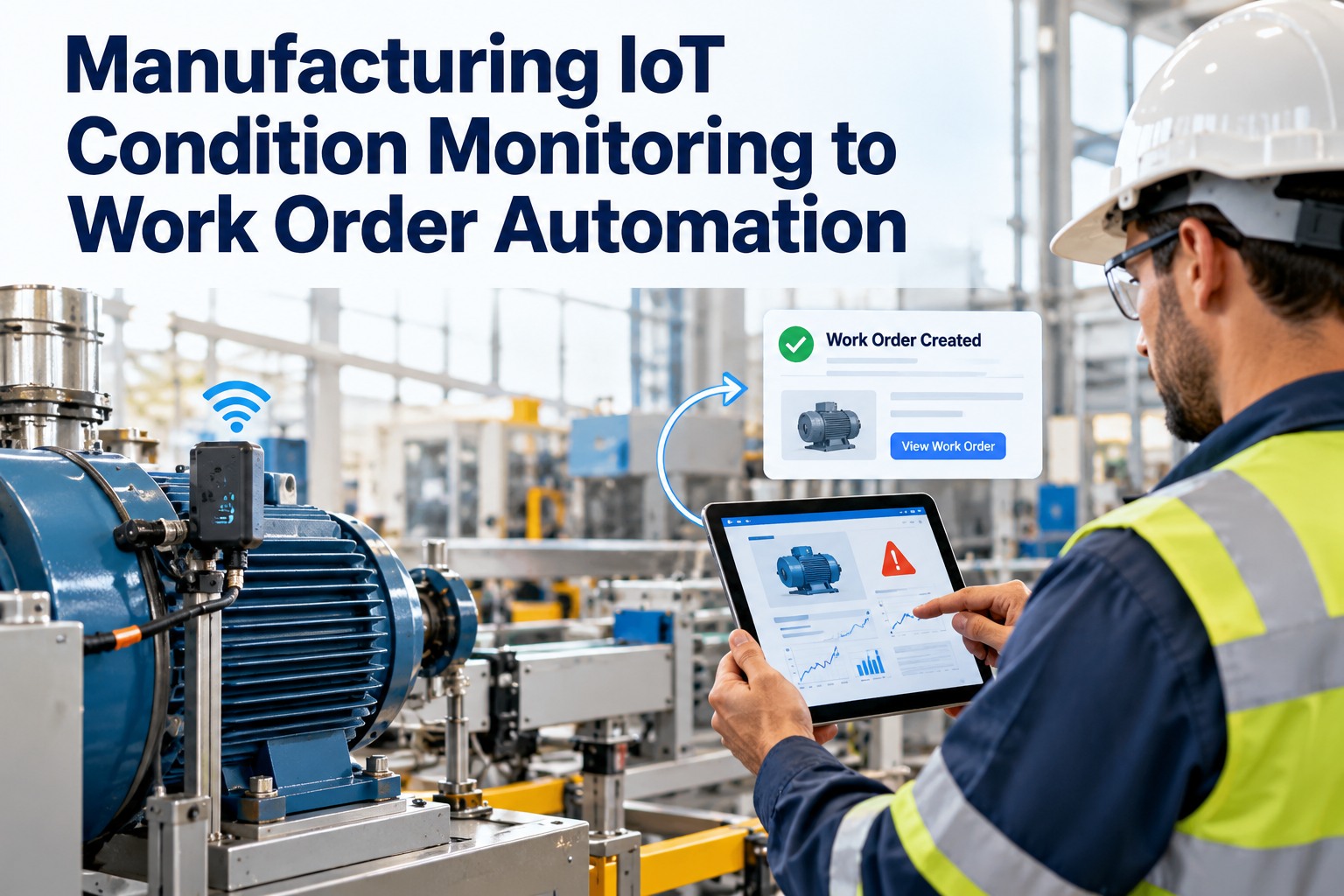
- Automated work orders: When PLC data indicates maintenance need, Oxmaint automatically generates work orders with complete diagnostic context—affected equipment, observed anomaly, probable cause, recommended action
- Priority routing: Critical equipment anomalies trigger urgent notifications to maintenance team with SMS/email escalation if unacknowledged
- False positive suppression: AI learns normal operating variability distinguishing genuine degradation from benign process fluctuations—maintaining 85-90% alert accuracy
Automated Compliance Documentation & Audit Trails
System automatically generates comprehensive compliance records meeting regulatory requirements without manual data entry:
- Equipment qualification documentation: IQ/OQ/PQ records linking equipment specifications, calibration certificates, PLC verification data, and performance test results
- Batch/lot traceability: Correlate production lot numbers with equipment used, PLC parameters during manufacturing, maintenance performed, and operator credentials—complete genealogy for regulatory investigations
- Deviation management: Automatic flagging when PLC readings exceed specifications with documented investigation, root cause, corrective action, and effectiveness verification
- 21 CFR Part 11 compliance: Electronic signatures, audit trails, data integrity controls meeting FDA requirements for electronic records
- Reporting automation: One-click generation of compliance reports for FDA inspections, ISO audits, customer quality reviews—complete data in minutes vs. days of manual compilation
Standardizing Compliance at Scale — A Manufacturing & Plants Blueprint with Digital Logs
The hardest challenge isn't integrating one production line—it's scaling standardized compliance across multiple lines, multiple facilities, multiple regions with different regulatory requirements. Digital integration creates the framework for enterprise-wide consistency impossible with manual systems.
Enterprise-Scale PLC-CMMS Integration Strategy
Standardized Equipment Asset Registry with Digital Twins
Create comprehensive equipment database serving as single source of truth across organization:
- Barcode/QR asset tracking: Every machine, tool, fixture labeled with unique identifier linking to digital record containing: OEM manuals, spare parts list, maintenance history, PLC connection details, compliance requirements
- Digital twin architecture: Virtual representation of physical equipment integrating: PLC real-time data, maintenance schedules, performance baselines, degradation models, failure predictions
- Standardized nomenclature: Consistent equipment naming, parameter definitions, alarm classifications across facilities eliminating confusion and enabling cross-plant analytics
- Mobile asset verification: Technicians scan barcode before maintenance confirming correct equipment and retrieving real-time PLC status plus historical context
Implementation approach: Start with critical equipment on one production line (20-30 machines). Document thoroughly with photos, specifications, PLC points. Replicate template to remaining equipment. Typical timeline: 50-100 assets fully documented per month with dedicated resources.
Mobile Work Order Execution with PLC Context Integration
Technicians receive maintenance alerts on mobile devices with complete equipment context from PLC integration:
- Contextual work orders: Alert includes not just "Check reflow oven temp sensor" but current PLC readings, deviation from baseline, trend over past 30 days, and probable failure mode based on pattern analysis
- Guided troubleshooting: Mobile app displays decision tree workflows based on PLC symptoms—if temp sensor reading erratic, check connections; if steady but inaccurate, verify calibration; if out of range, replace sensor
- Real-time validation: After corrective action, technician observes PLC parameters on mobile device confirming repair effectiveness before closing work order—no return trips for "did we actually fix it?"
- Photo documentation integration: Mandatory before/after photos linked to PLC data snapshots creating visual + data compliance record
- Offline capability: Mobile app functions in RF-shielded production areas syncing data when connectivity restored
Implementation approach: Configure Oxmaint mobile app with equipment-specific troubleshooting workflows. Train technicians on smartphone/tablet usage (typically 2-4 hours per person). Pilot on one shift before full deployment. Adoption typically exceeds 90% within 2 weeks with proper training and demonstrated value.
Continuous Compliance Monitoring & Automated Reporting
Transform compliance from periodic manual exercise to continuous automated verification:
- Real-time compliance dashboards: Live visibility into: equipment operating within specifications, PM schedules on track, calibrations current, training up to date, quality metrics trending—identify issues immediately vs. discovering during audits
- Exception-based monitoring: System automatically flags non-conformances: equipment operated outside specification limits, missed PM deadlines, expired calibrations, incomplete documentation—triggering corrective action workflows
- Regulatory report automation: Pre-configured templates for common compliance requirements (FDA, ISO, IPC, IATF) auto-populating with integrated PLC + CMMS data—generate comprehensive audit responses in minutes
- Trend analysis for CAPA: Identify systemic compliance patterns requiring corrective/preventive action—repeated temperature excursions on specific equipment, PM tasks consistently running late, training gaps on certain procedures
Implementation approach: Configure dashboards specific to regulatory requirements (FDA medical device manufacturers different views than ISO automotive). Establish review cadence (daily for production supervision, weekly for quality management, monthly for executive leadership). Typical setup: 20-40 hours defining KPIs and building initial dashboards, then continuous refinement based on user feedback.
What Results Can You Actually Expect? (Real Numbers)
Moving beyond theory to actual implementation results. Here's what electronics assembly facilities achieve with PLC-CMMS integration:
Typical 12-Month Results (Mid-Size Electronics Assembly Facility)
- Before integration: 22-28 unplanned stoppages annually
- After integration: 5-8 unplanned stoppages annually
- Improvement: 70-75% reduction
- Savings: $1.2M-$2.1M (prevented production losses at $60K-$80K per incident)
- Before integration: Out-of-spec production 8-12 times annually
- After integration: Early detection prevents spec violations
- Improvement: 85-95% reduction in quality escapes
- Savings: $280K-$520K (prevented rework, scrap, customer returns)
- Before integration: Manual documentation 3-4 FTEs (120-180 hrs/month)
- After integration: Automated capture, minimal manual intervention
- Improvement: 85-90% labor reduction
- Savings: $180K-$280K annually in labor redeployment
- Before integration: Reactive troubleshooting, repeated failures
- After integration: Predictive maintenance, first-time fix improvement
- Improvement: 35-45% reduction in maintenance hours
- Savings: $125K-$220K annually in labor + parts optimization
- Before integration: Audit findings, warning letters, remediation costs
- After integration: Comprehensive documentation, zero findings
- Risk Avoidance: $500K-$2M per major compliance incident
- Soft Benefits: Reduced audit frequency, faster product approvals
- Oxmaint CMMS with PLC integration module: $65,000 - $95,000
- Industrial IoT gateway hardware (OPC UA servers, edge devices): $35,000 - $55,000
- PLC protocol licenses and middleware: $15,000 - $25,000
- Integration engineering and configuration: $45,000 - $75,000
- Training and change management: $20,000 - $30,000
Stop operating blind between your PLCs and maintenance system
Unified PLC-CMMS integration delivers predictive maintenance, automated compliance, and measurable ROI. Join 100+ electronics manufacturers using Oxmaint for intelligent operations management.
Implementation Best Practices for Electronics Assembly
Successfully integrating PLC and CMMS systems requires systematic approach balancing technical configuration with organizational change management:
7 Critical Success Factors
1. Start with Critical Equipment, Not Everything
Attempting to integrate entire facility simultaneously overwhelms teams and delays value realization. Instead, identify 20-30 most critical machines—production bottlenecks, quality-critical equipment, high-failure-rate assets, or regulatory focus areas. Prove ROI on pilot before expanding.
Quick Start: Convene cross-functional team (production, maintenance, quality, IT) selecting pilot equipment. Prioritize by: production impact if failed, regulatory scrutiny level, current failure frequency. Target equipment generating 60% of downtime or quality issues despite being only 20-30% of asset base.
2. Define Meaningful KPIs Before Integration
Integration generates massive data volumes. Without predefined objectives, you'll drown in information without actionable insights. Establish specific metrics you're trying to improve: OEE percentages, MTBF increases, MTTR reductions, compliance documentation time, quality escape rates.
Quick Start: Baseline current performance on pilot equipment: current OEE (typically 65-75% electronics assembly), unplanned downtime incidents per month, average troubleshooting time per failure. Set specific improvement targets (e.g., increase OEE to 85%, reduce downtime 60%, cut troubleshooting 40%).
3. Invest in Industrial-Grade IoT Infrastructure
Consumer IoT solutions fail in harsh industrial environments. Electronics manufacturing involves ESD-sensitive areas, RF interference, temperature extremes, and 24/7 operation demands. Deploy industrial-grade components with: wide temperature range (-40°C to +85°C), industrial protocols (OPC UA, not consumer Wi-Fi), redundant communications, and proven reliability in manufacturing environments.
Quick Start: Partner with experienced industrial IoT integrator—don't attempt DIY unless your IT team has specific OT (operational technology) expertise. Budget 15-25% of project cost for robust edge infrastructure preventing connectivity issues during production.
4. Establish Clear Data Governance Policies
PLC integration creates questions: Who can modify PLC connection configurations? What happens if real-time data contradicts manual operator entries? How long is historical data retained? Who has authority to override automated alerts? Address these before deployment preventing conflicts during operations.
Quick Start: Document: data ownership (OT vs IT responsibilities), change control procedures for PLC mapping modifications, conflict resolution protocols when data sources disagree, retention policies meeting regulatory requirements (typically 7-10 years electronics/medical), and escalation paths for system issues.
5. Train Cross-Functional Teams, Not Just Maintenance
PLC-CMMS integration affects multiple departments: operators monitoring dashboards, technicians responding to alerts, quality investigating deviations, engineers analyzing trends, managers making decisions. Everyone needs role-appropriate training understanding how integrated system changes their workflows.
Quick Start: Develop role-based training: operators (30-60 min on dashboard interpretation), technicians (2-4 hours on mobile tools + PLC context), quality (1-2 hours on deviation management), supervisors (1-2 hours on KPI tracking). Hands-on practice in test environment before production deployment.
6. Tune Alert Thresholds to Prevent Alarm Fatigue
Initial deployment often generates excessive alerts as AI learns normal operating patterns. If technicians receive 50 alerts daily with only 2-3 requiring action, they'll start ignoring all alerts (the "cry wolf" problem). Start conservative, then adjust thresholds based on operational experience achieving 85-90% alert accuracy.
Quick Start: First 4-6 weeks, set alert thresholds conservatively (wider bands) accepting some false negatives to avoid false positive overload. Require technician feedback on every alert: was it actionable? Was timing appropriate? Use feedback to progressively tighten thresholds improving signal-to-noise ratio.
Common Questions About PLC-CMMS Integration
Yes, modern CMMS platforms support multi-vendor PLC integration through universal industrial protocols and middleware:
OPC UA (Unified Architecture): Industry-standard protocol supported by all major PLC manufacturers. Functions as "universal translator" enabling CMMS to communicate with diverse controllers using single standardized interface. 95% of modern PLCs support OPC UA natively or through add-on modules.
Legacy protocol support: For older PLCs lacking OPC UA, middleware gateways translate proprietary protocols (Modbus, EtherNet/IP, PROFINET, BACnet) into standardized format. Gateways cost $1,500-$4,000 per protocol type but enable integration without replacing functional PLCs.
Practical approach: Oxmaint CMMS integrates with 30+ industrial protocols through partner ecosystem—you won't need separate CMMS for each PLC brand. During assessment phase, create inventory of all PLCs with make/model/protocol. Integration partner maps connectivity approach for each ensuring comprehensive coverage.
Real example: Medical device contract manufacturer had 8 different PLC types across facility (Allen-Bradley Logix, Siemens S7, Omron CP/CJ, Mitsubishi Q-series). Single Oxmaint deployment integrated all through combination of native OPC UA (newer PLCs) and protocol gateways (legacy controllers)—unified visibility across heterogeneous environment.
Phased implementation over 12-16 weeks delivers best results balancing thoroughness with speed to value:
Phase 1: Assessment & Design (Weeks 1-3)
- Equipment inventory and PLC protocol identification
- Network infrastructure assessment (bandwidth, cybersecurity)
- KPI definition and dashboard mockups
- Integration architecture design and approval
Phase 2: Pilot Configuration (Weeks 4-8)
- Deploy IoT gateways and establish PLC connectivity for 20-30 pilot machines
- Configure CMMS data models and automated workflows
- Build compliance dashboards and reports
- Conduct user acceptance testing in non-production environment
Phase 3: Production Deployment (Weeks 9-12)
- Go-live on pilot equipment with parallel operations (manual + automated)
- Train cross-functional teams on integrated system
- Tune alert thresholds based on operational feedback
- Measure baseline KPI improvements validating ROI
Phase 4: Enterprise Expansion (Weeks 13-16+)
- Roll out remaining equipment following proven template
- Expand to additional production lines or facilities
- Continuous optimization based on accumulated operational experience
Aggressive timelines (6-8 weeks) possible for simple deployments with modern PLCs and experienced integrators. Complex environments (many legacy controllers, extensive customization, stringent validation requirements) may extend to 20-24 weeks. Key success factor: dedicated project team with authority to make decisions vs. part-time effort competing with day-to-day firefighting.
PLC-CMMS integration actually improves compliance when implemented properly, but requires validation to regulatory standards:
Computer System Validation (CSV) requirements: Integrated system becomes computerized system under FDA purview requiring: User Requirements Specification (URS) defining functional needs, Design Specification documenting how requirements met, Installation Qualification verifying correct setup, Operational Qualification confirming system functions per specifications, Performance Qualification demonstrating sustained performance in production environment.
21 CFR Part 11 considerations: Electronic records generated by integrated system must have: secure user authentication (unique logins, strong passwords, multi-factor where appropriate), audit trails capturing all data modifications with timestamp + user credentials, electronic signatures for critical actions (work order approvals, deviation investigations), data integrity controls preventing unauthorized changes or deletions.
Practical implementation: Modern CMMS platforms like Oxmaint designed with regulatory requirements built-in—validation templates, Part 11 controls, audit trail functionality—reducing validation burden vs. custom solutions. Typical CSV effort: 200-400 hours documentation + testing depending on complexity and risk categorization (GAMP Category 4/5).
Long-term benefits: After initial validation investment, ongoing compliance dramatically easier. Instead of manual compilation of equipment records for audits, system generates validated reports automatically—comprehensive documentation maintained continuously vs. scrambling during inspections. Organizations typically recover validation costs within 6-12 months through audit preparation efficiency alone.
Properly designed integrations use redundant architecture preventing single points of failure:
Edge intelligence: IoT gateways buffer PLC data locally (typically 24-72 hours capacity). If network connectivity to CMMS interrupted, gateways continue collecting data forwarding when connection restored—no data loss during outages.
CMMS independence: Core CMMS functions (work orders, PM schedules, inventory management) continue operating normally if PLC integration offline. You lose real-time monitoring dashboards and automated condition-based alerts, but can still execute planned maintenance and respond to operator-reported issues.
Graceful degradation: System displays connectivity status clearly—users immediately aware if PLC data stale. Critical equipment can trigger local alarms at PLC level independent of CMMS integration ensuring safety systems unaffected.
Redundant communications: For ultra-critical equipment, deploy dual communications paths (primary and backup) ensuring continued monitoring even with network failures. Adds 15-20% to integration cost but eliminates blind spots on most important assets.
Practical experience: Network outages occur occasionally (facility power events, IT maintenance, equipment moves). Well-designed systems handle gracefully—brief outages invisible to users (buffering), extended outages degrade to manual mode until restored. No instances of PLC integration causing production stoppages when properly architected with independence principle.
Bridge the gap between your PLCs and maintenance management
Stop operating blind. Integrated PLC-CMMS delivers predictive maintenance, automated compliance, and measurable ROI. Join 100+ electronics manufacturers using Oxmaint for intelligent operations. Get started today.
Oxmaint CMMS — Intelligent PLC Integration for Electronics Manufacturing
100+ facilities integrated | Average ROI: 680% first year | 2-3 month payback period


.png)

