Workplace injuries in US manufacturing alone cost employers roughly $167 billion every year — split across $54 billion in lost wages and productivity, $36 billion in medical expenses, and $77 billion in administrative overhead. Behind those numbers, around 27 workers each day suffer injuries serious enough to require hospitalisation or amputation, with manufacturing consistently among the top contributors. The plants with mature safety programs are not lucky — they have built systematic hazard control, digitised LOTO and permits, and tied incident data back into their maintenance system so the same failure cannot happen twice. This overview walks through what a comprehensive manufacturing safety program actually contains in 2026, what the highest-ROI improvements look like, and where software finally earns its place in the hierarchy of controls. To see how OxMaint links safety incidents, work orders, and asset history in one place, you can start a free trial or book a 30-minute safety walkthrough with a specialist.
Safety Management Brief / Manufacturing / EHS 2026
Manufacturing Plant Safety Management — A Comprehensive Overview
From the hierarchy of controls to LOTO, permit-to-work, incident management, and EHS software — a practical, end-to-end picture of what mature manufacturing safety looks like, the data that drives it, and where most plants quietly leave value on the table.
$167B
Annual US cost of workplace injuries
27/day
Severe injuries needing hospitalisation
3.3
Manufacturing TRIR per 100 FTE
$165K
Max OSHA wilful violation penalty
The Hierarchy of Controls — Where Real Safety Comes From
Every credible safety framework is built on the same five-tier hierarchy of controls. The further up you sit, the more effective and durable the control. Most plants over-rely on the bottom two tiers — administrative procedures and PPE — because they are cheap and visible. The plants with the lowest TRIR push hazards up the hierarchy until elimination or engineering controls take them off the floor entirely.
Elimination
Remove the hazard entirely. Redesign the process so the dangerous step does not need to exist. Highest control authority, lowest residual risk.
Substitution
Replace the hazard with a less dangerous alternative — water-based for solvent-based, mechanical for manual lifting, automated for confined-space work.
Engineering Controls
Machine guards, interlocks, ventilation, sound enclosures, fall arrest systems. Physical barriers between worker and hazard that work whether procedures are followed or not.
Administrative Controls
Procedures, permits, training, signage, job rotation. Depend on people doing the right thing every time — which is why they fail more often than engineering controls.
Personal Protective Equipment
Hard hats, gloves, respirators, hearing protection. The last line of defence when every other tier has failed. Necessary, but never the primary control.
The Six Pillars of a Modern Safety Program
A real safety management system is not a binder on a shelf. It is six interlocking disciplines that together turn safety from a compliance exercise into an operating advantage. Mature plants run all six in parallel; struggling plants typically run two well and four badly.
01
Risk Assessment
Systematic hazard identification, likelihood-severity scoring, and control assignment. Risks reduced to ALARP — As Low As Reasonably Practicable. Reviewed when processes, equipment, or people change.
02
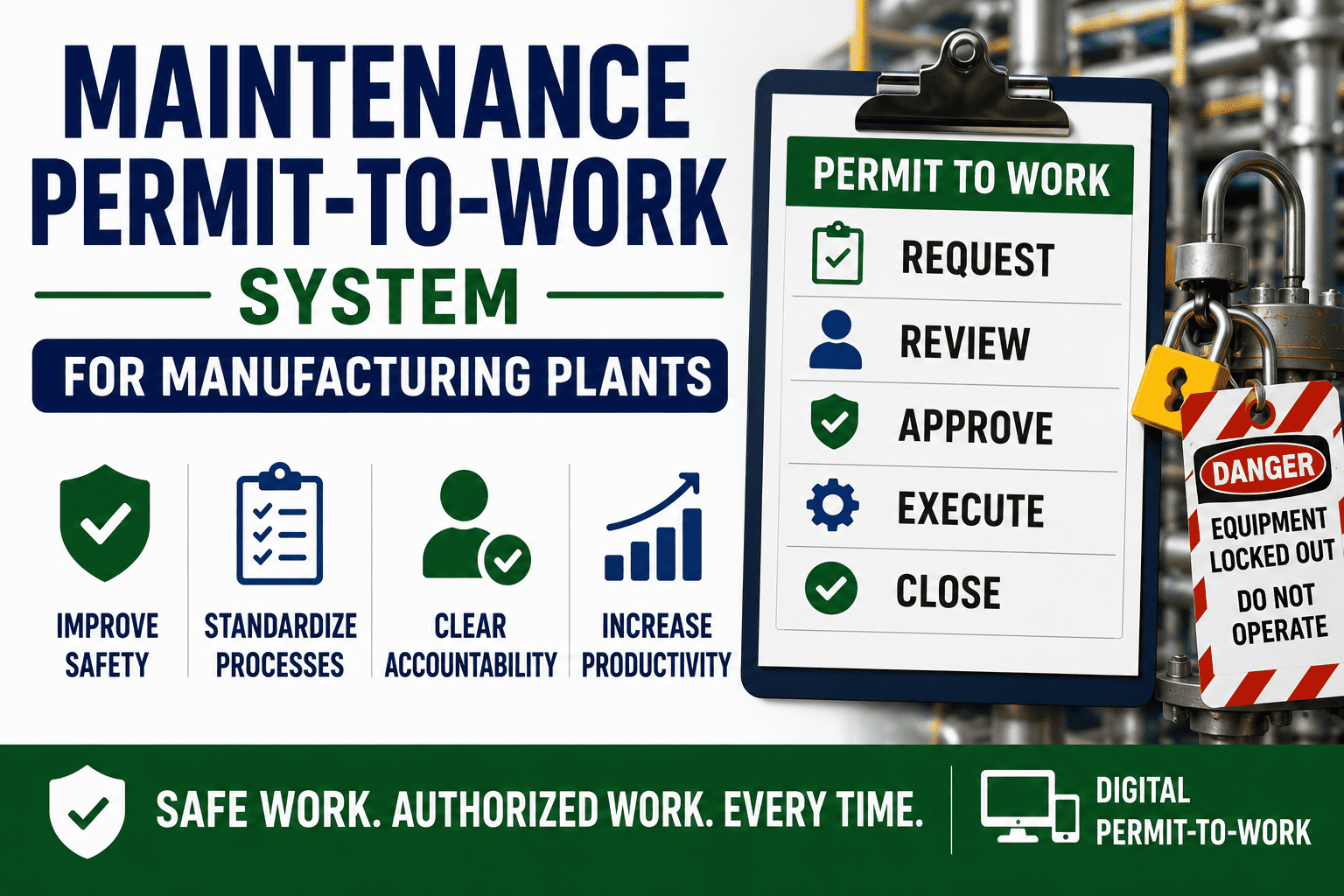
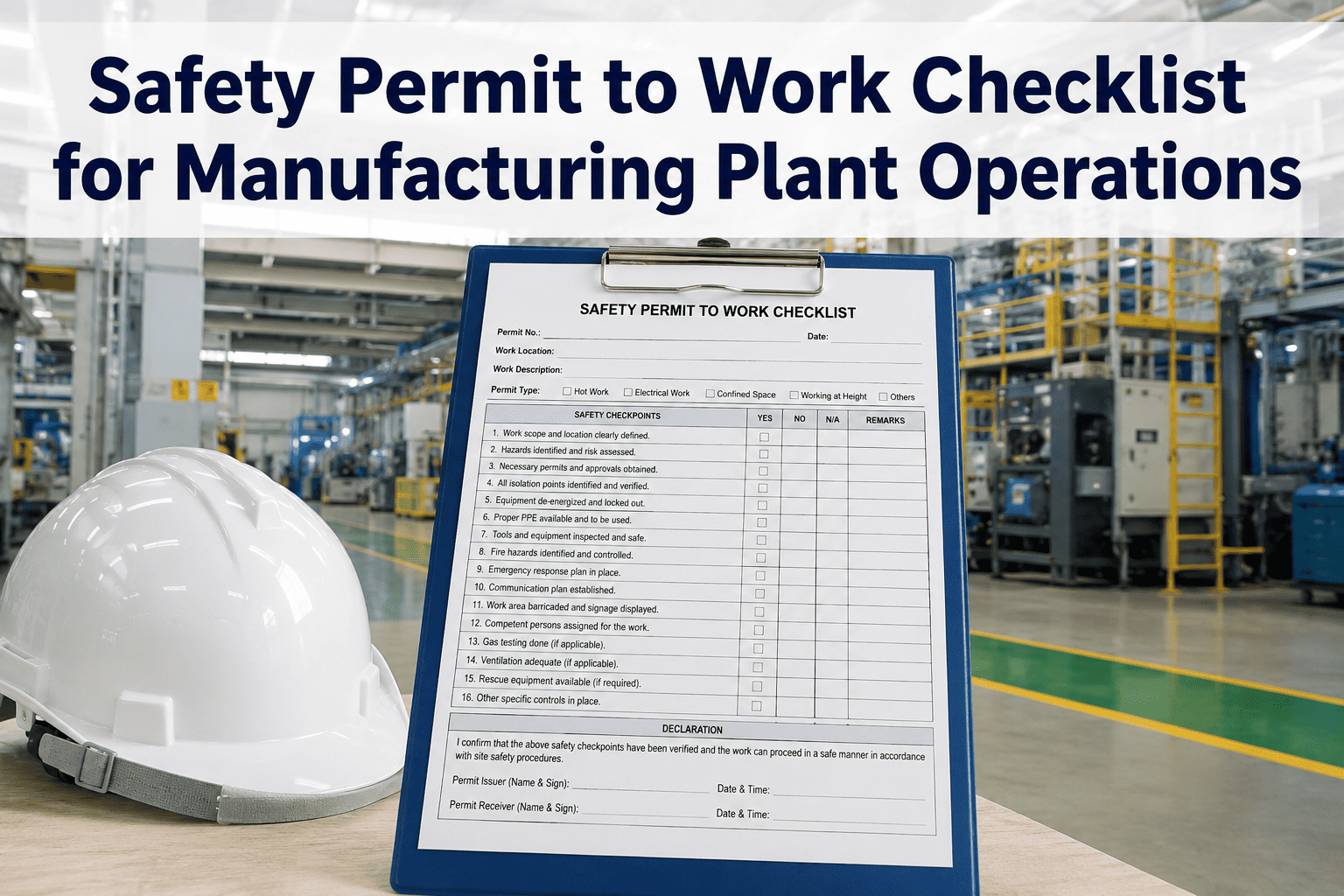
Permit to Work
High-risk tasks require formal authorisation — hot work, confined space, electrical, work at height. The signature is the least important part. The joint site inspection before work starts is what actually controls the risk.
03
LOTO
Energy isolation for any maintenance work where the equipment could move or energise unexpectedly. Six-step procedure, ending with the try-test that proves zero-energy state. The most-skipped step is also the most-deadly.
04
Incident Management
Capture, investigate, root-cause, and close out — with corrective actions tracked through to verification. Near-misses logged with the same rigour as recordables, because near-misses are the warning signal that prevents the recordable.
05
Training & Competency
Role-specific training matrices with refresh cycles, competency assessments, and visible expiry tracking. The most common OSHA citation is not absent training — it is undocumented training.
06
Management of Change
Every modification — equipment, process, personnel, procedure — runs through formal MoC. Even temporary bypasses require engineering and safety review. The phrase "while we are at it" is where MoC programs go to die.
Digitise LOTO, Permits, and Incidents in One Platform
OxMaint links every safety-critical workflow — energy isolation, permit-to-work, hazard observations, incident reports — directly to the assets and work orders they relate to. Walk through it with a specialist in 30 minutes.
LOTO in Six Steps — The Procedure That Has to Be Right Every Time
OSHA 29 CFR 1910.147 is the most frequently cited safety standard in US manufacturing for a reason — the procedure is simple but unforgiving. Skip a step and a worker dies. Here is the canonical six-step sequence every authorised employee must complete every time.
01
Notify
Inform all affected operators and workers that the equipment is being shut down for maintenance and will be locked out.
02
Shut Down
Use the equipment's standard stopping procedure — no shortcuts. Confirm normal shutdown completes before proceeding.
03
Isolate
Open electrical breakers, close valves, disconnect lines for every hazardous energy source — electrical, hydraulic, pneumatic, mechanical, thermal, chemical.
04
Lock & Tag
Apply a personal padlock with a unique key plus a tag identifying the worker by name. One worker, one lock — no shared keys, no group locks for individual work.
05
Dissipate
Bleed off residual hydraulic and pneumatic pressure. Discharge capacitors. Allow thermal energy to dissipate. Stored energy kills people who skipped this step.
06
Verify (Try)
Attempt to start the equipment. Test the controls. Prove zero-energy state physically — the try-test is the last barrier between the worker and uncontrolled energy. It is the most-skipped and most-deadly failure point.
Top OSHA Violations Manufacturing Keeps Repeating
The same handful of citations dominate manufacturing OSHA inspections year after year. None of them are obscure or technical — they are the foundational programs that every plant claims to have. Closing these gaps is where most safety-program ROI sits.
01
Lockout / Tagout (1910.147)
Missing energy control procedures, undocumented try-tests, untrained authorised employees
02
Machine Guarding (1910.212)
Guards removed for cleaning never refitted, point-of-operation hazards uncovered, gaps wider than spec
03
Hazard Communication (1910.1200)
Out-of-date Safety Data Sheets, missing GHS labels, training gaps on chemical hazards
04
Powered Industrial Trucks (1910.178)
Forklift operators uncertified or expired, missing pre-shift inspections, modifications without OEM approval
05
Respiratory Protection (1910.134)
Fit-test gaps, programme not in writing, medical evaluations missing or expired
Reactive vs Proactive Safety — Where the Best Plants Have Already Moved
The headline number on most safety dashboards is the lagging indicator — TRIR, DART, lost-time incidents. By the time those numbers move, someone is already in the hospital. Mature programs run on leading indicators that predict the next incident before it happens.
Reactive Safety
Lagging indicators only
TRIR and DART tracked monthly after the fact
Investigations triggered by recordables
Near-misses underreported or ignored
Safety reports compiled at quarter-end
Corrective actions logged but rarely verified
Proactive Safety
Leading indicators on a dashboard
Hazard observations and near-misses logged daily
Audit and inspection findings tracked to closure
Permit-to-work compliance measured per shift
Training expiries surfaced before they lapse
Corrective actions verified, not just closed
Where the CMMS Quietly Carries the Safety Program
Safety, maintenance, and asset management are not separate disciplines — they are three views of the same operational reality. A modern CMMS is where that reality gets unified, and most safety leaders only realise this after their first incident traced back to a missed PM.
Work Orders
Every safety-critical maintenance task — guard reinstall, sensor calibration, interlock test — is a work order with attached SOP, required PPE, and LOTO procedure linked to the asset.
Permit Linkage
Hot work, confined space, and electrical permits attached directly to the work order and the asset. Permit history surfaces during the next risk assessment automatically.
Incident to Asset
When an incident occurs, the asset record holds every prior PM, every prior work order, every prior near-miss. Root-cause investigation starts with evidence, not opinion.
Training Records
Authorised-employee status, LOTO certification, forklift licence — all tied to the user record. Expired credentials block the work order assignment instead of being discovered after the incident.
Audit Readiness
OSHA, ISO 45001, and internal audit packages generated from real operational data — not assembled manually from emails and spreadsheets the week before the inspector arrives.
Frequently Asked Questions
What is TRIR and what is a good number for manufacturing?
TRIR is Total Recordable Incident Rate per 100 full-time workers, calculated as recordable cases multiplied by 200,000 then divided by total hours worked. The US manufacturing average is around 3.3; world-class programs run below 1.0.
Book a benchmark review to compare your numbers.
Are paper LOTO and permit systems still acceptable in 2026?
Acceptable to OSHA, yes. But paper systems are the leading source of try-test misses, expired permits going live, and incomplete energy-isolation records. Most modern manufacturers digitise LOTO and permits because the audit trail and enforcement are dramatically stronger.
What is the difference between a near-miss and a recordable incident?
A recordable is an injury or illness meeting OSHA's recording criteria — medical treatment beyond first aid, lost time, or restricted duty. A near-miss is an unplanned event that could have caused harm but did not. Mature programs treat near-misses with the same investigation rigour as recordables.
How does CMMS software actually contribute to safety outcomes?
By linking PMs to safety-critical assets, attaching LOTO and permits to work orders, blocking work assignment when training is expired, and tying incidents back to asset history. The result is fewer escapes between maintenance and safety.
Start a trial to see this in action.
What are the maximum OSHA penalties for serious violations in 2026?
Serious violations carry a maximum penalty of $16,550 per incident. Wilful or repeated violations can exceed $165,000 per violation, and OSHA continues to adjust these caps for inflation. Penalty exposure compounds quickly when multiple workers are affected by the same violation.
Safety Is Built, Not Bought
No software prevents an incident on its own. But a CMMS that ties LOTO, permits, training, work orders, and incident records to the actual assets on the floor turns a paper safety program into a working operating system — one where the right control is enforced before the work begins, not investigated after the worker is hurt. Start with one plant, or talk to a specialist about rolling it out across your group.