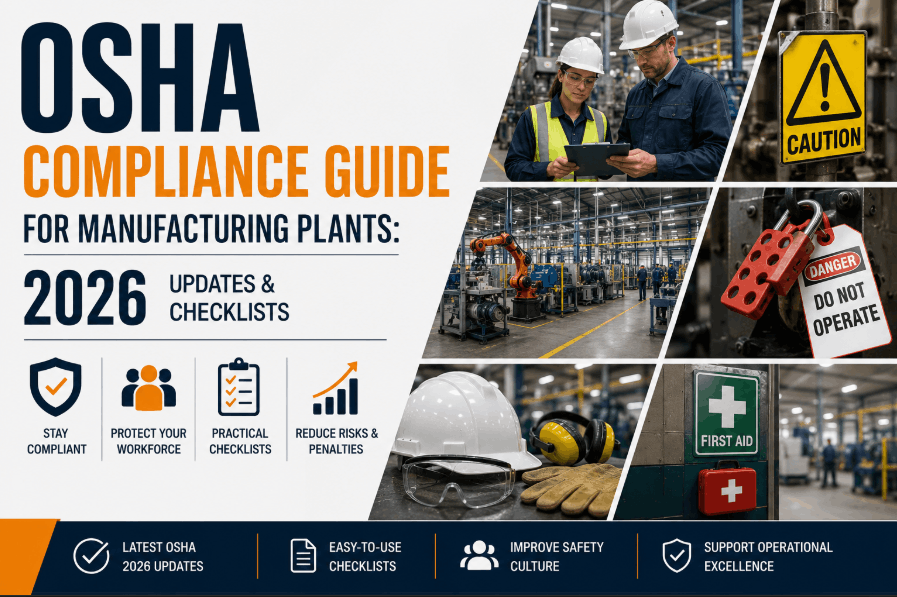
Running a manufacturing plant without a structured safety checklist is like operating heavy machinery blindfolded—it is only a matter of time before something goes wrong. In FY 2025, OSHA issued over 13,700 citations across its top 10 most violated standards, with machine guarding, hazard communication, and lockout-tagout consistently hitting manufacturing the hardest. With penalty amounts now reaching $165,514 per willful violation and new standards like heat illness prevention taking effect, 2026 demands a smarter, more systematic approach to plant safety. This checklist gives you exactly that—a ready-to-use, OSHA-aligned inspection framework covering every critical safety area in your facility. Schedule a demo to see how Oxmaint turns this checklist into a live, trackable digital workflow your team can complete from any device.
$165,514
Max fine per willful OSHA violation (2025)
1,239
Machine guarding citations in FY 2025
2,546
HazCom violations—most cited for general industry
How to Use This Checklist
This checklist is organized into eight critical safety categories that align directly with the OSHA standards most frequently cited in manufacturing inspections. Each item maps to a specific federal regulation so your team knows exactly what inspectors evaluate during a facility walkthrough. Use it as a weekly, monthly, or pre-audit inspection guide. Better yet, sign up for Oxmaint to convert every section below into an automated, mobile-friendly digital inspection with timestamped records, photo evidence, and automatic work order generation for any failed items.
01
Machine Guarding & Equipment Safety
29 CFR 1910.212 | 1,239 citations in FY 2025
Point-of-operation guards are installed, secure, and functioning on all presses, saws, mills, grinders, and shears
Rotating shafts, belts, pulleys, chains, sprockets, and flywheels are fully enclosed or guarded to prevent contact
Safety interlocks on machine guards are tested and verified to prevent operation when guards are removed or open
Emergency stop buttons (E-stops) are visible, accessible within reach, color-coded red, and tested on every machine
Damaged, missing, or bypassed guards are documented, tagged out of service, and replaced before equipment resumes operation
Anchoring and stability of all fixed machinery is verified—no vibration-caused loosening or shifting
02
Lockout/Tagout (LOTO) Procedures
29 CFR 1910.147 | 1,670 citations in FY 2025
Written energy control procedures exist for every machine and piece of equipment requiring maintenance or servicing
Locks, tags, hasps, and energy-isolating devices are available, standardized, and individually assigned to authorized employees
All energy sources (electrical, hydraulic, pneumatic, mechanical, thermal, gravitational) are identified and verified as zero-energy before servicing
Annual LOTO procedure inspections are conducted and documented with written certification records
Training records are current for all authorized employees, affected employees, and other workers in the LOTO area
03
Hazard Communication (HazCom)
29 CFR 1910.1200 | 2,546 citations in FY 2025
Written hazard communication program is current and updated to reflect the 2024 HazCom rule aligned with GHS 7th revision
All chemical containers (primary and secondary) have GHS-compliant labels with correct hazard pictograms, signal words, and precautionary statements
Safety Data Sheets (SDS) are current, updated to new classification rules, and accessible to all employees at all times
Complete, up-to-date chemical inventory list covers every hazardous substance used or stored at the facility
Employee training on updated labeling systems, SDS access, and chemical emergency procedures is documented with dates and sign-offs
Tired of tracking checklists on paper? Oxmaint converts every safety inspection into a digital workflow—complete with photo evidence, automatic corrective work orders, and audit-ready records.
Documented workplace hazard assessment completed for all job roles as required under 29 CFR 1910.132(d)
Eye and face protection provided and worn in all areas with flying particle, splash, or radiation hazards
Hearing protection available and mandatory in all areas exceeding 85 dB TWA exposure levels
Hand protection (gloves appropriate for chemical, thermal, cut, or puncture hazards) available for each task type
All PPE properly sized, maintained, inspected before each use, and replaced immediately when damaged
PPE training records are current—covering proper use, limitations, care, and disposal for each equipment type
05
Electrical Safety
29 CFR 1910.301-399
Electrical panels have minimum 36 inches of clear workspace and are properly labeled with circuit identification
All wiring, outlets, junction boxes, and conduit in good condition with no exposed or damaged conductors
GFCIs installed and tested monthly in wet, damp, or outdoor locations
Extension cords are not used as permanent wiring, are rated for the application, and inspected before each use
Electrical equipment in hazardous (classified) locations meets NFPA 70 requirements for the area classification
06
Fire Safety & Emergency Preparedness
29 CFR 1910.155-165 | 29 CFR 1910.38
Fire extinguishers inspected monthly, professionally serviced annually, and positioned within 75 feet of travel distance
Emergency exit routes clearly marked with illuminated EXIT signs, unobstructed at all times, leading to safe assembly area
Written Emergency Action Plan (EAP) posted, reviewed annually, and all employees trained on evacuation procedures
Fire drills conducted at least annually with documented results, response times, and corrective actions
Sprinkler systems, fire alarm pull stations, and smoke/heat detectors tested per NFPA schedule with records maintained
Automate Every Checklist Item with Oxmaint
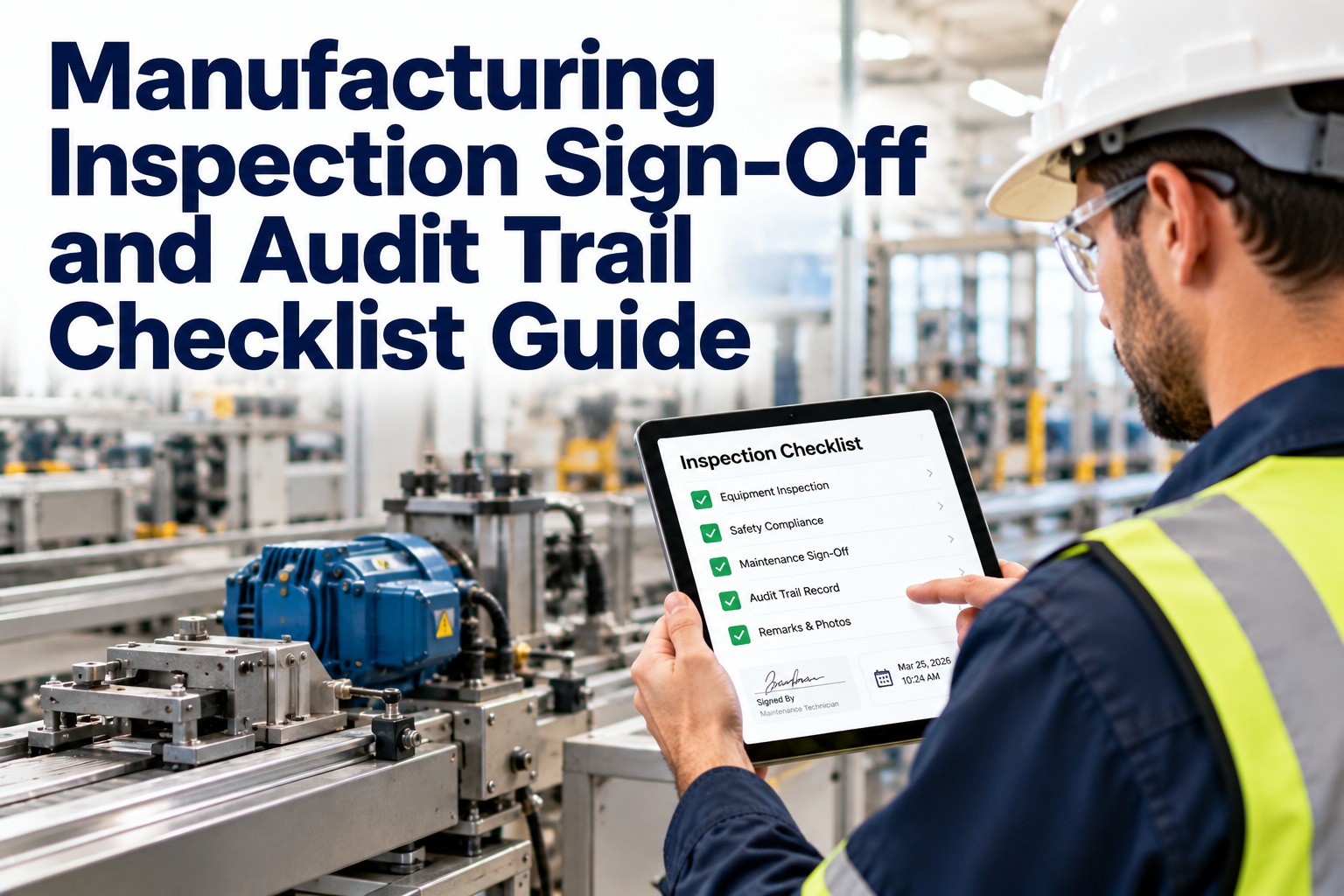
Oxmaint transforms static safety checklists into live digital inspections. Your team completes checks on mobile devices with photo evidence and digital signatures. Every failed item automatically generates a corrective work order. Every record is timestamped, searchable, and audit-ready.
Pedestrian traffic areas clearly marked, separated from forklift routes, intersections have mirrors or warning signals
Defective trucks removed from service immediately and not returned until repairs are completed and documented
Need help identifying gaps in your current safety program? Our team will walk you through how Oxmaint maps to your specific OSHA requirements and plant layout.
Several regulatory changes are reaching compliance deadlines or taking effect in 2026. Manufacturers who prepare now will avoid the elevated inspection scrutiny that accompanies new rule implementation.
New Standard
Heat Illness Prevention Rule
OSHA's upcoming federal standard will require hydration plans, mandatory rest breaks, acclimatization programs for new or returning workers, and documented emergency response protocols—applicable to indoor manufacturing environments with high-temperature exposures.
2026 Deadline
HazCom GHS 7th Revision Compliance
OSHA's 2024 HazCom update aligned with GHS Rev. 7 has select compliance deadlines extending into 2026. Ensure all SDS documents, container labels, chemical inventories, and worker training reflect the updated classification system.
Expanded Enforcement
Increased Manufacturing Inspections
OSHA has signaled expanded inspections targeting high-hazard sectors. Expect heightened focus on documentation quality, training records, and proactive hazard identification programs.
Penalty Increase
Higher OSHA Violation Fines
Willful or repeat violations now cost up to $165,514 per occurrence. Serious violations can reach $16,550 each. Further increases are expected in early 2026.
Why a CMMS Is Essential for Safety Compliance
Checklists only work when tied to real work, real accountability, and real-time visibility. Paper forms leave gaps that OSHA inspectors consistently find. A CMMS like Oxmaint closes those gaps by connecting every inspection item to automated workflows, corrective actions, and auditable records. Sign up for Oxmaint to see the difference a digital safety backbone makes.
Digital Inspections
Mobile checklists with photo evidence, digital signatures, and GPS timestamps
Auto PM Scheduling
Never miss a fire extinguisher check, guard inspection, or safety equipment test
Audit-Ready Records
Every action logged with timestamps—pull OSHA reports in seconds, not days
Hazard Reporting
Workers report issues from their phone—each report auto-triggers a corrective work order
Make OSHA Compliance Effortless with Oxmaint
Your manufacturing plant deserves a safety system that works as hard as your team. Oxmaint automates inspections, tracks corrective actions in real time, and keeps every compliance record organized and audit-ready—so you can focus on production instead of paperwork.
What are the most common OSHA violations in manufacturing plants?
The most frequently cited OSHA violations in manufacturing include hazard communication (29 CFR 1910.1200), respiratory protection (29 CFR 1910.134), powered industrial trucks (29 CFR 1910.178), lockout/tagout (29 CFR 1910.147), and machine guarding (29 CFR 1910.212). These five standards consistently appear in OSHA's annual top 10 list. Sign up for Oxmaint to build automated inspection workflows around each of these critical standards.
How often should manufacturing safety inspections be conducted?
Inspection frequency depends on the hazard level. High-risk areas like machine shops and chemical storage should be inspected daily or weekly. General facility walkthroughs should occur monthly. Comprehensive safety audits should be completed at least annually, with additional inspections after any incident, near-miss, or process change.
What are the OSHA penalty amounts for 2026?
As of January 2025, OSHA penalties reach up to $16,550 per serious violation and $165,514 per willful or repeat violation. Failure-to-abate penalties can accumulate at $16,550 per day. These amounts are adjusted annually for inflation. Book a demo to see how Oxmaint helps you avoid costly violations through proactive compliance tracking.
What new OSHA standards should manufacturers prepare for in 2026?
Key changes include OSHA's upcoming heat illness prevention standard, extended compliance deadlines for the 2024 HazCom GHS Rev. 7 update, expanded enforcement inspections in high-hazard manufacturing, and stricter electronic recordkeeping and reporting requirements.
How does a CMMS help with OSHA compliance?
A CMMS like Oxmaint centralizes all safety activities—inspections, preventive maintenance, corrective action tracking, training records, and compliance documentation—into one platform. It automates scheduling, creates an auditable digital trail, and provides real-time dashboards showing compliance status. Sign up for free to digitize your safety program today.

![monthly-manufacturing-plant-safety-audit-checklist-[osha---iso-45001]](./manage-post-2k26/uploads/monthly-manufacturing-plant-safety-audit-checklist-[osha---iso-45001].png)