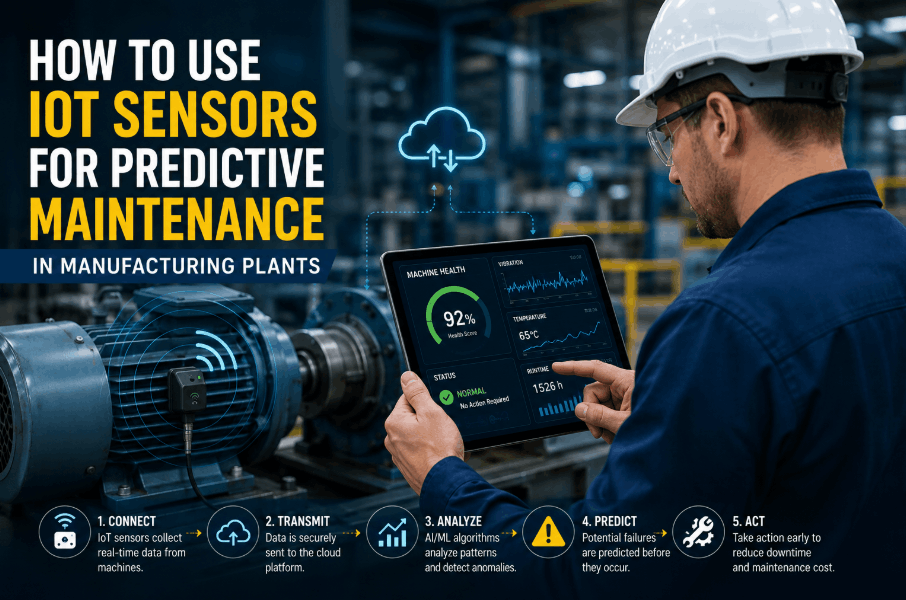
Your electronics assembly line runs at 62% OEE. Competitors implementing predictive maintenance hit 85%+—gaining 15-25% capacity advantage. Technology isn't the barrier—people are. Veterans resist sensors "telling them what to do." Technicians prefer paper clipboards. Meanwhile, market share erodes.
Condition monitoring systems like Oxmaint CMMS deliver 20-35% OEE gains—but only with proper change management. Successful implementations spend 60% effort on people, 40% on technology—achieving 82-88% OEE within 12-18 months and $1.2M-$3.8M annual value.
Ready to break through OEE barriers with predictive maintenance?
Condition monitoring delivers measurable OEE gains—but requires systematic change management. See how 180+ electronics manufacturers achieved 82-88% OEE through people-focused implementation.
Understanding the OEE-Condition Monitoring Connection
OEE measures productivity through Availability (uptime), Performance (speed), and Quality (yield). Condition monitoring impacts all three:
Availability Impact
Without monitoring: Unexpected failures 15-22 times annually. Availability = 68-75%.
With monitoring: Predictive alerts enable planned interventions. Unplanned failures reduced 70-85%. Availability = 88-94%.
Gain: +15-20 points
Performance Impact
Without monitoring: Developing problems reduce throughput 8-15% below ideal.
With monitoring: Early detection triggers correction before speed loss. Equipment maintains optimal parameters.
Gain: +5-10 points
Quality Impact
Without monitoring: Equipment problems cause defects. Scrap/rework = 3-8%.
With monitoring: Optimal equipment condition prevents process variations. First-pass yield improves to 97-99%+.
Gain: +3-5 points
The 5 Change Management Challenges (And Solutions)
Technology fails when people resist. Here's how to overcome the barriers:
Change Resistance Patterns & Solutions
Challenge 1: "We've Always Done It This Way"
Manifestation: Operators trust senses over sensors. Technicians prefer experience. Fear: "If sensors detect problems, what value do I provide?"
Solution: Frame as amplification. "Sensors make you superhuman." Start with "sensor + operator confirmation" workflow—system flags anomaly, operator verifies, both credited.
Success indicator: Operators say "sensors confirm what I suspected"—validation, not replacement.
Challenge 2: "This Will Slow Us Down"
Manifestation: Resistance to mobile routes—"Scanning takes longer than clipboards." Concern about production interruptions.
Solution: Design mobile workflows faster than paper in Oxmaint—barcode auto-populates, photos with single tap. Measure actual time: typical 30-40% reduction vs. paper.
Success indicator: "Mike completed 80-point route in 2.1 hours vs. previous 3.2—extra 1.1 hours for value-added work."
Challenge 3: "Prove It Works Before We Commit"
Manifestation: Management demands ROI proof. Engineers want validation. Finance questions cost. Everyone wants someone else first.
Solution: Limited pilot—one line, 30-60 days, $25K-$45K. Clear metrics: baseline OEE, target improvement, decision criteria. First prevented failure (week 3-6) becomes proof.
Success indicator: Weekly ROI tracker showing prevented failures, OEE trend—visible progress builds momentum.
Challenge 4: "Too Much Information, Analysis Paralysis"
Manifestation: Overwhelmed by data. Dashboards show 200+ parameters—unclear which matter. Alert fatigue.
Solution: Start with 10-15 critical metrics. Three-tier alerting: Advisory (monitor), Alarm (schedule), Critical (urgent). Exception-based dashboards. First 30 days: conservative thresholds, tighten to 85-90% accuracy.
Success indicator: Teams act on alerts confidently, not ignore them.
Challenge 5: "What Happens When It's Wrong?"
Manifestation: Fear of false positives causing shutdowns. Concern about missed problems. Liability if predictions fail.
Solution: Set realistic expectations: "System catches 80-90% of failures weeks early, misses 10-20%, generates 10-15% false positives. Still massive improvement over reactive approach." Critical alerts require human confirmation.
Success indicator: Quarterly results showing 85-90% accuracy—builds trust through transparency.
Modernize Audit Readiness Through Predictive Maintenance
Electronics assembly operates under intense regulatory scrutiny (FDA for medical devices, ISO 9001/13485, IPC standards). Condition monitoring transforms compliance from burden to competitive advantage:
Automated Documentation
Traditional challenge: Manual recordkeeping of equipment inspections, maintenance performed, calibrations completed. Incomplete records create audit findings.
With condition monitoring: Every sensor reading timestamped, operator-verified, and stored automatically. Maintenance triggered by alerts creates audit trail: what was detected → when action taken → results verified.
Audit impact: Complete equipment history available instantly—zero findings for inadequate documentation. Typical audit prep time: 3 weeks → 4 hours.
Continuous Compliance vs. Periodic Scrambles
Traditional challenge: Quarterly or annual audits require mad scramble assembling records, verifying maintenance current, addressing overdue tasks.
With condition monitoring: Real-time compliance dashboard showing: all equipment current on inspections, predictive maintenance preventing failures that would trigger unplanned corrective actions, no overdue calibrations or PM tasks.
Audit impact: Operate in continuous state of audit readiness. Inspections become non-events—inspectors arrive, review digital records, depart with zero findings.
Proactive vs. Reactive Quality
Traditional challenge: Quality issues traced back to equipment operating outside specification—but no evidence equipment monitored properly. "Should have caught this earlier" citations.
With condition monitoring: Continuous verification equipment operates within specification. Parameter excursions flagged immediately triggering investigation—problems corrected before affecting quality.
Audit impact: Demonstrate proactive quality management. When rare quality issue occurs, data proves equipment monitored continuously and responded to appropriately—eliminates "inadequate monitoring" findings.
Turning Alerts into Actions — Analytics Lifecycle
Data without action is noise. Here's how signals convert to OEE improvement:
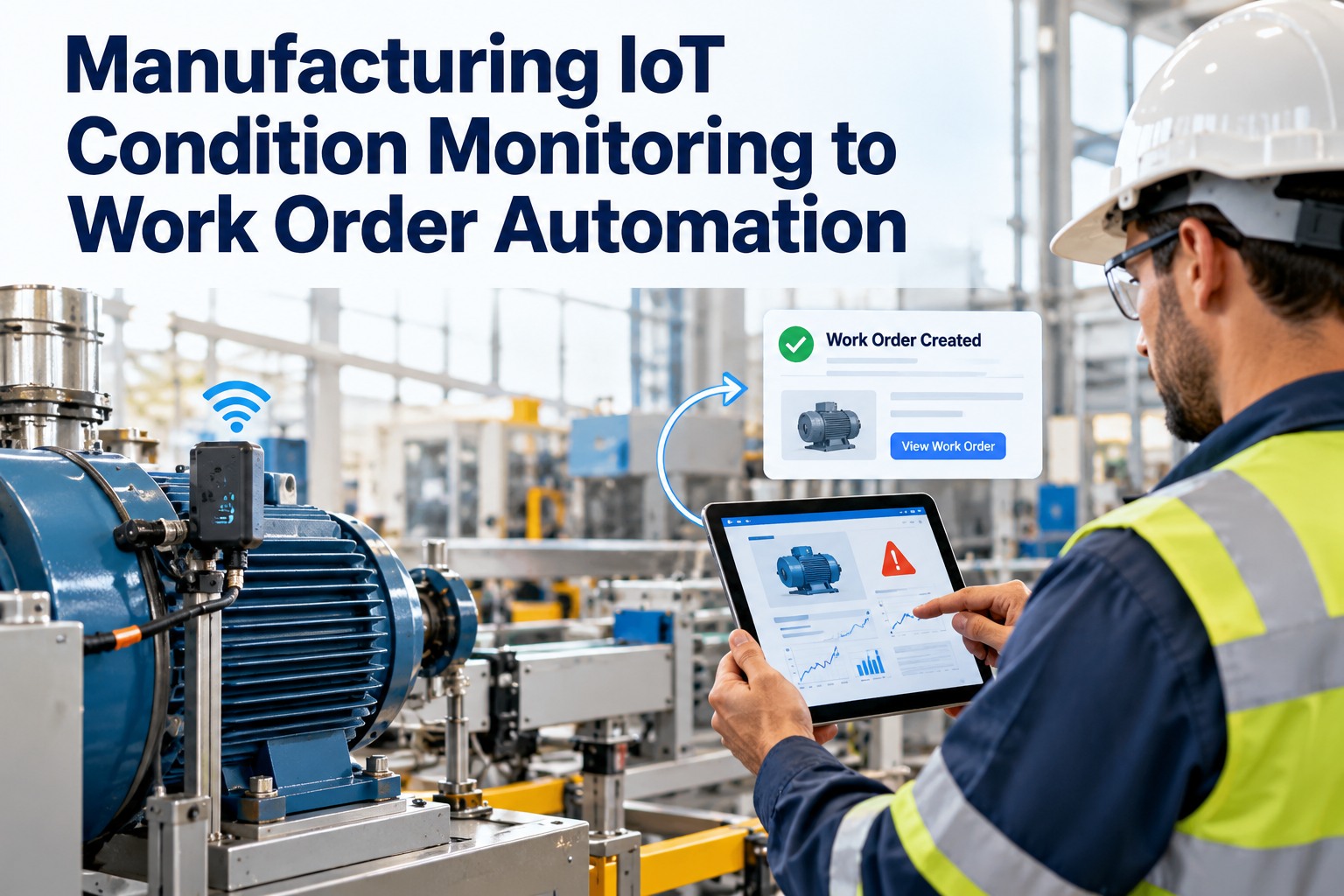
Detection: IoT Sensors Capture Signals
What's monitored: Vibration, temperature, current draw, cycle counts, quality metrics. Sensors sample 1-10 times per second. Edge computing filters noise—only deviations transmitted.
Baseline comparison: AI compares real-time readings to equipment-specific baselines under current conditions. Flags statistically significant deviations.
Diagnosis: AI Classifies Problems
Pattern recognition: Correlates sensor signatures with failure modes. Vibration peak at 2× speed + elevated temp + increasing current = misalignment with bearing stress.
Confidence scoring: AI assigns probability—"85% confident bearing outer race defect, 15% related issues."
Severity classification: Advisory (monitor), Alarm (schedule), Critical (urgent) based on degradation rate and criticality.
Action: Automated Work Order Generation
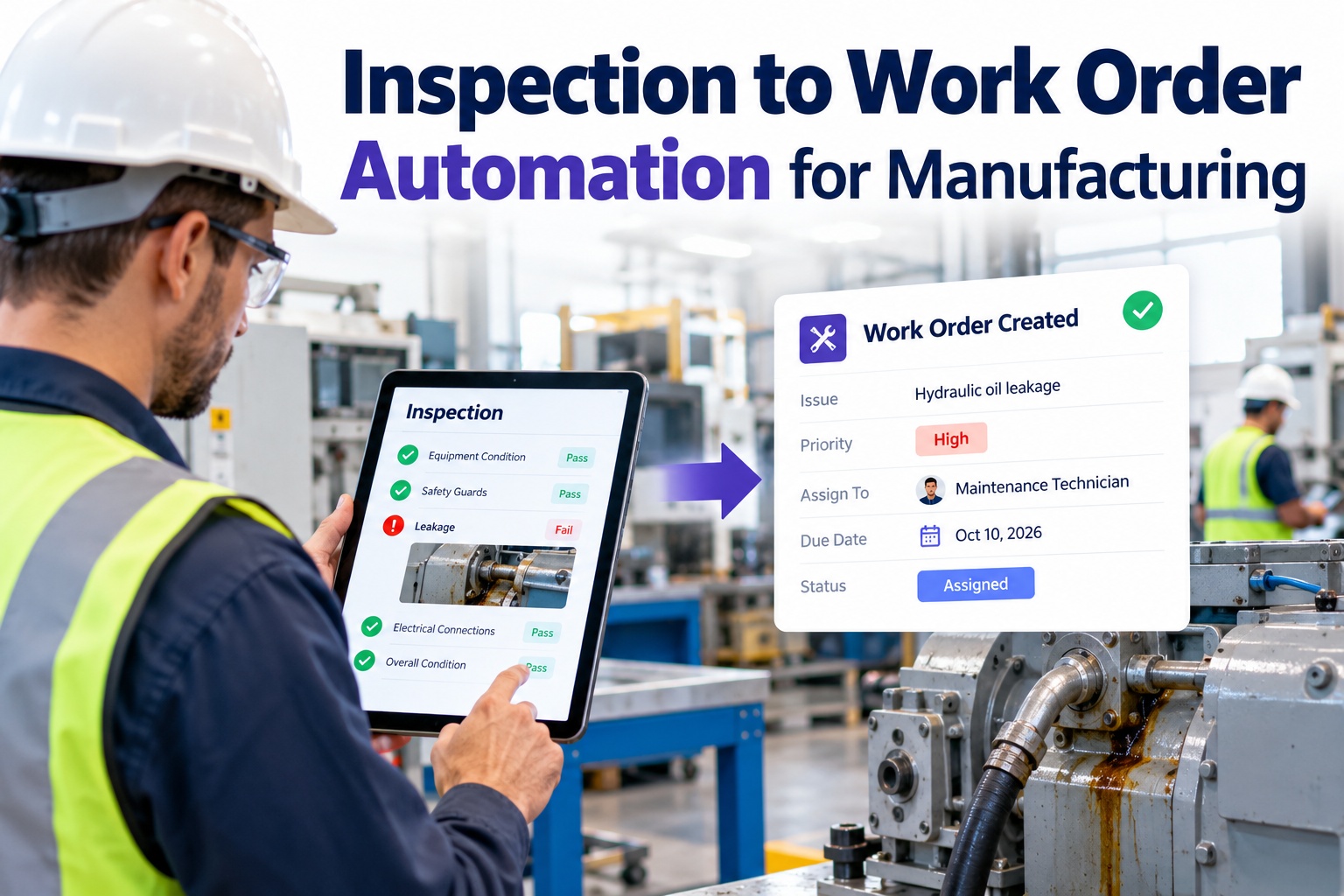
Trigger workflow: When Alarm/Critical, Oxmaint automatically generates work order—equipment details, sensor data, recommended action, parts needed.
Intelligent scheduling: Considers production schedule, parts availability, technician skills, criticality—suggests optimal window balancing urgency vs. impact.
Execution: Mobile-Guided Repair
Technician workflow: Mobile app shows complete context—historical trends, previous repairs, OEM specs, troubleshooting guide.
Real-time verification: After repair, observes sensor readings confirming problem resolved—vibration normalized, temperature dropped.
Documentation: Before/after photos, parts replaced, labor time, verification measurements—timestamped with credentials creating audit trail.
Learning: Continuous Improvement Analytics
Outcome tracking: Did repair solve problem? Timeline accurate? Cost vs. estimate? AI learns from outcomes improving predictions.
Pattern analysis: Identify equipment with repeat problems requiring design improvements. Recognize seasonal patterns. Discover root causes needing upstream correction.
Real OEE Transformation: 64% → 86% in 14 Months
Medical Device Contract Manufacturer — 3 SMT Lines, FDA Registered, $180M Annual Revenue
Starting Position: OEE averaging 64% across 3 high-speed SMT lines (Availability 76%, Performance 88%, Quality 96%). Unplanned downtime 18-24 incidents annually costing $1.8M in lost production. Quality escapes requiring rework $420K annually. Management frustrated—"expensive equipment underperforming, competitors pulling ahead."
Change Management Approach:
- Months 1-3: Pilot Phase — Selected Line 2 (middle performer) for pilot avoiding best line (unrepresentative) or worst (too challenging). Baseline OEE 62%. Engaged 6 operators and 4 technicians in design—"what would make this actually useful vs. annoying?" Installed vibration sensors on 8 critical motors/drives, temperature monitoring on 12 bearing locations, integrated with existing SCADA for cycle counts.
- Months 4-6: Early Wins — First prevented failure occurred week 5 (pick-and-place motor bearing detected via vibration, replaced during scheduled PM, $125K downtime avoided). Shared success across organization. Line 2 OEE improved to 72% (+10 points)—proof of concept validated. Operators seeing value: "System caught problems we'd never notice until failure."
- Months 7-9: Expansion — Rolled out to Lines 1 and 3 using Line 2 template. Technicians now requesting monitoring on additional equipment—change from resistance to pull. Refined alert thresholds based on 6-month operational data reducing false positives from 22% to 8%.
- Months 10-14: Optimization — All three lines fully operational with condition monitoring. Continuous improvement: added quality correlation analytics (vibration trends vs. defect rates revealing optimal maintenance windows). Operators trusted system enough to accept automated recommendations without secondary verification.
14-Month Results:
- OEE improvement: 64% → 86% (+22 percentage points). Availability 76% → 93% (+17 points from prevented failures). Performance 88% → 94% (+6 points from maintaining optimal equipment condition). Quality 96% → 98% (+2 points from process stability).
- Unplanned downtime: Reduced from 18-24 incidents to 3-5 incidents annually (82% reduction). Average incident duration decreased 40% (faster diagnosis with sensor data).
- Production capacity gain: 22-point OEE improvement = 34% more throughput without new equipment. Additional annual output: $3.2M revenue at existing margins.
- Quality improvements: Rework/scrap reduced $420K → $95K annually (77% reduction) through maintaining equipment optimal state preventing process variations.
- Maintenance efficiency: Planned vs. unplanned maintenance ratio improved from 40:60 to 85:15. Maintenance cost per unit produced decreased 28% (fewer emergencies, better parts planning).
- Regulatory compliance: FDA re-inspection zero findings related to equipment monitoring or preventive maintenance—comprehensive digital records impressed auditors.
Total 14-Month Value: $3.715M (increased throughput $3.2M + reduced quality costs $325K + maintenance efficiency $190K)
Implementation Investment: $285,000 (sensors + CMMS + integration + training)
ROI: 1,204% | Payback: 5.2 weeks
Expert Insight
Common Questions About OEE & Condition Monitoring
Phased trajectory: Months 1-3 (pilot, 8-12 points), Months 4-6 (expansion, 12-18 points), Months 7-12 (optimization, 18-25 points), Months 13-18 (full potential, 20-35 points sustained).
Critical success factors: 60% change management effort, appropriate pilot selection, celebrating quick wins, patience through "valley of despair" (months 4-6), management commitment when enthusiasm wanes.
Red flags: <5 points after 6 months (poor implementation), resistance increasing (change management failure), >20% false alarms (threshold tuning needed).
The "valley of despair" (months 4-7): Excitement wears off, problems emerge (false alarms, workflow friction). This phase kills most initiatives.
Survival strategies: Anticipate and normalize ("months 4-6 hardest, we push through together"). Visible leadership commitment. Data transparency showing trend despite dips. Rapid problem resolution ("8 taps → 3 screens, try now"). Refresh engagement with retrospective months 6-8.
Turning point: Technicians requesting monitoring on additional equipment (pull), operators defending system to visitors, fewer "why" questions.
Common misconception: "We need vibration analysts and thermography experts." Reality: Modern systems designed for mainstream technicians.
Required (trainable in weeks): Mobile device operation, barcode scanning, photo capture, following workflows, understanding red/yellow/green indicators, basic troubleshooting logic.
Nice-to-Have (specialists or contracted): FFT vibration analysis, thermography certification, advanced diagnostics—useful for 5-10% of situations, not daily operation.
System design: Oxmaint embeds expertise in workflows—AI performs analysis, presents simple recommendations. Junior person with system makes better decisions than veteran without it.
Training: 4-8 hours hands-on. Competency within 2 weeks on-the-job with system coaching.
Making gains tangible:
Availability gain = Revenue capacity: 15-point improvement (75% → 90%) on $12M line = $2.4M additional capacity. Formula: Current Revenue ÷ Current Availability × Availability Gain.
Performance gain = Throughput: 6-point improvement (88% → 94%) = 6.8% more units. Line producing 25,000 units/day = 1,700 additional daily = 425,000 annually. Calculate units × margin.
Quality gain = Reduced waste: 2-point improvement (96% → 98%) = 50% scrap reduction. $420K annually → $210K = $210K savings.
Combined business case: "$285K investment delivers $3.2M revenue capacity + $325K quality + $190K efficiency = $3.715M benefit, 13× ROI, 5-week payback."
Risk mitigation: Start with pilot ($25K-$45K, one line, 90 days). If fails to show 10+ points, stop. If successful, expand with confidence backed by actual facility data.
Ready to Break Through Your OEE Ceiling?
You've seen competitors achieving 85%+ OEE while you're stuck at 62-68%. You know condition monitoring can close that gap—but worry about implementation challenges, team resistance, and proving ROI.
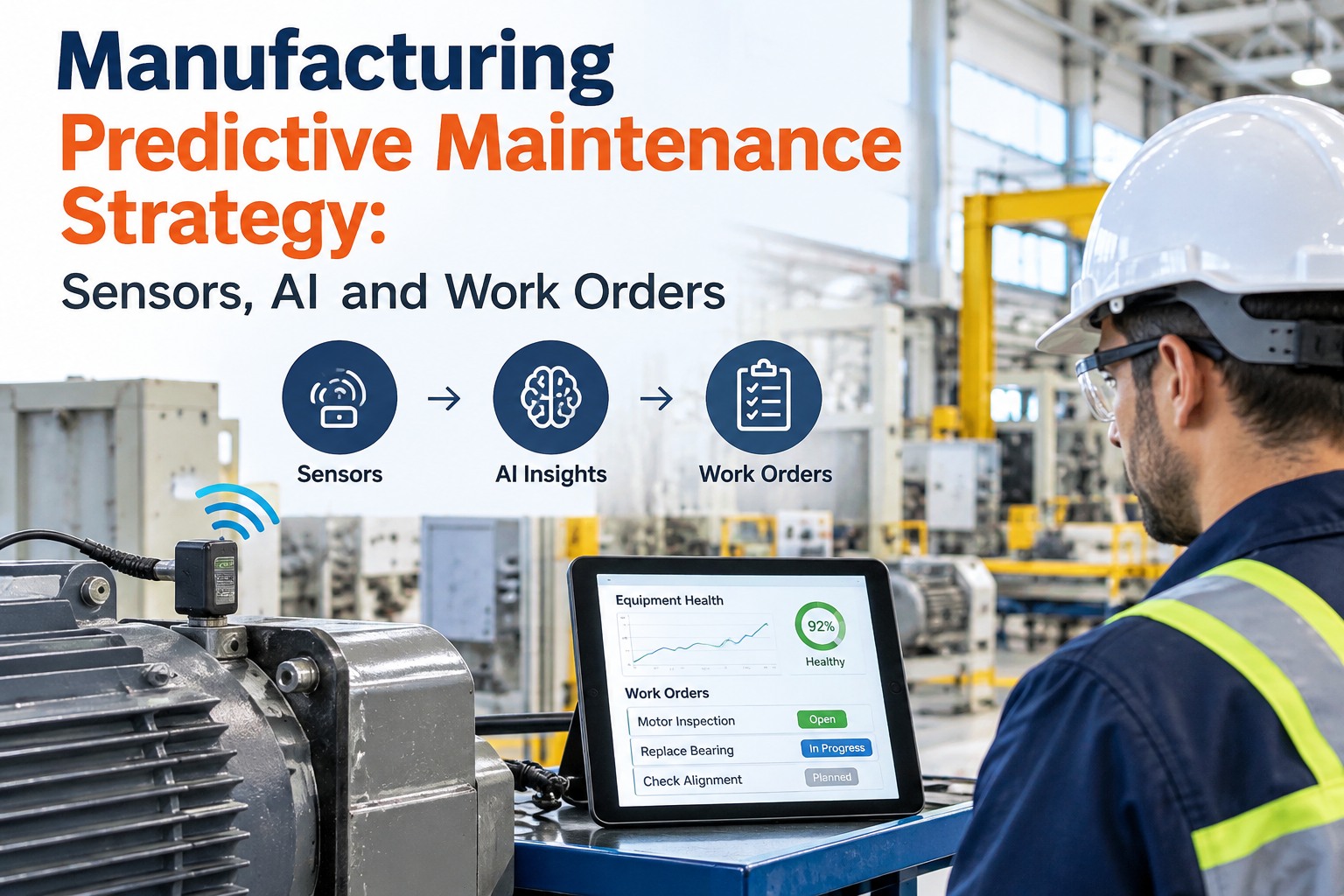
The path forward: Start small (pilot line, 90 days, $25K-$45K), focus on people (60% change management, 40% technology), celebrate quick wins (first prevented failure typically week 3-6), expand systematically (replicate success template). Real electronics manufacturers achieve 20-35 point OEE improvement, $1.2M-$3.8M annual value, and cultural transformation within 12-18 months.
Transform OEE from limitation to competitive advantage
Stop accepting 60-70% OEE. Condition monitoring with systematic change management delivers world-class 82-88% performance. Join 180+ electronics manufacturers using Oxmaint for predictive maintenance and OEE excellence.
Oxmaint CMMS — Predictive Maintenance for World-Class OEE
180+ electronics facilities optimized | Average OEE: 82-88% | 1,200%+ typical ROI


.png)