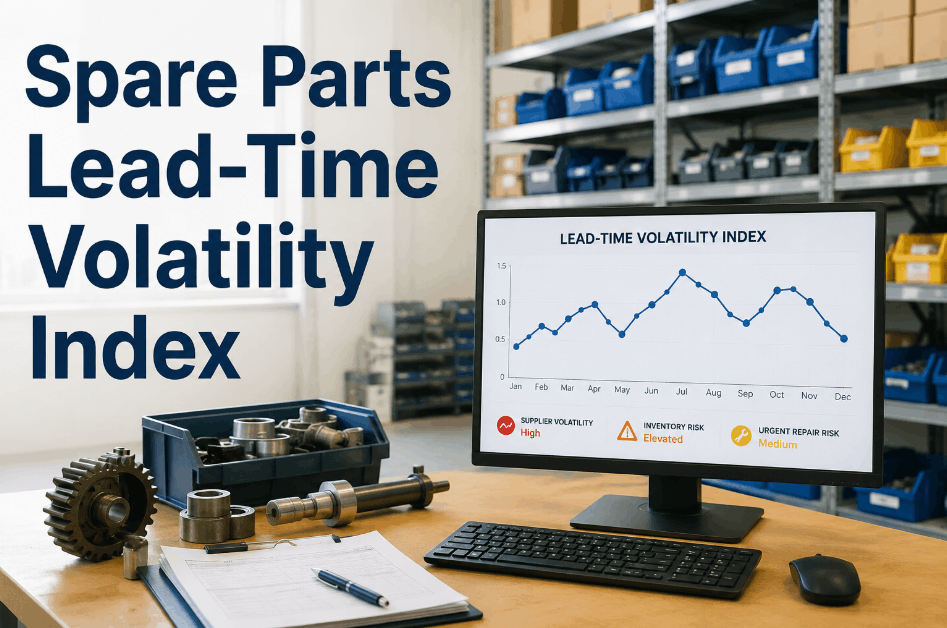
A plant storeroom can hold thousands of parts and still fail a technician at the exact moment a critical pump goes down — not because the part was never stocked, but because the reorder rule behind it was set once, years ago, and never adjusted to actual consumption. Sign Up Free to start calculating reorder points from real consumption history inside Oxmaint, or Book a Demo to see how criticality-based reorder rules prevent both stockouts and dead inventory across your plant store.
Maintenance Operations · Spare Parts · 2026
Plant Store Reorder Rule Design for Spare Parts Teams
Set reorder rules by criticality, consumption rate, and lead time so spare parts teams avoid both stockouts and dead inventory.
40%Lower parts expenditure reported with consumption-driven reorder rules and ABC analysis
98%Parts availability achievable with dynamic reorder points tied to criticality tier
30–40%Of stocked parts in typical storerooms show zero consumption in the past two years
4.8xCost premium on emergency procurement when a reorder rule fails to trigger in time
Where Reorder Rule Design Breaks Down in Plant Stores
Reorder rule failures rarely come from a purchasing problem or a storage problem — they come from a data problem, where stocking decisions are made on memory and gut feel instead of consumption history. Sign Up Free to load your parts catalog and start tracking consumption against criticality before the next stockout reaches a work order.
01
Static Min-Max Without Usage Data
Risk Window: Set once, rarely revisited
Stale RuleReorder points set more than a year ago without a usage review are usually misaligned with current consumption, triggering either stockouts or excess stock.
02
Uniform Stocking Across Criticality
Risk Window: Mixed-criticality catalogs
Largest VariableA bearing for a critical compressor and a bearing for a non-essential pump often carry the same stocking priority because the inventory system has no equipment context.
03
No Lead-Time Adjustment
Risk Window: Supplier disruption
Coverage GapReorder points calculated without current supplier lead time leave a coverage gap exactly when delivery reliability degrades.
04
Manual Purchase Requisition Lag
Risk Window: Between stock counts
Detection DelayA part pulled for a work order without an automatic count update can sit invisible below its reorder point until the next manual stock check.
05
Dead Stock Accumulation
Risk Window: Decommissioned assets
Capital DragParts specific to retired equipment remain on the shelf indefinitely because no link exists between asset lifecycle and parts disposition.
06
Multi-Site Reorder Blind Spots
Risk Window: Multi-plant operations
Visibility GapWithout a shared catalog, a part already in stock at a sister plant gets reordered externally instead of transferred, doubling the spend.
Reorder Rule Design — Without vs. With Oxmaint
The difference between gut-feel ordering and consumption-driven reorder rules shows up directly in stockout frequency, carrying cost, and emergency procurement spend. Book a Demo to walk through your current parts catalog and identify where reorder rules need recalculating.
Plant Store Reorder Rule Maturity — Where Does Your Storeroom Score?
Reorder rule maturity ranges from fixed min-max levels nobody has revisited in years to consumption-driven thresholds that recalculate automatically as usage patterns shift. Book a Demo to assess your storeroom's reorder rule maturity with an Oxmaint solutions engineer.
Plant Store Reorder Rule Maturity
Score 5 = consumption-driven, criticality-tiered automation · Score 1 = fixed rules, no review
5
Consumption-Driven · Criticality-Tiered Automation
Reorder points recalculate from real usage and lead time data, with safety stock weighted by ABC-VED criticality tier across every site.
Profile: Parts availability and carrying cost are managed as a single optimization, not two competing goals.
4
Structured Reorder Logic · Partial Criticality Use
Reorder points are calculated from consumption data for most A-class parts, but criticality tiering and multi-site visibility remain inconsistent.
Action: Extend criticality-based safety stock rules to B and C-class parts as well.
3
Periodic Min-Max Review
Reorder levels are reviewed on a fixed schedule, typically annually, with adjustments based on recent stockout history rather than full consumption data.
Gap: Mid-cycle reorder point drift between review periods is the primary source of avoidable stockouts.
2
Reactive Reordering · Stockout-Triggered
Parts are reordered after a technician reports a stockout. Reorder points exist on paper but are rarely consulted in practice.
Risk: Emergency procurement spend climbs steadily while inventory value sits unmanaged elsewhere.
1
No Reorder Rule Structure
Stocking decisions are made from memory with no documented reorder points, criticality tiers, or consumption tracking of any kind.
Risk: Storeroom performance depends entirely on individual tenure and recall, not on data.
Stop Reordering by Memory. Start Reordering by Data.
Oxmaint calculates reorder points from real consumption history, supplier lead time, and asset criticality — eliminating stockouts without inflating storeroom value.
How Oxmaint Structures Plant Store Reorder Rules
Oxmaint connects every part in your catalog to the assets it serves, the work orders that consume it, and the reorder logic that keeps it on the shelf when it's actually needed. Sign Up Free to configure reorder rules for your parts catalog. Book a Demo to see automated reorder running on live consumption data from your storeroom.
Consumption-Driven Reorder Calculation
ROP = (Avg Daily Use × Lead Time) + Safety Stock
Reorder points calculated from real usage, not guesswork
Oxmaint recalculates reorder points from actual work order consumption history and current supplier lead time, replacing static min-max levels with thresholds that reflect real demand.
ABC-VED Criticality Scoring
Tiered Safety Stock
Stocking priority weighted by asset criticality, not catalog position
Parts tied to assets whose failure stops production carry higher safety stock and shorter review cycles, while non-critical parts can rely on leaner, just-in-time rules.
Automated Purchase Requisition
Threshold → PO, No Manual Step
Requisitions fire the moment stock crosses the reorder point
When a work order pulls the last unit of a part below its threshold, Oxmaint generates a purchase requisition automatically, closing the gap between consumption and replenishment.
Multi-Site Inventory Visibility
Global Catalog · Local Stock
Shared parts catalog across every connected facility
Managers see global inventory across sites and can flag inter-site transfers before placing an external purchase order, reducing duplicate spend on parts already in the network.
"
We were spending well into six figures a year on emergency parts orders — parts that, in most cases, we had actually stocked before but the bin had run out before anyone noticed. After setting reorder points in Oxmaint from real consumption data instead of the old min-max sheet, our emergency order spend dropped sharply within the first eight months.
Stores Manager — Industrial Manufacturing Plant, Multi-Site Network, North Carolina
Frequently Asked Questions
What is a reorder point and how is it calculated?
A reorder point is the stock level that triggers a replenishment order. It is calculated as average daily usage multiplied by supplier lead time, plus a safety stock buffer for demand variability.
How does Oxmaint prevent both stockouts and overstocking?
Oxmaint calculates reorder points from actual consumption and lead time data rather than fixed estimates, and applies criticality tiering so safety stock matches real failure risk instead of guesswork.
Can Oxmaint manage spare parts across multiple plant sites?
Yes. Oxmaint provides a centralized parts catalog across connected facilities with site-specific stock levels, allowing managers to flag inter-site transfers before placing external orders.
How does ABC-VED analysis improve reorder rule design?
ABC-VED segments parts by consumption value and criticality, so high-impact parts get tight reorder control while low-value, low-risk items can run on simpler, lower-effort rules.
Does Oxmaint integrate spare parts with existing ERP systems?
Oxmaint supports integration with major ERP platforms, mapping material groups, storage locations, and vendor data to keep inventory consistent between the CMMS and ERP systems.
Design Reorder Rules That Reflect Real Demand — Not Last Year's Guess.
Oxmaint sets reorder points by criticality, consumption rate, and lead time, automating purchase requisitions before stockouts happen.