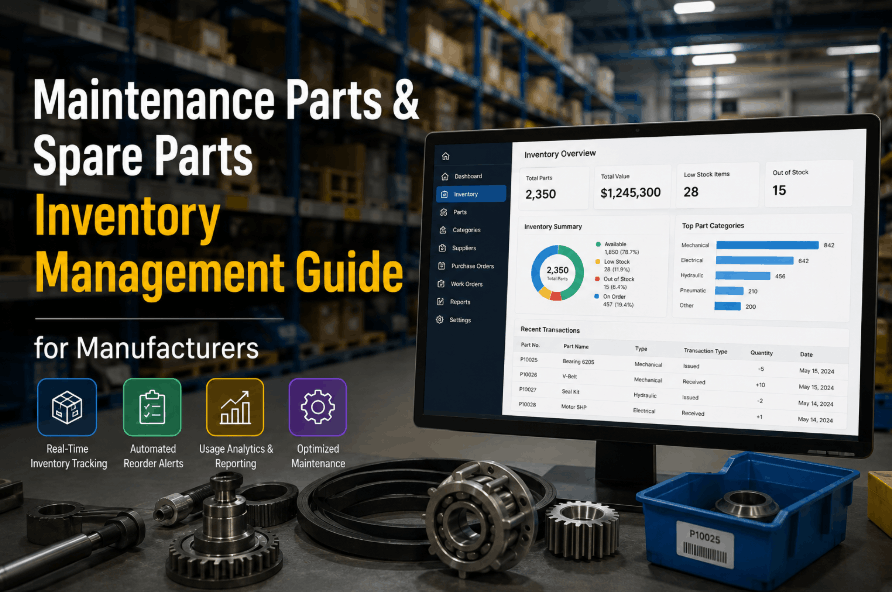
Spare parts inventory is one of the most expensive and most mismanaged assets in manufacturing maintenance. Too little stock means emergency downtime while waiting for a critical bearing or seal — too much means capital locked in shelving, obsolescence risk, and parts that expire before they are ever used. The optimal spare parts inventory strategy sits precisely between these two failure modes, and it is driven by asset criticality data, consumption history, and lead time intelligence that most plants are not yet capturing systematically. Sign Up Free to see how OxMaint connects your asset registry, work order consumption data, and parts inventory into one platform — giving your maintenance team the visibility to stock exactly what you need and nothing you do not. Book a Demo to explore how OxMaint's CMMS-driven inventory management eliminates both emergency stockouts and costly overstock across single-site and multi-facility maintenance operations.
Optimize Spare Parts Inventory with OxMaint
Link parts consumption to asset history, criticality tiers, and work order data — eliminating stockouts and overstock in one connected maintenance platform.
Why Spare Parts Inventory Fails Manufacturing Maintenance Teams
The root problem in most spare parts programs is disconnection — parts data lives in a spreadsheet or a legacy ERP module that has no relationship to the CMMS managing work orders and asset history. Technicians order parts from memory, stores teams reorder based on gut feel, and finance sees only a growing inventory value with no visibility into what is actually needed. Book a Demo to see how OxMaint bridges this gap — linking every part in your stores to the assets it supports and the work orders that consume it, so reorder decisions are driven by data instead of instinct.
6 Strategies for Spare Parts Inventory Optimization
World-class maintenance teams build spare parts programs around asset criticality, consumption data, and lead time risk — not historical habit. Sign Up Free and connect OxMaint's parts inventory module to your asset registry and work order system — creating the data foundation every effective spare parts optimization strategy depends on.
Criticality-Based Stocking Tiers
Not every asset warrants the same parts stocking investment. Tier-1 critical assets — those whose failure stops production — justify higher safety stock levels and shorter reorder cycles. Tier-3 non-critical assets can rely on just-in-time procurement. OxMaint's asset criticality scoring drives parts stocking decisions automatically.
Consumption-Driven Reorder Points
Reorder points set from historical consumption data eliminate both stockouts and overstock. OxMaint tracks every part consumed on every work order — building a rolling consumption history that automatically recalculates reorder points as actual usage patterns evolve, replacing gut-feel min/max settings with data-backed thresholds.
Lead Time Risk Classification
Parts with long or unpredictable supplier lead times — specialty bearings, custom seals, imported electrical components — require higher safety stock regardless of consumption frequency. OxMaint's parts master allows lead time flags that override standard reorder calculations for long-lead critical items.
Obsolescence and Shelf-Life Monitoring
Belts, seals, filters, and chemical compounds degrade on the shelf. OxMaint tracks part shelf-life dates and flags items approaching expiry before they are consumed — preventing the costly discovery of degraded parts during an emergency repair. Obsolete parts for retired assets are flagged for disposal review automatically.
Work Order-Linked Parts Reservation
Planned maintenance work orders should reserve parts before the job begins — not discover they are missing when the technician arrives at the asset. OxMaint links planned work orders to required parts at the scheduling stage, automatically checking stock availability and triggering procurement when required parts are not on hand.
Condition-Triggered Parts Procurement
When predictive monitoring or inspection data indicates a likely failure on a specific asset, OxMaint can trigger advance parts procurement before the repair work order is generated. This eliminates emergency procurement on assets where the failure is anticipated — converting reactive parts buying into planned supply chain activity.
Spare Parts Stocking Approaches: Reactive vs Optimized
| Inventory Dimension | Reactive Approach | Structured Approach | Optimized with CMMS |
|---|---|---|---|
| Reorder Trigger | Technician memory / stockout | Manual min/max rules | Consumption-driven auto-reorder |
| Stocking Logic | Historical habit | Category-based averages | Asset criticality tiers |
| Lead Time Handling | Emergency expedite orders | Manual buffer stock | Lead time flags with safety stock rules |
| Parts Reservation | None — first-come basis | Informal verbal reservation | Work order-linked reservation |
| Obsolescence Control | None — discovered at use | Annual physical count | Shelf-life tracking with expiry alerts |
| Procurement Timing | After failure occurs | Scheduled purchasing cycles | Condition-triggered advance procurement |
| Inventory Visibility | Physical walk to stores | Spreadsheet lookup | Real-time CMMS dashboard |
How to Build a Data-Driven Spare Parts Inventory Program
Audit Current Inventory Against Active Asset Register
Start by comparing every stocked part to the assets it supports. Parts with no active asset linkage — because the asset was retired or replaced — are immediate candidates for disposal. This single step typically reduces inventory value by 10–15% without any procurement risk.
Link Every Part to Its Parent Asset in OxMaint
Build the parts-to-asset relationship in OxMaint's parts master. This linkage is what allows consumption tracking by asset, criticality-based stocking rules, and automatic parts reservation when work orders are created for specific equipment.
Set Criticality-Based Stocking Rules
Using your asset criticality tiers, assign stocking rules by tier: Tier-1 assets get higher safety stock and shorter reorder cycles; Tier-3 assets get just-in-time procurement with no standing stock. Book a Demo to see how OxMaint automates this rule application across your full parts master.
Capture Consumption on Every Work Order
Technicians must record parts used on every completed work order — not just major repairs. This consumption data becomes the engine of all future reorder point calculations. OxMaint's mobile work order app makes parts consumption capture a standard step in the job completion process.
Activate Automatic Reorder Alerts
Once consumption history has been established — typically after 60–90 days of data capture — activate OxMaint's automatic reorder alerts. When stock falls below the calculated reorder point, the system notifies the parts coordinator and generates a procurement request without manual monitoring. Sign Up Free to activate this workflow in your maintenance operation.
Review Inventory Performance Monthly
Track inventory turnover rate, stockout frequency, emergency procurement spend, and obsolescence write-offs monthly. OxMaint's inventory analytics surface these metrics in a live dashboard — allowing stores managers and reliability engineers to make data-backed adjustments to stocking strategy as consumption patterns evolve.
What Optimized Spare Parts Inventory Delivers
Where Spare Parts Optimization Generates the Highest ROI
High-Criticality Rotating Equipment
Motors, pumps, and gearboxes require precision stocking of bearings, seals, and coupling components. OxMaint links parts consumption to asset-specific failure history — ensuring the right parts are stocked at the right quantity based on actual failure patterns, not industry averages.
Electrical and Control Components
VFD modules, PLC cards, and sensor components often have long lead times and high unit costs. OxMaint's lead time risk flags ensure adequate safety stock on long-lead items without over-ordering components that rarely fail on shorter lead-time equipment.
Consumables and PM Materials
Filters, belts, lubricants, and gaskets consumed on regular PM schedules are predictable in quantity and timing. OxMaint's PM schedule integration allows consumables to be pre-ordered based on scheduled PM frequency — eliminating last-minute parts scrambles before planned maintenance windows.
Multi-Site Inventory Standardization
Cloud-native CMMS platforms allow maintenance managers to see parts inventory levels across all facilities — enabling inter-site parts transfers that prevent emergency purchases when one site holds excess stock of what another site urgently needs.
Connect Parts Inventory to Your Maintenance Workflow with OxMaint
OxMaint links your spare parts store to asset criticality, work order consumption, and procurement workflows — giving your team real-time inventory visibility and automatic reorder intelligence.
Spare Parts Inventory Optimization — Common Questions
Ready to Stop Overstocking and Eliminate Stockouts?
OxMaint gives your maintenance team asset-linked parts management, consumption-driven reorder intelligence, and condition-triggered procurement — all in one connected platform.