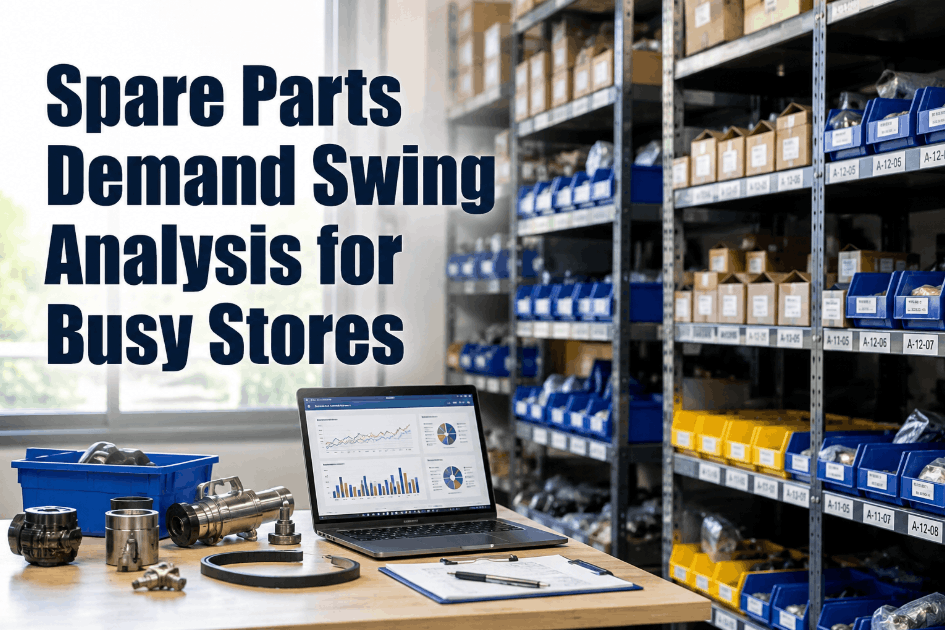
Spare parts inventory management in active maintenance stores is never a static problem. Demand patterns swing with production schedules, seasonal maintenance cycles, equipment age, and unplanned breakdown events — creating stockouts on the parts that matter most and excess inventory on components that rarely move. Demand swing analysis is the process of systematically reviewing consumption variance across the parts register to identify fast movers, slow movers, spike patterns, and reorder logic gaps before those imbalances disrupt active maintenance work. Without this analysis, stores teams are always reacting — either rushing emergency procurement or writing off obsolete stock that consumed capital for years. Sign Up Free to start linking work order consumption data to your spare parts planning. Oxmaint AI connects maintenance work orders to parts consumption records — giving stores teams the demand visibility they need to build tighter reorder logic before the next breakdown exposes a critical stockout. Book a Demo to see how parts demand data flows from Oxmaint work orders into inventory planning decisions.
See Where Your Parts Demand Is Swinging Before a Stockout Stops a Repair
Oxmaint AI connects maintenance work orders to spare parts consumption — giving stores managers the demand trend data they need to tighten reorder logic, reduce emergency purchases, and keep critical parts in stock when breakdowns happen.
Why Spare Parts Demand Swings Are Missed in Busy Maintenance Stores
Gap #1
No Consumption Trend Visibility
Parts issue records are captured in CMMS or ERP systems but never aggregated into consumption trend reports — leaving stores teams unable to see which parts are accelerating in demand before they reach zero stock.
Gap #2
Static Reorder Points
Reorder quantities and minimum stock levels are set at procurement and rarely reviewed — remaining unchanged as production volumes rise, equipment ages, or maintenance strategy shifts toward higher PM frequency.
Gap #3
Spike Events Not Captured
Demand spikes driven by major breakdowns or overhaul campaigns are treated as normal consumption — inflating reorder quantities for parts that have returned to steady-state demand after the event resolved.
Gap #4
Fast and Slow Movers Mixed
All parts are managed with the same review cycle and reorder logic regardless of movement velocity — meaning fast movers run out before reorder triggers while slow movers accumulate past their useful shelf life.
Gap #5
Work Order Data Not Connected
Parts consumption is recorded at issue but never linked back to the work order type that drove demand — making it impossible to forecast parts requirements from planned maintenance schedules or upcoming overhauls.
Gap #6
No Critical Parts Flag
Parts stores don't distinguish between components whose stockout would stop production and those that would only cause a minor delay — so all parts receive the same replenishment urgency regardless of operational consequence.
How Oxmaint AI Connects Work Orders to Parts Demand Data
01
Work Order Linked Issue
Every part issued against a work order in Oxmaint captures the part number, quantity, asset, work type, and technician — creating a consumption record linked to the maintenance event that drove demand.
→
02
Demand Pattern Analysis
Oxmaint aggregates parts consumption data across time periods and work types — identifying fast movers, slow movers, spike events, and seasonal demand patterns by asset class and maintenance category.
→
03
Reorder Logic Review
Consumption trend data flags parts where current reorder points, minimum quantities, or safety stock levels are misaligned with actual demand patterns — enabling data-driven stocking parameter updates.
→
04
Availability Assurance
Critical parts are flagged by asset criticality tier and consumption rate — ensuring that the components most likely to be needed during a breakdown are stocked to a level that supports immediate repair.
What Oxmaint Captures Per Spare Parts Demand Record
Consumption Data Layer
Parts issued per work order linked to asset and work type
Consumption quantity and frequency tracked by part number
Spike events flagged and separated from steady-state demand
Stocking Parameters
Fast and slow mover classification updated from consumption data
Reorder point variance alerts when actual demand exceeds targets
Safety stock adequacy checked against lead time and demand rate
Criticality Alignment
Parts linked to asset criticality tier for stocking priority
Production-critical parts flagged for minimum stock enforcement
Obsolete or zero-demand parts identified for stock review
Operational Outcome
Stockouts on critical parts reduced through demand-aligned reorder logic
Emergency procurement events and associated premium costs reduced
Inventory capital freed from slow-moving and obsolete stock
28%
Average reduction in emergency parts procurement costs when demand swing analysis informs reorder logic updates
2.7×
Improvement in critical parts availability rate when stocking parameters are aligned to actual work order consumption
48hrs
Typical time to deploy Oxmaint and begin capturing linked parts consumption records from maintenance work orders
90days
Average time to measurable improvement in parts availability and reduction in stockout events after Oxmaint deployment
Oxmaint AI vs Standard CMMS for Spare Parts Demand Visibility
Standard CMMS — Limited Demand Insight
Parts issued against work orders but consumption not aggregated into demand trend reports
Reorder points set manually and rarely reviewed against actual consumption patterns
No differentiation between fast movers, slow movers, and spike-driven demand events
Critical parts not distinguished from general stock — all parts managed with equal urgency
No link between planned maintenance schedules and future parts demand forecasts
Emergency procurement events treated as normal operations with no root cause correction
Oxmaint AI — Demand-Linked Inventory Visibility
Parts consumption linked to work orders — demand trends visible by part, asset, and work type — Sign Up Free
Reorder logic review alerts when actual consumption diverges from stocking parameters
Fast mover, slow mover, and spike classifications updated from live consumption data
Production-critical parts flagged with minimum stock enforcement and priority replenishment alerts
Planned PM schedules and upcoming overhauls linked to anticipated parts demand requirements
Emergency procurement events tracked and analysed to drive reorder logic corrections
6 KPIs to Measure Spare Parts Demand Swing Management
These KPIs give stores managers and maintenance planners the metrics to confirm that demand swing analysis is improving parts availability and reducing inventory waste. Book a Demo to see how Oxmaint tracks all six automatically from work order consumption data.
KPI 01
Critical Parts Availability Rate
Percentage of production-critical spare parts available at required minimum stock levels. Stockouts on critical components directly extend equipment downtime and repair lead times during breakdown events.
Parts Readiness
KPI 02
Emergency Procurement Rate
Percentage of parts purchases made outside normal procurement cycles due to unexpected stockouts. High emergency procurement rates indicate that demand swings are exceeding current reorder logic parameters.
Procurement Efficiency
KPI 03
Reorder Logic Accuracy Rate
Percentage of parts with reorder points, minimum quantities, and safety stock levels aligned to actual consumption patterns. Misaligned parameters are the root cause of most stockout and excess inventory events.
Stocking Accuracy
KPI 04
Slow Mover and Obsolete Stock Value
Total inventory value held in parts with zero or near-zero consumption over a defined period. Slow mover analysis identifies capital that could be freed through returns, redeployment, or controlled write-off.
Inventory Efficiency
KPI 05
Demand Variance Rate by Part Class
Coefficient of variation in parts consumption by movement class. High variance on fast movers identifies parts where safety stock and reorder quantities need upward revision to absorb demand spikes.
Demand Stability
KPI 06
Work Order to Parts Link Rate
Percentage of parts issues captured with a linked work order record. High link rates enable demand trend analysis by asset, work type, and maintenance category — driving progressively more accurate stocking decisions.
Data Quality
Industries Using Oxmaint for Spare Parts Demand Management
Heavy Manufacturing
Demand Swing Analysis Across High-Volume Maintenance Stores
Steel, mining, and heavy manufacturing operations use Oxmaint to track parts consumption against planned maintenance and breakdown work orders — identifying fast movers at risk of stockout and slow movers consuming valuable store space and capital. Sign Up Free for your maintenance operation.
Process Industries
Repairable Item and Consumable Demand Tracking
Chemical and refining plants use Oxmaint to separate consumable parts demand from repairable item cycles — ensuring that both categories are stocked appropriately and that repair loops for repairable components are captured in the work order record. Book a Demo for your facility.
Food and Beverage
Seasonal Demand Pattern Management for Production Lines
F&B manufacturers use Oxmaint to identify parts demand patterns driven by seasonal production volume changes — building forward-looking stocking plans that prevent stockouts during peak production periods on critical filling and packaging lines.
Utilities and Infrastructure
Long Lead Time Parts Management for Critical Infrastructure
Power and water utilities use Oxmaint to track consumption demand on long lead time components — ensuring that transformer parts, pump wear components, and electrical spares are reordered well in advance of demand to avoid extended outage exposure.
Your Work Orders Already Contain the Demand Signal. Oxmaint Reads It.
Oxmaint AI links parts consumption to work orders, aggregates demand trends by part and asset class, and alerts stores teams when reorder logic needs to change before a stockout interrupts a critical repair. Book a Demo to see how parts demand analysis works across your maintenance stores.
Frequently Asked Questions
What is spare parts demand swing analysis in maintenance?
Demand swing analysis is the process of reviewing consumption variance across the spare parts register to identify which parts experience demand spikes, which are slow-moving, and where reorder logic parameters are misaligned with actual usage patterns — enabling proactive stocking corrections before stockouts or excess inventory events occur.
How does Oxmaint connect work orders to spare parts demand data?
Every part issued against a work order in Oxmaint creates a consumption record linked to the asset, work type, and maintenance event — building a demand history that stores managers can analyse by part number, asset class, and time period to identify consumption trends and stocking gaps.
How can I separate spike demand from steady-state consumption in Oxmaint?
Oxmaint links consumption records to work order types, so demand driven by major breakdowns or overhaul campaigns can be filtered from steady-state PM consumption — preventing spike events from distorting reorder quantity calculations for parts with normally stable demand patterns.
Can Oxmaint help identify which spare parts are critical to stock?
Yes. Oxmaint links parts to asset criticality tiers, so components whose stockout would stop production on a Tier 1 asset can be flagged for minimum stock enforcement and priority replenishment — ensuring critical parts are available when breakdowns on the most important assets occur.
Does Oxmaint work for multi-store or multi-site spare parts operations?
Yes. Oxmaint supports multi-site asset registers and stores records, with consolidated demand reporting across all locations — giving central procurement teams visibility over consumption patterns, reorder requirements, and stock transfer opportunities across the entire maintenance operation.
Stop Running Out of the Parts That Matter Most.
Oxmaint AI connects maintenance work orders to spare parts consumption data — giving your stores team the demand swing visibility to build smarter reorder logic, reduce emergency procurement, and keep critical components in stock when breakdowns happen.