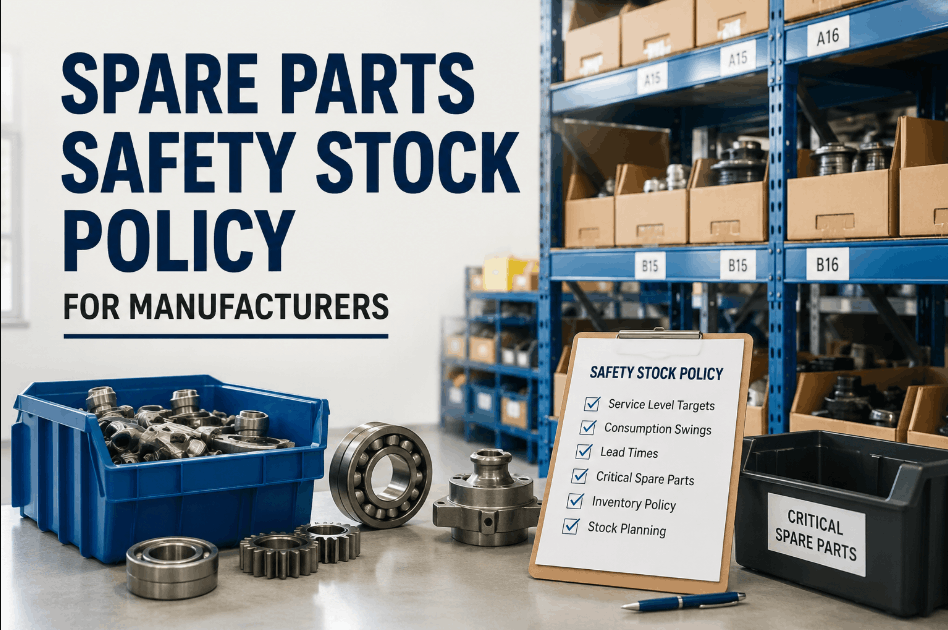
Spare parts safety stock policy failures cost manufacturers far more than the price of a missed replenishment. When stock levels are set by gut feel rather than service-level targets, consumption variability, and supplier lead times, critical assets sit idle waiting for parts that should have been on the shelf. A structured safety stock policy for manufacturers eliminates reactive purchasing, aligns warehouse capacity to real demand patterns, and ensures material availability matches the reliability expectations placed on production equipment. Maintenance teams using Sign Up Free on OxMaint can link spare parts inventory parameters directly to asset criticality ratings, track consumption history by part number, and set replenishment rules that respond automatically to demand swings and lead time changes — before a stockout becomes a shutdown event.
Why Manufacturers Get Safety Stock Wrong
Most manufacturers inherit safety stock levels from purchase orders placed years ago, informal experience rules, or minimum-quantity defaults from their ERP system. None of these account for consumption variability at the asset level, supplier lead time fluctuations, or the actual cost of a stockout on a critical production line. Book a Demo to see how OxMaint gives maintenance and procurement teams the consumption data and lead time visibility they need to set defensible, asset-linked safety stock targets.
Six Inputs That Drive a Defensible Safety Stock Policy
Effective safety stock policy for manufacturers requires more than a reorder point formula. Each policy input must reflect the actual operating conditions of the plant, the asset, and the supply chain behind each critical spare. Sign Up Free to start building asset-linked inventory parameters in OxMaint and establish safety stock logic grounded in real consumption and lead time data.
Service-Level Target by Asset Criticality Class
Safety stock levels should be set to achieve different service-level targets depending on how critical the associated asset is to production throughput. OxMaint's asset criticality ratings allow inventory parameters to be differentiated — holding higher stock for Tier 1 assets and leaner buffers for non-critical equipment classes.
Consumption Variability Over Rolling Periods
Parts with high demand variability need larger safety buffers than parts with predictable consumption. OxMaint tracks parts consumption per asset across maintenance work orders — giving procurement teams the rolling consumption data required to calculate standard deviation inputs for safety stock formulas accurately.
Supplier Lead Time and Lead Time Variability
A part with a 12-week lead time from a single-source supplier requires a fundamentally different safety stock calculation than a commodity available next-day locally. OxMaint stores supplier lead time data at the parts record level — keeping stock parameters calibrated to the actual replenishment timeline for each stocked item.
Seasonal Demand Patterns and Planned Shutdown Windows
Consumption spikes before planned shutdowns and seasonal production peaks require temporary safety stock adjustments. OxMaint's work order scheduling visibility allows inventory planners to anticipate demand surges from planned maintenance events and pre-position stock before replenishment lead times compress available response time.
Cost of Stockout vs. Cost of Carrying Inventory
Safety stock policy requires a conscious tradeoff between the carrying cost of buffer inventory and the production loss cost of a stockout event. OxMaint's asset downtime records and work order cost tracking provide the input data needed to quantify the true cost of stockout for each critical spare — making the service-level target a business decision, not a guess.
Replenishment Trigger Logic and Reorder Point Alignment
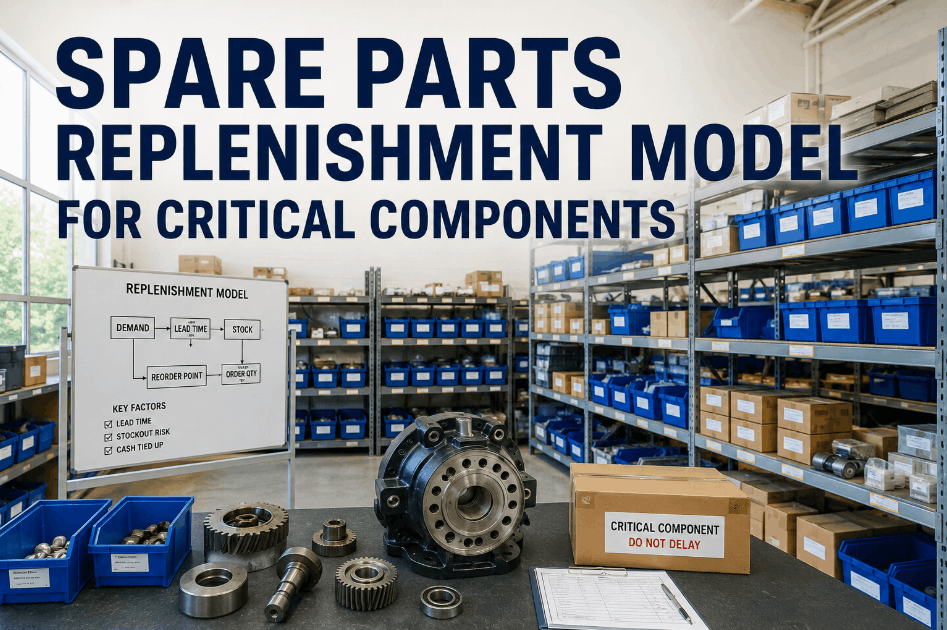
Safety stock without a functioning reorder point tied to it is an incomplete policy. OxMaint links safety stock parameters to automatic reorder point calculations — triggering procurement actions when on-hand inventory drops to the level where safety stock is needed to bridge the replenishment lead time gap without a stockout.
Safety Stock Parameters by Spare Parts Category
Spare parts categories carry different demand profiles, lead time risks, and criticality levels. Mapping safety stock parameters by parts category ensures each inventory class is protected appropriately without over-carrying across the entire warehouse. Book a Demo to explore how OxMaint manages inventory parameters across parts categories linked to asset records and work order consumption history.
| Parts Category | Typical Lead Time Risk | Demand Pattern | Recommended Service Level | OxMaint Policy Lever |
|---|---|---|---|---|
| Rotating Equipment Spares | High — OEM-sourced, long lead | Irregular, failure-driven | 97–99% | Asset criticality-linked safety stock + reorder trigger |
| Seals and Gaskets | Medium — multiple suppliers available | Moderate, shutdown-clustered | 95–97% | Shutdown schedule-linked demand planning in OxMaint |
| Electrical and Control Components | High — specification-specific | Low frequency, high impact | 97–99% | Single-source supplier flag + extended safety buffer |
| Lubricants and Consumables | Low — commodity, local supply | Predictable, usage-based | 90–95% | Consumption-driven auto-replenishment via work orders |
| Structural and Fabricated Parts | Very High — custom, long fabrication | Very low, critical failure event | 99%+ | Insurance stock policy with annual review in OxMaint |
How Poor Safety Stock Policy Compounds Plant Costs
Understocked safety buffers produce emergency procurement premiums, production delays, and rushed maintenance decisions that introduce reliability risk. Overstocked buffers consume working capital, generate obsolescence write-offs, and mask procurement process failures. Both failure modes are preventable with a data-driven safety stock policy grounded in OxMaint's consumption, lead time, and asset criticality records. Sign Up Free to connect your spare parts inventory to the asset and work order data that makes safety stock policy defensible and self-correcting.
Building a Safety Stock Policy Program with OxMaint
Classify Assets and Assign Criticality Ratings
Build asset criticality ratings in OxMaint that reflect production impact, redundancy availability, and failure consequence. Criticality class determines the service-level target that drives each asset's linked spare parts safety stock calculation.
Extract Consumption History by Part Number and Asset
Pull rolling consumption data from OxMaint work order parts usage records for each stocked spare. Calculate average demand and demand standard deviation per part — the two consumption inputs required for any statistically-grounded safety stock formula.
Load Supplier Lead Times and Lead Time Variability
Record average lead times and lead time standard deviation for each supplier and part number in OxMaint's inventory records. Flag single-source items and long-lead components for elevated safety stock buffers that reflect supply chain fragility.
Calculate Safety Stock and Reorder Points by Service-Level Target
Apply service-level-driven safety stock formulas using consumption variability and lead time inputs stored in OxMaint. Set reorder points that trigger procurement actions automatically when on-hand inventory approaches the safety stock threshold — before a stockout is possible.
Review and Recalibrate Policy Parameters Each Quarter
Compare actual stockout events, consumption variances, and lead time changes against safety stock assumptions in OxMaint each quarter. Update parameters to reflect supplier changes, asset modifications, and production demand shifts — keeping safety stock policy current rather than static.
Frequently Asked Questions: Spare Parts Safety Stock Policy
What is spare parts safety stock in manufacturing?
Safety stock is the buffer inventory held above average demand to protect against consumption spikes or supplier delays. For spare parts, it ensures critical components are available for unplanned failures without requiring emergency procurement.
How do service-level targets affect safety stock quantity?
Higher service-level targets require larger safety buffers to absorb more demand and lead time variability. Linking service-level targets to asset criticality in OxMaint ensures that critical spare parts carry appropriately sized buffers while non-critical items hold leaner stocks.
How does OxMaint support spare parts safety stock policy?
OxMaint tracks parts consumption through work order records, stores supplier lead time data at the parts level, links inventory parameters to asset criticality, and generates reorder alerts when on-hand stock approaches safety stock thresholds.
How often should safety stock levels be reviewed?
Quarterly reviews aligned with consumption data updates and annual reviews following supplier changes or asset modifications. OxMaint's consumption history and lead time records give planners the data to recalibrate parameters without manual data collection.
What is the difference between safety stock and reorder point?
Safety stock is the minimum buffer held to cover variability. The reorder point is the on-hand quantity that triggers a replenishment order — calculated to ensure inventory doesn't drop below safety stock before the replenishment arrives.