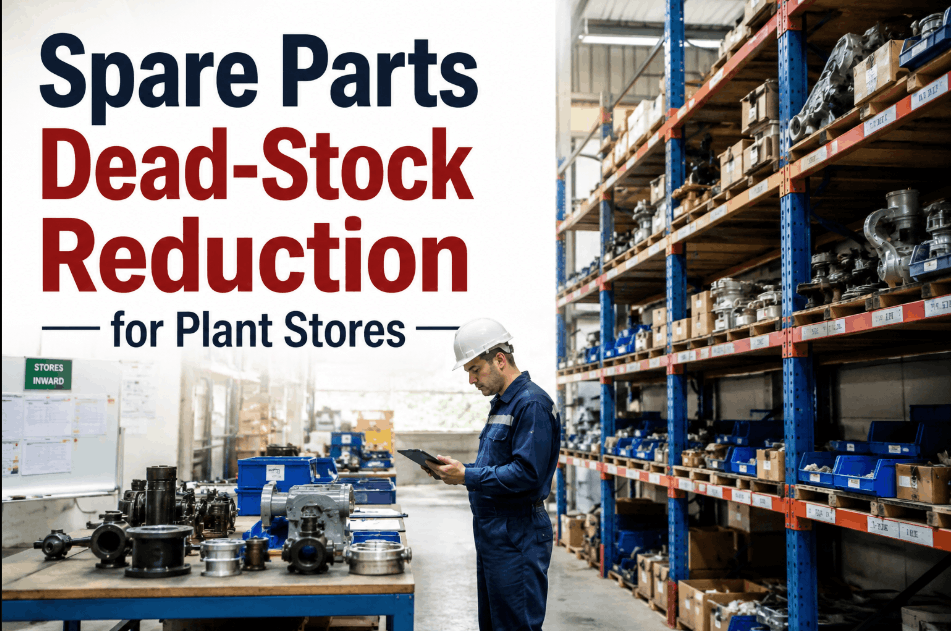
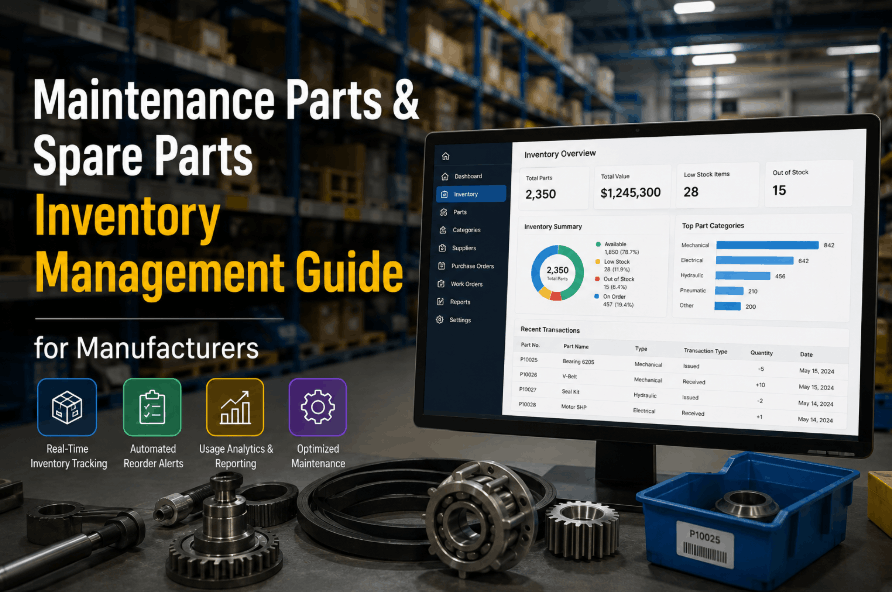
Every manufacturer carries inventory that costs 20–30% of its own value per year just to sit on a shelf — and simultaneously runs out of the $12 bearing that halts a $40,000-per-hour production line. Both problems exist in the same storeroom, managed by the same team, and neither gets solved by adding more shelves or ordering more parts. The answer is AI-driven spare parts inventory optimization inside your CMMS — a discipline that cuts carrying costs by up to 30% while virtually eliminating stockout-driven downtime. This guide breaks down exactly how it works, what the data shows, and what manufacturers who implement Oxmaint's inventory module achieve in measurable financial terms.
Spare Parts Inventory Optimization for Manufacturing: Reduce Stockouts & Cut Costs with AI
The storeroom is where maintenance budgets are won or lost. Most manufacturers are losing — without knowing exactly how much.
Why Your Storeroom Is Losing Money in Two Directions Simultaneously
Spare parts inventory failure has two faces — and most manufacturers are experiencing both at the same time. Understanding this duality is the first step to solving it.
- Capital locked in parts that never move
- Storage space, HVAC, insurance costs compound
- Rubber seals dry-rot. Batteries discharge. Electronics corrode.
- Parts become obsolete before they are ever used
- Finance cannot see the working capital trapped in bins
- Emergency freight at 2–3x standard part cost
- Idle workforce waiting for a $12 bearing
- Missed shipments, customer penalties, reputation damage
- Overtime labor to recover lost production window
- Technicians searching three storerooms to find what should be tracked
Both problems exist because the storeroom lacks a system that connects parts consumption to asset failure data, maintenance schedules, and supplier lead times in real time. That system is what Oxmaint provides. Sign up for Oxmaint to connect your storeroom to your maintenance workflow today.
What Poor Inventory Management Actually Costs — By the Numbers
These are not abstract risks. They are line items that appear in every manufacturing operation's budget under different labels — emergency procurement, unplanned downtime, maintenance overhead, working capital.
How AI-Driven Inventory Optimization Actually Works: The Four Pillars
AI does not magically reduce your parts inventory. It replaces four specific manual processes that are consistently inaccurate, slow, and disconnected from actual asset condition data — with automated, data-driven equivalents.
Not all parts deserve the same stocking policy. ABC classification segments parts by annual usage value (A = high, B = medium, C = low). XYZ classification segments by demand predictability (X = consistent, Y = variable, Z = sporadic). A critical motor with a 12-week lead time and zero substitutes scores differently from a standard filter with three local suppliers. Oxmaint's inventory module runs this analysis automatically against your consumption history and asset criticality scores — assigning each SKU a stocking policy rather than leaving it to technician intuition.
Manual reorder points are set once and forgotten. They do not reflect changing asset condition, seasonal maintenance peaks, or supplier lead time volatility. AI calculates dynamic reorder points using actual consumption data from closed work orders, supplier lead times per vendor, demand variability over rolling 12-month windows, and asset failure patterns from the maintenance history. Safety stock is not a fixed number — it is a calculation that changes as your assets age, your maintenance schedule intensifies, and your suppliers' delivery times shift. Oxmaint recalculates these thresholds continuously and surfaces alerts before a part reaches the stockout threshold — not after.
The most accurate consumption data in any facility already exists — in closed maintenance work orders. Every time a technician replaces a bearing, uses a filter, or installs a seal, that part consumption is recorded against the asset and the work order. When this data flows into inventory management automatically, the reorder model becomes self-learning. Parts that are consumed faster than forecast trigger reorder point adjustments. Parts that sit untouched for 12 months get flagged as dead stock candidates. Sign up for Oxmaint to connect your work orders to inventory consumption automatically from day one.
Reactive inventory management waits for a part to be consumed before thinking about replenishment. Predictive demand forecasting looks forward — reading the maintenance schedule to know that twelve bearing replacements are planned in the next 90 days, and pre-positioning stock accordingly. When Oxmaint's PM module shows a quarterly overhaul is approaching for a critical asset, the inventory module can raise a purchase requisition for the required parts six weeks in advance — at standard supplier pricing instead of emergency freight rates. This is the single highest-ROI use of CMMS-integrated inventory management. Book a demo to see predictive demand forecasting configured for your maintenance schedule.
Before and After: What Changes When Your Storeroom Connects to Your CMMS
These comparisons reflect documented outcomes from facilities that moved from manual or spreadsheet-based inventory management to Oxmaint's integrated inventory module.
| Storeroom Activity | Without Oxmaint | With Oxmaint AI | Impact |
|---|---|---|---|
| Reorder point setting | Manual — set once, rarely updated | AI-calculated from consumption history and lead times | 20–40% fewer emergencies |
| Stockout detection | Discovered when technician needs part | Alert fires before minimum threshold reached | Stockouts eliminated for managed parts |
| Parts demand forecasting | Based on gut feel and past orders | Driven by PM schedule and failure pattern data | 15–25% lower inventory costs |
| Dead stock identification | Discovered during annual physical count | Flagged continuously — any part inactive 12+ months | 15–25% of inventory value recovered |
| Consumption recording | Manual log or not recorded at all | Auto-deducted when work order is closed | Inventory accuracy 95%+ |
| Emergency purchase rate | 3–8 events per month at 1.5–2x price | Near-zero for planned maintenance parts | $12K–$40K/yr eliminated |
| Parts-to-asset linkage | No connection — parts and assets tracked separately | Every SKU linked to the assets it supports | Full failure-to-part traceability |
| Carrying cost visibility | Unknown — finance sees total inventory value only | Per-SKU holding cost calculated and reported | 30% carrying cost reduction possible |
Swipe right to view full table on mobile
From Chaotic Storeroom to Optimized Inventory: A 90-Day Path
Spare parts optimization does not require a multi-year transformation project. A phased 90-day approach delivers measurable financial wins in the first month while building the systems for long-term control.
Count every SKU, assign bin locations, and upload to Oxmaint with manufacturer part numbers, unit of measure, and current stock quantity. Standardize part names to eliminate duplicates — a typical facility with 2,000 SKUs finds 200–400 duplicates on first audit.
Run ABC-XYZ classification in Oxmaint against the last 12 months of consumption data. Tag each part with its asset linkage and criticality score. Identify dead stock candidates — parts with zero consumption in 12+ months. This alone typically surfaces 15–20% of inventory value as actionable reduction opportunity.
Set minimum quantity thresholds, reorder quantities, and preferred supplier per part — informed by Oxmaint's AI suggestions based on consumption history and lead times. For high-criticality parts with long lead times, Oxmaint recommends higher safety stock levels automatically. Technicians receive a mobile alert when any part approaches its minimum threshold.
Configure Oxmaint so that closing a work order automatically deducts consumed parts from inventory. This eliminates manual stock reconciliation and creates the consumption history that makes AI forecasting accurate over time. First consumption-linked work orders complete within days of configuration.
Oxmaint reads the upcoming 90-day PM schedule and identifies parts required for planned maintenance events. Purchase requisitions are raised automatically for parts below the required quantity — at standard pricing, before any urgency. A quarterly gearbox overhaul requiring eight specific components triggers procurement six weeks before the job — not the morning of.
Activate Oxmaint's inventory analytics dashboard — tracking stockout rate, inventory turnover, carrying cost by category, emergency purchase frequency, and dead stock value. Monthly storeroom reviews use this data to make continuous adjustments to reorder points, retire obsolete SKUs, and reclassify parts that have changed consumption patterns.
The Seven KPIs That Define a World-Class Storeroom
These are the metrics Oxmaint tracks automatically from the moment your storeroom is connected to your maintenance workflow. World-class facilities benchmark against all seven.
Percentage of time critical MRO items are unavailable when needed. Even 5% stockout rate on critical assets causes disproportionate downtime cost.
How many times your MRO inventory is consumed and replenished per year. Low turnover signals excess stock tying up working capital.
Total annual cost of holding inventory as a percentage of inventory value. Includes storage, insurance, obsolescence, and opportunity cost of tied capital.
Share of purchase orders placed on an expedited basis. Emergency orders typically cost 1.5–2x standard pricing plus freight premiums.
Value of inventory items with zero consumption in the past 12 months. Dead stock consumes storage space and carrying cost without providing any operational value.
Agreement between system record and physical count. Below 90% accuracy causes false stockout alerts and over-ordering. Auto-deduction from work orders keeps this above 95% without manual counting.
MRO inventory value as a percentage of replacement asset value. World-class facilities achieve below 1.5% by accurately forecasting what they need rather than hoarding against uncertainty.
Spare Parts Inventory Optimization — Questions Answered
Oxmaint's AI calculates reorder points using three data inputs: historical consumption from closed work orders, supplier lead times per vendor, and demand variability over a rolling 12-month window. For high-criticality parts with long or unreliable lead times, the algorithm applies a higher safety stock multiplier automatically. Reorder points update continuously as consumption patterns change — meaning a part that gets used twice as often after a plant expansion will have its threshold adjusted without any manual intervention. Sign up for Oxmaint to see AI-calculated reorder points configured for your first 50 SKUs at no cost.
Standard min/max stocking applies the same logic to a $4,000 motor with a 12-week lead time as it does to a $3 filter with next-day delivery — which is why so many storerooms are simultaneously overstocked on low-risk parts and understocked on critical ones. ABC-XYZ analysis segments parts by both value impact (A/B/C) and demand predictability (X/Y/Z), producing nine distinct stocking policies. An A-Z part — high value, sporadic demand — needs a completely different approach than a C-X part — low value, predictable consumption. Book a demo to see ABC-XYZ analysis applied to your actual parts catalog in Oxmaint.
When Oxmaint is configured correctly, closing a work order triggers an automatic inventory deduction for every part listed in that work order's parts consumed field. Technicians do not fill in a separate inventory form — they close their work order as normal, and the system handles the stock adjustment. This eliminates the manual reconciliation process that causes inventory records to drift from physical reality, and it creates the consumption history that makes AI forecasting progressively more accurate over time. Sign up for Oxmaint to configure automatic inventory deduction for your work orders.
The first measurable result — dead stock identification — typically arrives within the first month of running ABC-XYZ analysis against the existing inventory. Emergency purchase frequency begins declining in Month 2 as automated reorder alerts fire before parts reach stockout. Most facilities see a measurable reduction in inventory carrying cost by Month 3, with the full optimization impact — including predictive demand forecasting from PM schedules — established by Month 6. Industry data shows AI-driven MRO optimization delivers 3–7x ROI within 6–12 months. Book a demo to build a facility-specific ROI model before you commit.
Your Storeroom Has Two Problems. Oxmaint Solves Both.
Too much inventory that costs 25% of its value per year to hold. Not enough of the part that brings the line down for six hours. Both problems have the same root cause: a storeroom disconnected from your maintenance data. Oxmaint connects them — giving you AI-calculated reorder points, automatic consumption tracking, predictive procurement from your PM schedule, and a live dashboard of the seven KPIs that separate world-class storerooms from reactive ones. The average manufacturer recovers $37,000–$60,000 per year on a $500K inventory. Yours is waiting.