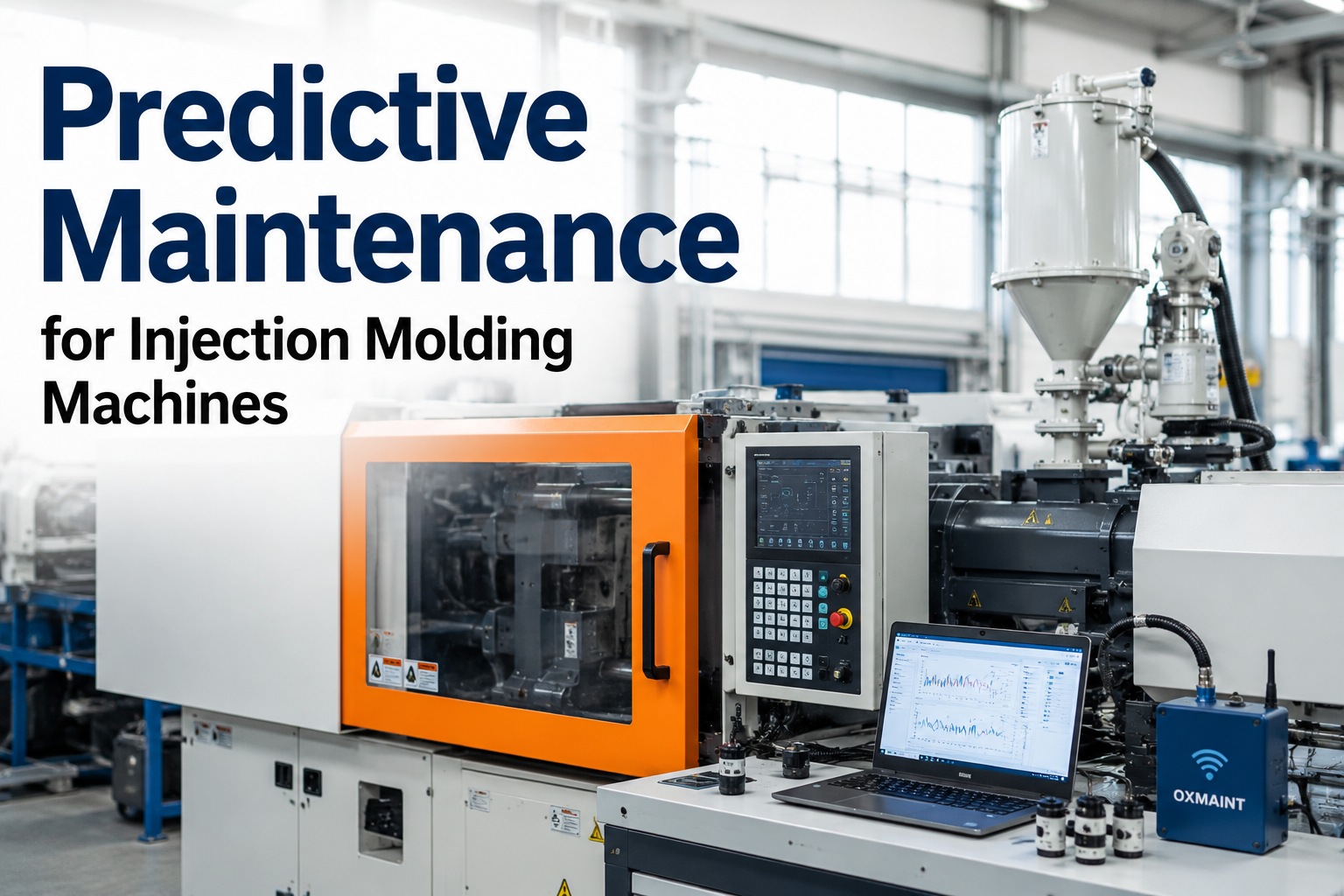
Predictive Maintenance for Injection Molding Machines

By William Jerry on August 25, 2026

predictive-maintenance-for-injection-molding-machines

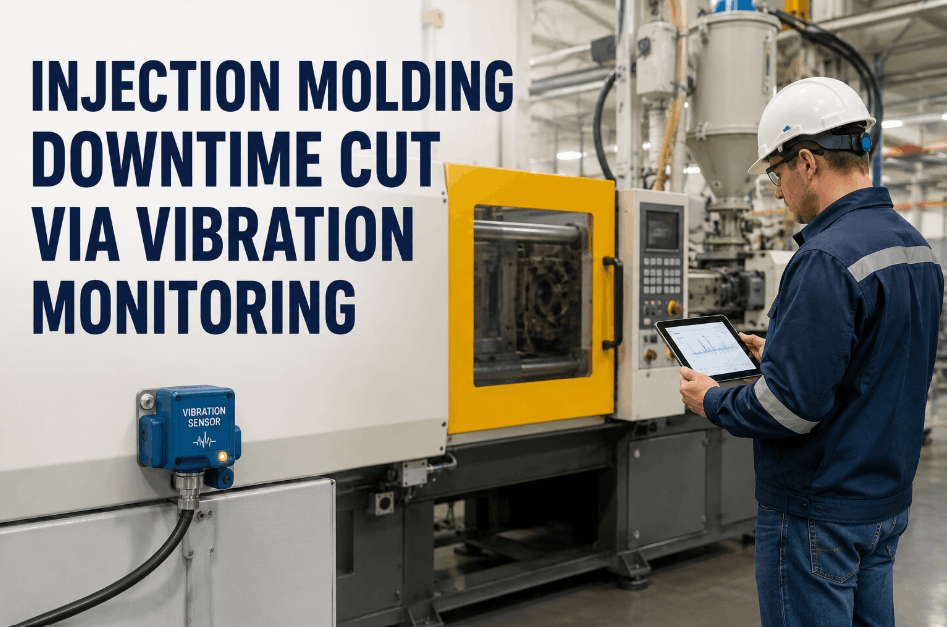
Predictive maintenance for injection molding machines is what turns an unscheduled hydraulic pump failure — the kind that sends metal contaminants through the whole hydraulic loop and costs days of flush plus a new set of valves and actuators into a planned five-minute swap. Modern IMM monitoring stacks run 8 to 20 measurement points per machine (thermocouples, pressure transducers, vibration sensors, motor current analyzers, position encoders) feeding AI models that detect check-ring wear 40–80 hours before failure and predict pump or bearing degradation 7–30 days in advance. Programs that push these signals into a CMMS work-order queue consistently deliver 30–50% fewer unplanned stops, longer component life, and lower energy per shot. Book a Demo to see OxMaint's IMM predictive workflow — sensor integration, RUL scoring, and auto-generated work orders on one dashboard.

Plastics · Predictive Maintenance · CMMS 2026

Predictive Maintenance for Injection Molding Machines

Cut injection molding machines downtime with AI-native predictive maintenance from OxMaint. Detect failures early, extend asset life, boost OEE — from sensor signal to closed work order in one platform.

30–50%
Reduction in unplanned stops on IMM lines running AI-based predictive monitoring
7–30 days
Advance warning window for pump, bearing, and screw wear on molding assets
40–80 hrs
Lead time to detect check-ring wear from shot-weight standard deviation trends
8–20
Measurement points per machine in a mature IMM predictive stack (Kistler benchmark)

The IMM Anatomy — Where Every PdM Sensor Lives

A modern injection molding machine is five subsystems working in tight coordination — clamp unit, injection unit, plasticizing screw and barrel, hydraulic power pack, and mold cooling loop. Each has its own failure modes, and each demands its own sensor coverage. Below is the map of where signals originate and what they predict. Start a free OxMaint workspace and register your first IMM asset with subsystem hierarchy pre-loaded — the free plan includes sensor ingestion via API, PM scheduling, and mobile work orders from day one.

Injection Molding Machine — PdM Sensor Map
A
Clamp Unit
Tie-bar strain · Platen parallelism · Clamp position encoder
B
Injection Unit
Injection pressure · Screw torque · Shot weight · Cushion
C
Screw & Barrel
Barrel zone temps · Motor current · Plasticating time
D
Hydraulic Power Pack
Pump vibration · Oil temp · Discharge pressure · Particle count
E
Mold Cooling Loop
Return water temp · Flow rate per half · Cavity pressure/temp
A → E: 5 subsystems · 8–20 signals feeding the OxMaint predictive queue in real time

Sensor → Signal → Failure Mode → Work Order

The AI predictive layer only earns its cost when a signal becomes an action. Below is the full traceable pipeline for the six highest-value IMM failure modes — from sensor input to the OxMaint work order that lands on a technician's phone. Book a live demo to see this pipeline running against your actual IMM controller data — an OxMaint reliability engineer maps your sensor tags to failure modes during the call.

Sensor
Signal Pattern
Predicts
OxMaint Work Order
Shot-weight monitor
Rising standard deviation across cycles
Check-ring / non-return valve wear (40–80 hr lead)
Scheduled screw pull & NRV replacement
Vibration + oil temp
Rising baseline + pressure ripple
Hydraulic pump / bearing degradation (7–30 day lead)
Planned pump changeout with parts staged
Barrel zone thermocouple
Zone imbalance + slow recovery
Heater band burnout / thermocouple drift
Heater replace + cross-sensor calibration WO
Motor current + plasticating time
Rising current at constant shot size
Progressive screw / barrel abrasive wear
Screw pull & wear measurement PM
Cooling water return
2 GPM flow drop over baseline
Mold cooling channel fouling / restriction
Cooling circuit cleaning work order
Tie-bar strain gauge
Uneven load distribution across posts
Clamp misalignment / platen parallelism drift
Platen alignment & tie-bar torque WO

Turn a Hydraulic Pump Failure Into a Five-Minute Planned Swap.

AI signals mean nothing if they don't reach the technician who fixes them. OxMaint receives sensor alerts via API, generates the work order with RUL context and repair history attached, and routes it to the right hands — before the machine trips.

Reactive vs. Preventive vs. Predictive — The IMM Cost Curve

Every IMM plant sits somewhere on a three-tier maintenance strategy curve. Reactive costs the most, calendar-based preventive over-maintains healthy machines and misses drifting ones, and predictive lands maintenance where and when it actually needs to happen. The comparison below shows the operational shape of each tier. Start free and move from reactive or calendar-PM to predictive on your first IMM within days — no CAPEX, no rip-and-replace of your existing controls.

Dimension
Reactive
Calendar-Based PM
Predictive (OxMaint)
Trigger
Machine fails or trips
500-hour interval regardless of actual load
Sensor signal crosses learned baseline
Downtime type
Unplanned mid-shift emergency
Planned but often unnecessary
Planned only when condition warrants
Collateral damage
Metal in hydraulics, screw + barrel scoring
Occasional early wear from over-service
Failure caught before secondary damage
Spare parts strategy
Rush freight, premium price
Blanket stocking of full PM kits
Parts staged inside the RUL window
OEE impact
Availability drops sharply
Stable but ceiling limited
Availability + quality both improve

The 5-Step OxMaint Predictive Workflow for IMM

Every predictive signal on an IMM travels the same five-step path in OxMaint — from raw sensor stream to closed work order with reliability history archived. This is the loop that closes the gap between analysis and action. Schedule a 30-minute walkthrough to see this workflow demonstrated on IMM-specific assets — bring your sensor tag list and we'll wire the first two failure modes live during the call.

01
Sensor Ingest
Vibration, temp, pressure, current, and encoder streams land in OxMaint via API — including edge-computed features from Raspberry Pi, Intel NUC, or Siemens SIMATIC layers.
02
Baseline & Anomaly
The model observes 2–4 weeks of normal operation per machine, learns the healthy signature, and flags subtle drift long before any control-panel alarm trips.
03
Failure Classification + RUL
Pattern-matched to known failure modes (NRV wear, pump degradation, heater band). Remaining Useful Life estimate returns a time-to-service window.
04
Work Order Generation
OxMaint spawns the WO with machine ID, subsystem, sensor readings, historical repair notes, and required parts pre-staged — routed to the assigned technician on mobile.
05
Execution & Feedback
Technician closes on mobile with findings and photos. Actual failure mode feeds back to sharpen the next RUL prediction. MTBF and OEE update on the dashboard.
"

We ran a 500-hour PM interval across all thirty-two presses regardless of shot size, material, or age. When we moved to OxMaint with vibration and shot-weight monitoring, the predictive layer flagged check-ring wear on IMM 14 forty-eight hours out — we swapped it during the shift changeover instead of losing eight hours mid-run. The same layer told us three other machines were over-serviced. Six months in, our unplanned stops on the IMM line dropped by more than a third and our PM labor budget is finally being spent where it moves the needle.

Plant Reliability Manager — Automotive Interior Plastics, 32 IMM presses, 3-shift

Frequently Asked Questions

Do I need to replace my existing IMM controller to start predictive?
No. OxMaint ingests controller tags via API and works with existing Kistler, Priamus, or machine-native sensors. Wireless clamp-on vibration and thermal sensors add coverage where needed without downtime for installation.
How long before the AI model produces useful predictions?
The model observes 2–4 weeks of normal operation per machine to establish a healthy baseline signature. Anomaly detection is live from day one; failure-mode classification and RUL scoring sharpen after the baseline window closes.
Can OxMaint overlay SAP PM or IBM Maximo without replacing them?
Yes. OxMaint runs alongside SAP PM and IBM Maximo, adding predictive triggers, mobile execution, and reliability analytics without disturbing ERP-side records that finance or procurement depend on.
Does OxMaint support cavity pressure and in-mold sensor data?
Yes. Cavity pressure and temperature trends ingest alongside machine-health data, letting quality and reliability teams share one dashboard where tooling drift and machine wear both surface.
Is this cost-justified for smaller plants?
Even single-cell operations recover cost quickly — one prevented hydraulic pump failure or one avoided screw-and-barrel scoring event typically pays for the first year of predictive coverage. Start free and scale as you prove ROI.

Move Your IMM Line from Firefighting to Forecasting.

OxMaint ingests every sensor stream, learns the healthy signature, predicts the failure mode, and lands the work order on the right technician's phone — with parts staged inside the RUL window. Predictive maintenance for injection molding, built to close the loop.

Share This Story, Choose Your Platform!