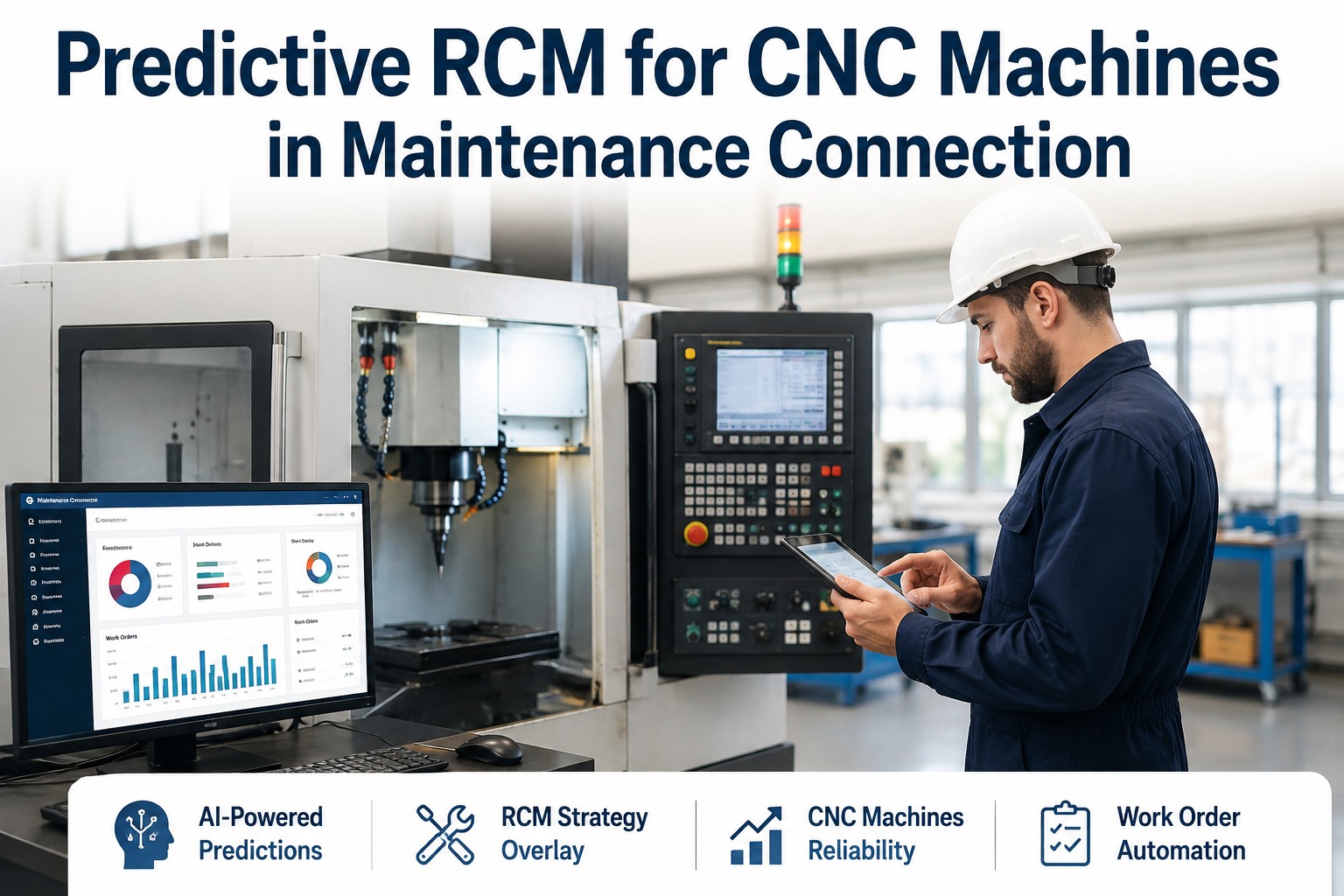
Maintenance Connection has been an Accruent flagship since the acquisition — a solid multi-site CMMS handling asset master data, work orders, PM scheduling, inventory, and multi-plant governance across thousands of manufacturers. What it isn't, and was never built to be, is a predictive RCM engine for high-speed CNC machining. CNC spindles run 5,000-30,000 RPM under variable cutting loads, coolant chemistry shifts hourly, ball screws see thermal drift across long cycles, and servo drive current signatures carry failure precursors weeks before a hard fault. Detecting those patterns needs vibration FFT analysis, motor current signature analysis, spindle temperature correlation, and machine-learning models trained on 6-12 months of live operation — capabilities outside Maintenance Connection's design center. The good news: you don't need to rip and replace. This guide covers how OxMaint layers predictive RCM on top of Maintenance Connection as a lightweight overlay — CNC telemetry ingested, ML failure prediction 2-3 weeks ahead, work orders automatically written back into Maintenance Connection as the enduring source of truth. Named Accruent MC customers (Toyota, Boeing suppliers, medium-large machine shops) keep their existing platform while adding modern predictive intelligence. Start free or book a demo to see the MC overlay live.
Manufacturing · Predictive RCM · MC Overlay · CMMS 2026
Predictive RCM for CNC Machines in Maintenance Connection
Add AI-native predictive RCM to Maintenance Connection for CNC machines. OxMaint layers on top — no rip-and-replace. Auto-create work orders back into your MC source of truth.
2-3 weeks
Spindle failure prediction lead time with ML-driven monitoring
5-30K RPM
CNC spindle speed range — variable loads defy calendar PM
56%
Organizations still running reactive maintenance (Accruent)
$100K+
Typical cost per unplanned CNC spindle failure event
Where Maintenance Connection Ends — And Where Predictive RCM Begins
Maintenance Connection excels at exactly what it was built for: multi-site CMMS backbone, work order governance, PM scheduling, spares inventory, and audit-grade record-keeping. What it doesn't do — and what CNC machining now demands — is real-time telemetry ingestion, ML failure prediction, and continuous FMEA against live operating conditions. Below is the honest capability gap map. Sign up free and OxMaint's manufacturing library ships with pre-configured connectors for Maintenance Connection — work orders flow bidirectionally, asset master stays in MC, predictive signals ride on top through a lightweight overlay you can trial without touching your existing MC deployment.
CAPABILITY GAP · WHERE MC NEEDS A PREDICTIVE OVERLAY
Capability
Maintenance Connection
OxMaint Overlay
Multi-site CMMS backbone
✓ Full — source of truth
— Not needed
Work order governance
✓ Full — MC handles
— Writes back to MC
CNC spindle vibration telemetry
✗ Not designed for this
✓ Native IoT sensor ingestion
FFT / spectrum analysis
✗ Absent
✓ Full frequency-domain analysis
Motor current signature analysis
✗ Absent
✓ MCSA for servo drives
ML failure prediction models
✗ Not designed for this
✓ 2-3 week lead time on major failure modes
Continuous FMEA against live data
✗ Static tables only
✓ Live criticality that shifts with condition
Auto WO creation from predictions
— Manual after diagnosis
✓ Auto-writes WO into MC on signal
Compliance record & asset master
✓ Full — MC handles
— Reads from MC
The CNC Subsystem Monitoring Map — 6 Failure Modes You Can Predict
Every CNC machine has six critical subsystems that account for the majority of unplanned failures. Each has a distinct sensor signature that surfaces weeks before a hard fault — if you're listening. Below is the subsystem-to-signal map. Book a 30-minute demo and an OxMaint CNC specialist will walk this map against your specific machine fleet (Haas, Okuma, Mazak, Fanuc, DMG Mori, Makino, Hurco) — you'll leave with a subsystem-by-subsystem monitoring rollout plan before you commit to a trial.
01
Spindle Bearings
EARLY SIGNAL: Vibration frequency shift at bearing defect frequencies (BPFI, BPFO, BSF)
The single most common failure mode. Wireless accelerometer catches sub-audible vibration changes 2-3 weeks before spindle-audible symptoms appear. Bearing defect frequencies are calculable from bearing geometry and RPM — FFT spectrum shows them cleanly.
02
Ball Screws & Linear Axes
EARLY SIGNAL: Motor current + position error correlation over cycles
Ball screw preload loss and nut wear show up as increasing servo current for the same commanded motion. Position error trending against servo current identifies degradation long before axis backlash affects part quality.
03
Servo Drives & Motors
EARLY SIGNAL: Motor current signature analysis (MCSA) — sidebands around line frequency
Broken rotor bars, bearing wear, insulation degradation all show up in current spectra before they show up as faults. MCSA is non-intrusive — reads existing servo drive current, no additional sensors on the motor itself.
04
Tool Holders & Chucks
EARLY SIGNAL: Vibration + acoustic emission during cutting
Tool holder runout, chuck balance loss, and clamping force degradation cause characteristic vibration signatures during cutting. AE sensors catch micro-fractures in inserts before they progress to catastrophic failure.
05
Coolant System & Contamination
EARLY SIGNAL: pH, particulate count, tramp oil %, temperature
Coolant chemistry drift accelerates spindle bearing wear, tool life reduction, and surface finish problems. Simple online sensors (pH, conductivity, turbidity) catch drift weeks before quality issues surface.
06
Thermal Drift & Positioning Accuracy
EARLY SIGNAL: Temperature-position correlation across cycle
Spindle thermal growth, ball screw thermal expansion, and column bending under thermal load cause positioning drift that ruins tight-tolerance work. Thermocouples on key structural points + cycle-time correlation identify drift before scrap generation.
Keep Maintenance Connection. Add the Predictive Intelligence It Was Never Built For.
Your MC platform stays. Your asset master stays. Your work order governance stays. OxMaint reads CNC telemetry, runs ML failure prediction, generates the work orders inside your MC system on the right cadence, and stays out of the way of everything MC already does well. No rip-and-replace, no CAPEX approval, no migration.
The Overlay Architecture — How OxMaint + Maintenance Connection Actually Works
"Overlay" is a specific technical pattern, not a marketing word. OxMaint runs the predictive/ML layer, Maintenance Connection stays the CMMS source of truth, and API integration handles the bidirectional flow. Below is the 3-lane architecture. Sign up free and OxMaint deploys as a cloud SaaS overlay — no on-premise install, no IT infrastructure change, no MC schema modification. Your first CNC subsystem can be monitored inside a week of sensor deployment.
SIGNAL LAYER
CNC machines & sensors
CNC controller telemetry
Wireless vibration sensors
Temperature probes
Motor current (MCSA)
Coolant chemistry sensors
→
PREDICTIVE LAYER
OxMaint AI overlay
FFT / spectrum analysis
ML failure prediction (2-3 wk lead)
Continuous FMEA scoring
Live criticality shifts
Auto WO generation
→
CMMS LAYER
Maintenance Connection (source of truth)
Asset master (stays in MC)
Work orders (created in MC)
PM scheduling (MC-driven)
Inventory (MC-managed)
Compliance records (MC-audit)
The 5 Highest-ROI CNC Predictive Use Cases on the MC Overlay
Below are the five predictive use cases that consistently deliver the fastest payback on a Maintenance Connection + OxMaint overlay — ranked by ROI in real deployments. Book a scoping call and an OxMaint CNC engineer will map these use cases against your specific machine fleet composition — you'll leave with a ranked rollout plan and expected payback ranges before you commit to a trial workspace.
#1
Spindle Bearing Failure Prediction
Single highest-value use case. One prevented spindle failure = $100K+ saved (rebuild + downtime). Wireless accelerometer per spindle ($2K-$5K) pays for itself on first prevented event.
#2
Tool Wear Estimation → Just-in-Time Changes
Replace fixed-interval tool changes with condition-based tool changes. Extends tool life 15-30%, cuts changeover downtime, prevents scrap from worn tools finishing the cycle.
#3
Coolant Chemistry Drift Alerting
Simple online sensors + automated WO creation when pH/conductivity drift out of spec. Cheap to deploy, prevents downstream spindle and tool life impact worth 10x the sensor cost.
#4
Servo Drive MCSA for Motor Failures
No additional sensors — reads existing drive current. Catches broken rotor bars, insulation degradation, bearing wear before hard fault. Highest sensor-cost-avoidance use case.
#5
Ball Screw Preload Loss Detection
Detected through servo current + position error correlation. Prevents axis backlash from affecting part quality on tight-tolerance work, extends ball screw service life.
Maintenance Connection Alone vs. MC + OxMaint Overlay
Your MC deployment is doing its job. The question is whether that job is enough for a modern CNC operation running high-value spindles at variable loads across multiple sites. Here's the honest comparison. Start free — no credit card, unlimited users, and OxMaint's manufacturing library ships with MC connectors pre-built, so your first predictive workflow can flow through to your existing MC deployment inside the first workspace session.
Manufacturing groups that want modern predictive CNC intelligence without a CMMS migration are exactly the customer for this overlay pattern. Start your free forever workspace to build your first MC-integrated predictive workflow this week, or book a demo to see the MC bidirectional integration live before you commit.
"
We run 34 CNC centers across four plants on Maintenance Connection — mixed Haas, Okuma, and DMG Mori — and MC was doing its job on the CMMS backbone. What it wasn't doing was catching spindle failures before they happened. Two spindle rebuilds last year at roughly $85K apiece plus 5 days production loss each convinced the operations director to look at overlay options. We chose OxMaint specifically because it didn't ask us to touch MC. Wireless accelerometers on our top-12 highest-value spindles inside two weeks, ML models tuned over the next 90 days, and the first predictive catch came at day 76 — bearing defect frequency rising on Spindle #17, WO auto-created in MC with the diagnostic data, planned rebuild during the next scheduled shutdown. No unplanned outage. Six months in, we've caught four more, and the CFO stopped asking whether the overlay was worth it.
VP Operations · 4-Plant CNC Machining Group · Midwest US
Frequently Asked Questions
Does OxMaint replace Maintenance Connection?
No. OxMaint is designed to overlay Maintenance Connection, not replace it. Your MC deployment remains the source of truth for asset master, work order governance, PM scheduling, inventory, and compliance records. OxMaint adds the predictive/ML layer — sensor ingestion, FFT analysis, failure prediction, continuous FMEA — and writes work orders back into MC via API when signals warrant action. Zero migration, zero MC schema change.
Which CNC failure modes can OxMaint predict?
Six primary subsystems: spindle bearings (vibration FFT — 2-3 week lead), ball screws and linear axes (motor current + position error), servo drives and motors (MCSA), tool holders and chucks (vibration + acoustic emission), coolant contamination (pH/particulate/tramp oil), and thermal drift affecting positioning (temperature-position correlation). Model tuning typically takes 6-12 months of live operation to hit high precision on your specific machine fleet.
Sign up free to start tuning on your fleet.
What sensors do we need to deploy?
Wireless vibration accelerometers on spindles ($2K-$5K per spindle), temperature probes on bearings and structural points, and existing servo drive current (no additional sensor — MCSA reads what's already there). Coolant systems benefit from simple pH/conductivity/turbidity online sensors. Wireless sensors install in minutes, no complex wiring, IP67/IP68 rated for shop-floor environments. One prevented spindle failure pays for the fleet's monitoring for years.
How does the MC integration actually work?
OxMaint connects to Maintenance Connection via API. Asset master data flows from MC to OxMaint (read-only) so predictive signals are correctly associated to the right asset. When OxMaint's ML models detect a failure precursor, a work order is auto-generated in MC with full diagnostic context — vibration spectrum, current signature, temperature trend, recommended action, priority. Your team continues to close WOs in MC. Zero learning curve for existing MC users.
Does OxMaint work with other Accruent products?
The overlay pattern is CMMS-agnostic. OxMaint integrates with Maintenance Connection, IBM Maximo, SAP PM, eMaint, Fiix, UpKeep, and other major CMMS platforms via API. If your organization also uses Accruent's Meridian (engineering information) or Kykloud (capital planning), OxMaint's predictive signals can inform both — but the primary integration for CNC predictive maintenance is MC as the CMMS backbone.
Book a demo to see the specific integration path.
How long until we see ROI?
Typical payback is 9-14 months on well-scoped CNC deployments. The math is simple: wireless vibration monitoring costs $2K-$5K per spindle, one prevented catastrophic spindle failure saves $100K+ (rebuild + 3-5 days lost production), and tool life extension of 15-30% on condition-based tool changes compounds monthly. Start with your top 10-20% highest-value spindles (typical Tier 1 criticality) to prove value before fleet expansion.
Is a credit card or CAPEX approval needed to start?
No. OxMaint's free forever plan requires no credit card, no CAPEX request, and no consulting engagement — you can
sign up in under 2 minutes and configure the MC integration workspace the same day. CNC machine asset templates ship pre-built for Haas, Okuma, Mazak, Fanuc, DMG Mori, Makino, and Hurco with their common failure modes and monitoring signatures loaded.
Add Predictive Intelligence Without Touching Maintenance Connection.
OxMaint overlays MC as an API-integrated predictive layer — CNC telemetry, ML failure prediction 2-3 weeks ahead, auto-generated WOs written back to your MC source of truth. No rip-and-replace, no migration, no CAPEX request. Start free — no credit card, unlimited users, forever. Or book a demo for an MC-specific integration walkthrough.