Most manufacturing plants are already running ERP, MES, SCADA, and IoT systems — but when those systems can't talk to each other, every department operates on a different version of reality. Maintenance teams log breakdowns hours after finance has already invoiced the lost time. Production schedules shift while the CMMS still shows the original plan. Oxmaint's integration layer connects your CMMS to all four systems — ERP, MES, SCADA, and IoT — so that a sensor alert on the shop floor automatically becomes a work order, a parts request, and a production update, all without a single manual step. This guide explains exactly how each integration works, what it automates, and why manufacturers who connect their CMMS to the rest of their stack report 40–60% better ROI than those running standalone maintenance software.
Integration Guide · Manufacturing Connectivity
CMMS Integration with ERP, MES, SCADA and IoT for Manufacturing Connectivity
Your maintenance system should be the hub of your operation — not another silo. Connect Oxmaint to the systems already running your plant and turn fragmented data into automated decisions.
40–60%
better ROI with connected CMMS vs standalone
75%
of ERP systems will natively support IoT by 2027
18 mo
typical full ROI payback on integrated CMMS
Zero
manual data re-entry when all four systems connect
Why Integration Is the Missing Multiplier in Your Maintenance Strategy
01
Data exists. Decisions don't.
Most factories already generate the data they need to prevent every major failure. The problem isn't collection — it's fragmentation. SCADA sees the temperature spike. The CMMS doesn't. The ERP never finds out until a production order is delayed.
02
Each system speaks a different language.
ERP runs in "dollars and days." MES runs in "cycles and yields." SCADA runs in "signals and thresholds." Without a CMMS that translates all three into maintenance actions, your plant has data but no closed loop.
03
Manual bridging destroys the value.
When technicians manually copy alerts from SCADA into CMMS work orders — or when finance manually reconciles maintenance costs with the ERP — the lag time and error rate eliminate most of the benefit that each system was supposed to deliver.
04
Integration is not complexity — it is the shortcut.
A CMMS connected to ERP, MES, SCADA, and IoT doesn't add four more systems to manage. It replaces four separate manual workflows with one automated loop that runs without human intervention between the trigger and the action.
The Connected Manufacturing Architecture
How Oxmaint sits at the centre of your plant's data ecosystem — receiving signals from every layer and converting them into maintenance actions
ERP
SAP · Oracle · Dynamics
Oxmaint CMMS
Integration Hub
SCADA
Real-time plant signals
IoT
Sensors · Condition data
Work order costs flow to ERP automatically
Production stops trigger CMMS work orders via MES
SCADA threshold breach generates maintenance task in real time
IoT sensor deviation creates predictive work order before failure
ERP / MES / SCADA / IoT Integration — Oxmaint
Connect Your CMMS to Every System Running Your Plant — Without Custom Development.
Oxmaint integrates with SAP, Oracle, Microsoft Dynamics, leading MES platforms, OPC-UA SCADA systems, and major IoT sensor networks via pre-built connectors and open REST API. One platform. Four integrations. Full loop closed.
The Four Integrations: What Each One Does and Why It Matters
Each integration solves a different operational gap. Understanding what each connection actually automates — not just what it connects — is the difference between an integration project that delivers measurable ROI and one that just adds complexity.
What the integration does
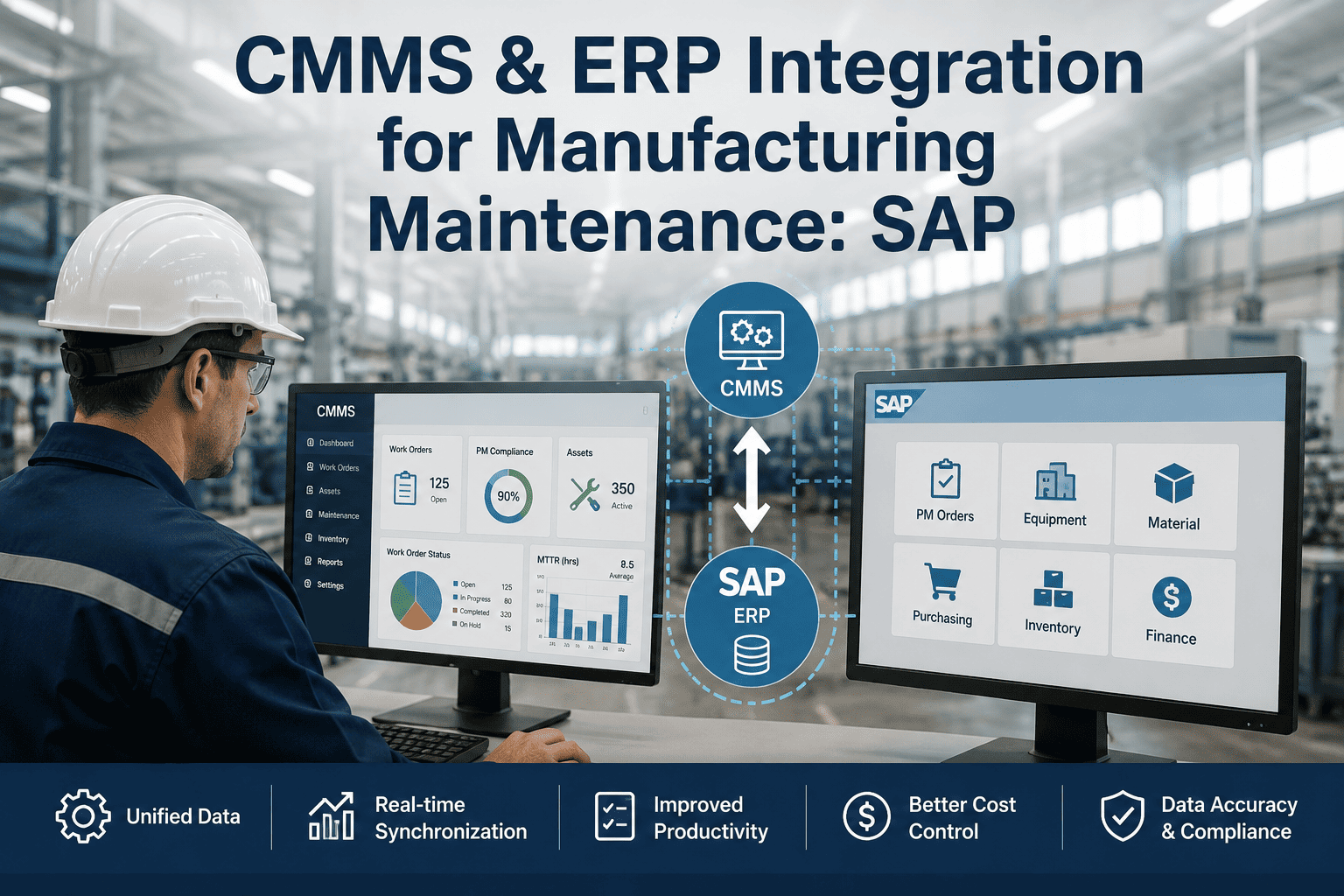
When a technician closes a work order in Oxmaint — logging labour hours, parts used, and contractor costs — those figures are pushed directly into the ERP's cost centre structure. No re-entry. No lag. When spare parts fall below reorder thresholds in the CMMS inventory module, the ERP generates a purchase requisition automatically. When preventive maintenance is scheduled 30 days out, the ERP can pre-position materials and adjust procurement plans accordingly.
What it eliminates
Manual reconciliation between maintenance records and financial reports. Double entry of labour and parts costs across two systems. Stockouts on critical spare parts because nobody checked the CMMS and ERP separately. Emergency procurement at 3–5× cost because reorder triggers were manual. Inaccurate asset depreciation because maintenance history wasn't flowing to the ERP asset register.
Data flows in this integration
CMMS Work Order
to ERP
Cost Centre Entry
CMMS Parts Request
to ERP
Purchase Requisition
ERP Production Order
to CMMS
PM Schedule Sync
ERP Inventory Level
to CMMS
Parts Availability Alert
Compatible with:
SAP S/4HANA
Oracle Fusion
Microsoft Dynamics 365
Infor CloudSuite
IFS Cloud
What the integration does
When the MES reports a production line running below its target OEE threshold — say, 65% instead of the forecasted 85% — Oxmaint receives that signal and generates a diagnostic work order immediately. When a production run completes and cycle count thresholds are met, Oxmaint schedules the next PM automatically. When a quality reject spike is linked to a specific machine in the MES, Oxmaint creates an inspection work order tied to that asset's maintenance history.
What it eliminates
The gap between when a production problem starts and when maintenance knows about it — which currently averages hours in unconnected plants. Maintenance schedules based on calendar time rather than actual production cycles and machine usage. The situation where a production quality escape is investigated by operations while maintenance looks at a completely separate dataset with no shared context.
Data flows in this integration
MES OEE Drop
to CMMS
Diagnostic Work Order
MES Cycle Count
to CMMS
PM Trigger by Usage
MES Quality Reject
to CMMS
Machine Inspection Task
CMMS Planned Downtime
to MES
Production Schedule Adjust
Protocol:
REST API
OPC-UA
Webhooks
CSV / SFTP batch sync
What the integration does
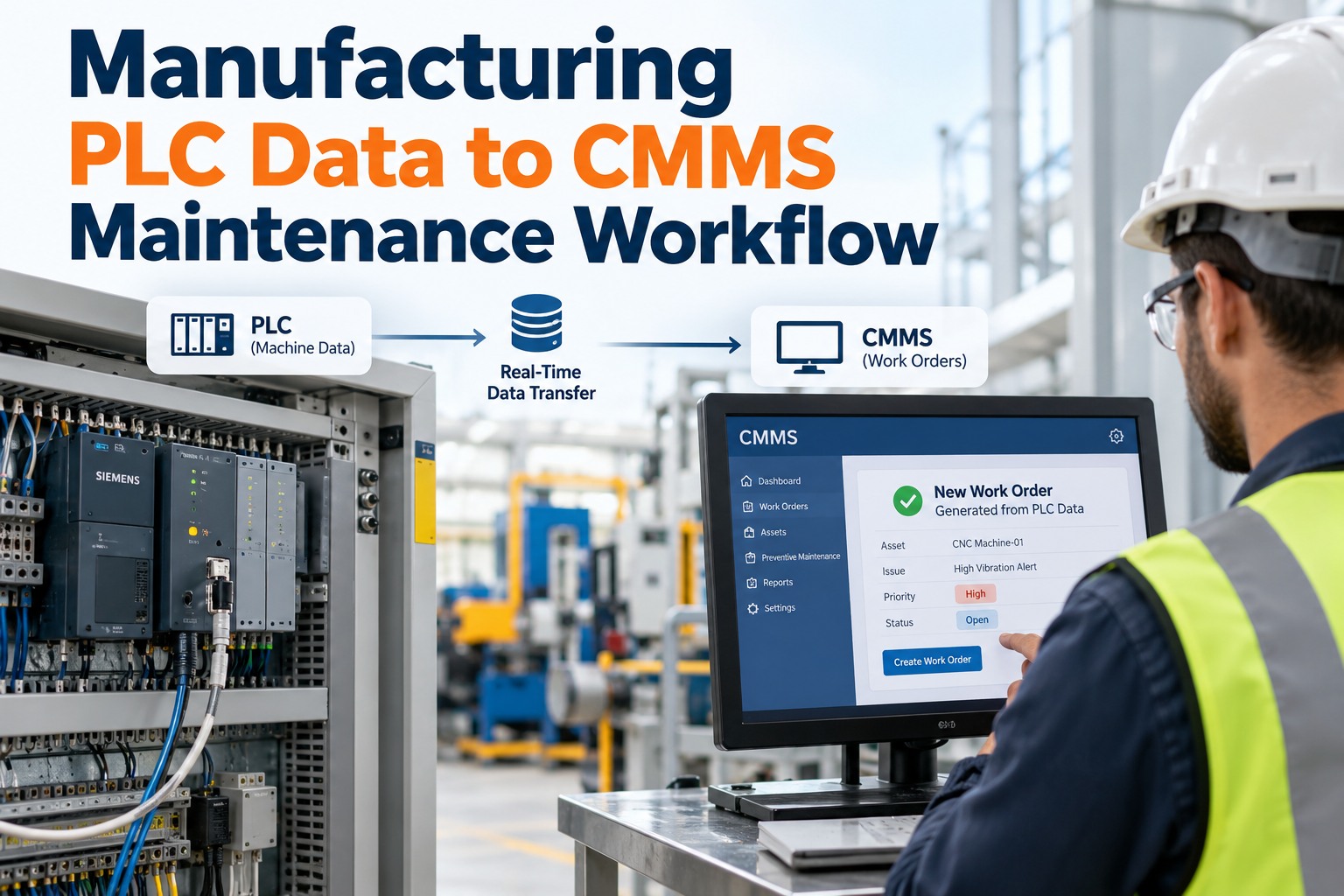
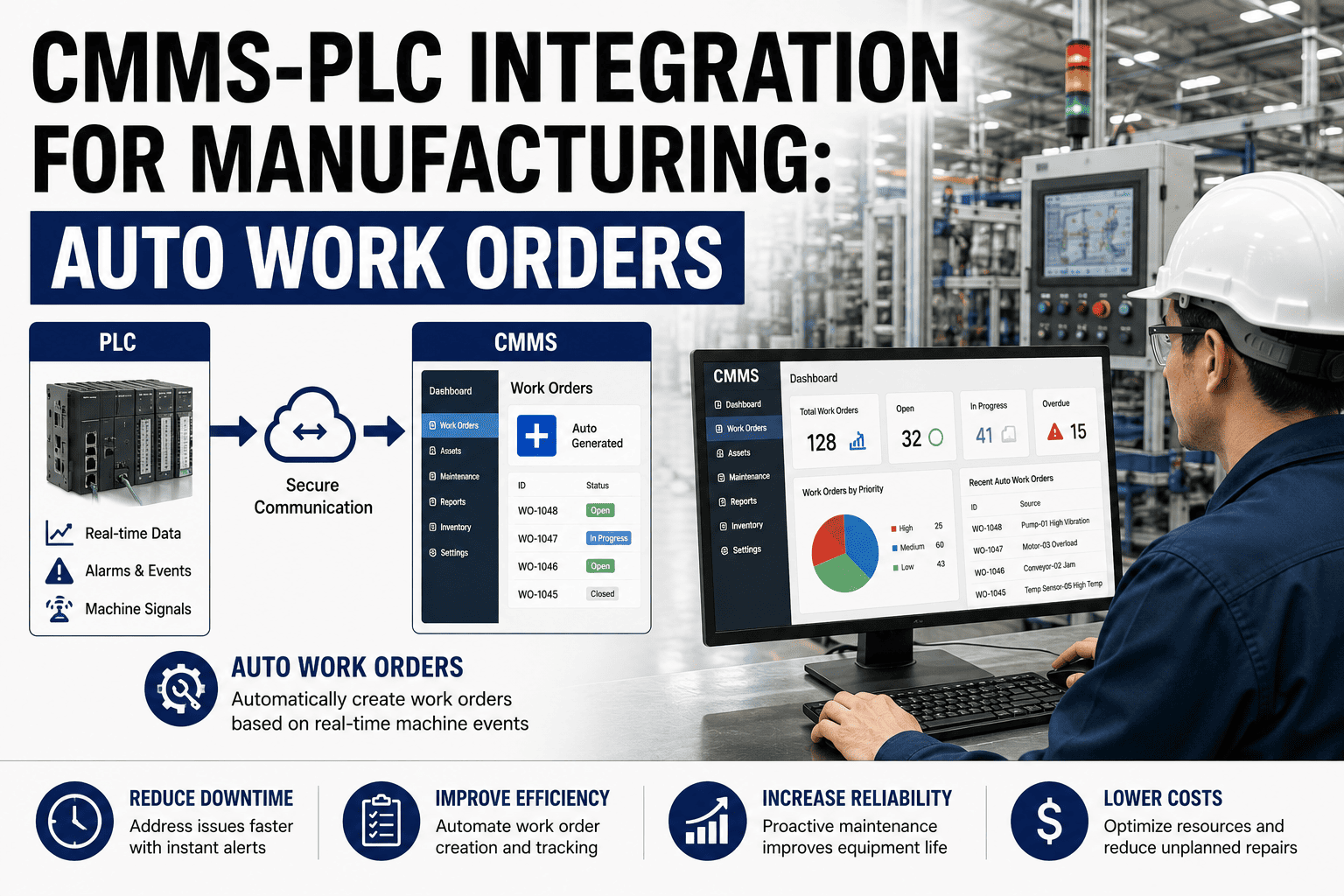
SCADA monitors temperatures, pressures, vibration levels, flow rates, and hundreds of other process variables in real time. When a defined threshold is crossed — a motor temperature exceeding 85°C, a pressure drop below safe operating range — Oxmaint receives that event via OPC-UA or MQTT and generates a maintenance work order automatically, assigned to the right technician, with the exact sensor reading and timestamp attached. No operator needs to call maintenance. No alert sits in a SCADA dashboard nobody is watching at 2am.
What it eliminates
The most dangerous gap in manufacturing maintenance: the time between a SCADA alarm and a maintenance response. In plants without this integration, SCADA alarms are acknowledged by operators who have no mechanism to formally assign a maintenance task. Those alarms get cleared, and the underlying condition deteriorates until it causes an unplanned failure. SCADA-CMMS integration closes that loop permanently.
Data flows in this integration
SCADA Threshold Breach
to CMMS
Emergency Work Order
SCADA Alarm Event
to CMMS
Asset History Log Entry
SCADA Runtime Hours
to CMMS
Usage-Based PM Trigger
CMMS Work Order Status
to SCADA
Operator Status Display
Protocols supported:
OPC-UA
MQTT
Modbus
Ethernet/IP
BACnet
What the integration does
IoT sensors on equipment continuously stream vibration signatures, temperature profiles, current draw, acoustic emissions, and other health indicators into Oxmaint. AI models trained on baseline equipment behaviour detect degradation trends — a bearing's vibration increasing 12% above its 90-day baseline, a motor running 4°C hotter than its load-adjusted norm — and generate predictive work orders with estimated remaining useful life before any fault code appears. Maintenance intervals become dynamic, based on actual asset condition rather than manufacturer default schedules.
What it eliminates
The fundamental inefficiency of calendar-based preventive maintenance: servicing equipment that doesn't need it, and missing failures that develop between scheduled intervals. IoT integration delivers condition-based maintenance, where work happens when the data says it should — not when the calendar says it should. This shift alone typically reduces maintenance costs by 18–25% while improving equipment availability by 30–50% through eliminated unplanned failures.
Data flows in this integration
IoT Vibration Deviation
to CMMS
Predictive Work Order
IoT Temp Trend
to CMMS
Bearing Inspection Alert
IoT Runtime Data
to CMMS
Adaptive PM Schedule
CMMS Asset Profile
to IoT
Sensor Threshold Config
Compatible with:
AWS IoT
Azure IoT Hub
Siemens MindSphere
Emerson AMS
Fluke Connect
Integration Methods: How Systems Connect to Oxmaint
Not every plant has the same technical environment. Oxmaint supports four connection methods so that any combination of legacy and modern systems can be integrated without rebuilding your IT infrastructure.
| Method |
Best For |
Speed to Deploy |
Typical Use Case |
| REST API |
Modern SaaS ERP, cloud MES, IoT platforms |
Days to weeks |
Real-time bidirectional data sync with SAP, Oracle, Dynamics |
| OPC-UA / MQTT |
SCADA systems, PLCs, industrial controllers |
1–2 weeks |
Live plant floor signal monitoring with automatic work order generation |
| Webhooks |
Event-driven triggers from MES or ERP |
Hours to days |
Instant notification when production events require maintenance response |
| CSV / SFTP Batch |
Legacy ERP, proprietary MES without open APIs |
2–4 weeks |
Scheduled data sync for inventory, asset records, and cost reporting |
| Middleware / iPaaS |
Complex multi-system environments |
4–8 weeks |
Orchestrated data flow across ERP + MES + SCADA + IoT simultaneously |
What a Fully Integrated Workflow Looks Like
Integration isn't just about which systems are connected — it's about what happens automatically when they are. Here is a single equipment failure scenario played out in a connected plant versus a disconnected one.
Without Integration
1
SCADA alarm fires at 2:14am. Night operator acknowledges it and notes it on a paper log.
2
Morning shift starts. Production manager verbally tells maintenance about the alarm from the handover sheet.
3
Maintenance technician manually creates a work order in the CMMS — 6.5 hours after the alarm.
4
Parts checked manually. Not in stock. Emergency purchase raised — at 4× planned cost.
5
Machine fails mid-shift. Production line stops. Finance finds out from a delayed production report.
Total delay: 14+ hours. Emergency repair cost premium: 4×. ERP cost entry: manual, next day.
With Oxmaint Integration
1
SCADA threshold breach at 2:14am triggers Oxmaint via OPC-UA. Work order auto-generated in 30 seconds.
2
Oxmaint checks IoT sensor trend — 14 days of rising vibration data confirms developing bearing fault.
3
CMMS checks ERP inventory — part in stock. Work order assigned to on-call technician with full asset history.
4
MES receives planned maintenance window from CMMS. Production schedule adjusted automatically before shift change.
5
Repair completed at 6am. Work order closed. ERP cost entry synced automatically. Zero production impact.
Total response: under 4 hours. Cost: planned rate. ERP entry: automatic at work order close.
Frequently Asked Questions
ERP / MES / SCADA / IoT — Oxmaint Integration Hub
Your Plant's Data Is Already There. Connect It to Oxmaint and Let It Run Maintenance Automatically.
4
system integrations in one platform
8–12 wk
typical full deployment
40–60%
better ROI vs standalone CMMS
Zero
manual data re-entry between systems