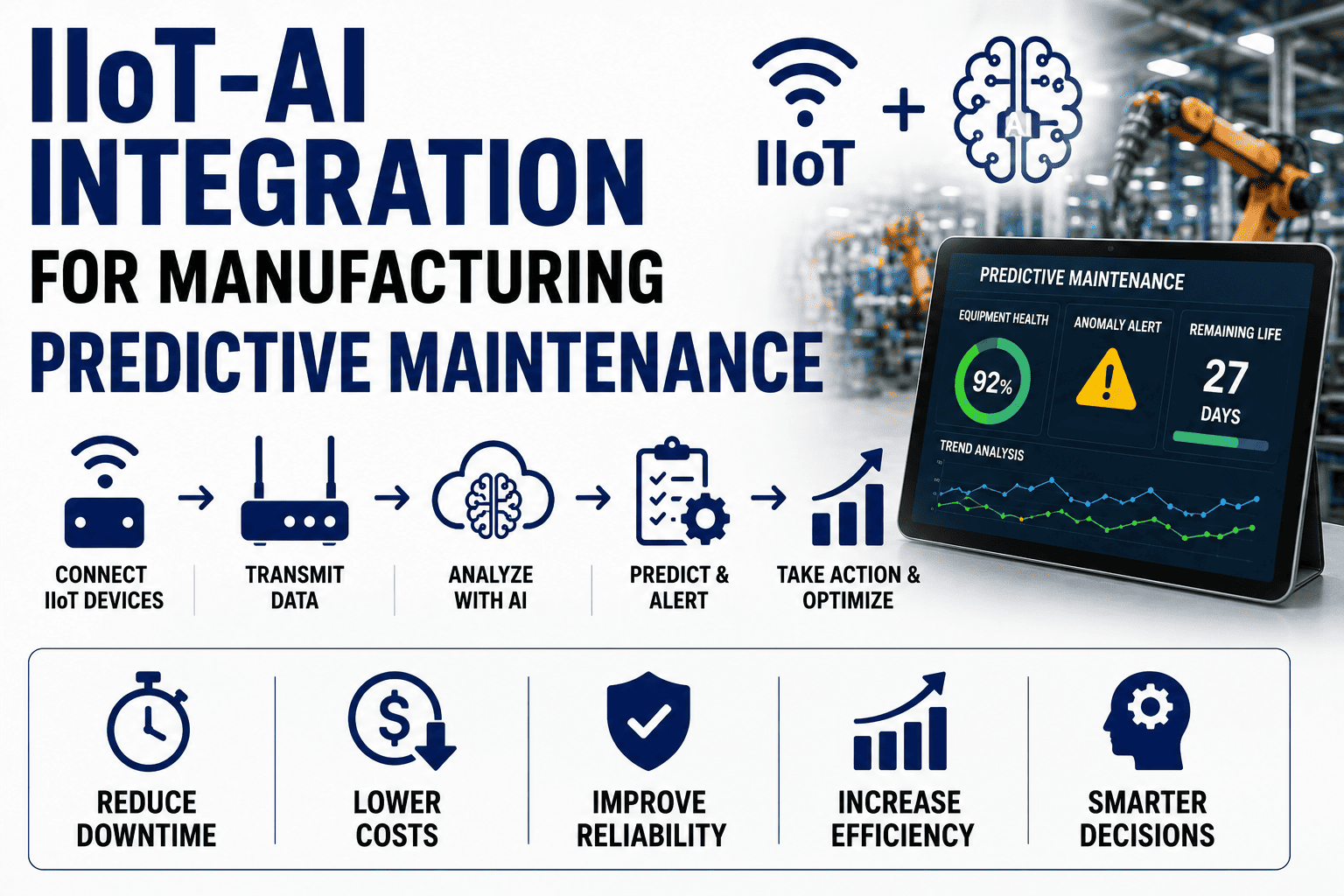
CNC spindles are the highest-value rotating assembly on every machine tool — $30,000 to $150,000 per replacement, spindle speeds swinging from 5,000 to 30,000 RPM under variable cutting loads, and directly upstream of every scrap, dimensional-drift, and part-quality event on the floor. SAP S/4HANA runs the plant's maintenance master data, work order lifecycle (PM01 planned / PM02 measurement-triggered / PM03 corrective / PM04 refurbishment), spare parts inventory, and financial close — but it does not natively ingest spindle vibration spectra, calculate BPFO/BPFI bearing defect frequencies from bearing geometry, or apply neural network models trained on 5,000-30,000 RPM spindle failure signatures. Rip-and-replace of S/4HANA to add predictive RCM is the wrong question — the correct architecture is an AI-native overlay that consumes controller telemetry from Fanuc, Siemens, Heidenhain, Mitsubishi, or Mazak controllers plus IoT vibration and temperature sensors, applies predictive models 2-3 weeks ahead of bearing failure, and creates pre-populated SAP PM02 measurement-triggered work orders via REST API or IDoc — with sensor trend, failure mode identification, recommended action, parts list, and priority already attached before the technician sees the WO. Below is the working guide — the SAP overlay architecture, the spindle telemetry stack, the AI failure signature detection, and the RCM strategy routing that turns each failure mode into the correct SAP PM order type automatically. Start free or book a demo.
Discrete Manufacturing · Machine Tools · SAP S/4HANA · 2026
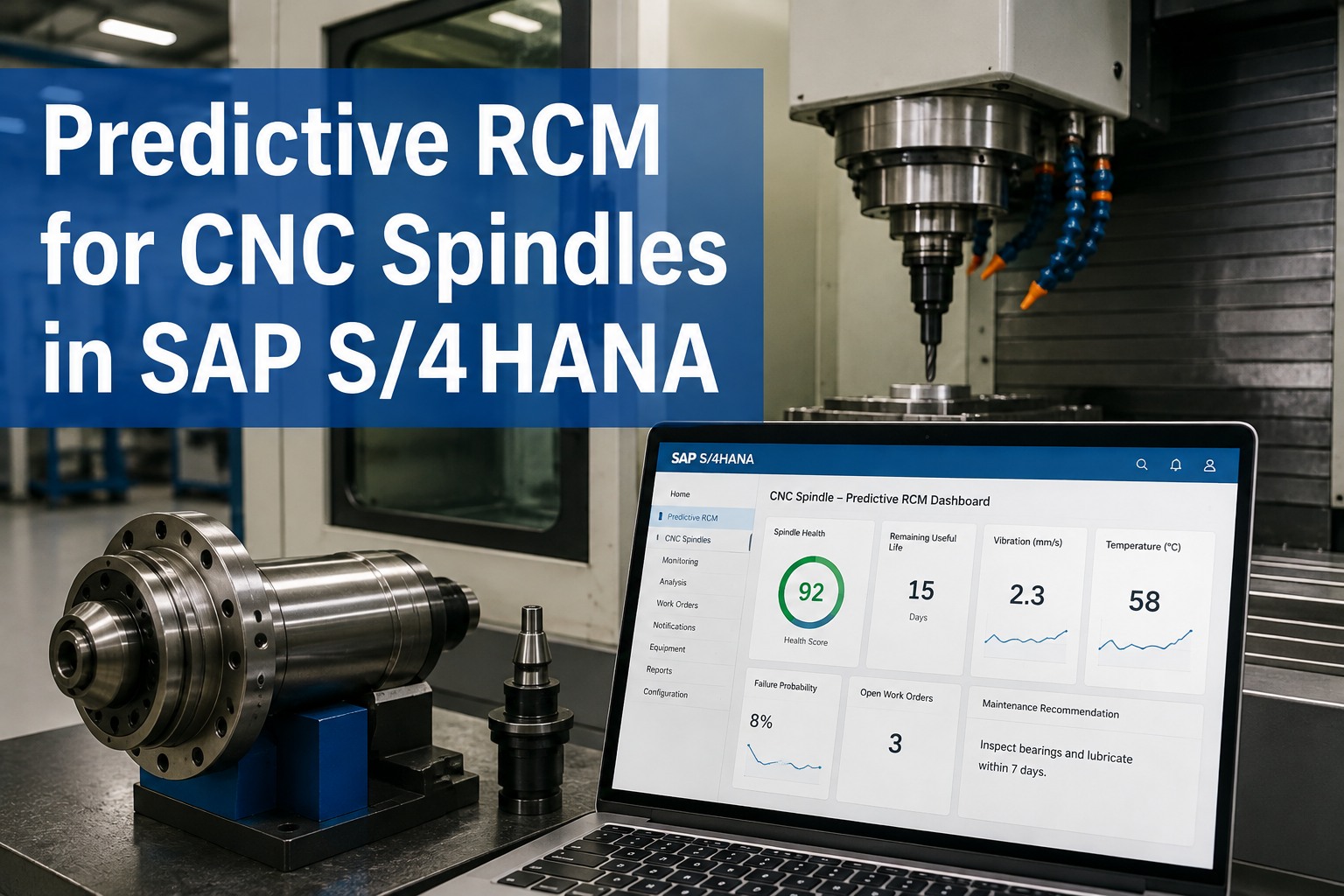
Predictive RCM for CNC Spindles in SAP S/4HANA
The AI-native overlay architecture that adds predictive RCM on top of SAP S/4HANA without rip-and-replace — controller telemetry, spindle vibration, and bearing defect frequency analysis feeding auto-created SAP PM work orders 2-3 weeks ahead of failure.
-
$30K–$150K
CNC spindle replacement cost per unit
-
2–3 wk
bearing failure detection window before catastrophic failure
-
5–30K RPM
operational envelope requiring RPM-adaptive AI models
-
Zero
SAP rip-and-replace — overlay architecture, not migration
The Overlay Architecture
Four Layers — SAP S/4HANA Stays Put, AI-Native RCM Sits On Top
The overlay pattern lets SAP S/4HANA keep every function it does well (master data, WO lifecycle, spares, financial close) while adding the predictive intelligence it does not do natively. Below is the working four-layer stack.
SAP S/4HANA — System of Record
Functional location, equipment master, BOM, spares (MM), PM notification and work order lifecycle (PM01/02/03/04), cost centres, financial close. Unchanged. Every WO created by the overlay lands in SAP with full traceability.
Oxmaint — Predictive RCM Engine
AI-native failure mode analysis, RPM-adaptive vibration analytics, BPFO/BPFI bearing defect frequency detection, RCM strategy routing per failure mode, threshold-triggered SAP PM02 WO creation via REST API or IDoc.
Sensor + Controller Telemetry
Wireless triaxial accelerometers on spindle nose and drawbar, bearing RTD temperature probes, motor current transformers, servo drive data from Fanuc / Siemens / Heidenhain / Mitsubishi / Mazak controllers via OPC-UA or MTConnect.
Machine Tool Fleet
CNC machining centres — spindle assemblies, ball screws, tool holders, coolant systems, axis drives. The physical layer where the failure modes actually manifest.
The Spindle Telemetry Stack
What AI-Native RCM Actually Monitors on a Spindle
Predictive RCM on CNC spindles is a sensor-and-analytics discipline. Below is the working parameter matrix — the signals that define spindle health and the failure signatures each one exposes.
| Signal | Source | Detects | Lead Time |
|---|---|---|---|
| Triaxial vibration (BPFO/BPFI) | Wireless accelerometer on spindle nose | Bearing race defects, imbalance, misalignment | 2–3 wk |
| Spindle bearing temperature | RTD probe on bearing housing | Lubrication failure, thermal drift, imbalance | 1–3 wk |
| Spindle motor current | CT + VFD data | Overload, drag, mechanical seizure onset | 1–2 wk |
| Spindle load (from controller) | Fanuc / Siemens / Mazak controller | Tool wear, tool breakage, chip evacuation | Immediate |
| Coolant condition | Contamination + concentration sensor | Bearing wear acceleration, corrosion | 2–4 wk |
| Alarm history | Controller alarm log | Recurring fault patterns, escalation signals | Trend |
The Data Flow
Sensor Trend Deviation to RCM Decision to SAP PM02 Work Order — In One Loop
Triaxial accelerometer detects BPFI (bearing inner race defect) frequency amplitude rising 3 sigma above baseline. Oxmaint's RCM engine matches the signature to failure mode library, applies condition-based strategy per the mode, and creates a pre-populated SAP PM02 measurement-triggered work order via REST API — sensor trend chart attached, failure mode ID, recommended action, spare bearing part number from SAP MM master, priority classification, and safe maintenance window all populated before the technician opens the WO. Response time from detection to WO in SAP: under 90 seconds.
The Strategy to SAP WO Mapping
Every RCM Strategy Routes to the Correct SAP PM Order Type
SAP S/4HANA supports distinct PM order types for planned, measurement-triggered, corrective, and refurbishment work. Oxmaint's RCM strategy routing maps each failure mode strategy to the correct SAP order type automatically.
Planned Preventive
Time-based strategy: spindle lubrication cycle, tool changer bearing grease, coolant filter service. Auto-scheduled from Oxmaint on SAP maintenance plan cadence.
Measurement-Triggered
Condition-based strategy: bearing vibration threshold, temperature threshold, motor current deviation. Sensor breach fires PM02 WO with trend chart + failure mode ID + parts list attached.
Corrective / Run-to-Failure
Run-to-failure strategy on low-consequence assets. Notification to PM03 corrective WO with failure history and root-cause template pre-populated. Feeds back into RCM analysis.
Refurbishment / Rebuild
Redesign / rebuild strategy: spindle refurbishment cycle, ball screw replacement, controller upgrade. Change control + engineering approval gate before PM04 executes.
Built for Reliability Engineering + SAP PM Teams
How Oxmaint Runs the SAP Overlay End to End
-
SAP Bi-Directional
REST API + IDoc + Direct Connector
Bi-directional integration with SAP S/4HANA — equipment master and functional location synced in, PM notifications and PM02 measurement-triggered WOs created out, completed WO data written back. IDoc, REST API, and direct DB connector all supported.
-
Multi-Controller Support
Fanuc, Siemens, Heidenhain, Mitsubishi, Mazak
Native connectivity to the major CNC controllers via OPC-UA and MTConnect. Spindle load, alarm history, tool behaviour, servo drive data ingested without controller replacement or licence upgrade.
-
RPM-Adaptive AI
Baseline per Speed Bin, Not Global
Spindle vibration signatures at 5,000 RPM differ fundamentally from 25,000 RPM. AI models establish baseline per operating speed bin so anomaly detection remains sensitive across the full operating envelope — not just around a single reference RPM.
-
BPFO/BPFI Frequency Analysis
Bearing Geometry-Derived Defect Detection
Bearing defect frequencies calculated from bearing geometry per spindle, monitored from first production shift. Baseline established in 5-14 days, high-confidence predictive coverage from day 15 onward.
-
Mobile Execution
Airport-Grade Airside Or Shop-Floor
Technicians execute WOs on mobile with offline mode, QR asset tags per spindle, photo capture per WO, and pre-populated failure mode diagnostic context. SAP WO closure syncs back to S/4HANA in real time.
-
Free Forever Plan
Pilot 5-10 Critical Spindles First
Cloud-based, mobile-first. Pilot on the 5-10 highest-value or highest-utilisation spindles, prove the 2-3 week detection window and SAP WO auto-creation, then scale to full machine tool fleet.
Frequently Asked
SAP S/4HANA + Predictive RCM Questions
Do we need to migrate off SAP S/4HANA to add predictive RCM?
No. The overlay architecture is designed specifically to preserve every function S/4HANA does well — equipment master, functional locations, PM notifications and work order lifecycle, MM spares, cost centres, financial close. Oxmaint adds the AI-native layer S/4HANA does not do natively (RPM-adaptive vibration analytics, BPFO/BPFI bearing defect detection, RCM strategy routing) and creates pre-populated PM02 measurement-triggered WOs into S/4HANA via standard REST API or IDoc integration. Zero rip-and-replace. Start free and test the SAP integration today.
Which SAP PM order type does a bearing vibration alert create?
PM02 — measurement-triggered. The sensor threshold breach acts as the measurement point trigger in SAP PM logic. Oxmaint creates the PM02 WO with the sensor trend chart embedded, failure mode identification, spare bearing part number from SAP MM master (auto-lookup), recommended action per RCM strategy, and priority classification per criticality. The SAP PM planner sees a fully-populated WO — no manual context gathering before dispatch.
How long before predictive coverage becomes reliable?
Bearing defect frequency tracking begins immediately after sensor deployment — BPFO/BPFI/FTF/BSF frequencies are calculated from bearing geometry and monitored from the first production shift. Baseline anomaly detection requires 5-14 production days to characterise normal vibration signature at each operating speed bin. Full RPM-adaptive high-confidence coverage from Day 15 onward. Tool wear estimation becomes reliable within 10-20 tool-life cycles per tool type. Book a demo to see the baseline establishment workflow.
Does this work with Fanuc, Siemens, and Mazak in the same plant?
Yes. Mixed-controller fleets are the operational reality at most discrete manufacturers — different machine tool OEMs use different native controllers. Oxmaint connects to Fanuc (FOCAS + OPC-UA), Siemens (SINUMERIK OPC-UA), Heidenhain (DNC + OPC-UA), Mitsubishi (MELSEC OPC-UA), Mazak (SmartBox / MTConnect), and generic MTConnect-compliant controllers. Spindle load, alarm history, tool behaviour, and servo drive telemetry ingested normalised across the fleet — the AI models see one data schema regardless of source controller brand.
Is there a free plan to pilot on our critical spindles?
Yes. Oxmaint offers a free forever plan — enough to load 5-10 critical spindles, connect controller telemetry, deploy sensor stack, and run the SAP S/4HANA overlay with PM02 WO auto-creation. Prove the 2-3 week detection window and the SAP integration on the pilot machines before scaling to full machine tool fleet. Cloud-based, mobile-first — no server procurement to start. Sign up and pilot on critical spindles today.
SAP Overlay · 2-3 Wk Lead · PM02 Auto-Create · Multi-Controller
SAP S/4HANA Runs What It Runs Well. Oxmaint Adds the AI-Native RCM It Doesn't. Together They Are the Programme.
S/4HANA keeps the master data, WO lifecycle, spares, and financial close. Oxmaint adds AI-native failure mode analysis, RPM-adaptive bearing signature detection, and RCM strategy routing that creates pre-populated SAP PM02 work orders 2-3 weeks ahead of spindle failure. Zero rip-and-replace. Multi-controller. Mobile-first. Free to pilot on your first critical spindles today.