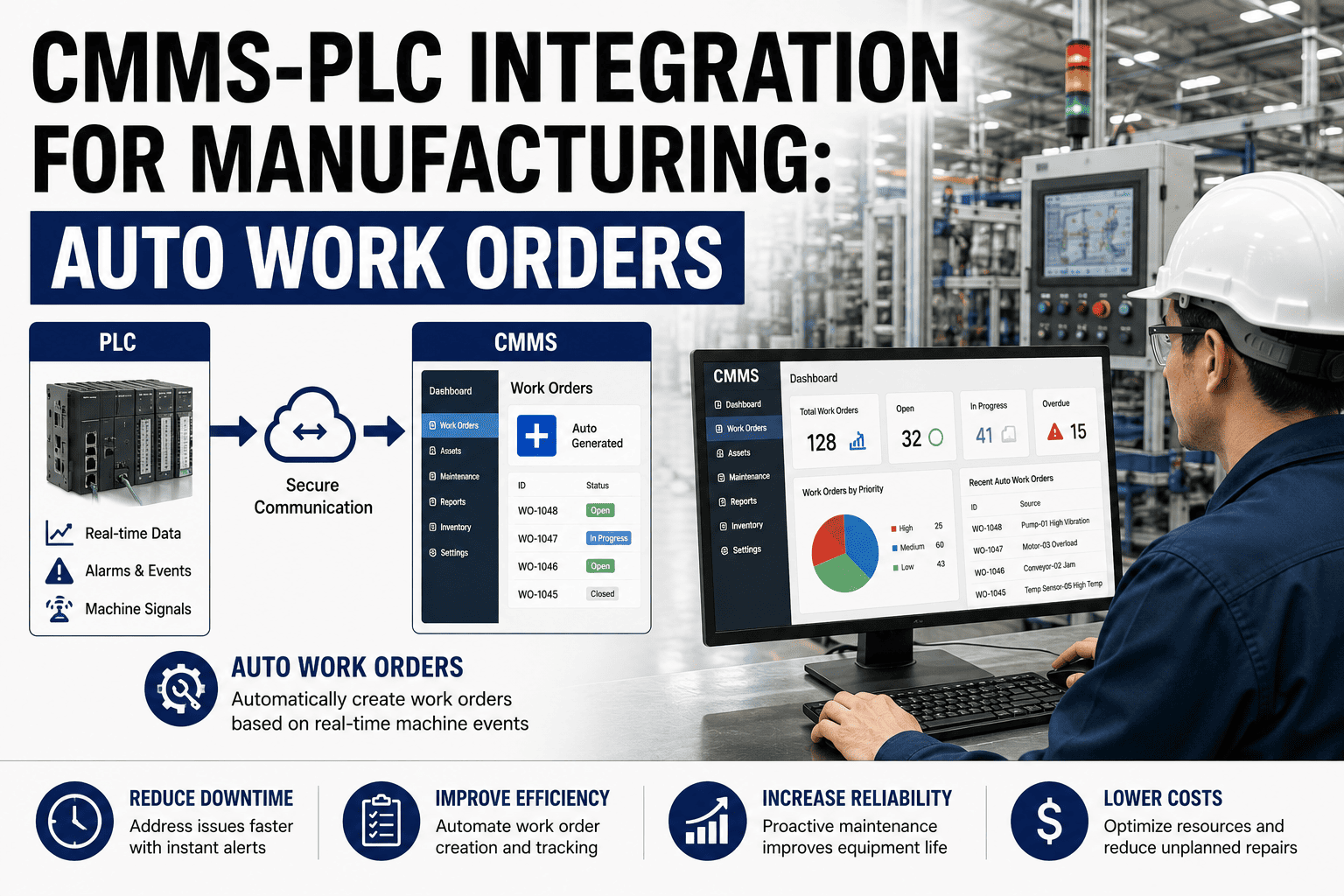
CMMS + IoT Integration for Manufacturing — From Sensor Alerts to Work Orders
By oxmaint on February 18, 2026
Every manufacturing plant runs on a simple promise — machines stay up, production stays on schedule, and maintenance stays ahead of failures. But when your maintenance team relies on clipboard inspections and calendar-based schedules, that promise breaks the moment a critical motor bearing fails at 2 AM on a Thursday. IoT sensors can catch that bearing degradation weeks in advance, but only if the alert reaches your CMMS, creates a work order, assigns the right technician, and stages the right parts — automatically. This guide walks you through exactly how to wire that connection, step by step, using Oxmaint as your maintenance command center. Schedule a free demo to see Oxmaint turn a live sensor alert into a dispatched work order in real time at your facility.
What Happens When Sensor Alerts Have No System to Land In
Most manufacturing facilities already have sensors installed. The problem is not data collection — it is data action. Without a CMMS receiving, interpreting, and acting on sensor signals, your IoT investment becomes an expensive monitoring screen that nobody watches. Here is what the disconnect costs you.
The Disconnect
Sensors alert, but no one triages or assigns work orders
Alert emails pile up in inboxes alongside meeting invites
No severity ranking — minor belt wear alerts treated like pump failures
Spare parts ordered after breakdown, not before
$260Kaverage cost per hour of unplanned downtime in large manufacturing plants
The Connected Fix
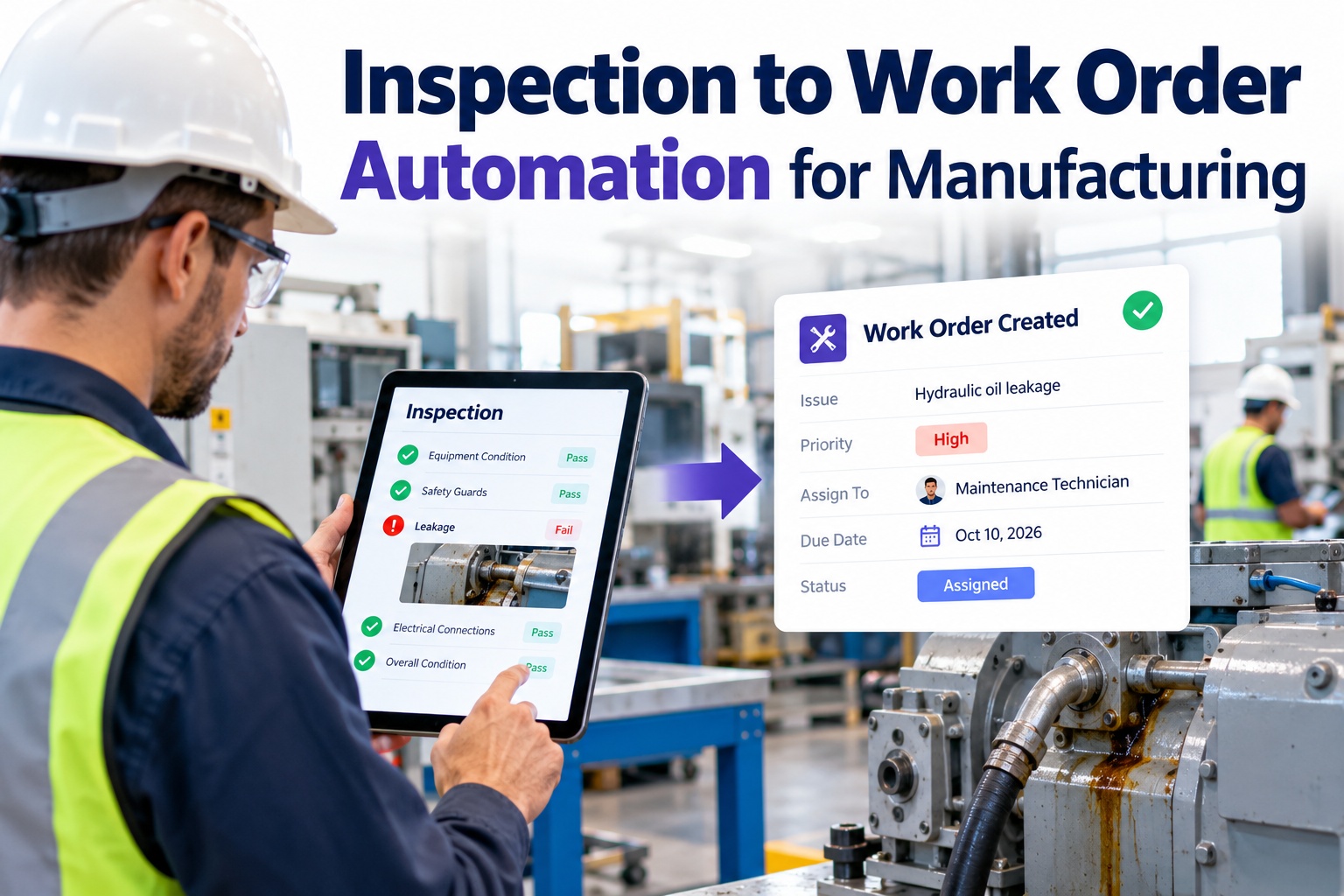
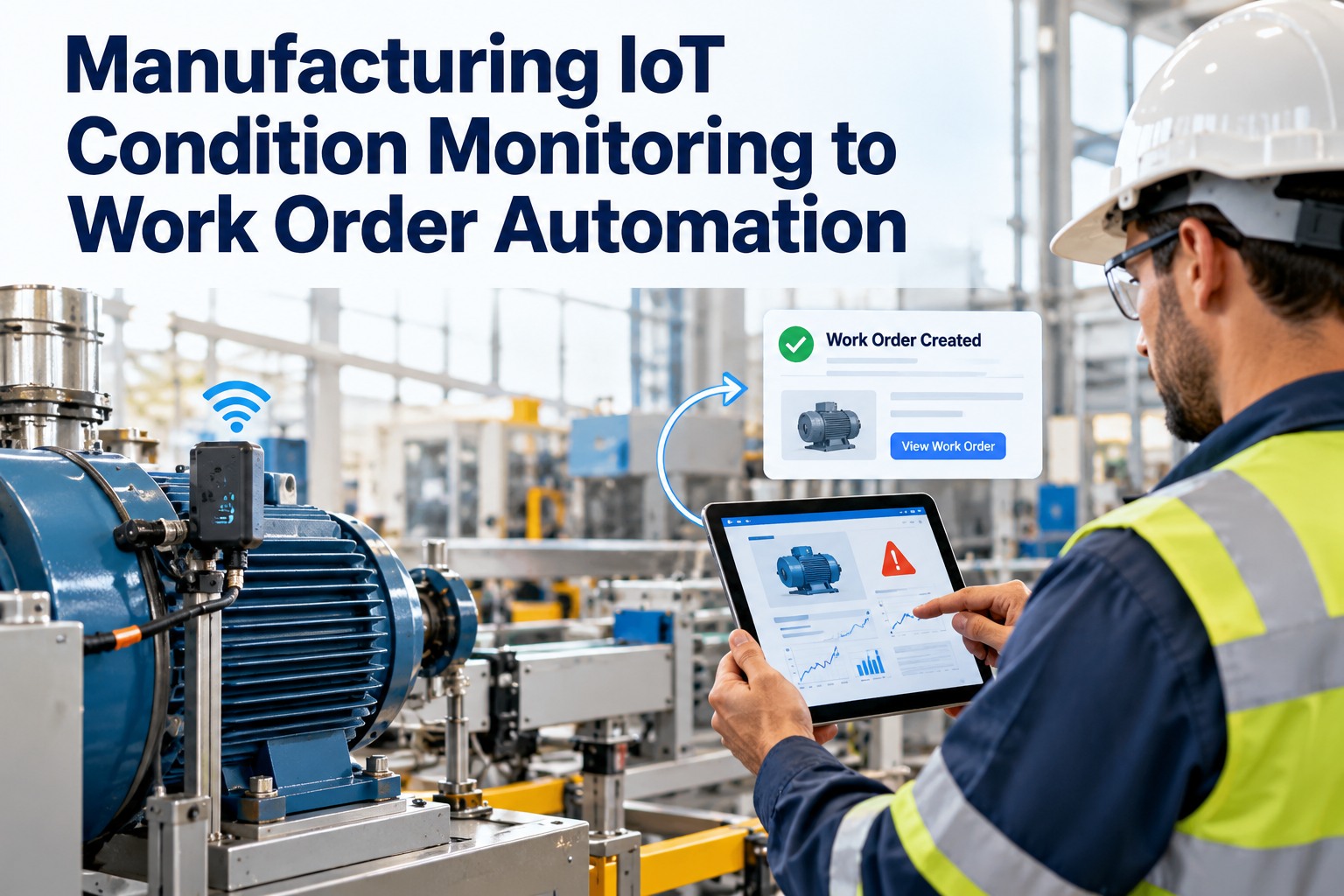
Sensor anomaly auto-creates a work order in Oxmaint within seconds
AI priority engine scores by criticality, not chronological order
Technician gets mobile push with sensor data, asset history, and parts location
Predictive models pre-stage spare parts weeks ahead of need
30-50%downtime reduction reported by plants with integrated IoT-CMMS workflows
Sign up now to connect your first IoT sensor to automated work orders in under 10 minutes. Oxmaint turns every sensor alert into a prioritized, dispatched, and tracked maintenance action — so your team fixes problems before production stops.
Connecting IoT sensors to your CMMS is not a single switch — it is a pipeline with five distinct stages. Each stage eliminates a manual bottleneck. When all five are automated, your maintenance operation runs on machine intelligence instead of human memory. Here is exactly how Oxmaint builds this pipeline for manufacturing teams.
1
Capture
IoT Sensors Stream Condition Data
Vibration accelerometers, RTD temperature probes, pressure transducers, and current clamps monitor assets continuously. Oxmaint accepts data via Modbus TCP, OPC-UA, MQTT, and REST API — connecting to sensors you already own without rip-and-replace.
2
Evaluate
Thresholds and AI Models Assess Severity
Pre-set thresholds catch obvious breaches (e.g., bearing temp above 85 C). Simultaneously, machine learning models trained on your historical data detect subtle degradation patterns — catching failures that fixed rules miss entirely.
3
Generate
CMMS Auto-Creates a Prioritized Work Order
Oxmaint instantly generates a work order pre-filled with asset ID, fault type, sensor data snapshot, corrective action checklist, and required parts. No dispatcher touches a keyboard. Sign up free to experience auto-generated work orders created from live sensor feeds the moment an anomaly is detected.
4
Dispatch
Right Technician, Right Skills, Right Now
The work order routes to the technician with the matching skill set who is closest to the asset. Mobile push notification delivers full context — trend charts, previous repair history, and bin location for needed parts.
5
Learn
Resolution Data Feeds Predictive Models
When the technician closes the work order, repair data flows back into the AI model. Every resolved issue makes the next prediction more accurate — building a self-improving maintenance intelligence loop unique to your facility.
Which Sensors Trigger Which Work Orders
Not all sensor readings require the same response. A vibration spike on a critical production-line motor demands immediate action. A slow temperature creep on an auxiliary compressor can wait for the next planned window. Here is how each sensor type maps directly to work order categories inside Oxmaint.
Sensor-to-Work-Order Mapping Guide
Vibration Accelerometer
Bearing wear, shaft misalignment, rotor imbalance
RMS velocity exceeds 7.1 mm/s per ISO 10816
Corrective WO — Mechanical inspection with bearing replacement kit staged
Critical Asset: P1Standard Asset: P2
RTD Temperature Probe
Overheating, coolant loss, friction buildup
Surface temp exceeds baseline + 15 C for 10+ minutes
Urgent WO — Thermal inspection with production hold advisory issued
Critical Asset: P1Standard Asset: P1
Current Clamp Monitor
Motor overload, winding degradation, phase imbalance
Amperage deviates 20%+ from nameplate rating
Corrective WO — Electrical diagnosis and motor assessment scheduled
Critical Asset: P1Standard Asset: P3
Pressure Transducer
Hydraulic leaks, pneumatic line drops, pump cavitation
Pressure falls below minimum operating threshold
Urgent WO — Leak detection and hydraulic system service dispatched
Critical Asset: P1Standard Asset: P2
Ultrasonic Leak Detector
Compressed air leaks, steam trap failure, valve bypass
Preventive WO — Oil change and filtration system inspection ordered
All Assets: P3
Book a demo to see how Oxmaint auto-maps your sensors to prioritized work orders. Our engineers will configure threshold rules, fault templates, and priority scoring tailored to your exact equipment — or sign up free and start configuring yourself today.
Building Predictive Models That Actually Prevent Failures
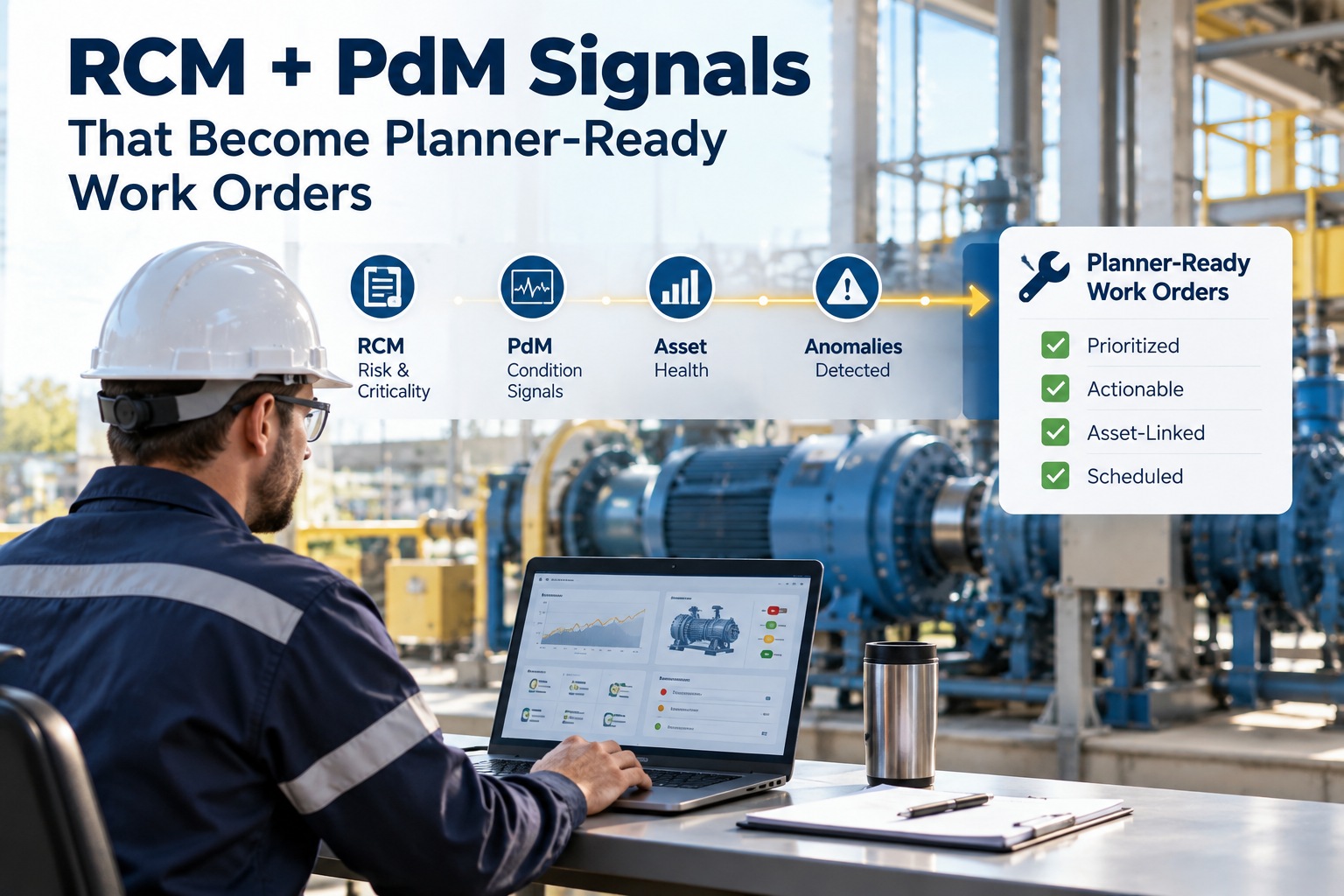
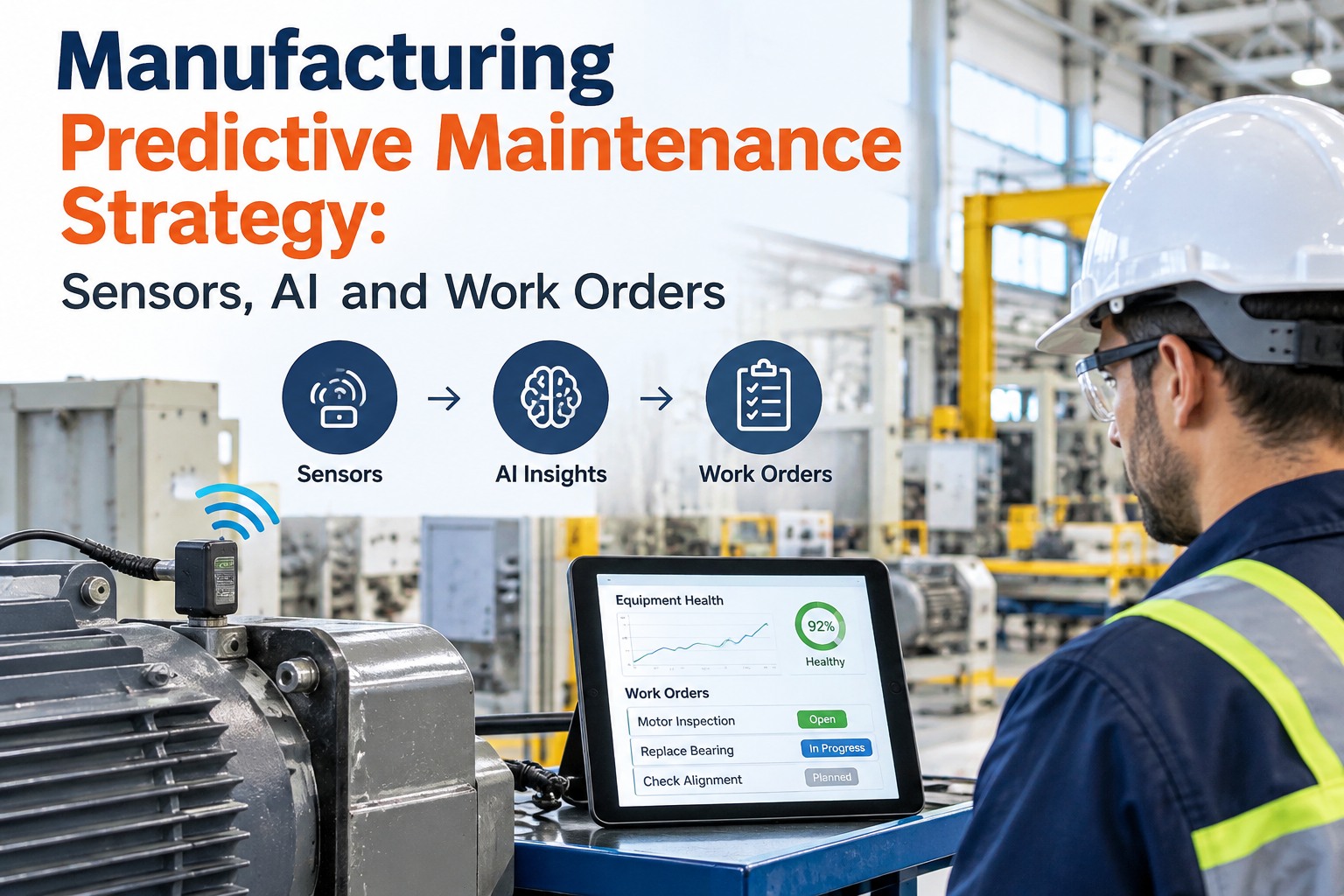
Condition-based alerts catch problems in progress. Predictive models catch them before they start. The difference is transformational — and it only becomes possible when your CMMS accumulates months of sensor data alongside completed work order history. Here is what predictive maintenance looks like when IoT data and CMMS records work together inside Oxmaint.
Remaining Useful Life Estimation
AI models calculate how many operating hours remain before a bearing, belt, or seal reaches its failure threshold. Maintenance gets scheduled during planned downtime — not during a production run.
Typical accuracy: 85-92% after 90 days of data
Fleet-Wide Pattern Recognition
When Motor A failed after showing a specific vibration signature, the system watches for that identical pattern across Motors B through Z. One failure teaches the model to protect every similar asset.
Cross-learning: Patterns propagate across all sites
Maintenance Window Optimization
The system groups upcoming predicted tasks into optimal windows that minimize production disruption. One coordinated stop replaces five emergency shutdowns — saving shift hours and expediting costs.
Efficiency gain: 25-40% fewer total maintenance events
Spare Parts Auto-Forecasting
Predictive models trigger inventory reorder points weeks before parts are needed. No more paying 3x for overnight shipping because a critical bearing was out of stock when the work order dropped.
Inventory savings: 20-30% reduction in carrying costs
Your Pre-Integration Readiness Checklist
A rushed IoT-CMMS rollout creates more problems than it solves — false alerts, orphaned work orders, and technician distrust. Use this checklist to ensure your facility is ready before flipping the switch. Missing even one item can undermine months of implementation work.
Pre-Go-Live Integration Checklist
Infrastructure
Audit all installed sensors — log protocol, polling frequency, and data format for each
Verify Wi-Fi, cellular, or Ethernet coverage at every sensor installation point
Tag every monitored asset with a unique ID matching your CMMS asset registry
CMMS Configuration
Define warning, alert, and critical thresholds for each sensor type per asset class
Build auto-populated work order templates for each fault category with checklists
Assign criticality weights to each asset based on production impact and replacement cost
Team Readiness
Train every technician to receive, accept, and close IoT-triggered work orders on mobile
Define escalation paths — who gets notified if a P1 work order is unacknowledged for 15 min
Run a 2-week pilot on 10-20 high-value assets before expanding to full plant coverage
Sign up to get a pre-built integration checklist customized for your facility. Or book a demo and our engineers will walk through your sensor landscape, identify quick-win assets, and deliver a phased rollout roadmap at no cost.
Real Numbers: What Integration Delivers in Year One
The ROI of connecting IoT sensors to a CMMS is not theoretical. Manufacturing facilities that complete the integration consistently report measurable improvements within the first 12 months. These numbers reflect real deployments across automotive, food processing, chemical, and general manufacturing sectors.
Documented First-Year Outcomes
Unplanned Downtime Reduction
30-50%
Maintenance Cost Savings
25-40%
Mean Time to Repair (MTTR) Improvement
22%
Mean Time Between Failures (MTBF) Gain
38%
Maintenance Labor Productivity
10-25%
Figures compiled from industry analyses across manufacturing sectors. Individual results vary based on facility size, asset criticality, and implementation maturity.
Five Integration Pitfalls and How Oxmaint Solves Each One
Every plant faces unique obstacles when wiring sensors into maintenance workflows. These are the five issues our implementation team encounters most often — and the solutions built directly into Oxmaint to eliminate them.
01
Legacy sensors speak proprietary protocols your CMMS cannot understand
Oxmaint includes built-in protocol adapters for Modbus RTU/TCP, OPC-UA, MQTT, BACnet, and custom REST APIs. No middleware purchase required — your existing sensors connect directly.
02
Alert fatigue — technicians receive so many notifications they start ignoring all of them
AI-powered alert deduplication and severity grouping reduces notification volume by up to 80%. Only actionable, prioritized work orders reach your team — not raw sensor noise.
03
No historical baseline — the system cannot distinguish normal operating behavior from abnormal
Oxmaint runs a 30-day learning mode that builds equipment-specific baselines automatically from live sensor feeds. Adaptive thresholds adjust for load changes, seasonal variation, and equipment aging.
04
Multiple sensor vendors create fragmented dashboards with no unified view
Vendor-agnostic integration layer normalizes data from any sensor brand into a single CMMS dashboard. One screen shows every asset, every sensor, every work order — regardless of hardware manufacturer.
05
Technicians resist new digital tools and revert to paper-based habits
Oxmaint's mobile app uses one-tap work order acceptance, built-in photo documentation, and gamified completion tracking. Technicians adopted the interface within one shift during pilot deployments.
Your Sensors Are Talking. Make Your CMMS Listen.
Sign up for Oxmaint and connect your first IoT sensor to automated work orders in minutes — no middleware, no coding, no rip-and-replace. Or book a demo and our team will map your entire sensor fleet to prioritized maintenance workflows, show you live predictive failure models, and deliver a custom integration roadmap for your facility.
What IoT protocols and sensor brands does Oxmaint support?
Oxmaint connects to any sensor that outputs data via Modbus RTU/TCP, OPC-UA, MQTT, BACnet, or REST API. This covers major industrial sensor brands and custom in-house setups. Our protocol adapter layer means you do not need to replace existing hardware. Sign up for a free account to test your sensor connections and explore the full list of supported protocols and integrations.
How quickly can we expect measurable downtime reduction?
Most manufacturing teams report visible downtime reduction within the first 30 days of activating automated sensor-to-work-order flows. The quick wins from eliminating manual alert triage and auto-dispatching technicians deliver ROI fast. Predictive models require 60 to 90 days of data accumulation to generate reliable failure forecasts, but condition-based alerts start working on day one.
Can this scale to hundreds of sensors across multiple production lines?
Yes. Oxmaint processes data from thousands of sensor endpoints simultaneously. Alert deduplication and intelligent severity grouping prevent dashboard overload even at scale. Multi-site deployments share predictive models, so a failure pattern learned at Plant A immediately protects every similar asset at Plant B. Book a demo to see live multi-site sensor dashboards and cross-plant predictive models in action.
Do we have to replace our existing CMMS to use Oxmaint's IoT integration?
No. Oxmaint works as a standalone CMMS or integrates alongside existing systems through API connections. Many facilities run Oxmaint's IoT layer in parallel with their current system during a trial period, then migrate fully once they experience the automated workflows. There is no forced migration or vendor lock-in.
What happens when a sensor goes offline or sends corrupt data?
Oxmaint includes automatic data validation that flags erratic readings and communication failures. If a sensor drops offline, the system generates a maintenance alert for the sensor itself and reverts the associated asset to its last known condition profile. False work orders from corrupted data are blocked before they reach your team.