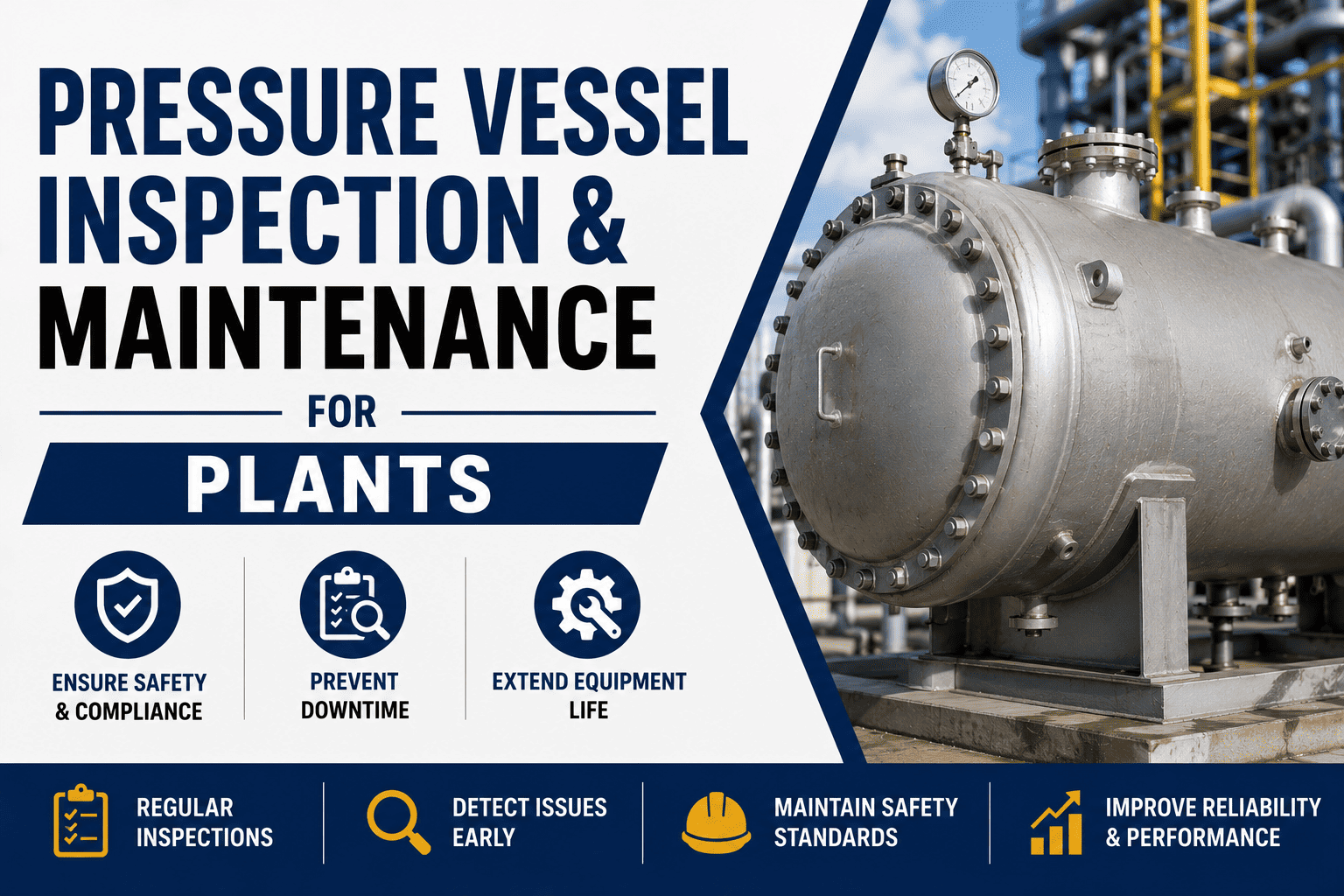
Pressure vessel maintenance in manufacturing plants is the single most compliance-driven discipline in asset reliability — miss an API 510 inspection interval or a relief valve test and you face regulatory fines, unplanned shutdowns, and catastrophic safety risk. This pressure vessel inspection guide walks maintenance and reliability teams through ASME and National Board requirements, in-service inspection intervals, thickness monitoring, corrosion control, and relief valve testing — then shows how a pressure vessel CMMS like OxMaint automates the scheduling, documentation, and audit trail so no deadline slips. Whether you manage five vessels or five hundred, configuring preventive maintenance around jurisdictional codes is the difference between a clean audit and a forced outage. Ready to stop tracking inspections on spreadsheets? Start Free Trial and see how OxMaint keeps every vessel compliant.
PRESSURE VESSEL COMPLIANCE GUIDE
Are You Confident Every Pressure Vessel in Your Plant Will Pass Its Next API 510 Inspection?
Over 60% of manufacturing plants miss at least one jurisdictional vessel inspection deadline each year — risking fines from $15K to $500K per violation, forced shutdowns, and invalidated insurance. OxMaint's pressure vessel CMMS tracks every inspection interval, thickness reading, and relief valve test date so nothing falls through the cracks.
REGULATORY FRAMEWORK
What Are the ASME, National Board & API 510 Requirements for Manufacturing Pressure Vessels?
Every pressure vessel in a manufacturing plant operates under a layered regulatory framework — ASME BPVC Section VIII governs design and fabrication, the National Board inspects repairs and alterations, and API 510 dictates in-service inspection, rating, and repair for vessels beyond code jurisdiction. Most states legally require vessels operating above 15 psi to be registered, inspected, and certified — and the plant owner, not the inspector, carries the liability for compliance.
ASME BPVC Section VIII
Governs design, fabrication, testing, and certification of new pressure vessels. Vessels must carry an ASME U-stamp. Manufacturing plants must verify nameplate data, MAWP, and design temperature before placing any vessel in service.
Applies at: fabrication & installation
National Board "R" Stamp
Required for any repair or alteration to an ASME-stamped vessel. Repairs must be performed by a National Board-authorized repair organization (R-stamp holder) and documented on an R-1 Form, filed with the jurisdiction.
Applies at: any weld repair or alteration
API 510 In-Service Inspection
The primary standard for in-service inspection, repair, and re-rating of pressure vessels. Defines inspection intervals (internal, external, UT thickness), corrosion rate calculations, and RBI eligibility. Most plants follow API 510 even when not legally mandated.
Applies at: throughout service life
Jurisdictional & NBIC
State boiler and pressure vessel laws adopt NBIC (National Board Inspection Code) for installation, inspection, and repair. Most states require an annual or biennial external inspection by a commissioned inspector and a periodic internal inspection every 3–10 years.
Applies at: state-mandated intervals
INSPECTION INTERVALS
API 510 Pressure Vessel Inspection Intervals: How Often Should You Inspect?
API 510 defines three inspection types — external (visual), internal (shutdown), and ultrasonic thickness (UT) — each with its own maximum interval. The actual interval depends on vessel service, corrosion rate, and risk-based inspection (RBI) analysis. A vessel in severe service (e.g., caustic, corrosive, or cyclic duty) may need internal inspection every 3–4 years, while a benign-service vessel with documented low corrosion may extend to 10 years under an RBI program.
| Inspection Type | API 510 Max Interval | What's Checked | Typical Methods | Critical Output |
|---|---|---|---|---|
| External / On-stream | 5 years (or per RBI) | Leaks, corrosion, insulation, supports, gauges | Visual, UT, acoustic emission | Condition assessment, CML readings |
| Internal / Shutdown | 10 years (or per RBI; 5 yrs default severe service) | Internal corrosion, welds, lining, debris | Visual, UT, MT/PT, radiography | Remaining life, re-rate decision |
| UT Thickness Monitoring | At each inspection or per CML plan | Wall thinning at condition monitoring locations | UT, PEC, RT spot | Corrosion rate, remaining life |
| Pressure Relief Valve Test | Annual (typical) or per service | Set pressure, seat tightness, operation | Bench test, pop test | Repaired / replaced / recalibrated PRV |
| RBI Reassessment | Per RBI plan (every 5–10 yrs) | Probability & consequence of failure | RBI software, HAZOP data | Optimized next inspection date |
A 220-vessel chemical plant in Texas was tracking inspection dates across 14 spreadsheets. During a 2023 OSHA audit, 9 vessels were found past their API 510 internal inspection dates — triggering $135K in penalties and an expedited shutdown that cost $310K in lost production. After deploying OxMaint's CMMS for pressure vessel compliance, the plant automated every inspection trigger, set 90-day advance notifications, and reduced overdue inspections to zero within one quarter.
MAINTENANCE CHECKLIST
Pressure Vessel PM Checklist: What to Inspect, Monitor & Test
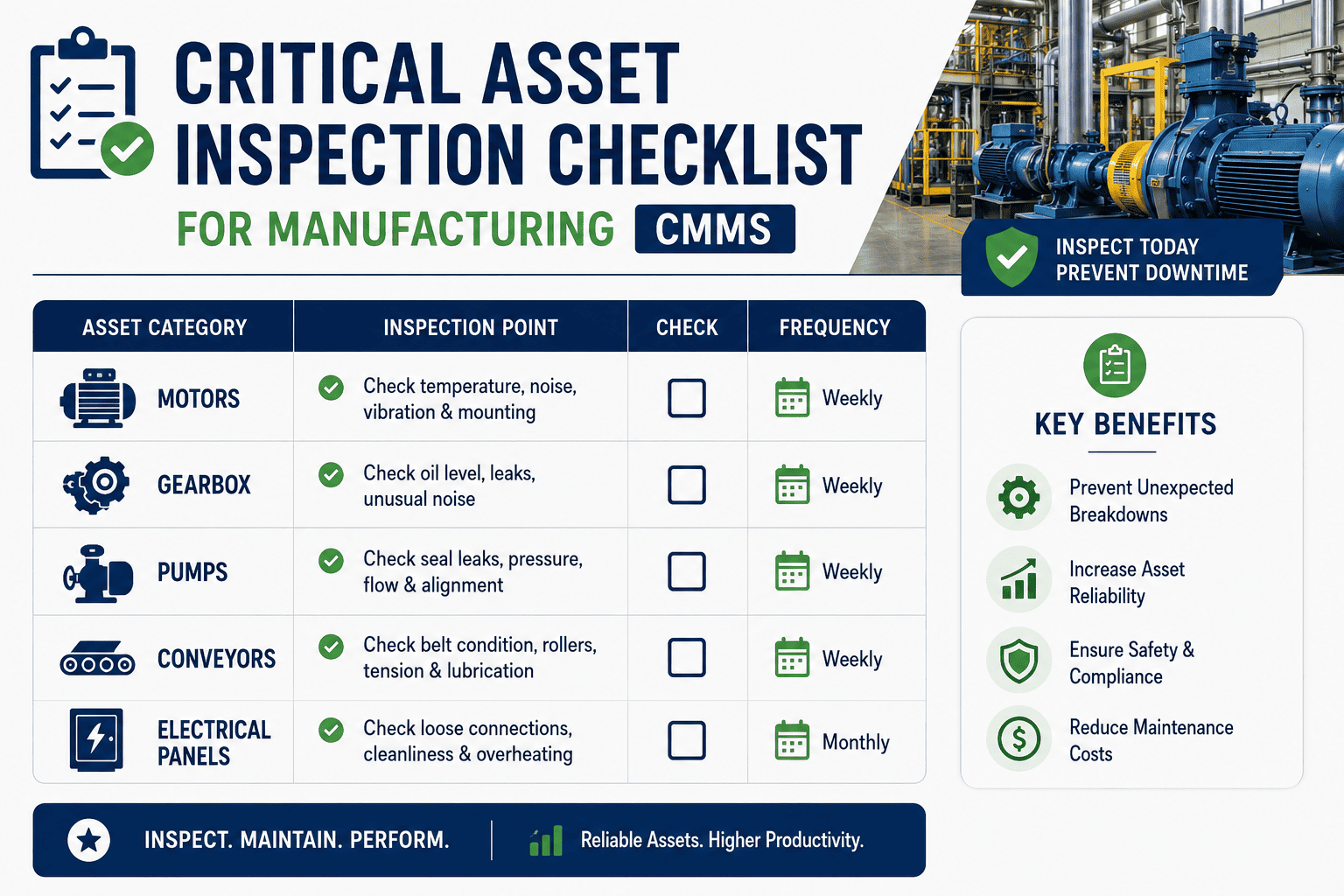
A robust pressure vessel PM program covers four layers: daily operator rounds, monthly condition monitoring, annual external inspections and relief valve tests, and scheduled internal shutdowns. Use this checklist as the baseline for configuring preventive maintenance triggers in your CMMS — every item below should map to a work order with a defined frequency, assigned technician, and required documentation.
Operator Round Inspections
- Walk vessel exterior; log visible leaks, weeps, or seepage at flanges
- Check pressure & temperature gauges against operating envelope
- Inspect insulation / cladding for damage or moisture intrusion
- Listen for abnormal noise from relief valves or vessel internals
- Verify drain valves are closed; no standing liquid at base
Condition Monitoring & UT
- Take UT thickness readings at all Condition Monitoring Locations (CMLs)
- Calculate short-term & long-term corrosion rates per API 510
- Inspect nozzles, manways, and handholes for gasket leakage
- Check vessel supports, legs, skirts, and anchor bolts for corrosion
- Photograph any coating breakdown or surface pitting
External Inspection & PRV Test
- Conduct API 510 external on-stream inspection (visual + UT)
- Bench-test every pressure relief valve — set pressure & seat tightness
- Calibrate all pressure & temperature instruments on the vessel
- Verify emergency vent paths are unobstructed and labeled
- Update vessel drawings, P&IDs, and MAWP documentation
Internal Shutdown Inspection
- Isolate, purge, and Confined-Space-Entry permit the vessel
- Internal visual: welds, shell, heads, lining, baffle integrity
- Supplemental NDE: MT/PT on suspected welds, UT grid mapping
- Hardness testing or metallurgical analysis if service-ageing suspected
- Calculate remaining life; file API 510 inspection report & re-rate if needed
CORROSION & RELIABILITY
How to Calculate Corrosion Rate, Remaining Life & Re-Rating for Pressure Vessels
API 510 requires plant owners to calculate both short-term and long-term corrosion rates at each CML, then derive the vessel's remaining life. If the remaining life falls below the next inspection interval, the vessel must be repaired, re-rated, or retired. These formulas — and the data behind them — should live inside your CMMS so every thickness reading automatically recalculates remaining life and triggers the next inspection work order.
Based on the last two UT readings. If CRshort exceeds the long-term rate, it signals an acceleration — investigate root cause immediately.
Uses the original constructed wall thickness (from the U-1 manufacturer's data report) versus the latest reading. This is the baseline rate for RBI scheduling.
trequired = minimum wall thickness per ASME BPVC or API 579. If RL < next inspection interval, shorten the interval, re-rate the vessel (lower MAWP), or repair/replace.
API 510 typically uses half the remaining life (capped at 10 years for internal, 5 years for external) — but never less than the jurisdictional minimum.
OXMAINT SOLUTION
How OxMaint's CMMS Automates Pressure Vessel Inspection & Compliance
OxMaint is an AI-powered CMMS and EAM platform built for maintenance and reliability teams that cannot afford to miss a compliance deadline. For pressure vessel programs, OxMaint replaces spreadsheets and paper binders with a single system that schedules every API 510 inspection trigger, stores UT thickness data, auto-calculates remaining life, and generates audit-ready reports — so your next jurisdictional inspection takes hours, not weeks.
Automated Inspection Scheduling
Configure every pressure vessel with its API 510 interval (internal, external, UT, PRV test). OxMaint auto-generates work orders 90, 60, and 30 days before each due date and escalates overdue items to supervisors.
UT Thickness Tracking & Auto Remaining Life
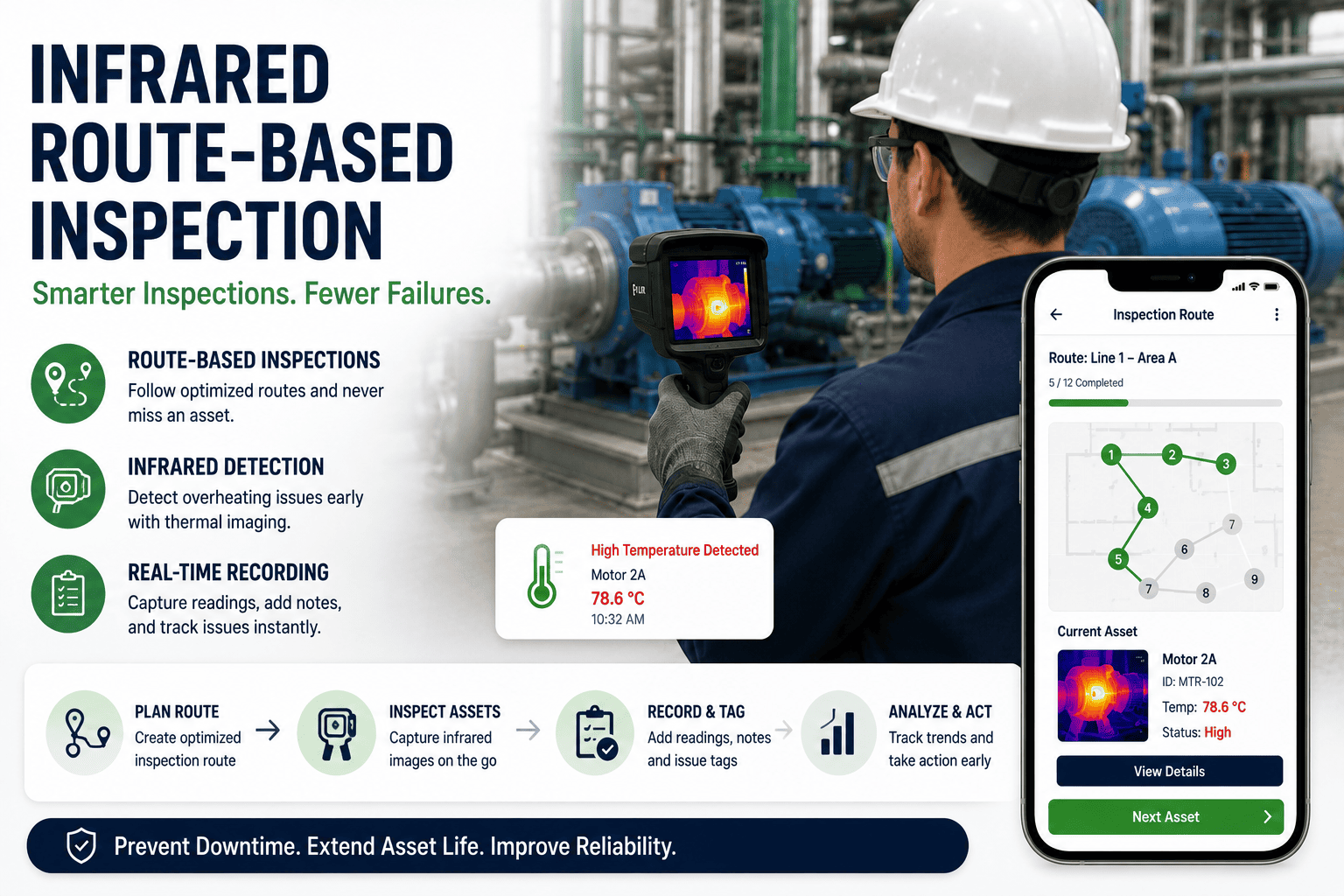
Log UT readings at each CML directly from the mobile app. OxMaint stores the data, calculates short-term and long-term corrosion rates, derives remaining life, and flags vessels below the next-interval threshold.
Audit-Ready Documentation
Every work order, UT reading, NDE report, and relief valve test record is time-stamped and linked to the vessel's asset profile. Generate a complete API 510 compliance binder in one click — no more digging through shared drives.
AI-Driven Predictive Alerts
OxMaint's AI engine analyses UT trend data across your fleet and flags vessels with accelerating corrosion rates — predicting which vessel will breach minimum wall thickness before the next scheduled reading.
SEE IT ON YOUR ASSETS
Book a 30-Minute Demo — See OxMaint Track Your Pressure Vessel Program
We'll load your vessel list, configure API 510 inspection triggers, and show you how automated remaining-life calculations and audit-ready reporting work in real time. No slides — just your assets in the system.
FREQUENTLY ASKED QUESTIONS
Pressure Vessel Inspection & Maintenance FAQ
How often should pressure vessels be inspected in a manufacturing plant?
API 510 recommends an external (on-stream) inspection every 5 years and an internal (shutdown) inspection every 10 years as default maximums. However, vessels in severe or corrosive service typically require internal inspections every 3–5 years. UT thickness monitoring should be performed at every inspection and at additional intervals defined by your CML plan. Relief valves should be bench-tested annually. A risk-based inspection (RBI) program can extend or shorten these intervals based on documented corrosion rates and consequence analysis.
What is API 510 and does it apply to my manufacturing pressure vessels?
API 510 is the American Petroleum Institute standard for in-service inspection, rating, repair, and alteration of pressure vessels. While originally written for petroleum and chemical processing, most manufacturing plants adopt API 510 as the industry best practice even when not legally required. Many state boiler and pressure vessel jurisdictions reference API 510 or NBIC for inspection requirements. If your vessels operate above 15 psi and are subject to state regulation, you likely need to follow API 510 or equivalent — schedule a demo at Calendly to see how OxMaint maps these requirements automatically.
Can a CMMS help with pressure vessel compliance tracking?
Yes — a pressure vessel CMMS like OxMaint is purpose-built to solve the #1 compliance failure: missed inspection deadlines. OxMaint stores each vessel's design data (MAWP, MDMT, construction code), schedules API 510 internal, external, UT, and relief valve inspections as recurring work orders, sends escalating notifications before due dates, and auto-calculates remaining life from UT thickness data. The system also maintains a complete, time-stamped audit trail of every inspection report, NDE result, and repair record — so jurisdictional reviews take hours instead of weeks.
What records must I keep for pressure vessel inspections?
API 510 and most jurisdictional codes require: the manufacturer's U-1 data report, as-built drawings, P&IDs, all external and internal inspection reports, UT thickness data and corrosion-rate calculations, relief valve test records, repair documentation (R-1 Forms), re-rating calculations, and a current vessel register with MAWP and next inspection dates. These records must be retained for the life of the vessel and be producible on demand for an inspector. OxMaint stores all of this in a single asset profile — start your free trial to digitize your vessel records today.
What happens if I miss a pressure vessel inspection deadline?
Consequences range from regulatory fines ($15K–$500K per violation in many jurisdictions), mandatory shutdown of the vessel until inspection is completed, invalidated property and liability insurance, and potential criminal liability if a failure causes injury. Even without a regulator, an overdue vessel that fails catastrophically exposes the plant owner to negligence claims. The cost of a CMMS that prevents even one missed deadline is a fraction of these costs — which is why most reliability managers consider pressure vessel compliance tracking software a non-negotiable.
START TODAY
Stop Tracking Pressure Vessel Inspections on Spreadsheets
Deploy OxMaint in minutes — import your vessel list, set API 510 inspection triggers, and let the system manage every deadline, UT reading, and audit report automatically.
Free 14-day trial · No credit card required