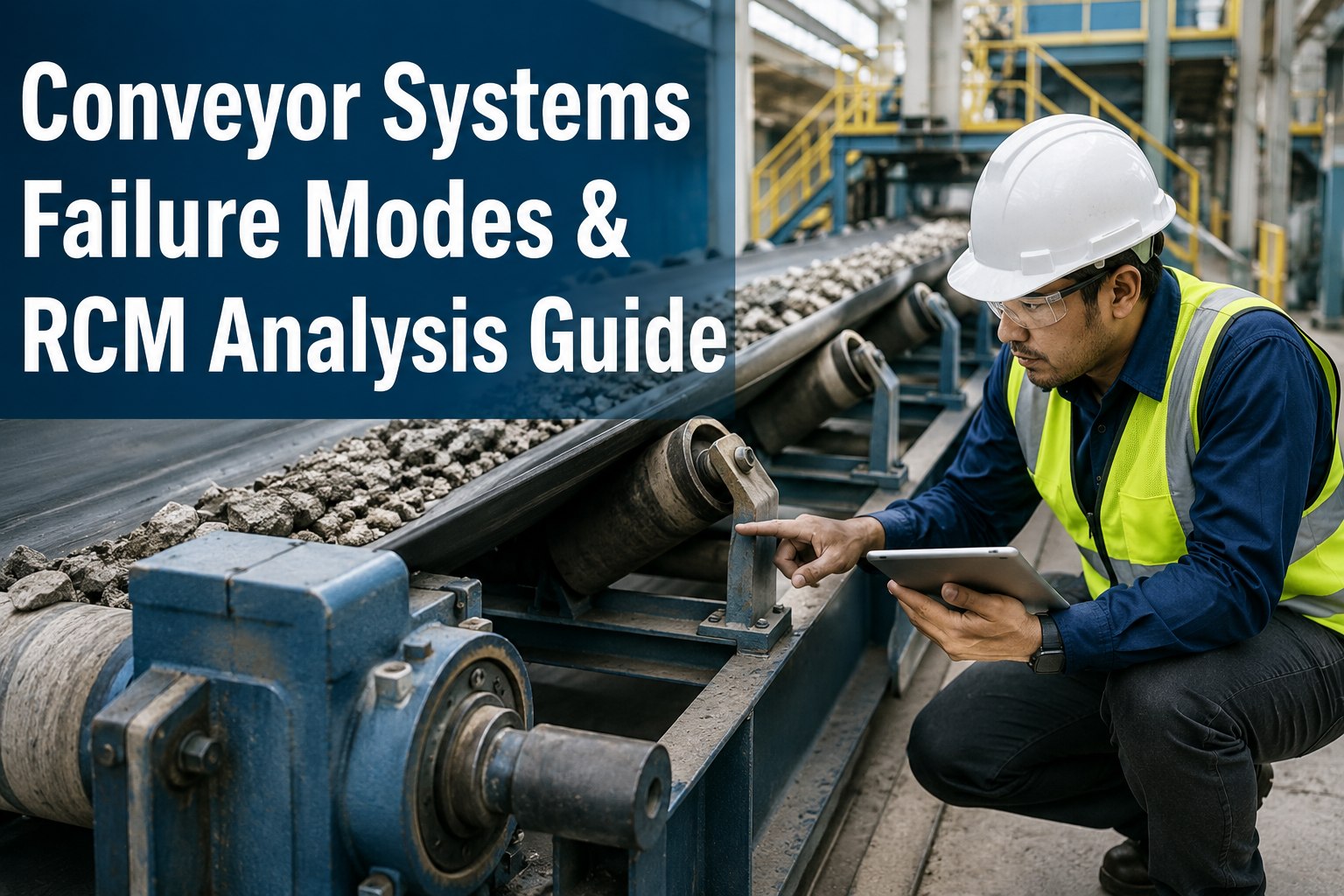
Conveyor systems are the circulatory system of modern manufacturing and logistics — and when they stop, everything stops. Unplanned conveyor downtime costs industrial operations an average of $260,000 per hour in lost production, yet most facilities still rely on scheduled maintenance intervals that have no relationship to actual equipment condition. AI-powered predictive maintenance changes that equation entirely: instead of reacting to failures or over-maintaining on fixed schedules, your conveyor system continuously reports its own health — and flags degradation weeks before a breakdown occurs. Book a demo with OxMaint to see how AI predictive maintenance is deployed on live conveyor assets today.
OxMaint AI · Conveyor Systems Predictive Maintenance
Stop Reacting to Conveyor Failures.
Start Predicting Them — Weeks Ahead.
AI-powered vibration, temperature, and motor current analysis that catches bearing wear, belt misalignment, and drive failure before your production line goes down.
$260K
Avg cost per hour of conveyor downtime
72%
Of conveyor failures are predictable with AI sensors
3–6 Wks
Advance warning window AI delivers before failure
40%
Reduction in maintenance costs with predictive AI
The Real Cost of Reactive Conveyor Maintenance
Most conveyor failures do not happen suddenly — they announce themselves through weeks of subtle signal changes that go undetected without the right monitoring in place. By the time a bearing seizes or a belt tears, the damage was already written in the data. The operational and financial consequences compound far beyond the repair cost itself.
Emergency Repair Premium
3–5×
Unplanned repairs cost 3 to 5 times more than scheduled maintenance due to emergency labour rates, expedited parts, and contractor call-outs.
Secondary Damage Cascade
62%
Of conveyor bearing failures cause secondary damage to shafts, housings, or drive components — turning a $400 bearing replacement into a $12,000 repair.
Mean Time to Repair
4.2 hrs
Average MTTR for unplanned conveyor outages in manufacturing — compared to 1.1 hours for planned maintenance interventions triggered by predictive alerts.
Compliance Risk
High
In food processing, pharmaceutical, and mining sectors, unplanned conveyor failures trigger mandatory incident reports, regulatory audits, and potential production holds.
The shift from reactive to predictive is not a technology decision — it is a financial one. AI predictive maintenance ROI is measurable within the first quarter of deployment.
How AI Reads Conveyor Health: The 3 Signal Pillars
Conveyor condition is encoded in three measurable physical signals that change predictably as components degrade. AI doesn't guess at failure — it reads the physics of your equipment in real time and correlates multi-sensor data to identify patterns that no single sensor could reveal alone.
01
Vibration Analysis
Bearing defects, roller imbalance, misalignment, and structural looseness all produce characteristic vibration signatures at specific frequency bands. AI analyses the full vibration spectrum — not just peak values — to distinguish between a bearing outer race defect, an inner race defect, and a roller element fault at different severity stages.
Detects:
Bearing outer/inner race wear
Roller imbalance
Drive shaft misalignment
Structural looseness
Warning window: 3–8 weeks before failure
02
Temperature Monitoring
Abnormal heat generation is one of the earliest and most reliable failure indicators in conveyor systems. Bearing temperature rising above baseline at a rate of more than 2°C per hour is a fault signature — even if the absolute temperature looks acceptable. AI tracks the rate of change, not just the value, to catch thermal anomalies that static threshold alarms miss entirely.
Detects:
Bearing lubrication failure
Overloaded drive motors
Gearbox deterioration
Belt friction hotspots
Warning window: 2–5 weeks before failure
03
Motor Current Signature Analysis
Every mechanical anomaly in a conveyor drive train — from a worn gear tooth to belt misalignment — creates a corresponding electrical signature in the motor current waveform. Motor Current Signature Analysis (MCSA) detects these patterns without any mechanical sensor installed on the conveyor itself, making it the lowest-cost entry point for conveyor predictive maintenance with the widest detection range.
Detects:
Broken rotor bars
Belt tension variation
Load imbalance
Gearbox mesh frequency faults
Warning window: 4–10 weeks before failure
5 Conveyor Failure Modes AI Catches Before Your Team Does
These five failure categories account for over 80% of all unplanned conveyor downtime in industrial operations. Each one follows a detectable degradation path that AI can identify weeks before visible symptoms appear — or before any alarm threshold is breached.
Failure Mode 01
Conveyor Belt Misalignment
Belt tracking deviation starts as a minor lateral drift detectable through load cell asymmetry and idler roller speed differential analysis. Undetected, it progresses to belt edge wear, spillage, and catastrophic belt damage within days. AI flags the initial drift pattern at stage one — before any physical inspection would catch it.
Load cell differential
Idler speed variance
Drive current asymmetry
Failure Mode 02
Bearing Degradation
Rolling element bearing failure follows a four-stage progression spanning weeks or months. Stage 1 is detectable only through ultrasonic and high-frequency vibration analysis. By Stage 4 — audible noise, heat, and vibration visible to operators — secondary damage has almost certainly already occurred. AI monitoring targets Stage 1 and Stage 2 detection, where intervention is cheapest and fastest.
High-freq vibration spectrum
kurtosis value trending
Bearing temperature rate-of-rise
Failure Mode 03
Drive Motor Overload
Material build-up on the belt, seized idlers, and belt tension creep all increase the mechanical load on drive motors progressively. Motor current increases in direct proportion — but the increase is gradual enough to evade manual inspection and static alarms. AI tracks the cumulative load trend and isolates whether current increases are load-driven, mechanical-friction-driven, or electrical-fault-driven.
Motor current baseline drift
Power factor trend
Start current amplitude
Failure Mode 04
Gearbox Wear
Gearbox gear mesh frequency sidebands in the vibration spectrum are the earliest indicator of gear tooth wear — detectable 4 to 10 weeks before macro-pitting develops. Oil particle count trending and temperature-corrected vibration amplitude together give a complete gearbox health picture that no single measurement can deliver alone.
Gear mesh frequency sidebands
Oil temperature deviation
Vibration amplitude at GMF
Failure Mode 05
Idler Roller Seizure
Seized idler rollers are one of the most common causes of belt fires in underground mining and dust-heavy environments. A seized roller builds friction heat against the moving belt — invisible to thermal cameras at distance but clearly detectable through the vibration signature change as the roller transitions from rolling to sliding. AI detects this transition in its earliest phase.
Roller rotation frequency loss
Localised temperature spike
Belt surface friction index
Reactive vs. Scheduled vs. AI Predictive: What the Numbers Say
The case for AI predictive maintenance is not theoretical — it is operational data from facilities that made the transition. The comparison across three maintenance strategies shows where the value is created and where costs are concentrated.
| Metric |
Reactive |
Scheduled PM |
AI Predictive |
| Unplanned downtime per year |
180–240 hrs |
60–90 hrs |
8–18 hrs |
| Maintenance cost as % of asset value |
12–18% |
7–12% |
3–6% |
| Average repair cost per event |
$18,000–$45,000 |
$6,000–$14,000 |
$1,800–$5,000 |
| Secondary damage rate |
62% |
28% |
4% |
| Parts replaced unnecessarily |
Low |
40–60% of tasks |
Less than 5% |
| Mean time between failures (MTBF) |
Baseline |
+35% |
+180% |
Data sourced from industry benchmarking studies across mining, food processing, automotive, and bulk materials handling sectors. AI predictive results reflect facilities using continuous sensor monitoring with ML-based anomaly detection.
OxMaint Predictive Maintenance Platform
Your conveyor's next failure is already generating signals. Is anyone reading them?
OxMaint connects to your conveyor sensors, PLCs, and SCADA systems and starts delivering predictive insights within days of deployment — no infrastructure overhaul required.
How OxMaint AI Works on Conveyor Systems
OxMaint is not a generic IoT platform — it is a maintenance intelligence system built around the specific failure physics of rotating and belt-driven equipment. Here is exactly how it operates on a conveyor asset from day one.
Step 1
Connect & Baseline
OxMaint ingests data from existing vibration sensors, temperature probes, motor current transducers, and PLC outputs via OPC-UA, Modbus, or direct API. If sensors are not installed, OxMaint's deployment team specifies a minimum viable sensor set. The AI then runs a 7-day baseline learning period to establish normal operating signatures for each asset.
Day 1–7
→
Step 2
Continuous Analysis
After baselining, OxMaint runs continuous multi-sensor anomaly detection using models calibrated to conveyor failure physics. The system tracks trend rate of change — not just absolute values — and correlates vibration, temperature, and motor current patterns to isolate fault type and severity. False positive rates are suppressed by requiring multi-signal confirmation.
Day 7 onwards
→
Step 3
Work Order Generation
When a fault signature crosses confidence threshold, OxMaint automatically generates a prioritised maintenance work order — including the fault type, affected component, recommended intervention, and estimated remaining useful life window. Work orders integrate directly with your CMMS or can be managed entirely within OxMaint's native workflow module.
Automated
→
Step 4
Feedback & Improvement
Every completed work order — whether it confirms the fault or clears the asset — feeds back into OxMaint's models. The system learns your specific conveyor's operating characteristics over time, reducing false positive rates and extending the detection lead time with each maintenance cycle. The model improves continuously without any manual retraining.
Continuous loop
Most conveyor assets are fully baselined and delivering actionable predictive alerts within 10 days of OxMaint deployment.
AI Conveyor Maintenance Across Industries: What Changes
Conveyor systems operate across radically different environments — from food-grade clean rooms to underground mine tunnels — and the failure modes that matter most shift by sector. OxMaint's conveyor monitoring is configured to the specific risk profile of each industry.
Mining
Primary Focus
Idler roller seizure and belt fire prevention are the defining safety and operational priorities. Continuous thermal and vibration monitoring on high-burden belt sections is critical. OxMaint tracks idler rotation signatures at scale across kilometre-length overland conveyors.
Avg downtime cost: $500K–$2M/hr in large-scale mining
Food & Beverage
Primary Focus
Lubrication contamination risk and hygiene compliance are paramount. AI monitoring in food processing targets bearing temperature and vibration changes that signal lubrication breakdown — before contamination reaches the product stream. Regulatory incident reports are eliminated through proactive intervention.
Recall cost avoidance: $10M+ per contamination incident
Automotive
Primary Focus
Just-in-time production environments have zero tolerance for unplanned stoppages. A single conveyor outage cascades through an entire assembly line within minutes. OxMaint's automotive configuration prioritises rapid fault identification and MTTR minimisation through pre-positioned part alerts and technician dispatch.
JIT line stoppage cost: $15,000–$50,000/min
Logistics & Distribution
Primary Focus
High-speed sortation conveyors running 24/7 operations across distribution centres have maintenance windows measured in minutes. AI monitoring allows OxMaint to schedule interventions during the brief natural gaps in throughput cycles — eliminating the choice between accepting failure risk and taking planned downtime.
Peak season outage cost: $1M+ per day in large 3PL operations
Frequently Asked Questions
Do we need to install new sensors on our conveyors to use OxMaint?
Not necessarily. OxMaint integrates with sensors already installed on most industrial conveyor systems — including vibration transducers, PT100 temperature probes, and motor current transducers connected to existing PLCs or SCADA systems. In facilities where sensors are limited, our deployment team specifies a minimum viable sensor set designed for cost-effective installation.
Book a scoping call to review what your current infrastructure can deliver before any hardware investment is confirmed.
How long before OxMaint starts delivering useful predictive alerts on our conveyor fleet?
The AI requires a 7-day baseline learning period to establish normal operating signatures for each conveyor asset — accounting for load variation, shift patterns, and seasonal temperature effects. After that period, the system begins issuing fault alerts with confidence scoring. Most facilities receive their first actionable predictive maintenance work order within 10–14 days of deployment.
Start a free trial to begin the baseline period on your highest-criticality conveyor assets immediately.
Can OxMaint manage conveyor maintenance scheduling alongside other plant equipment?
Yes — OxMaint is a full maintenance management platform, not a standalone conveyor monitoring tool. Conveyor assets sit within the same asset hierarchy as pumps, compressors, packaging lines, and any other equipment category in your facility. Work orders generated by AI alerts are managed within the same workflow module as routine planned maintenance tasks, giving maintenance supervisors a unified view across all assets. Integration with existing CMMS platforms is supported via standard API connection.
How does OxMaint reduce false positive alerts that waste maintenance team time?
False positives are the primary reason maintenance teams lose confidence in predictive monitoring systems. OxMaint addresses this through multi-signal confirmation — an alert is only escalated to a work order when anomalies are independently confirmed across at least two correlated sensor channels. The system also applies load-normalisation to distinguish fault signatures from legitimate operating condition changes. Over time, the feedback loop from completed work orders further reduces false positive rates specific to your equipment and operating environment.
OxMaint · AI Predictive Maintenance
Your Next Conveyor Breakdown Is Avoidable.
The Data to Prevent It Already Exists.
OxMaint turns your conveyor sensor data into predictive maintenance work orders — automatically. Most facilities are live within two weeks, with no infrastructure overhaul required.