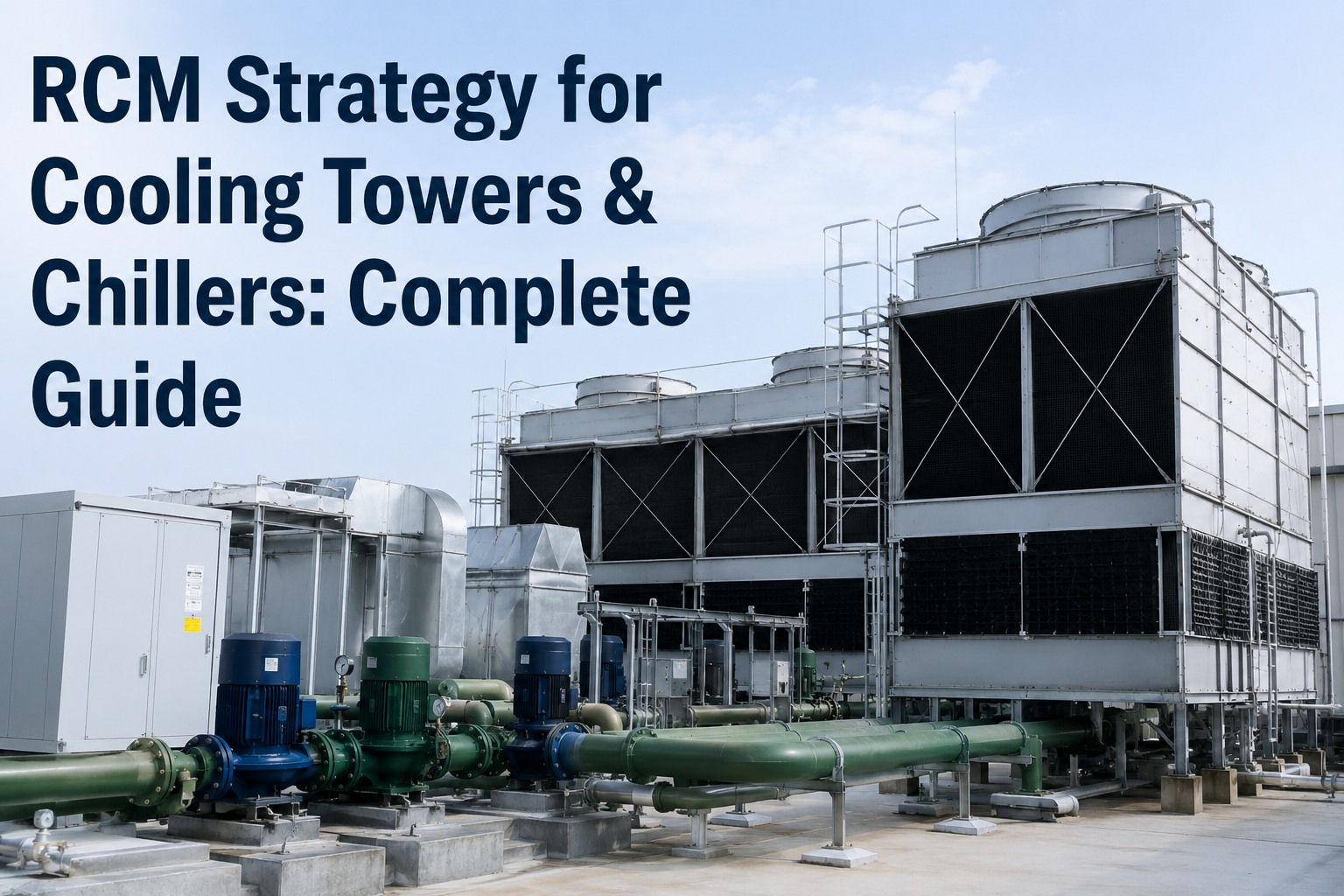
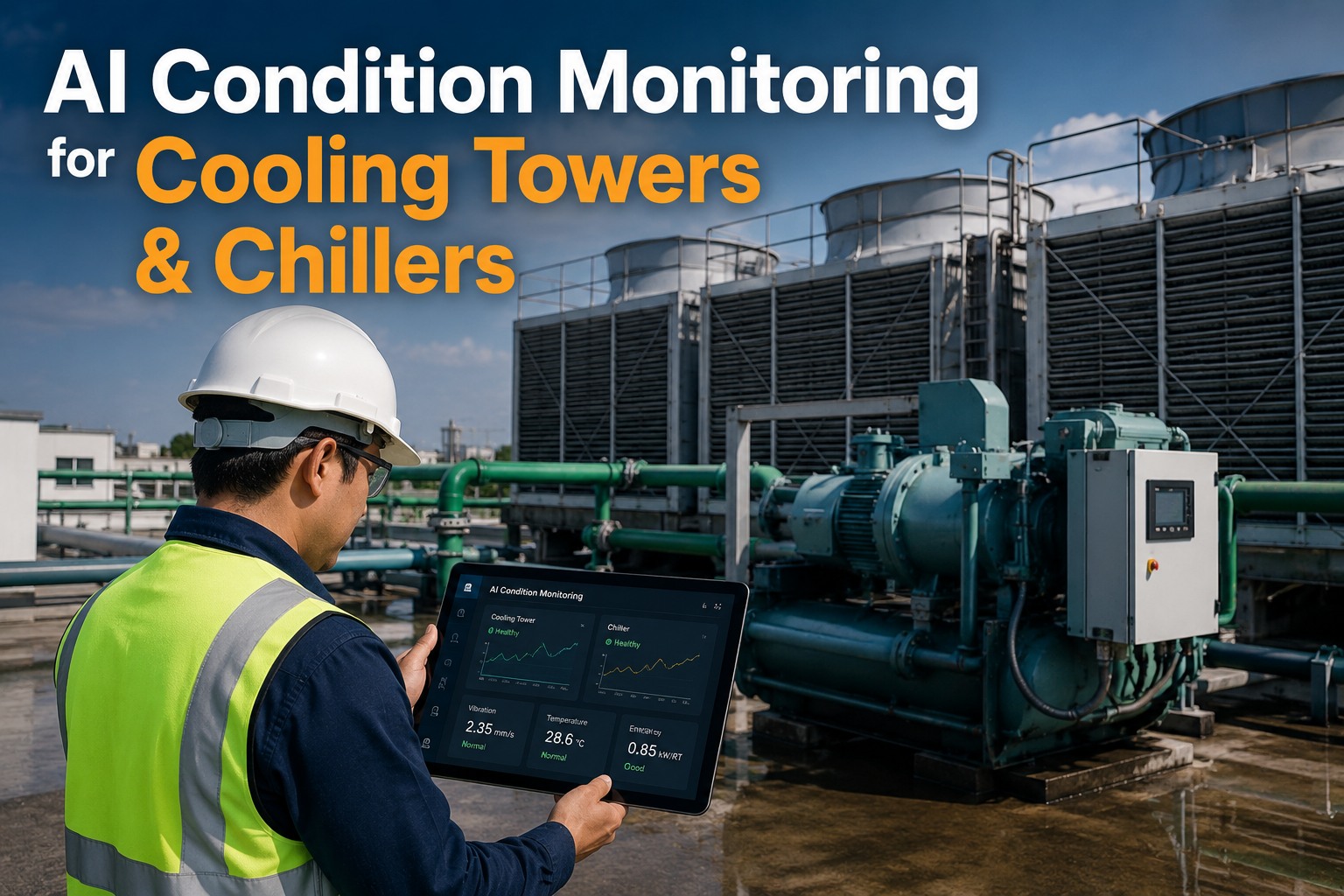
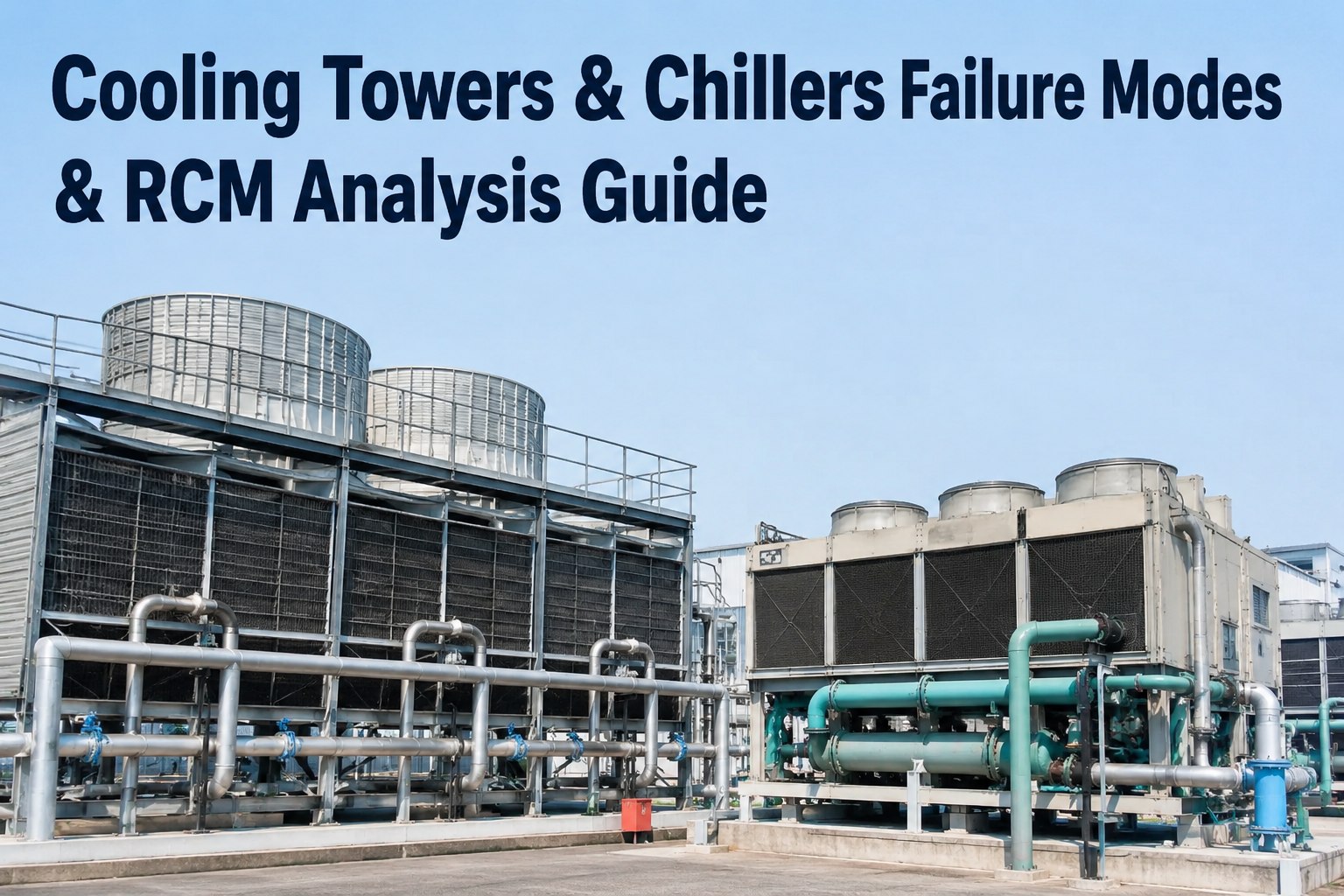
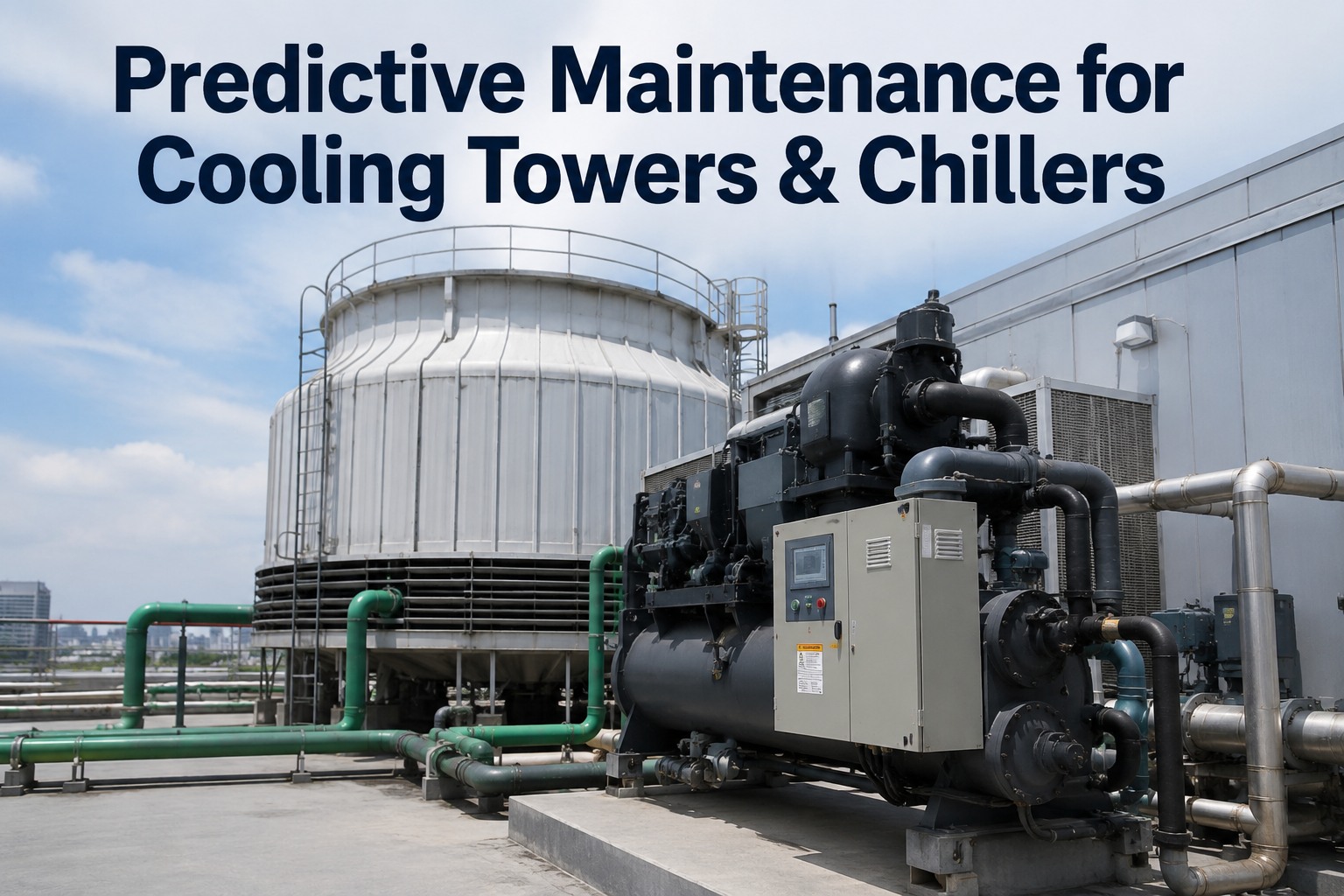
Cooling towers and chillers fail three ways at once, and that's what makes them perfect case for Reliability-Centered Maintenance. There's the reliability failure — a fan bearing that seizes and throws blades through the tower casing in a $150,000–$400,000 event, or a compressor that fails on a 500-ton chiller that costs $200,000–$500,000 and takes 16 to 26 weeks to replace. There's the efficiency failure — condenser tubes fouling silently until the chiller burns 15–25% more energy per ton of cooling, with every degree of approach-temperature drift compounding daily. And there's the safety failure — a lapse in biocide dosing that lets Legionella multiply in the basin within 24 to 48 hours, a public-health hazard regulated under ASHRAE 188 and local law. RCM is built to weigh exactly these different consequences and assign the right task to each mode rather than greasing everything on a flat calendar. This guide walks the complete RCM strategy for cooling towers and chillers: the failure modes across both assets, the four task strategies, criticality ranking, and the condition-monitoring overlay — anchored on the one parameter that ties it all together, approach temperature. Book a live RCM demo against your own cooling assets.
Three Failures at Once: Reliability, Efficiency, Safety
A seized fan, a fouled condenser, and a Legionella bloom are three different consequences — RCM weighs each.
3°F
Approach-temp rise above baseline that signals condenser tube fouling
15–25%
More energy per ton from a heavily fouled condenser
30–45 d
Vibration warning a fan bearing gives before it fails
24–48 h
Window for Legionella growth once biocide drops below threshold
The Dominant Failure Modes · Tower and Chiller
FMEA is the analytical engine of RCM — it answers how each asset fails and what the failure causes. Cooling towers and chillers share a loop but fail differently: the tower's risks are mechanical and biological, the chiller's are thermodynamic and mechanical. Both converge on lost cooling and rising energy.
Fan & Drive Failure (Tower)
The catastrophic mode. Fan-motor bearing wear, gearbox degradation, and blade imbalance. Unchecked, a bearing can escalate to blades through the casing — a $150K–$400K event. Imbalance alone cuts airflow up to 25%.
Fill Fouling & Scale (Tower)
The efficiency drain. Fill fouling, drift-eliminator damage, and scale degrade heat exchange and raise the approach temperature — forcing the chiller to work 5–10% harder for the same cooling.
Condenser Tube Fouling (Chiller)
The silent energy thief. Open-loop tower water fouls condenser tubes fastest — a 1-inch deposit lifts condensing pressure 10–15% and energy 15–25% per ton, showing first as rising approach temperature.
Refrigerant & Compressor Faults (Chiller)
The high-cost mode. A 10% refrigerant charge loss drops capacity 15–20% and accelerates oil and bearing wear. Compressor valve, bearing, and oil-pump degradation follow — avoidable failures worth $40K–$120K each.
The Safety Mode · Legionella & Water Treatment
One tower failure mode stands apart because its consequence is public health, not just cost. It gets its own control regime — and RCM treats it as a safety-critical, regulated function that can't be deferred.
Basin Microbial Growth & Legionella Risk
Gaps in biocide dosing, damaged drift eliminators, and biofilm in low-flow zones create Legionella growth conditions — and once ORP drops below the biocide threshold, growth can begin within 24 to 48 hours. This is governed by ASHRAE 188 water-management planning and local regulation such as NYC Local Law 77, with defined biocide residuals and remediation protocols. In RCM terms it's a hidden, high-consequence hazard demanding failure-finding discipline: continuous ORP monitoring, logged biocide dosing, drift-eliminator integrity checks, and routine testing — never a deferrable task.
See RCM Live on Your Cooling Plant in 30 Minutes
Working session with our reliability team — bring your tower and chiller list. We'll rank them by criticality, map failure modes to tasks, and show how OxMaint auto-generates PM, approach-temperature triggers, and Legionella-prevention logs from live data.
Failure Modes to Detection · The FMEA Core
The value of the FMEA is the detectability column. Nearly every mode here has an early signature — and approach temperature is the master indicator, the single most informative parameter across the whole cooling system.
Failure Mode
Early Signature
Best Detection Task
Fan bearing wear
Vibration harmonic 30–45 days early, RMS velocity climb
Vibration analysis
Fill fouling / scale
Approach temperature rising faster than ambient explains
Approach-temp trending
Condenser tube fouling
Condenser approach 3°F over baseline, rising head pressure
Approach trend + eddy-current testing
Refrigerant charge loss
Rising superheat, high discharge temp, capacity drop
Pressure/temp logging + leak test
Compressor wear
Oil wear metals, current-signature change, discharge-temp rise
Oil analysis + motor current signature
Legionella / microbial growth
ORP below biocide threshold, biofilm, dosing lapse
ORP monitoring + biocide log (failure-finding)
The Four RCM Task Strategies · Where Each Mode Lands
RCM routes each failure mode to one of four maintenance strategies by failure pattern and consequence. For cooling systems, condition-based tasks dominate — because approach temperature, vibration, and oil all give weeks of warning — while Legionella control sits firmly in failure-finding.
On-Condition
Predictive / Condition-Based
For modes with a detectable P-F interval. Approach-temperature trending, fan-motor vibration, and compressor oil analysis catch fouling, bearing, and refrigerant faults weeks ahead — the primary strategy here.
Scheduled Restoration
Time / Usage-Based
Restore or replace at a fixed interval — annual condenser tube brushing, fill cleaning, drift-eliminator replacement, gearbox oil change on a known service life.
Failure-Finding
Safety & Hidden-Function Checks
The critical one here. Legionella biocide/ORP verification, high- and low-pressure cutout tests, and oil-pressure switch checks — hidden protective functions proven on a schedule, never deferred.
Run-to-Failure
Deliberate Acceptance
A conscious choice for low-consequence, non-safety components with redundancy — never a compressor, a fan drive, or the water-treatment regime.
Criticality Ranking · Where the Analysis Goes
RCM analysis is time-intensive, so it's spent where consequences justify it. For cooling systems, criticality blends production impact, the high replacement cost and long lead time of chillers, and the public-health weight of Legionella control.
CRITICAL
Primary Chillers & Water Treatment
Lead chillers on the main cooling load and the Legionella-control regime. Failure means lost production or a public-health hazard, plus a 16–26 week chiller lead time — full RCM, condition monitoring, and failure-finding.
IMPORTANT
Towers, Pumps & Redundant Units
Cooling-tower cells, condenser-water pumps, and units with N+1 redundancy or a tolerable short outage. Targeted FMEA, condition-based tasks, and scheduled restoration on wear parts.
SUPPORTING
Non-Critical Auxiliaries
Low-consequence auxiliaries where a short outage is a non-event. Simple inspection or planned restoration — no exhaustive analysis needed.
The AI Overlay · Keeping the Analysis Alive
An RCM study is only valuable if something is actually watching the parameters it identified. The mode that ranked "detectable by approach temperature" only helps if that approach is trended continuously and a missed biocide check can't slip through. This is where a live CMMS overlay turns a static study into an operating discipline.
Sensors Watch the Modes
IoT vibration on fan motors, approach-temperature calculation, refrigerant pressures, oil condition, and ORP track exactly the parameters the FMEA flagged — sampling continuously, not on inspection day.
Thresholds Fire Work Orders
A 5% approach drift, a vibration harmonic, or an ORP drop auto-generates a work order tied to the specific mode — fill cleaning at the optimal trigger, not after 15% loss forces an emergency.
Findings Feed Back
Closed-work-order findings and water-treatment logs return to the failure and compliance history — keeping the RCM analysis live and the Legionella record audit-ready.
How OxMaint Runs RCM for Cooling Towers & Chillers
OxMaint embeds RCM directly into execution — failure-mode libraries in the asset record, criticality scoring that drives task selection, condition-monitoring triggers, auto-generated work orders at RCM-defined intervals, and cloud reliability reporting that replaces spreadsheet RCM, from one dashboard on desktop or mobile.
FMEA
Live Failure-Mode Libraries
Tower and chiller failure modes loaded into each asset record, linked to work-order templates and condition triggers — not stranded in a spreadsheet.
Criticality
Consequence-Driven Scoring
Rank every asset by production, cost, and public-health consequence, so primary chillers and water treatment rise to the top and PM strategy follows risk.
Approach
Approach-Temp & Efficiency Triggers
Continuous approach-temperature and kW/ton monitoring convert efficiency drift into work orders at the optimal trigger — before fouling forces emergency action.
Condition
Vibration, Oil & IoT
Fan-motor vibration, compressor oil, and refrigerant-pressure data auto-convert threshold breaches into prioritized work orders — the P-F window put to use.
Legionella
Water-Treatment Compliance
Schedule ORP checks, biocide dosing logs, and drift-eliminator inspections on a failure-finding cadence — audit-ready for ASHRAE 188 and local law.
Reporting
Audit-Ready Reliability
Reliability and efficiency dashboards plus ISO 55000-aligned records, with SAP and Maximo overlay across a single plant or a global network.
Maintain Cooling by Risk, Not by Calendar
Replace spreadsheet RCM with a live program that ranks criticality, maps failure modes to tasks, and turns approach-temperature and ORP data into work orders before capacity, energy, or safety slips. See OxMaint on your own assets. Free forever plan available.
Frequently Asked Questions
Why is RCM well-suited to cooling towers and chillers?
Because these assets fail in three different ways that each demand a different response, and RCM is built to weigh consequence. There's reliability failure — a fan bearing or compressor that fails catastrophically and costs six figures to repair or replace, with chillers carrying 16-to-26-week lead times. There's efficiency failure — fouling that silently drives energy consumption up 15–25% per ton with no dramatic breakdown. And there's safety failure — Legionella growth in the tower basin, a regulated public-health hazard. A flat calendar treats all three the same; RCM assigns condition-based monitoring to the efficiency and reliability modes and rigorous failure-finding to the safety mode, matching each task to its failure pattern and consequence.
Book a demo to see it on your assets.
What are the main cooling tower and chiller failure modes?
On the tower: fan and drive failure (bearing wear, gearbox degradation, blade imbalance — which can escalate to catastrophic fan failure), fill fouling and scale that degrade heat exchange, and basin microbial growth including Legionella. On the chiller: condenser tube fouling (worst because it sees open-loop tower water), refrigerant charge loss, and compressor wear in valves, bearings, and the oil pump. The two are coupled — a fouled tower raises condensing temperature, which forces the chiller to work harder — so a problem in one shows up as degraded performance in the other. Most of these modes are detectable early, which is what makes a condition-based RCM program so effective for cooling systems.
Why is approach temperature the key parameter to monitor?
Approach temperature — the difference between the refrigerant condensing temperature and the leaving condenser water temperature — is the single most informative performance parameter in any chiller, because so many failure modes converge on it. A rising approach trend indicates condenser fouling, non-condensable gas accumulation, or refrigerant charge loss before cooling capacity is visibly affected. On the tower side, a growing gap between leaving water temperature and wet-bulb signals fill fouling or fan degradation weeks before failure. Because each degree of approach drift adds roughly 1.5–2% to energy consumption, trending it continuously catches both efficiency loss and developing mechanical faults at the earliest, cheapest point to act.
Sign up free to trend approach temperature.
How does RCM handle Legionella and water treatment?
As a safety-critical, hidden-function control that falls squarely under the failure-finding task strategy. Legionella risk isn't visible in normal operation — a tower can look and perform fine while biocide has lapsed and bacteria are multiplying, and once oxidation-reduction potential drops below the biocide threshold, growth conditions can develop within 24 to 48 hours. RCM addresses this with scheduled, non-deferrable verification: continuous or frequent ORP monitoring, logged biocide dosing within target residual, drift-eliminator integrity checks, and routine testing, all structured around a water-management plan per ASHRAE 188 and any local regulation. Treating it as a failure-finding function ensures the protective regime is proven on a cadence rather than assumed, with an audit-ready record to prove compliance.
How does OxMaint support an RCM program for cooling systems?
OxMaint embeds RCM into execution: failure-mode libraries live in each tower and chiller asset record linked to work-order templates and condition triggers, criticality scoring weighs production, cost, and public-health consequence, and IoT data — fan-motor vibration, approach temperature, refrigerant pressures, compressor oil, and ORP — auto-converts threshold breaches into prioritized work orders. Efficiency drift generates fill-cleaning or tube-brushing work orders at the optimal trigger; Legionella prevention runs on a failure-finding cadence with audit-ready ASHRAE 188 logs; and closed-work-order findings feed a living failure and compliance history. It overlays SAP PM and IBM Maximo and delivers ISO 55000-aligned reliability and efficiency reporting from one dashboard on desktop or mobile. A free forever plan is available to trial the full workflow.