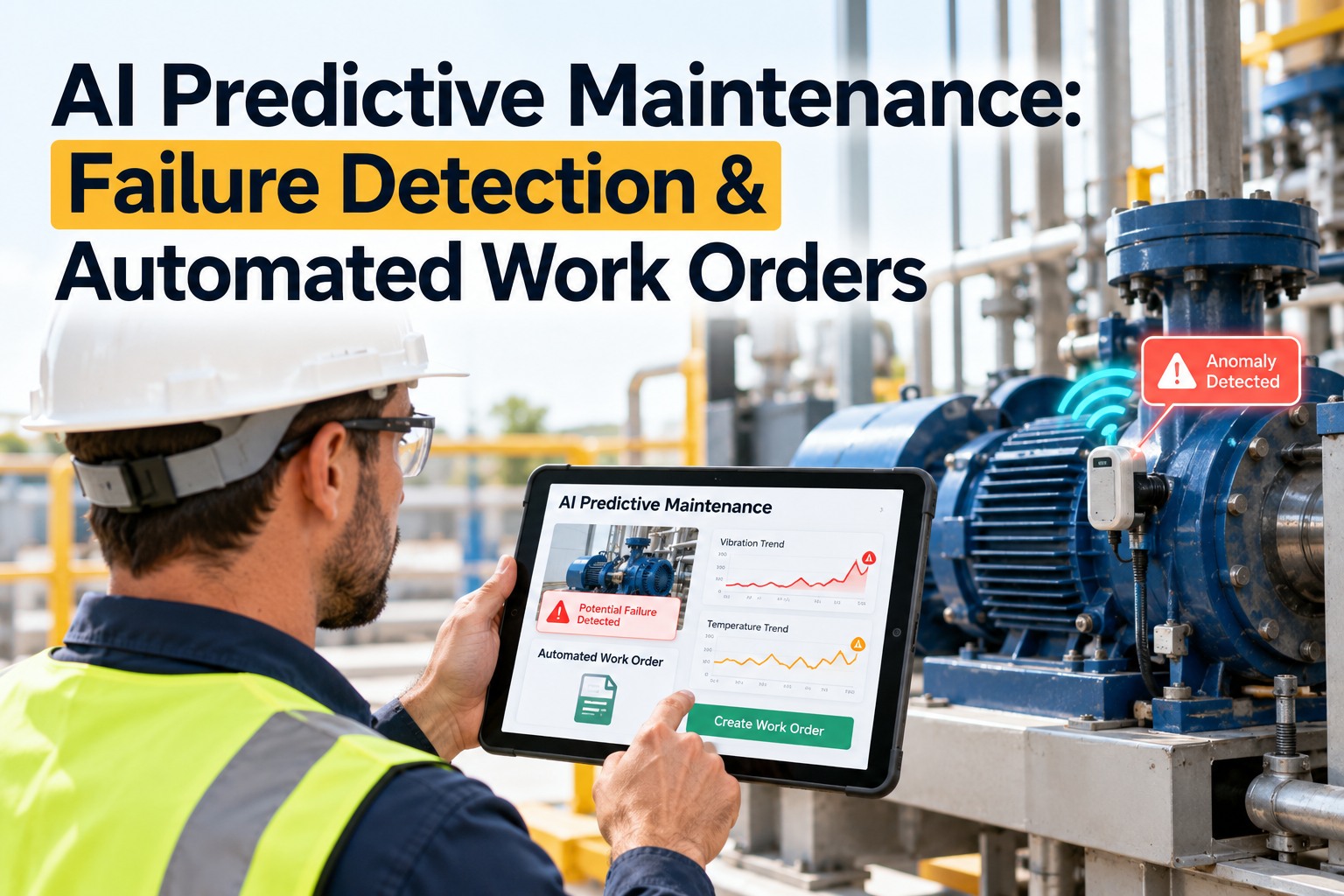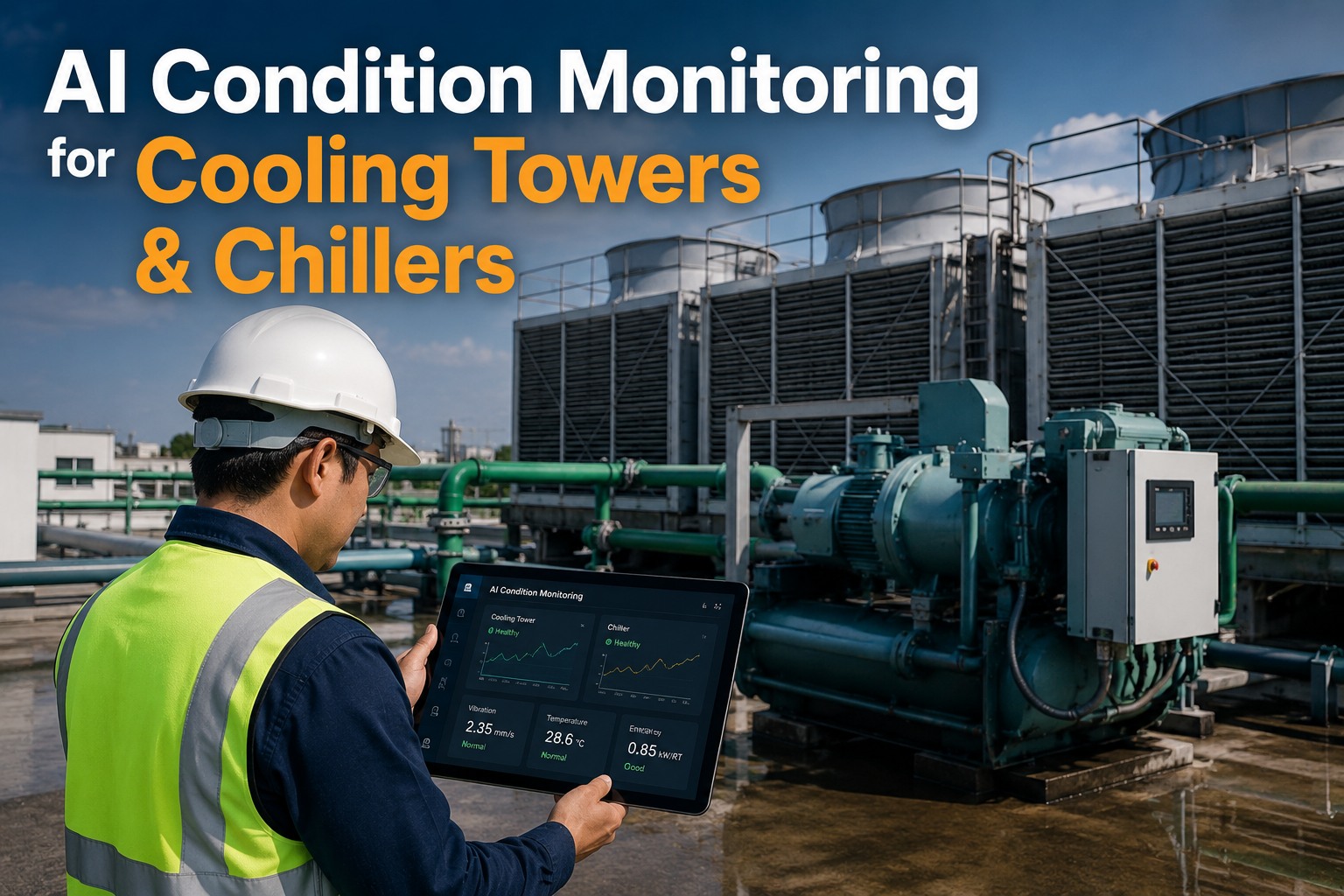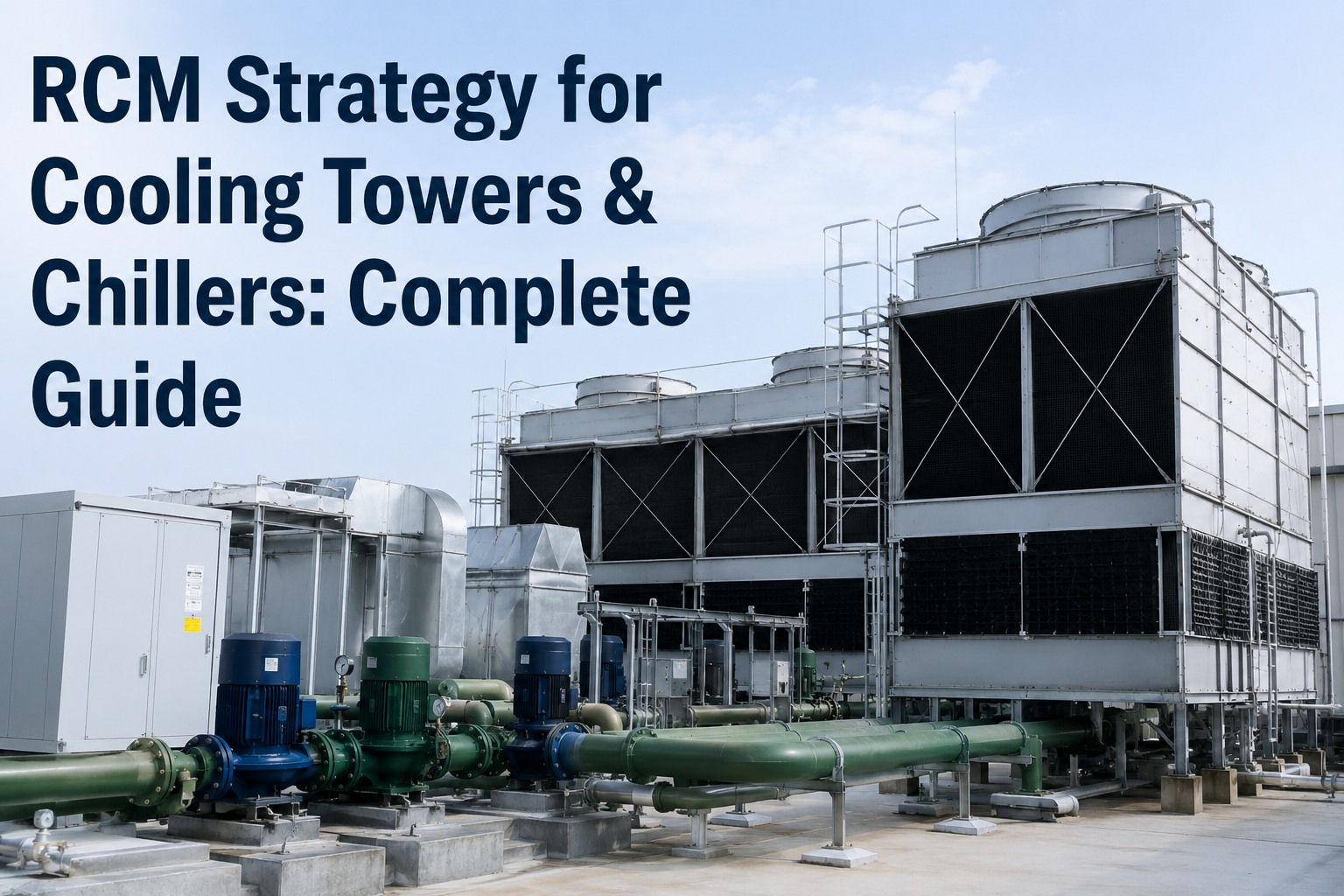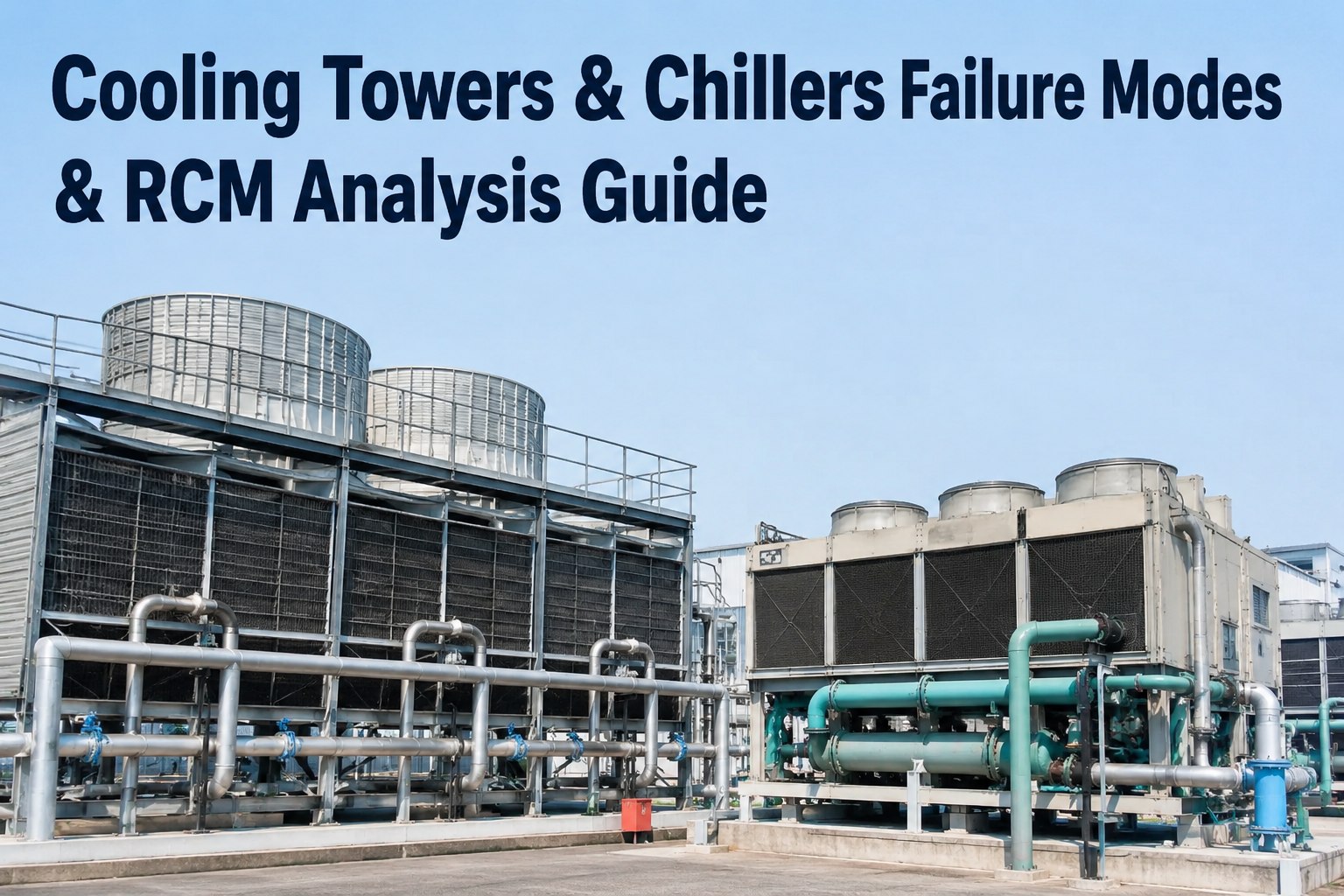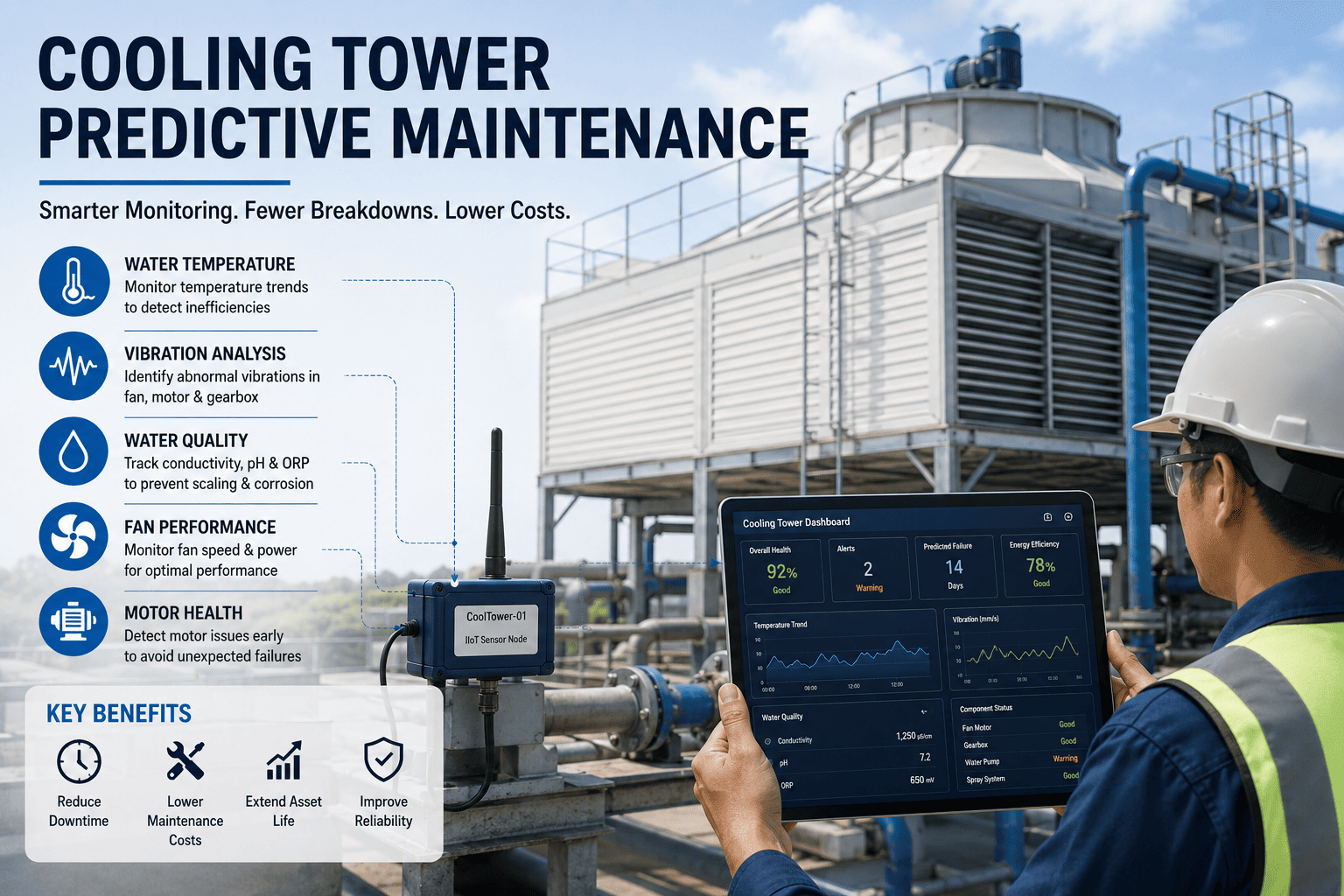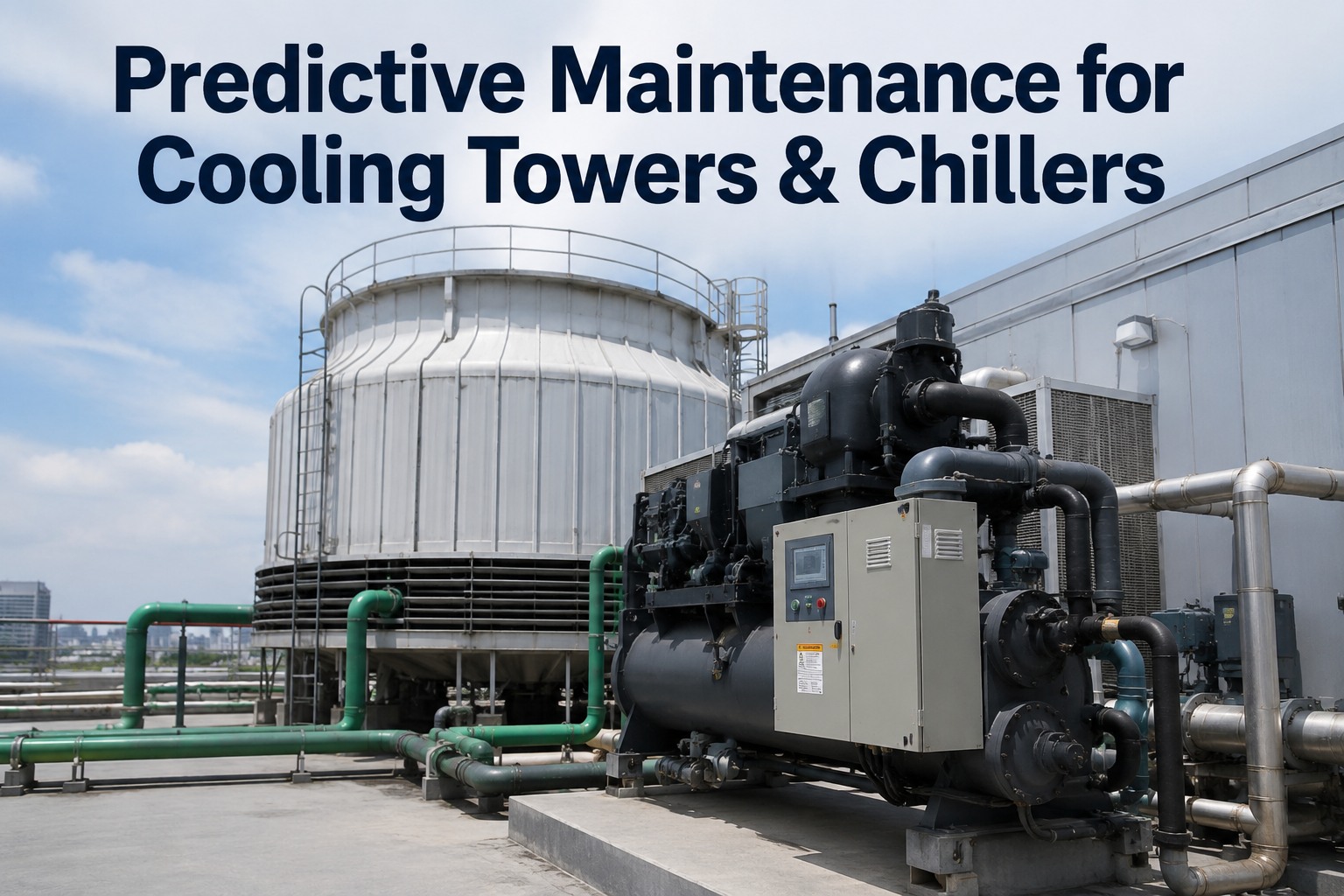
Chillers and cooling towers sit at the top of the industrial asset criticality list — a 500-ton centrifugal chiller runs $200,000 to $500,000 installed with a 16-to-26-week replacement lead time, consumes 40% to 60% of a building's total energy, and represents the single point of cooling failure for hundreds of thousands of square feet of production or occupied space. When it goes down unplanned, the plant does not lose one zone — it loses everything. Emergency chiller repairs average $12,000 to $45,000 per event, compressor replacements run $25,000 to $120,000, and unplanned downtime in critical facilities produces $5,000 to $50,000 per day in business impact. Cooling tower catastrophic fan failures throw blades through the casing and generate $150,000 to $400,000 events plus four-to-eight weeks of degraded capacity. Yet nearly every one of these failures announces itself weeks in advance — bearing wear shifts vibration signatures 4-8 weeks out, condenser fouling raises approach temperature by 1°C long before capacity drops, and refrigerant charge loss shows on compression ratios 3-6 weeks before efficiency degrades measurably. Traditional time-based PM cannot see these signals; predictive maintenance can. Oxmaint's AI-native PdM continuously monitors 15-25 critical parameters per asset, converts trend deviations into work orders 3-8 weeks before failure, and delivers 40-60% reduction in unplanned events. Below is the working guide — the money-cost anatomy, the parameter matrix, the AI early-detection timeline, and the digital loop that closes it. Start free or book a demo.
Industrial Reliability · Chillers & Cooling Towers · AI-Native PdM · 2026
Predictive Maintenance for Cooling Towers & Chillers
The parameter matrix, the failure-cost economics, and the AI-native predictive workflow that catches bearing wear, condenser fouling, refrigerant loss, and fan drivetrain faults 3 to 8 weeks before they become $50K+ emergency events.
-
40–60%
of building energy consumed by chillers alone
-
3–8 wk
typical PdM early-detection window before failure
-
15–25
critical parameters monitored per asset
-
-40 to -60%
reduction in unplanned events after PdM deployment
The Cost of Doing Nothing
Why Chiller Failure Is the Most Expensive Building Event
A chiller does not fail cheaply. Below is the working cost anatomy for the four most common failure classes — the direct repair range plus the operational impact that usually eclipses it.
Compressor Replacement
$25K – $120K
Bearing failure, valve degradation, or catastrophic motor damage. Cost scales with tonnage and refrigerant type. 3-8 wk lead on large units.
Cooling Tower Fan Failure
$150K – $400K
Catastrophic scenario: driveshaft coupling loosens, gearbox degrades, blade throws through casing. Plus 4-8 wk of degraded cooling capacity.
Emergency Chiller Repair
$12K – $45K
Average per-event cost for unplanned service call, replacement parts at premium, expedited freight, overtime labour. Excludes downtime cost.
Unplanned Downtime Impact
$5K – $50K/day
Business impact per day in critical facilities — production halt, product spoilage, tenant SLA breaches, data centre thermal event. Compounds fast.
The Parameter Matrix
What AI-Native PdM Actually Monitors
Predictive maintenance is a sensor-and-analytics discipline. Below is the working parameter matrix — the 15-25 signals that define chiller and cooling tower health, grouped by failure mode they detect and typical early-warning window.
| Monitored Parameter | Sensor Type | Detects | Warning |
|---|---|---|---|
| Compressor bearing vibration | Wireless triaxial accelerometer | Bearing wear, imbalance, impeller wear | 4–8 wk |
| Condenser approach temperature | Temperature transmitters (inlet/outlet) | Tube fouling, scaling, biofilm | 3–6 wk |
| Compressor amp draw | Current transformer / VFD data | Overload, wear, bearing progression | 3–6 wk |
| Refrigerant discharge/suction pressure | Pressure transducers | Charge loss, valve failure, expansion issues | 3–6 wk |
| Superheat & subcooling | Calculated from P/T | Refrigerant charge state, TXV/EEV drift | 2–5 wk |
| Oil pressure differential | Differential pressure sensor | Compressor lubrication issues | 2–4 wk |
| Cooling tower fan drivetrain vibration | Wireless accelerometer on gearbox/motor | Coupling wear, gearbox degradation | 4–8 wk |
| Basin water chemistry | Conductivity + pH + ORP probe | Scaling potential, biofilm growth | 2–7 day |
| Refrigerant leak (continuous) | IoT leak detector (EPA AIM Act ready) | Refrigerant loss ≥ 0.5 oz/year | Real-time |
The Money Signal
1°C of Approach Deviation = 3-5% Higher Energy — Detected Weeks Before Anyone Feels It
Approach temperature is the single most telling health indicator on a chiller. A 1°C rise above design signals condenser fouling starting to bite — energy consumption climbs 3-5%, capacity margin erodes, and a $25,000 compressor burnout becomes measurably more likely. AI-native PdM catches this deviation weeks before it shows on the utility bill or any single-point alarm.
The Detection Timeline
From Sensor Trend to Closed Work Order — the AI-Native Loop
The value of predictive maintenance is not the sensors — it is the loop. Below is the working sequence from a threshold breach to a completed technician intervention.
-
S1
Continuous Sensor Ingestion
Wireless vibration, temperature, pressure, current, and water chemistry sensors stream to Oxmaint every 30 seconds to 15 minutes depending on parameter class. Historical baseline built from first 60-90 days of operation.
-
S2
AI Pattern Recognition & Time-to-Failure Estimate
Neural network trained on chiller and cooling tower failure signatures identifies subtle degradation patterns — approach temp drift, vibration signature shift, compression ratio deviation — and estimates weeks-to-failure per parameter. Cost-of-inaction calculation attached.
-
S3
Auto Work Order with Pre-Diagnostic Context
WO generates with sensor trend data, failure mode identification, recommended action, parts list, and priority classification pre-populated. Technician arrives with the diagnostic context already built — no manual data gathering before the service event.
-
S4
Mobile Execution & Verification
Technician executes the corrective action on mobile, captures photo evidence, and closes the WO. Sensor readings post-repair verified against baseline — the "did the fix hold" question answered by data, not conversation.
-
S5
Reliability KPI Feedback
MTBF, MTTR, OEE impact, PM compliance, and cost-per-asset roll up to the reliability dashboard. Each closed loop becomes training data — the model gets better at catching this asset class's failure signatures over time.
Built for Reliability & Facilities Teams
How Oxmaint Runs Chiller & Cooling Tower PdM End to End
-
AI-Native Detection
15-25 Parameters, 3-8 Week Lead Time
Neural network models trained on chiller and cooling tower failure signatures — bearing wear, condenser fouling, refrigerant loss, fan drivetrain degradation — with failure probability score and time-to-threshold per parameter.
-
IoT Sensor Integration
Wireless Vibration, Temp, Pressure, Current
Native integration with common wireless vibration, temperature, pressure, current, and water chemistry sensors. BMS/BAS telemetry ingested via BACnet/Modbus for existing installed instrumentation.
-
Auto Work Orders
Pre-Diagnostic Context Included
Threshold breach auto-generates work order with sensor trend, failure mode identification, recommended action, parts list, and priority — technician arrives with the diagnostic story already told.
-
ERP Overlay
SAP, Maximo, Oracle, Dynamics Compatible
Runs as the execution layer alongside existing SAP PM, IBM Maximo, Oracle EAM, or Dynamics 365 — cost centres and financial close stay in the ERP, mobile execution runs in Oxmaint.
-
Reliability KPI Reporting
MTBF, MTTR, OEE Impact, Cost per Asset
Dashboard reporting for reliability engineers and multi-site groups — MTBF, MTTR, OEE impact per asset, PM compliance, and cost-per-asset trended across the portfolio.
-
Free Forever Plan
Pilot on One Chiller or Tower Before Scaling
Cloud-based, mobile-first. Pilot AI-native PdM on one critical chiller or cooling tower, prove the early-detection window and cost-of-inaction math, then scale to the full portfolio.
Frequently Asked
Chiller & Cooling Tower PdM Questions
How is predictive maintenance different from preventive maintenance?
Preventive maintenance runs on fixed calendar or run-hour intervals — the same tube cleaning cadence regardless of actual water chemistry, load, or fouling rate. Predictive maintenance runs on actual equipment condition — sensor data feeds AI models that flag interventions when the asset needs them, not when the calendar says so. Same technicians, same tools, better timing. Start free and pilot on one asset today.
Do we need to rip out existing BMS or DCS to deploy PdM?
No. Oxmaint's PdM runs as an overlay — existing BMS/BAS, DCS, chiller controllers, water treatment programs, and CMMS/ERP stay in place. The platform ingests telemetry via standard BACnet, Modbus, or OPC-UA and adds AI pattern recognition plus mobile execution on top. Typical deployment paths: augment in place (6-8 weeks), hybrid migration (8-12 weeks), full modernisation (10-14 weeks).
What sensors do we need to start?
A practical starter configuration: wireless triaxial vibration sensors on compressor and cooling-tower-fan bearings, temperature transmitters for approach temperature on condenser and evaporator, and current transformers or VFD data on compressor motors. Add refrigerant leak sensors for EPA AIM Act compliance and basin chemistry probes on cooling towers. Six to ten sensors per chiller typically covers 80%+ of high-consequence failure modes. Book a demo to see the sensor spec for your asset class.
How quickly does the AI model become accurate?
The model uses 60-90 days of historical operating data to build the normal-envelope baseline per asset — bearing temperatures, refrigerant pressures, fan speeds, valve positions, energy consumption. Pattern detection begins immediately using industry-trained models for chiller and cooling tower failure signatures. Site-specific tuning improves over the first 3-6 months as the model learns local operating patterns and seasonal load variation.
Is there a free plan to pilot on one asset?
Yes. Oxmaint offers a free forever plan — enough to connect one chiller or cooling tower, ingest sensor data, run the AI detection loop, and generate the first PdM work orders with pre-diagnostic context. Prove the early-detection window and cost-of-inaction math on the pilot asset, then scale to the portfolio. Cloud-based, mobile-first, no server procurement to start. Sign up and pilot on one critical asset today.
15-25 Parameters · 3-8 Week Lead · Auto WO · Reliability KPI
The Signal Is Weeks Ahead of the Failure. The Loop Turns That Into a Planned Job.
Bearing wear announces itself 4-8 weeks out. Condenser fouling shifts approach temperature by 1°C weeks before capacity drops. Refrigerant loss shows on compression ratios 3-6 weeks before efficiency degrades measurably. Oxmaint's AI-native PdM catches all of them, turns each into a work order with pre-diagnostic context, and closes the loop with mobile execution and reliability KPI feedback.