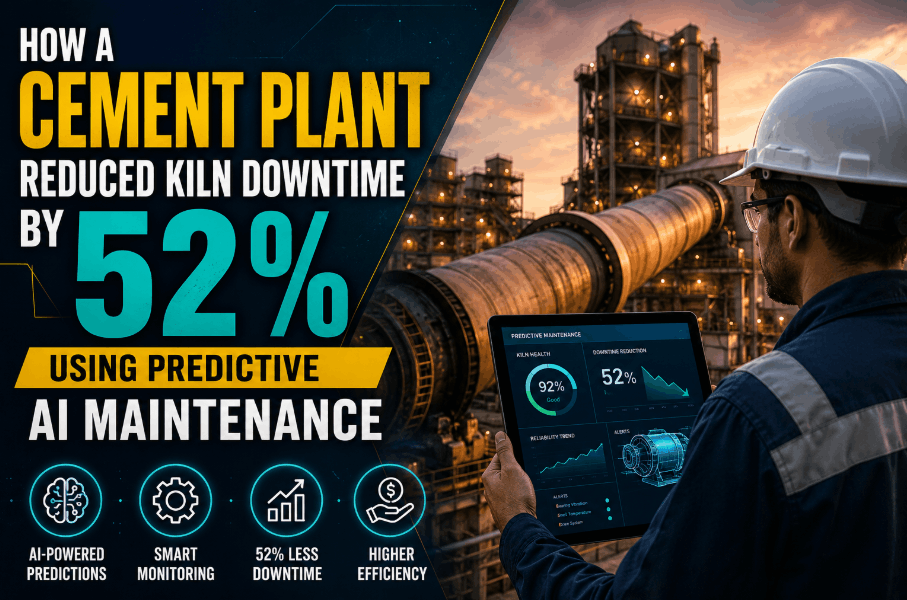
Your kiln is producing 2,000 tonnes of clinker daily, but you won't know if the last four hours of production meets quality standards until the lab results arrive. By then, you've either wasted fuel over-burning to stay safe, or produced off-spec material that requires rework. This is the reality at most cement plants: lab testing delays of 2-4 hours create a blind spot where quality problems compound before operators can respond.
AI-powered soft sensors change this equation entirely. By analyzing real-time data from your existing DCS, CEMS, and kiln cameras, machine learning models predict free lime content within minutes—not hours. Plants implementing this technology report 96% prediction accuracy, $600,000 in annual savings, and the confidence to operate closer to optimal targets instead of maintaining expensive safety margins.
Traditional Lab Testing
0 min
Sample Collected
+30 min
Lab Prep
+60 min
XRF/Titration
+90 min
Results Ready
2-4 hrs
Total Delay
VS
AI Soft Sensor
Continuous
DCS + Camera Data → AI Model → Prediction
Real-Time
Instant Feedback
Why Free Lime Content Matters
Free lime (f-CaO) is the single most critical quality indicator for cement clinker. It represents unreacted calcium oxide—too much indicates under-burning and wastes raw materials; too little means over-burning and wastes fuel. Both extremes create problems that ripple through the entire production chain and into customer applications.
Below 0.5%
Over-Burned
1.0% - 2.0%
Optimal Zone
Above 2.5%
Under-Burned
Over-Burned Clinker
Hard to grind (higher mill energy)
Low reactivity
Reduced cement strength
Excess fuel consumption
Under-Burned Clinker
Volume expansion in concrete
Cracking and flaking
Increased setting time
Customer complaints
The challenge is that free lime develops in the burning zone at 1,350-1,450°C—conditions that make direct measurement impossible. Traditional plants sample clinker every 2-4 hours, send it to the lab, and wait for results. By the time operators learn about a quality deviation, tonnes of problematic material have already been produced. For kiln engineers seeking faster feedback loops, connecting with process optimization specialists reveals approaches that eliminate this delay entirely.
How AI Prediction Works
AI soft sensors don't require new hardware in most plants—they leverage data you're already collecting. Your DCS captures dozens of process variables every minute: kiln temperatures, feed rates, fuel consumption, oxygen levels, and more. Machine learning algorithms identify the complex relationships between these inputs and clinker quality outcomes, creating predictive models that update continuously.
AI Model
SVM / Neural Network / Ensemble
Real-Time Prediction
Free Lime: 1.4%
Within Target
Proven Accuracy & Results
Multiple research studies and commercial implementations validate AI prediction accuracy. Support Vector Machine models achieve 96% classification accuracy for clinker quality. Neural network approaches predict free lime within 1.3% precision. Regression models demonstrate R² values of 0.9999—meaning predictions closely match actual lab measurements.
96%
Prediction Accuracy
SVM classification model
$600K
Annual Savings
Per plant documented
15%
Production Increase
Reduced rework & waste
9%
Energy Reduction
Optimized burning
The financial impact breaks down clearly: $300,000 saved annually from reduced fuel waste (no more over-burning to maintain safety margins), and $300,000 from eliminated product loss and rework. For process heads evaluating this technology, scheduling a technical assessment provides clarity on implementation requirements for your specific kiln configuration.
Stop Flying Blind Between Lab Tests
See how AI soft sensors integrate with your existing DCS to deliver real-time free lime predictions—no new instrumentation required.
Expert Analysis
"The measurement delay and cost associated with traditional lab analysis are a significant concern in the cement industry. Soft sensors that predict clinker quality parameters in real-time enable operators to optimize the process continuously—rather than reacting to problems hours after they occur."
Every 2 hrs
Current sampling frequency at most plants—leaving hours of production unmonitored
10 min
Online analysis frequency with AI—enabling real-time kiln adjustments
0.9999
R² coefficient achieved by regression models—near-perfect correlation with lab results
Implementation Path
Deploying AI clinker prediction doesn't require replacing your existing control systems. The technology layers on top of your DCS, pulling data through standard interfaces. Most implementations follow a structured approach: data collection and validation, model training on your specific kiln characteristics, and gradual rollout with parallel lab verification. Plants ready to explore this capability should request a technical consultation to assess data availability and integration requirements.
1
Data Integration
2-3 Weeks
Connect to DCS, validate data quality, establish baseline
2
Model Training
3-4 Weeks
Train AI on historical data, calibrate to your kiln
3
Validation
2-3 Weeks
Parallel testing with lab results, accuracy verification
4
Go-Live
Ongoing
Real-time predictions, operator dashboards, continuous learning
Ready for Real-Time Quality Control?
Join cement plants already using AI to predict clinker quality, optimize kiln operations, and eliminate the costly gap between production and lab results.
Conclusion
The gap between clinker production and quality verification has constrained cement operations for decades. Lab testing delays of 2-4 hours force operators to choose between maintaining expensive safety margins or risking off-spec production. AI soft sensors eliminate this trade-off by providing continuous free lime predictions based on process data you're already collecting.
With documented accuracy rates of 96% and annual savings of $600,000 per plant, the technology has moved beyond research into proven commercial application. For kiln engineers and process heads responsible for quality and efficiency, exploring AI-powered prediction represents the logical next step toward truly optimized cement manufacturing.
Frequently Asked Questions
What is the target free lime content for cement clinker?
Most cement manufacturers target free lime between 1.0% and 2.0% of clinker composition. The lower limit is approximately 0.5%—below this, clinker becomes hard to grind and shows low reactivity, resulting in reduced cement strength. The upper limit is around 2.5%—above this, excess free lime causes volume expansion and cracking in concrete applications. Operating within this narrow window requires precise kiln control that traditional lab testing cannot support.
How accurate are AI models for predicting clinker quality?
Research implementations demonstrate high accuracy across multiple approaches. Support Vector Machine (SVM) models achieve 96% classification accuracy for distinguishing good clinker from under-burned batches. RBF Neural Networks predict free lime within 1.3% precision. Advanced regression models achieve R² coefficients of 0.9999—indicating near-perfect correlation between predictions and actual lab measurements. These accuracy levels enable operators to make confident process adjustments in real-time.
What data inputs do AI soft sensors require?
AI models typically use data already available in your DCS: kiln zone temperatures, NOx levels (which correlate with burning intensity), raw meal feed rate, fuel flow rate, oxygen content, kiln rotation speed, and secondary air temperature. Some advanced implementations add flame image analysis from kiln cameras. The key advantage is that no new instrumentation is required—the technology leverages existing sensors and control system data.
What are the cost savings from real-time clinker prediction?
Documented case studies report approximately $600,000 in annual savings per cement plant. This breaks down to roughly $300,000 from reduced fuel consumption (eliminating over-burning to maintain safety margins) and $300,000 from reduced product loss and rework (catching quality deviations before tonnes of off-spec material accumulate). Additional benefits include 15% production increases and 9% energy cost reductions from optimized kiln operation.
How long does it take to implement AI clinker prediction?
Typical implementations require 8-12 weeks from project start to go-live. Phase 1 (2-3 weeks) covers DCS integration and data validation. Phase 2 (3-4 weeks) involves training AI models on your historical data and calibrating to your specific kiln characteristics. Phase 3 (2-3 weeks) validates predictions against parallel lab testing. After go-live, models continue learning and improving accuracy based on ongoing production data.