Reducing Machine Downtime Through AI & Predictive Monitoring
By oxmaint on March 4, 2026
Every manufacturing facility faces the same invisible threat — machines that appear healthy today but are quietly heading toward failure. Traditional maintenance catches problems too late, after the breakdown has already halted your production line. AI-powered predictive monitoring flips this model entirely. By reading real-time vibration patterns, thermal signatures, and power consumption data, it identifies the earliest signs of mechanical degradation and alerts your team days or weeks before a costly shutdown. Schedule a free consultation to explore how Oxmaint helps maintenance teams move from reactive firefighting to proactive uptime protection.
How Much Does Machine Downtime Really Cost Your Factory?
Most plant managers know downtime is expensive. What surprises them is just how expensive — and how quickly the hidden costs pile up beyond the repair invoice. When a critical machine stops unexpectedly, the financial damage extends across idle labor, scrapped materials, missed shipments, overtime recovery, and even long-term customer trust. According to industry research, manufacturers globally face an estimated $50 billion per year in losses from unplanned stoppages alone.
$260,000
Average cost per hour of unplanned downtime in manufacturing
800 hrsAverage annual unplanned downtime per facility — over 15 hours every week
42%Of all unplanned downtime is directly caused by equipment failure
82%Of companies experienced at least one unplanned downtime event in the past 3 years
Your facility could be losing thousands every week to hidden downtime costs. Sign up for Oxmaint to start tracking equipment health in real time, catch failures before they happen, and keep that money on your bottom line instead of spending it on emergency repairs.
What Is AI Predictive Monitoring and How Does It Prevent Breakdowns?
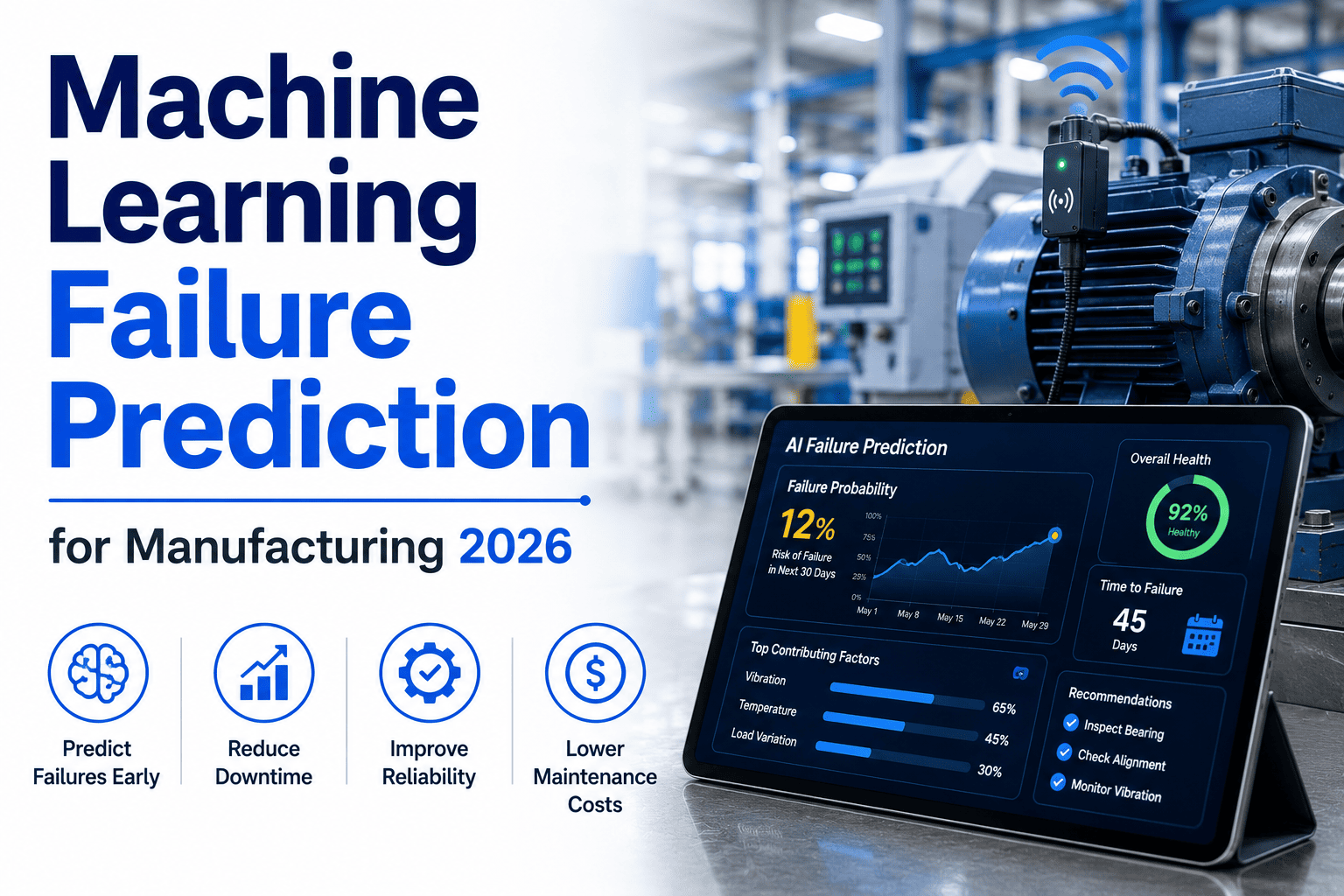
AI predictive monitoring is a condition-based maintenance strategy that uses machine learning algorithms to analyze continuous streams of sensor data from your equipment. Instead of servicing machines on fixed schedules or waiting until they fail, the AI learns what healthy operation looks like for each individual asset and then watches for the earliest deviations that signal a developing problem. The technology has matured rapidly — research suggests that predictive maintenance can reduce unplanned downtime by up to 50% and cut total maintenance costs by 10% to 40%.
How AI Turns Machine Data Into Prevented Downtime
Collect
Sensor Data Acquisition
IoT sensors installed on critical assets capture vibration, temperature, acoustic emissions, current draw, and pressure readings at high frequency — often thousands of data points per second per machine.
Learn
AI Baseline Modeling
Machine learning models study 2-4 weeks of operational history to build a unique behavioral fingerprint for each asset — learning normal vibration signatures, thermal curves, and performance patterns specific to your equipment.
Predict
Anomaly Detection and Forecasting
When sensor readings deviate from learned baselines, the AI classifies the failure type — bearing wear, misalignment, lubrication degradation — and estimates remaining useful life so your team knows exactly what to fix and when.
Act
Automated Work Orders via CMMS
Predictive alerts automatically generate prioritized maintenance work orders in your CMMS — complete with failure diagnosis, recommended parts, and optimal repair windows. Sign up for Oxmaint to connect predictions directly to action.
5 Critical Warning Signs AI Detects Before Equipment Fails
Human senses and periodic manual inspections miss the vast majority of early-stage degradation. AI monitoring operates continuously, catching subtle shifts in machine behavior that would be invisible until the moment of failure. Here are the five most impactful failure indicators that AI-powered systems track around the clock.
01
Abnormal Vibration Patterns
Bearing degradation, shaft misalignment, and rotor imbalance each produce distinct vibration frequency signatures. AI analyzes spectral data in real time, detecting shifts that indicate wear progression weeks before a bearing seizes or a shaft cracks — the number one cause of rotating equipment failure.
02
Thermal Anomalies and Hotspots
Rising temperatures in motors, gearboxes, and electrical connections often precede insulation breakdown, lubrication failure, or overload conditions. AI tracks thermal trends and correlates them with load data to distinguish normal operating heat from dangerous degradation-driven temperature rise.
03
Power Consumption Drift
When a motor draws more current than its baseline for the same workload, it signals internal friction, worn components, or mechanical resistance building up. AI detects these subtle energy increases that human operators would never notice on a standard ammeter reading.
04
Acoustic Emission Changes
Ultrasonic sensors pick up high-frequency sounds emitted by developing cracks, leaks, and electrical discharge that are completely inaudible to humans. AI models trained on acoustic signatures can pinpoint the type and location of the developing fault with remarkable precision.
05
Cycle Time and Performance Degradation
Gradual increases in cycle time or decreases in output quality indicate mechanical wear or control system drift. AI correlates production metrics with equipment health data to identify the root cause and predict when performance will drop below acceptable thresholds.
Want to see exactly how AI detects these warning signs on your equipment? Schedule a demo and our team will walk you through live vibration analysis, thermal anomaly detection, and power drift monitoring — configured for the specific machines running on your floor.
Predictive vs. Preventive vs. Reactive: Which Maintenance Strategy Actually Works?
Manufacturers typically operate under one of three maintenance philosophies. Understanding the performance gap between them is essential for justifying the move to AI-powered monitoring. The data consistently shows that predictive approaches outperform both reactive and calendar-based strategies across every metric that matters to operations leaders.
Maintenance Strategy Performance Comparison
Performance Metric
Downtime per year
Maintenance cost impact
Equipment lifespan
Failure detection lead time
Parts inventory efficiency
Team productivity
Reactive
800+ hours
Highest — emergency premiums
Shortest — run-to-failure
Zero — after breakdown
Overstocked or missing parts
80% spent on firefighting
Preventive
400-600 hours
Moderate — some over-servicing
Average — calendar-based
None — time-based schedule
Better, but still guesswork
Scheduled but not optimized
AI Predictive
Under 200 hours
10-40% lower than traditional
20-40% longer asset life
Days to weeks in advance
Data-driven, demand-matched
Proactive, high-value work
Real-World Results: How Manufacturers Cut Downtime by Up to 50%
The business case for AI predictive monitoring is no longer theoretical. Across automotive, pharmaceutical, food processing, and heavy industry sectors, manufacturers deploying AI-driven maintenance are reporting consistent, measurable gains. Here is what the documented evidence shows across key performance areas.
Documented Outcomes from AI Predictive Maintenance
50%reduction
Unplanned downtime reduced by up to half through real-time anomaly detection and proactive scheduling
25%savings
Total maintenance costs lowered by eliminating unnecessary scheduled services and preventing emergency repairs
70%fewer breakdowns
Equipment breakdowns reduced as AI detects degradation patterns invisible to manual inspection rounds
40%longer lifespan
Asset lifespan extended by addressing root causes early and running machines within optimal parameters
These downtime reductions and cost savings are achievable for your facility too. Sign up for Oxmaint today and our maintenance specialists will help you build a predictive monitoring plan designed to deliver measurable results within your first 90 days of deployment.
Which Industries Benefit Most from Predictive Monitoring?
While every manufacturing environment benefits from reduced downtime, certain industries face uniquely high stakes where AI monitoring delivers outsized returns. The failure modes, equipment types, and cost-per-hour figures vary dramatically across sectors — and AI models adapt their analysis accordingly.
Grid impact: power generation loss and cascading infrastructure disruption
How to Get Started with AI Predictive Monitoring
Implementing predictive monitoring does not require ripping out your existing infrastructure. The most successful deployments follow a phased approach that delivers quick wins on your highest-impact equipment while building toward comprehensive plant-wide coverage. Most facilities start seeing actionable predictions within the first 30 to 60 days. Book a demo with Oxmaint to get a customized implementation plan for your facility.
Your Path to Predictive Uptime
Week 1-2
Asset Criticality Assessment
Audit your equipment fleet and rank assets by downtime impact, failure frequency, and repair cost. Focus initial monitoring on the 20% of machines causing 80% of your unplanned stops.
Week 3-4
Sensor Deployment and CMMS Connection
Install retrofit vibration, thermal, and power sensors on priority assets. Connect data feeds to Oxmaint for centralized monitoring, automated alerting, and work order generation.
Week 5-7
AI Model Training and Calibration
The AI learns normal operating baselines for each monitored asset. Historical failure data is imported to accelerate model training and fine-tune anomaly detection sensitivity.
Week 8+
Live Predictions and Continuous Expansion
Predictive alerts go live. Automated work orders flow into your team's queue with diagnosis details and timing recommendations. Expand monitoring to additional assets based on early results.
Your Machines Are Talking — Are You Listening?
Every critical asset on your floor is generating data that reveals its health in real time. Oxmaint connects AI predictive monitoring to your maintenance workflow, turning sensor signals into prevented breakdowns, optimized schedules, and measurable uptime gains — before your next unplanned stop costs you another quarter million dollars.
How fast does AI predictive monitoring start detecting problems?
Most AI models require 2 to 4 weeks of operational data to build accurate baselines for each machine. After that learning window, the system begins flagging anomalies immediately. Many facilities receive their first actionable predictive alert within the first month of going live. Schedule a consultation to discuss expected timelines for your specific equipment.
Do we need to replace our existing sensors or equipment to use predictive monitoring?
No. AI platforms work with most existing industrial sensors and can also integrate retrofit wireless sensors that install in minutes without stopping production. If your equipment already has vibration or temperature monitoring, the AI can often begin learning from that data immediately — no additional hardware required.
How does predictive monitoring connect with our current CMMS workflow?
Oxmaint is built for seamless integration. When the AI detects a developing problem, it automatically creates a prioritized work order in your CMMS with the failure diagnosis, recommended spare parts, and an optimal repair window. Your maintenance team continues working in the same system they already know. Sign up for a free account to explore the full integration.
What is the typical payback period for AI predictive maintenance?
Most manufacturing facilities see full payback within 6 to 12 months. The math is straightforward — preventing even a single major unplanned downtime event often covers the entire initial investment. Ongoing savings from fewer emergency repairs, lower spare parts inventory, and extended equipment life compound over time, with some deployments delivering a tenfold return on investment.
Can AI predictive monitoring work on older or legacy machines?
Yes. Retrofit sensor kits are designed to attach to virtually any rotating, reciprocating, or electrical equipment regardless of age or manufacturer. AI models adapt to the unique behavioral patterns of older machines, which frequently benefit the most from monitoring since they carry higher failure risk. Book a demo to see legacy equipment monitoring in action.