The maintenance manager at a pharmaceutical manufacturing facility reviews last quarter's performance discovering a troubling pattern: $2.8M spent on maintenance yet unplanned downtime increased 12%, critical equipment reliability declined, and the plant still cannot answer basic questions like "What's our actual maintenance ROI?" or "Which preventive maintenance manufacturing & plants tasks prevent failures vs. waste resources?" The facility performs 847 scheduled PM tasks monthly—many inherited from decades-old programs never validated for effectiveness—while simultaneously firefighting 60-80 emergency breakdowns monthly. When asked to justify maintenance budget increases, the manager has only gut feelings and anecdotal examples, not data proving which investments deliver returns and which simply consume resources without reliability improvement.
This RCM implementation gap affects process industries globally—chemical plants, pharmaceutical facilities, food processing operations, refineries, pulp mills—where continuous production demands systematic reliability yet most facilities operate with preventive maintenance programs designed 20-30 years ago and never optimized. Reliability-Centered Maintenance offers proven methodology identifying which equipment failures matter, determining optimal maintenance strategies, and quantifying ROI through measurable failure reduction—yet only 15-20% of process manufacturers successfully implement RCM because traditional approaches require extensive analysis consuming 18-24 months before delivering value.
Process manufacturers implementing streamlined RCM using mobile inspections manufacturing & plants, AI analytics, and systematic ROI tracking achieve 40-60% unplanned downtime reduction within 12-18 months while reducing total maintenance costs 15-25% through elimination of non-value-adding tasks. This transformation requires understanding RCM fundamentals, building comprehensive ROI calculators quantifying benefits, and leveraging mobile technology accelerating implementation and sustaining results. Organizations ready to transform maintenance from cost center to reliability driver can explore how Oxmaint CMMS enables RCM implementation.
What if you could prove maintenance ROI through data—demonstrating which $1M invested in reliability delivers $4-7M in prevented failures and improved production?
While other process manufacturers justify maintenance budgets through anecdotes, RCM-driven operations prove value through measurable failure reduction, quantified downtime prevention, and documented cost savings. Discover why 200+ process facilities trust Oxmaint for RCM implementation and ROI tracking.
Understanding Reliability-Centered Maintenance for Process Industries
RCM provides systematic methodology for determining optimal maintenance strategies based on actual equipment failure consequences and operational impact. Unlike traditional time-based PM programs treating all equipment identically, RCM asks critical questions: "What functions does this equipment perform?" "How can it fail?" "What happens when it fails?" "What should we do to prevent failures that matter?"
The Seven RCM Questions Applied to Process Industries
What are the equipment's functions?
Process Industry Example: Centrifugal pump functions: (1) Deliver 500 GPM at 150 PSI, (2) Maintain seal integrity preventing chemical leaks, (3) Operate continuously for 8,000 hours between maintenance windows.
How can it fail to fulfill functions?
Failure Modes: Bearing seizure, seal failure, impeller wear, motor failure, coupling misalignment, cavitation, vibration damage, electrical faults.
What causes each failure mode?
Root Causes: Inadequate lubrication (bearing seizure), seal degradation from process chemicals, corrosive product erosion, installation errors, process upsets, contamination.
What happens when failures occur?
Consequences: Production stoppage ($25,000/hour lost throughput), environmental release requiring regulatory reporting, safety hazard from chemical exposure, quality deviation affecting downstream batches.
What can be done to predict or prevent failures?
Strategies: Vibration monitoring (predictive), quarterly seal inspection (preventive), oil analysis (condition-based), redesign seal system (proactive), accept run-to-failure for non-critical components.
What if suitable preventive task cannot be found?
Alternatives: Redesign equipment eliminating failure mode, install redundancy, accept run-to-failure with spare availability, implement finding failures through operation (operators detect issues).
What is the cost-benefit of each strategy?
ROI Analysis: Compare preventive task cost ($2,000 quarterly seal inspection) vs. failure cost ($180,000 unplanned shutdown + environmental incident). ROI Calculator determines optimal approach.
RCM Maintenance Strategy Selection
RCM systematically determines optimal maintenance approach for each failure mode based on consequence severity and task effectiveness:
Condition-Based Monitoring
When: Failure develops gradually with detectable warning signs
Process Industry Examples: Vibration monitoring on rotating equipment, oil analysis on gearboxes, ultrasonic testing on pressure vessels, thermal imaging on electrical systems
Time-Based Prevention
When: Failures occur at predictable age/cycles and prevention is cost-effective
Process Industry Examples: Replace pump seals every 18 months, change filters quarterly, calibrate instruments annually, replace wear parts at manufacturer intervals
Failure Finding
When: Hidden failures (protective devices, backup systems) only matter when primary function demands them
Process Industry Examples: Test emergency shutdown systems, verify relief valve functionality, check backup pump operation, validate instrument trip points
Run-to-Failure
When: Failure consequences minimal and prevention costs exceed failure costs
Process Industry Examples: Light bulbs, non-critical instruments, redundant small pumps, certain electrical components with low replacement cost
The Comprehensive ROI Calculator Framework
RCM's power lies in data-driven decision making quantifying maintenance investment returns. This framework calculates total maintenance program ROI considering all cost categories and benefit sources—proving which strategies deliver value and which waste resources.
RCM ROI Calculation Methodology
Cost Categories (Investment Side)
- Oxmaint CMMS software licensing and configuration: $60,000-$120,000
- Equipment failure mode analysis (FMEA): $40,000-$80,000
- Mobile device deployment (tablets/phones): $15,000-$30,000
- Staff training on RCM methodology: $25,000-$45,000
- Condition monitoring equipment (sensors, instruments): $80,000-$150,000
- Preventive maintenance labor (optimized tasks): Calculate per task
- Condition monitoring analysis time: 10-15 hours weekly
- Spare parts inventory (optimized levels): Reduced 20-35% from baseline
- Contractor services (specialized inspections): As needed
- Software annual licensing and support: $12,000-$24,000
Benefit Categories (Return Side)
Calculation: (Baseline Downtime Hours × Reduction % × Production Value per Hour)
Process Industry Example: Chemical plant baseline 600 hours annual unplanned downtime, RCM achieves 50% reduction, production value $35,000/hour
Conservative Assumptions: Use 40-60% downtime reduction (proven RCM results), verify production value includes both revenue loss and fixed cost burden during stoppages.
Sources: Elimination of non-value-adding PM tasks, reduction in emergency repairs (3-5x cost premium vs. planned), optimized spare parts inventory, improved labor efficiency
Process Industry Example: Facility spending $4.2M annually on maintenance, RCM optimization reduces 18% through task elimination and emergency work reduction
Conservative Assumptions: Use 15-25% maintenance cost reduction (documented RCM implementations), ensure calculations exclude downtime costs (counted separately).
Benefit: RCM identifies critical spares requiring stock vs. items acceptable to procure on failure. Reduces carrying costs while improving availability for truly critical parts.
Process Industry Example: $1.8M spare parts inventory, RCM analysis reduces 28% through criticality-based stocking while improving critical parts availability from 82% to 96%
Conservative Assumptions: Use 20-35% inventory reduction, apply actual carrying cost percentage (typically 20-30% annually including capital cost, storage, obsolescence).
Benefit: Condition-based maintenance catches efficiency degradation early. Misaligned equipment, worn components, and dirty heat exchangers consume excess energy detected and corrected through monitoring.
Process Industry Example: RCM condition monitoring identifies efficiency losses across motors, pumps, compressors totaling 4% of $6M annual energy cost
Conservative Assumptions: Use 3-6% energy savings (equipment efficiency improvement), requires condition monitoring identifying degradation before operators notice performance loss.
Benefit: Equipment failures cause quality deviations, batch rejections, and compliance incidents. RCM prevents failures impacting product quality and regulatory compliance.
Process Industry Example: Pharmaceutical facility experiencing 8 equipment-related quality events annually averaging $180,000 impact (investigation, batch rejection, regulatory reporting). RCM prevents 70%.
Conservative Assumptions: Track quality events linked to equipment failures, calculate full impact including investigation costs, scrap, and opportunity cost of lost production capacity.
Comprehensive ROI Example: Mid-Size Chemical Plant
Transform Manufacturing & Plants Efficiency Using Mobile Inspections
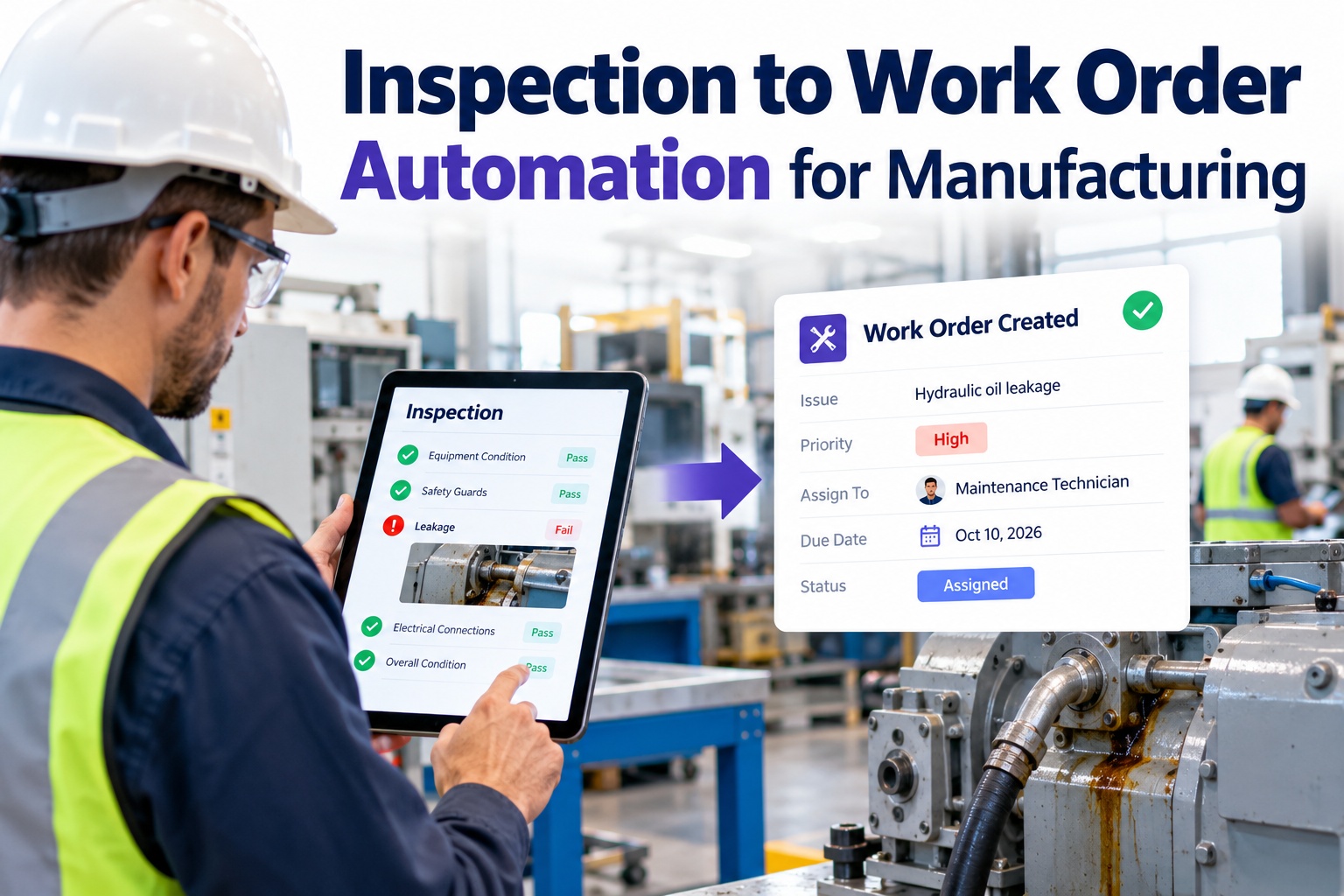
RCM identifies optimal maintenance strategies, but mobile inspections manufacturing & plants transform execution—enabling technicians to collect consistent condition data, follow standardized procedures, and provide real-time visibility into equipment health. This combination of RCM strategy and mobile execution drives sustainable reliability improvement.
Mobile Inspection Capabilities Enabling RCM
Equipment-Specific Inspection Routes
RCM analysis determines inspection requirements for each asset based on failure modes and consequences. Mobile apps guide technicians through optimized routes with equipment-specific checklists—ensuring critical assets receive appropriate attention while non-critical equipment gets minimal inspection overhead.
Condition Data Collection & Trending
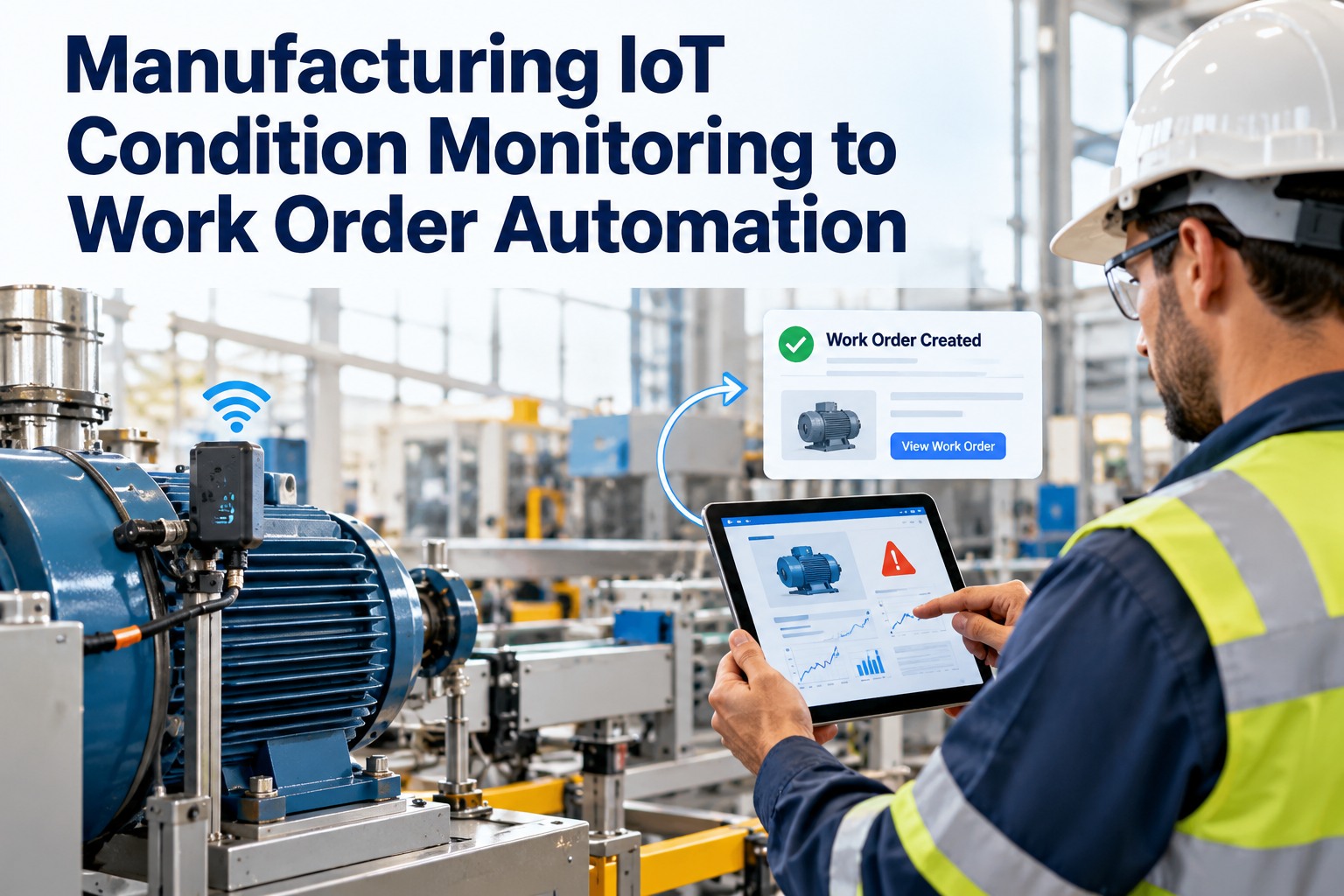
Condition monitoring only delivers value when data is captured consistently, trended over time, and analyzed for degradation patterns. Mobile apps enforce standardized data collection (vibration readings, temperatures, pressures, visual observations) with automatic trending and alert generation when readings exceed thresholds.
Visual Evidence & Knowledge Capture
RCM depends on understanding failure modes—often requiring visual evidence of degradation, leak sources, wear patterns, and corrosion. Mobile apps mandate photo documentation creating visual history supporting failure analysis and validating inspection completion.
Real-Time Issue Escalation
Process industry equipment failures can escalate quickly—minor leaks become environmental releases, small vibrations become catastrophic failures. Mobile apps enable immediate issue escalation when technicians identify problems requiring urgent attention rather than waiting for end-of-shift reporting.
Task Verification & Compliance
RCM programs fail when inspections become "pencil whipping"—technicians checking boxes without actual verification. Mobile apps enforce task completion through barcode/QR scanning (proving physical presence), mandatory data entry, and photo requirements—creating audit trail demonstrating work occurred.
AI-Assisted Anomaly Detection
AI analytics analyze mobile inspection data identifying subtle patterns invisible to manual review. Gradual temperature rises, slowly increasing vibration trends, or consumption pattern changes trigger predictive alerts 30-90 days before traditional monitoring would detect issues.
Making Audits Painless — A Manufacturing & Plants Operating Model with Mobile Apps
Process industries face extensive regulatory auditing—FDA (pharmaceutical/food), EPA (environmental), OSHA (safety), ISO certifications, customer quality audits. RCM with mobile inspections creates comprehensive audit trail demonstrating systematic reliability program compliance.
Audit Requirement #1: Documented Maintenance Strategy
Audit Requirement #2: Execution Records & Verification
Audit Requirement #3: Continuous Improvement Evidence
Multi-Site Rollout Considerations
Process manufacturers operating multiple facilities achieve maximum value deploying standardized RCM approach across all sites—enabling performance comparison, best practice sharing, and consolidated ROI demonstration.
Implementation Roadmap: 90-Day Quick Start
Traditional RCM implementations consume 18-24 months analyzing thousands of failure modes before delivering value. This streamlined approach focuses on highest-impact equipment achieving measurable results within 90 days while building capability for broader deployment.
Foundation: Criticality Assessment & Pilot Equipment Selection
- Deploy Oxmaint CMMS with comprehensive asset tracking manufacturing & plants (all equipment registered)
- Conduct equipment criticality ranking using consequence analysis (safety, environmental, production, quality)
- Select 20-30 highest-criticality assets for pilot RCM analysis (production bottlenecks, safety-critical, high-failure-rate)
- Assemble cross-functional RCM team: maintenance, operations, engineering, quality, safety
Analysis: FMEA & Strategy Development
- Conduct facilitated FMEA workshops for pilot equipment (functions, failure modes, consequences, strategies)
- Develop maintenance task library: condition monitoring procedures, inspection checklists, PM tasks
- Configure mobile inspection workflows with equipment-specific data collection requirements
- Deploy condition monitoring equipment (vibration sensors, thermal cameras, oil analysis kits)
Execution: Mobile Deployment & Results Measurement
- Launch mobile inspections for pilot equipment with technician training and support
- Execute new maintenance strategies (condition-based tasks, optimized PM intervals, eliminated non-value tasks)
- Track baseline vs. RCM performance: failure rates, downtime hours, maintenance costs, inspection quality
- Calculate pilot ROI quantifying benefits from prevented failures and eliminated waste
Key Performance Indicators
Measuring RCM program success requires tracking both leading indicators (program health) and lagging indicators (reliability outcomes). This KPI framework demonstrates continuous improvement and quantifies ROI.
Reliability Outcomes (Lagging Indicators)
Program Execution (Leading Indicators)
Financial Performance
Conclusion
Reliability-Centered Maintenance transforms process industry maintenance from cost burden to strategic asset by systematically determining which equipment failures matter, selecting optimal prevention strategies based on consequences and effectiveness, and quantifying program value through comprehensive ROI tracking. The methodology's power lies in data-driven decision making—proving which maintenance investments deliver returns and which waste resources performing tasks that don't prevent meaningful failures.
Success requires combining RCM analytical rigor with modern execution technology: mobile inspections manufacturing & plants enforcing consistent data collection, AI analytics detecting degradation patterns, and comprehensive audit trails demonstrating program compliance. Process manufacturers implementing this approach consistently achieve 40-60% failure reduction while reducing total maintenance costs 15-25% through elimination of non-value-adding activities—generating 10-30x ROI in first year through prevented downtime, optimized spending, and improved operational efficiency.
The competitive advantage belongs to process manufacturers that prove maintenance value through measurable reliability improvement and quantified ROI. RCM provides the methodology, mobile technology enables execution, and comprehensive analytics demonstrate results. The 90-day pilot approach delivers quick wins proving effectiveness while building organizational capability for enterprise-wide deployment—creating sustainable reliability culture driving continuous operational excellence.
Imagine presenting your next operations review with data proving $12.6M annual benefit from $335K maintenance investment—what credibility would that build with executive leadership?
Every month without RCM is another month of unproven maintenance spending and preventable failures. Join the 200+ process facilities that transformed reliability from cost center to strategic driver with Oxmaint's proven RCM platform—the same technology delivering measurable results across chemical, pharmaceutical, food processing, and refining operations.