The ROI of AI quality inspection in manufacturing typically lands between 200% and 400% in the first year — but only when the business case captures every benefit stream and honest cost. Most quality managers underestimate the return because they count only labor savings and miss the bigger wins: scrap reduction, warranty claim avoidance, and throughput gains from faster inspection cycles. This guide gives you a defensible framework for calculating AI inspection ROI, structuring the capital request, and presenting numbers your CFO will actually approve. Plants that pair AI vision systems with a connected maintenance platform see the fastest payback — Start Free Trial to see how OxMaint tracks the asset and quality data that makes the business case undeniable.
What Is the Real ROI of AI Quality Inspection?
Most manufacturers recover their AI vision investment in 6 to 18 months. The difference between a rejected proposal and an approved one is whether your business case counts all five value streams — or just the obvious one.
Where AI Quality Inspection ROI Actually Comes From
Labor redeployment is the smallest piece. The manufacturers who build winning business cases quantify all five streams — and the biggest two are the ones most teams forget.
AI vision catches defects at the station, not at end-of-line. Plants running 3-shift operations typically cut scrap 40–90% and rework labor 50–70%. For a line producing $8M in annual goods with a 4% scrap rate, that's $128K–$288K recovered per year.
A single escaped defect that reaches a customer costs 10–100x more than catching it in-plant. Automotive suppliers report warranty cost reductions of 30–60% after deploying AI inspection — often the largest single line item in the business case.
Manual visual inspection ties up 1–3 operators per line per shift. AI doesn't eliminate these roles — it moves them to higher-value work like root-cause analysis and process improvement. Value: $45K–$75K per redeployed inspector per year.
Human inspectors max out around 60–80 parts per minute with 70–85% accuracy. AI vision runs at line speed — 200–600+ parts per minute at 99%+ accuracy. On a constrained line, that 5–15% throughput increase often justifies the entire investment alone.
AI systems log every inspection with timestamp, image, and disposition — creating an automatic audit trail for ISO 9001, IATF 16949, FDA 21 CFR Part 11, or customer-specific requirements. Audit prep time drops 60–80%, and the risk of a failed audit (or lost customer) drops with it.
How to Calculate AI Inspection ROI: A Worked Example
A 2-line plant running 3 shifts with 4 manual inspectors, $9M annual output, 3.8% scrap rate, and $210K in annual warranty claims. Here's the math that got their capital request approved in one cycle.
| Benefit Stream | Calculation Basis | Annual Value |
|---|---|---|
| Scrap reduction (60%) | $9M × 3.8% × 60% | $205,200 |
| Warranty claim reduction (40%) | $210K × 40% | $84,000 |
| Labor redeployment (3 FTEs) | 3 × $52K fully loaded | $156,000 |
| Throughput gain (8%) | 8% × $9M × 35% margin | $252,000 |
| Audit prep time saved | 120 hrs × $85/hr | $10,200 |
| Total Annual Benefit | $707,400 | |
| Total Annual Cost (system + integration + maintenance) | Amortized over 3 years | $185,000 |
| Net Annual ROI | ($707,400 − $185,000) ÷ $185,000 | 282% |
Payback period: 3.1 months. That's the number that gets capital committees to say yes. The key is that every line item traces back to a measurable baseline — which is exactly where a connected CMMS like OxMaint becomes essential, because it already tracks the scrap, downtime, and quality data you need.
What AI Quality Inspection Actually Costs (No Surprises)
Business cases get rejected when hidden costs surface after approval. Budget for all four cost categories upfront and your credibility — and approval odds — go up sharply.
Cameras, lighting, edge compute, enclosures. High-speed lines or micron-level defect detection push toward the top; standard surface inspection sits lower.
PLC integration, conveyor modifications, reject mechanisms, MES/ERP connectivity. Varies with line complexity and existing automation maturity.
Perpetual or subscription. Includes model training, retraining as products change, and vendor support. Some vendors bundle this into hardware pricing.
Lens cleaning, lighting replacement, recalibration, model drift monitoring. This is where OxMaint's preventive maintenance scheduling keeps the system accurate and audit-ready.
See How OxMaint Tracks the Data Behind Your AI Inspection ROI
Book a 30-minute demo and we'll show you how OxMaint connects quality, maintenance, and asset data so your business case writes itself.
Myth vs. Reality: What Kills AI Inspection Business Cases
Capital committees reject proposals for predictable reasons. Here's how to pre-empt the four most common objections with data instead of opinions.
"AI inspection is only for high-volume automotive or electronics plants."
Food & beverage, pharma, plastics, and metal fabrication plants with 50+ SKUs see the same 200–400% ROI. Modern AI models retrain on new products in hours, not weeks — the flexibility barrier is gone.
"We need perfect data and a data science team before we can start."
Most vendors train initial models on 200–500 sample images you collect in a week. You don't need a data scientist — you need a quality engineer who knows what a defect looks like. The AI handles the rest.
"The system will generate too many false rejects and slow the line down."
First-month false reject rates of 5–8% are normal. By month three, tuned systems run below 1–2%. Compare that to human inspectors who miss 15–30% of actual defects on repetitive tasks — the AI is wrong far less often, and it never gets tired.
"We'll just add more inspectors instead — it's cheaper and simpler."
Adding one inspector per shift costs $150K–$225K per year and still misses 15–30% of defects. AI inspection costs less annually, catches 99%+, and generates the digital audit trail your customers increasingly demand. The status quo is the expensive option.
How OxMaint Maximizes Your AI Quality Inspection Investment
AI vision systems are assets — and like any asset, they only deliver ROI when they're calibrated, maintained, and connected to the rest of your operation. OxMaint makes that happen.
Automated PM schedules for lens cleaning, lighting checks, and recalibration keep detection accuracy above 99%. Plants using OxMaint for vision system maintenance report 40% fewer accuracy drift incidents.
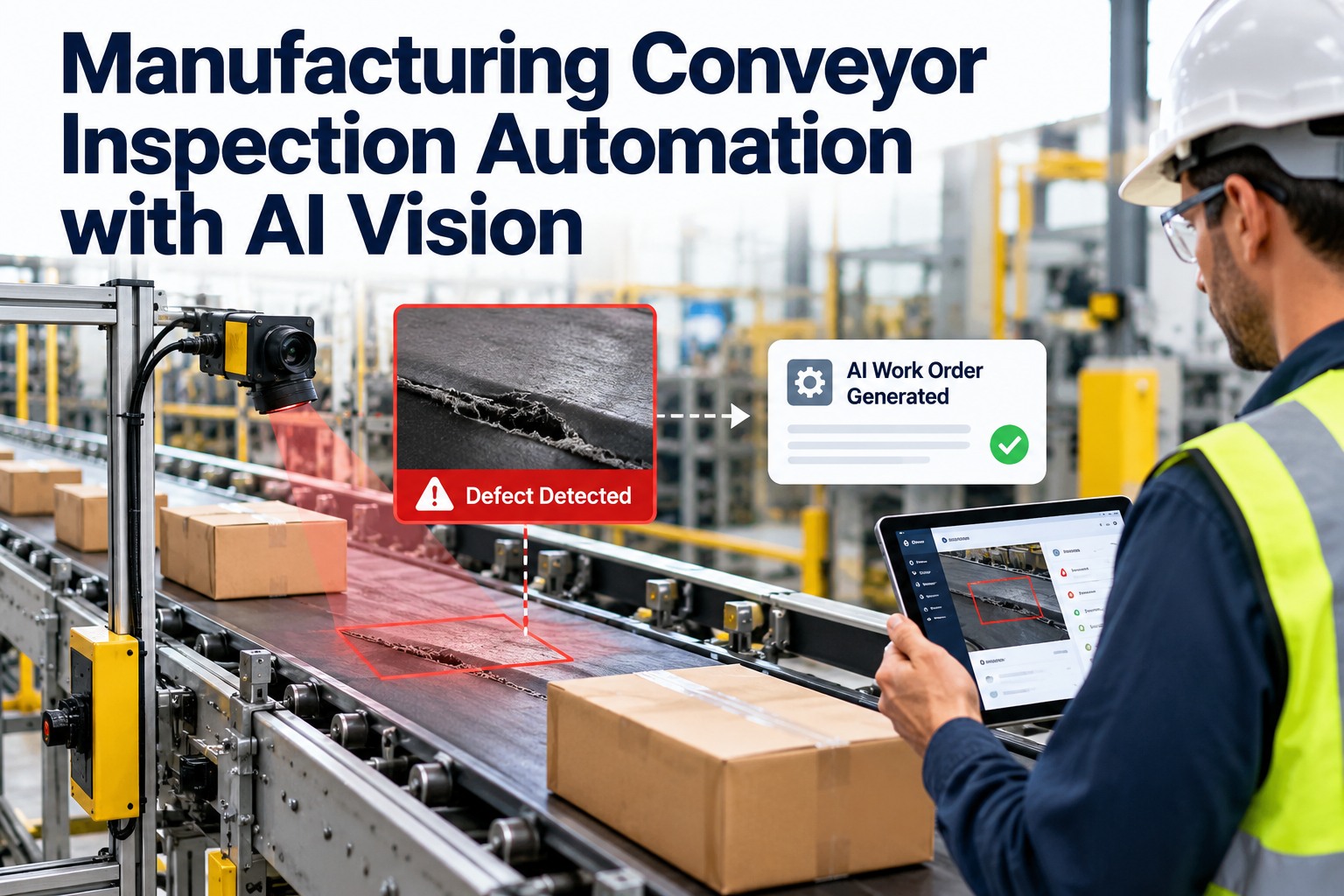
When AI inspection flags a process drift or recurring defect pattern, OxMaint auto-generates a work order for the maintenance team — closing the loop between quality detection and root-cause correction in minutes, not days.
Track scrap rates, defect trends, and inspection system uptime alongside your other asset KPIs. This is the baseline data that makes your AI inspection business case bulletproof — and proves the ROI after deployment.
Every calibration, maintenance event, and inspection system check is logged with timestamps and technician sign-off. When your ISO 9001 or IATF auditor asks for vision system maintenance records, you pull them in seconds — not days.
AI Quality Inspection ROI: Your Questions Answered
A well-scoped AI quality inspection project should deliver 200–400% first-year ROI with payback in 6–18 months. Projects focused on high-scrap lines or high-warranty-cost products often exceed 400%. If your calculated ROI is below 150%, revisit whether you've captured all five benefit streams — especially warranty avoidance and throughput gains, which are the most commonly missed.
Typical deployment takes 8–16 weeks from purchase order to production: 2–3 weeks for hardware installation, 2–4 weeks for AI model training and validation, and 2–4 weeks for line integration and operator training. Pilot programs on a single station can be running in 4–6 weeks. Book a Demo to see how OxMaint manages the maintenance schedule from day one.
AI vision excels at detecting subtle surface defects (scratches, dents, discoloration), dimensional variations below 0.1mm, contamination, label misalignment, and assembly errors — especially at line speeds above 60 parts per minute. Human inspectors miss 15–30% of defects on repetitive visual tasks due to fatigue; AI systems maintain 99%+ accuracy continuously across all shifts.
Build the business case around your plant's actual numbers: current scrap rate, warranty costs, inspection labor, and throughput constraints. Use the five-stream framework in this guide, present honest costs including ongoing maintenance, and show payback under 12 months. Proposals with real baseline data from a CMMS get approved 3x more often than estimates. Start Free Trial to start building that data baseline today.
Yes — modern AI inspection systems retrain on new products with 200–500 sample images, making them viable for high-mix, low-volume environments. Job shops and contract manufacturers running 50+ SKUs report the same 200–400% ROI as high-volume plants. The key is choosing a system with fast model retraining and a vendor experienced in your product category.
Stop Guessing. Start Measuring Your Quality Inspection ROI.
OxMaint gives you the asset data, maintenance tracking, and analytics to build a bulletproof AI inspection business case — and then maximize the system's performance after deployment.