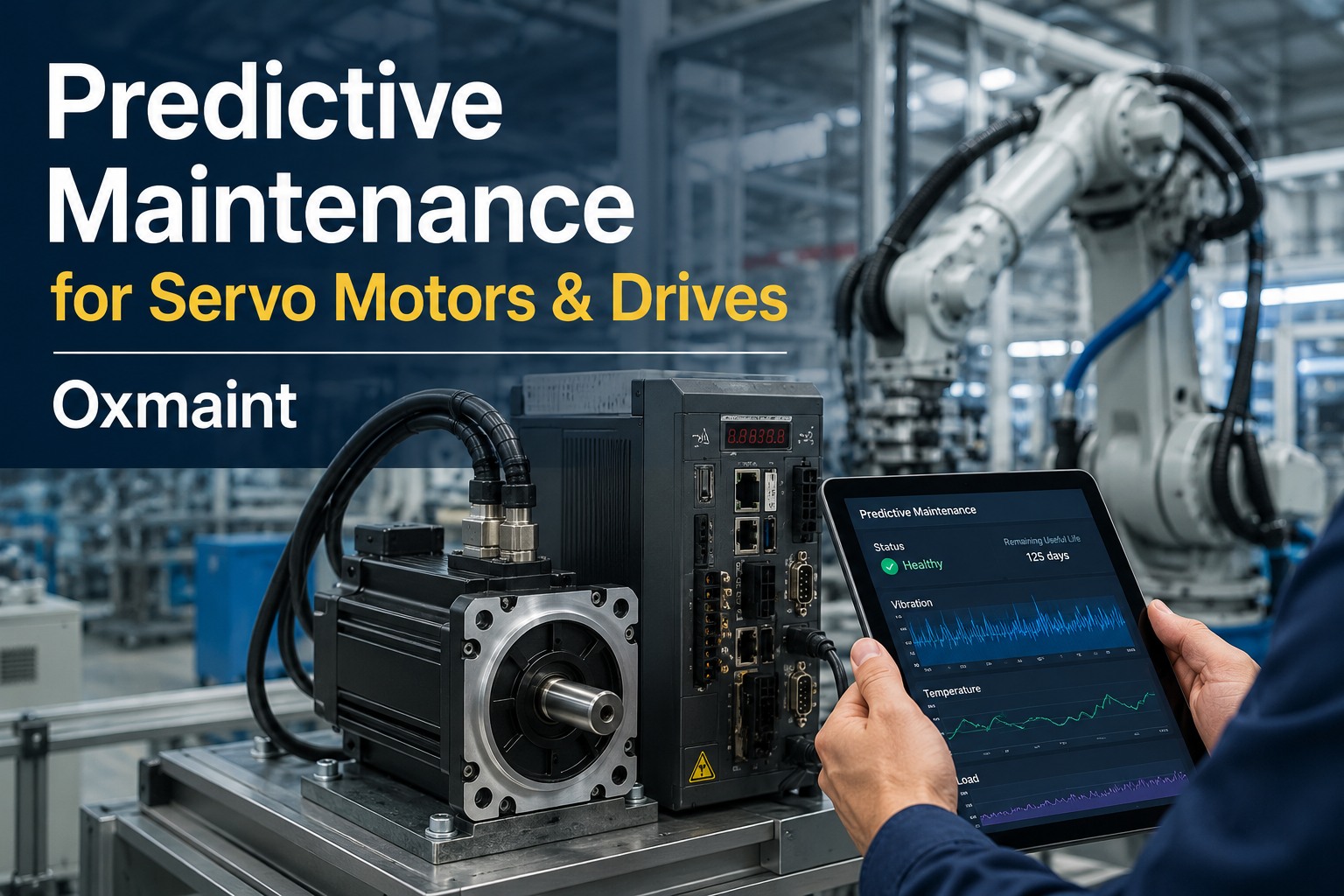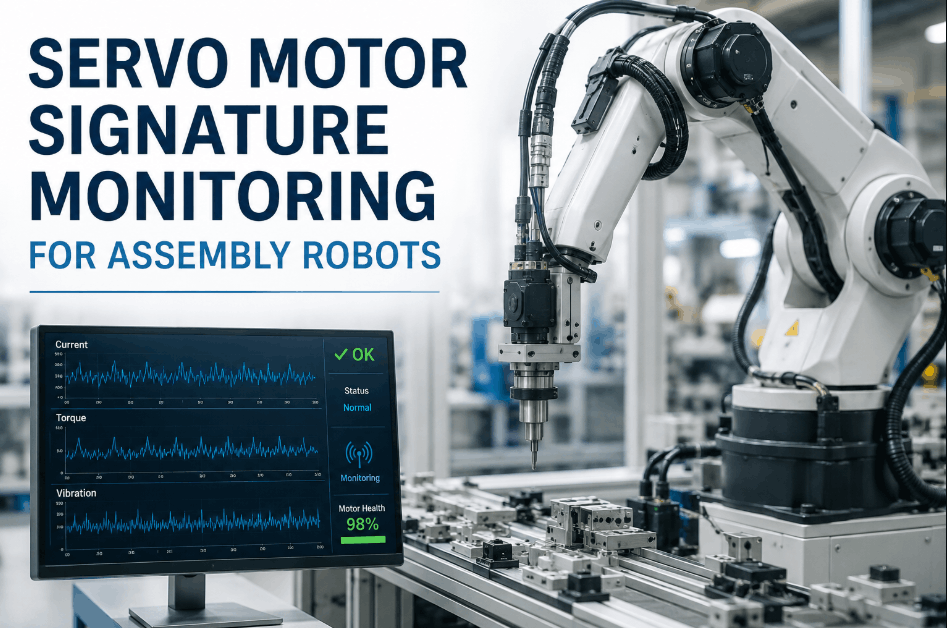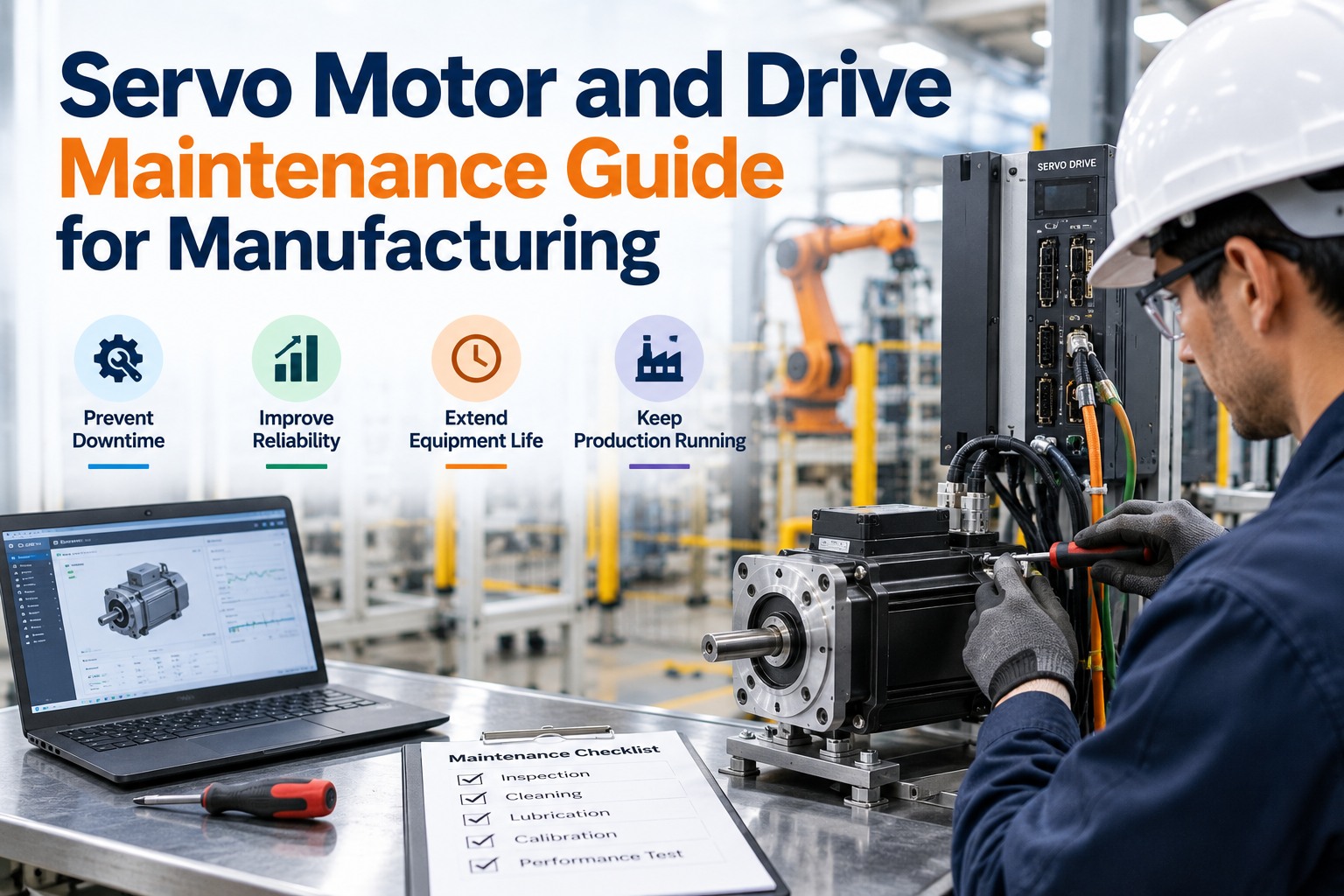
A servo motor doesn't fail like an induction motor. The "muscles" — bearings and windings — usually outlast the electronics and feedback loop that run them. The failure signatures live in high-frequency current, encoder jitter, PWM-induced shaft voltage and position error, not in the temperature and vibration numbers most maintenance teams already trend. Get the diagnostic signals right and a servo tells you it's dying two shifts before the drive trips. This guide covers those signals, the failure modes behind them, and how to route each one into a scheduled work order using OXMAINT AI, the AI-powered CMMS for automation and robot cell reliability.
The Servo Is Talking. Your CMMS Should Be Listening.
OXMAINT AI, the AI-powered CMMS/maintenance management software, connects the full workflow on one platform — drive fault codes, encoder signals and inspection findings in, defects raised and prioritised, work orders assigned, and preventive & predictive PM cadence tuned per servo axis.
Why Servos Fail Differently — And Why Standard Motor PM Misses It
Servo motors sit inside a closed control loop, so a millisecond of encoder attenuation trips the drive before a bearing gets warm. That's why routine motor-shop checks (megger, vibration probe, IR gun) miss most servo failures. The signals live in the drive itself. Sign up free and start capturing drive fault codes in OXMAINT AI.
- Bearing wear → vibration + heat
- Insulation degradation → megger drop
- Failure develops over weeks / months
- Vibration + IR + MCA catch most modes
- Encoder jitter → position error spike
- PWM shaft voltage → bearing fluting
- Failure can escalate in hours
- Drive telemetry catches what sensors can't
The 6 Failure Domains — Where Each One Shows Up
Servo failures aren't one problem — they're six, and each has its own telemetry signature. OXMAINT AI classifies every incoming drive fault or inspection finding into a domain, so the pattern-detection loop looks at the right history. Book a demo to see domain-tagged fault history live.
The Diagnostic Signal Cheat Sheet
Every domain above has a signal signature the drive already publishes — no new sensors required. The trick is knowing what "normal" looks like for your axis and catching the early drift. OXMAINT AI baselines each signal per axis and flags deviations against that axis's own history, not a generic threshold. Start free and baseline your first axis in OXMAINT AI.
| Signal | What It Shows | Early Warning Pattern | Domain |
|---|---|---|---|
| Motor Current | Torque demand, MCSA spectrum | Sideband frequencies rising, RMS drift on stable load | Mechanical / Electrical |
| Position Error | Commanded vs actual encoder position | Growing following error, "hunting" oscillation | Control Loop |
| Torque Trend | Commanded torque at same duty cycle | Same move needs more torque week-over-week | Mechanical |
| Motor / Drive Temp | Winding, bus, heatsink temperature | Baseline rise on unchanged duty cycle | Thermal |
| Encoder Signal | Feedback quality, jitter, marker count | CRC errors, dropped bits, position glitches | Feedback / Comms |
| DC-Bus Voltage | Drive bus rail stability | Ripple rising, regen events climbing | Electrical |
A Drive Fault Code That Never Becomes a Work Order Is a Signal Wasted.
OXMAINT AI ingests drive telemetry, classifies it into a domain and opens a defect with the axis history already attached — no more root-causing from a fault-code screenshot.
Preventive Tasks That Actually Move the Failure Curve
Not every PM task earns its outage window. On servos, the tasks that pay back consistently are the ones aimed at contamination, cooling and cable health — not "megger the winding annually." OXMAINT AI ships a PM template tuned to the failure domains above, editable per axis and per duty cycle. Book a demo to walk the default PM template.
A Robot Cell Isn't 6 Motors — It's 6 Correlated Axes
Every articulated robot has 6 (or more) servo axes, and their signals correlate. A rising J2 torque and drifting J3 position error often trace to the same fixture-side issue, not two separate faults. OXMAINT AI holds all axes on one asset record so cross-axis patterns surface without a separate analytics tool. Sign up free and load your first robot cell into OXMAINT AI.
Signal → Defect → Work Order — The Automation Loop
The point of every diagnostic signal above is a scheduled work order — not another dashboard. OXMAINT AI closes that loop automatically: drive telemetry lands, the domain classifier tags it, the axis history contextualises it, a defect record opens, and a WO drops onto the planner's board with parts and craft pre-scoped. Book a demo to see the loop close on live drive data.
What OXMAINT AI Gives an Automation Reliability Team
OXMAINT AI is built for the servo/drive reality — telemetry-first, per-axis history, PdM triggered by signals rather than calendar and PM templates that reflect what actually kills servos, not what killed induction motors 30 years ago. Start free and configure your first cell in OXMAINT AI.
We had a J5 axis on one welding cell tripping the drive intermittently for six weeks. Every time we opened it up, everything looked fine. Once the drive telemetry was landing on the axis record, we could see position error and DC-bus ripple both rising at the same duty cycle — an encoder cable that was failing only under motion. A $180 cable saved us a $14,000 servo swap and three lost shifts we would have burned troubleshooting the wrong thing.
Frequently Asked Questions
Every Axis Has a Story. Read It on One Screen.
Move your servo, drive and robot-cell maintenance onto OXMAINT AI — telemetry-first, domain-classified defects, per-axis baselines and a PM library actually built for automation.