An industrial robot will run for years with almost no attention — right up until it doesn't. The failures that stop a robot cell are rarely dramatic: a reducer starved of grease, a backup battery that died and took the robot's position memory with it, a dress-pack cable that flexed one million times too many and faulted mid-cycle. Every one is on a schedule you can keep. This guide covers the lubrication intervals, the inspection points and the preventive maintenance tasks that keep a robot running, tracked by operating hours in OXMAINT AI — or book a demo of robot maintenance scheduling in OXMAINT AI.
INDUSTRIAL ROBOT MAINTENANCE · LUBRICATION · INSPECTION · 2026
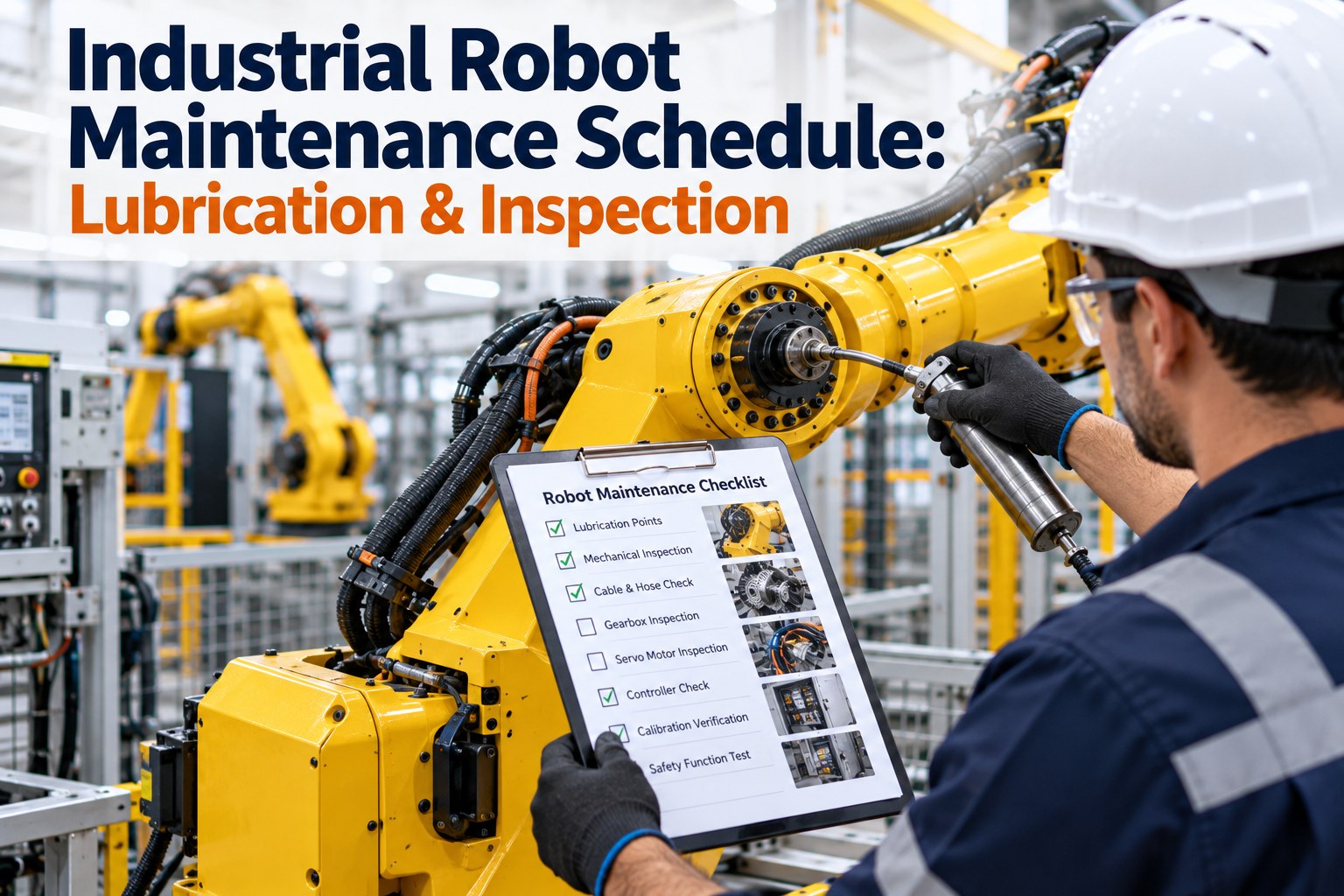
Industrial Robot Maintenance Schedule: Lubrication & Inspection
A dry reducer, a dead encoder battery or a worn dress pack will each take a robot cell down without warning — and every one is preventable on a schedule. OXMAINT AI is the AI-powered CMMS that schedules robot lubrication and inspections by operating hours, tracks the battery and calibration, and turns a fault into a work order — so the robot is serviced on time, not recovered after a stop.
1 · Lubricate
2 · Inspect
3 · Calibrate
4 · Track hours
Hours
operating hours, not calendar days, drive robot service intervals
Grease
reducer lubrication is the single most important scheduled task
Battery
a dead encoder backup battery loses the robot's mastered position
OEM
the maker's manual sets the exact lubricant, interval and quantity
The Parts That Need Maintaining
A robot is a few subsystems that each age differently — and knowing which is which tells you what to watch. These are the maintenance points on a typical six-axis arm. Start free and build your robot asset register in OXMAINT AI.
Reducers / Gearboxes
The harmonic or RV reducers at each axis — lubricated on schedule, the heart of robot maintenance.
Servo Motors
Drive each joint — watch temperature, vibration and current for early wear.
Encoders & Backup Battery
Hold joint position — the backup battery must be replaced before it dies and loses mastering.
Cables & Dress Pack
The flexing harness along the arm — a leading failure point from repeated motion.
Brakes
Hold each axis when power is off — checked so the arm can't drift or fall.
End-of-Arm Tooling
Grippers, welders, suction — inspected and serviced as its own wear item.
The Lubrication Schedule
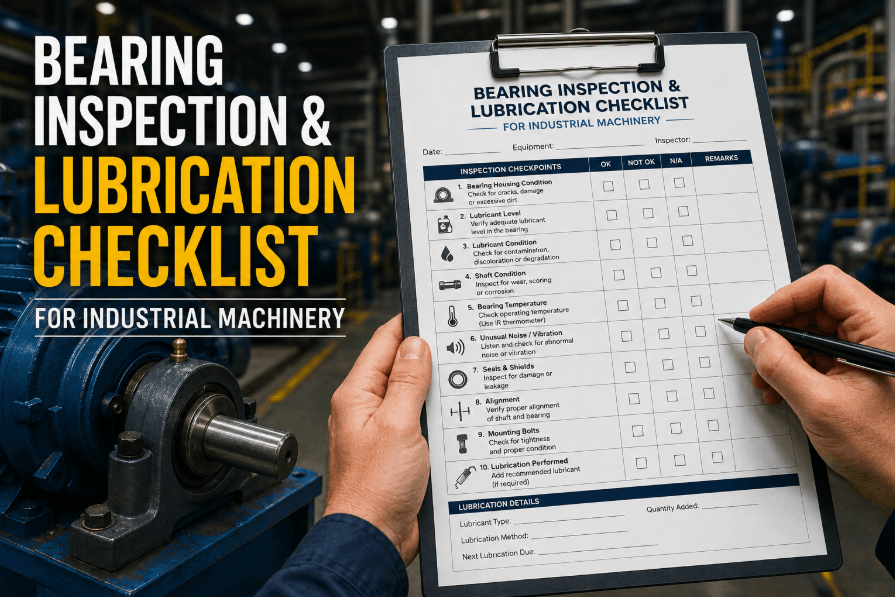
Lubrication is where robot maintenance is won or lost. Each reducer and wrist unit has a specified lubricant and a service interval in operating hours — too little grease wears the gear, too much builds pressure and leaks. These are typical reference points; the robot's own manual is the authority. Book a demo of hour-based lubrication scheduling in OXMAINT AI.
Lubrication point
Lubricant
Typical interval
Watch for
Axis reducers (J1–J3)
OEM reducer grease
By operating hours / periodic
Noise, heat, metal in old grease
Wrist reducers (J4–J6)
OEM reducer grease
By operating hours / periodic
Backlash, play at the wrist
Gearbox oil (where used)
OEM specified oil
Oil change at the set hours
Discoloured or contaminated oil
Balancer / bearings
Per model spec
Periodic re-grease
Dryness, squeal, stiffness
Use only the grease the maker specifies — mixing incompatible greases can damage a reducer — and relieve any grease-outlet pressure as the manual directs to avoid seal damage.
Inspection & PM by Interval
Around the lubrication sit the inspection tasks, tiered by how often they're needed — from a quick daily look to the annual deep service.
Daily
Quick checks
Listen and look for abnormal noise, vibration or leaks; check the EOAT, air and warning lights.
Periodic
Inspection round
Dress-pack and cable condition, cover and bolt tightness, controller filters, teach-pendant function.
By hours
Lubrication & battery
Reducer greasing and oil changes on the hour schedule; replace the encoder backup battery before end of life.
Annual
Deep service
Check mastering and calibration, reducer backlash, brake function, full harness inspection, controller health.
How Robots Actually Fail
Robot downtime concentrates in a handful of causes — and almost all of them are a scheduled task that slipped. Watch for these first.
×Reducer Wear
Missed or wrong lubrication wears the gear — backlash, noise, then an axis failure.
×Lost Position
A dead encoder backup battery wipes the mastering, forcing recalibration before the robot can run.
×Dress-Pack Failure
Flex fatigue breaks a cable or hose in the harness — an intermittent fault that halts the cell.
×Collision Damage
An impact shifts the mastering or bends a component, needing recalibration or repair.
×Overheating
Blocked controller filters or a straining motor raise temperature and shorten servo life.
×Brake Wear
A worn axis brake lets the arm drift or fall when power is removed — a safety issue.
How OXMAINT AI Keeps Robots Running
OXMAINT AI is the AI-powered maintenance management software that keeps a robot fleet on schedule — the asset register, the hour-based lubrication plan, the battery and calibration tracking, and the downtime record on one platform. Put your robots on it when you start free and schedule robot lubrication in OXMAINT AI.
Robot Asset Register
Each robot with its model, operating hours, lubricant specs and service history on file.
Hour-Based Lubrication
Greasing and oil changes triggered by operating hours, so a reducer is never run dry.
Battery & Calibration
Encoder-battery replacement and mastering checks tracked before they cause a stop.
Inspection Routes
Daily, periodic and annual checks generated on cadence and run from a phone at the cell.
Fault → Work Order
A robot alarm or inspection finding raised as a prioritised repair with the data attached.
Downtime Analytics
Robot downtime and failures trended so the recurring bad actor gets a real fix.
Every Robot Stop Was Once a Task on a Schedule.
The dry reducer, the dead battery, the worn cable — each had a service date that passed unnoticed. OXMAINT AI counts the operating hours, raises the lubrication and battery work before it's due, and keeps the robot running the cell instead of stopping it.
EXPERT REVIEW
Written for manufacturing, automation and maintenance teams. Industrial robot maintenance follows the robot maker's manual — FANUC, ABB, KUKA, Yaskawa and others each specify the exact lubricant type, grease quantity, service interval and procedure for every model, and those take precedence over any general guidance. The lubrication points and intervals here are typical references, not model-specific values; use the manual for your robot and its duty. Robot service involves stored energy, axis brakes and mastering, and should be done by trained personnel following lockout and the maker's safety procedures, with recalibration by a qualified technician after a collision or battery loss. OXMAINT AI is a maintenance management platform that schedules the work, tracks hours and records the history — it is not a robot controller, a calibration tool, or a substitute for the OEM manual or a qualified robot technician.
Frequently Asked Questions
How often should an industrial robot be lubricated?
On a schedule driven by operating hours, with the exact interval set by the robot maker for each reducer and model — greasing is typically done periodically and oil changed at a set number of hours. Because a robot's wear tracks how much it runs, not the calendar, counting operating hours is the right basis for the schedule.
Start free and schedule by robot hours in OXMAINT AI.
What happens if the encoder backup battery dies?
The robot loses its mastering — the stored zero-position reference for each axis — and can't run until it's recalibrated. It's one of the most common avoidable robot stoppages, because the battery has a known life and simply needs replacing before it reaches it. Tracking battery age as a scheduled task prevents the surprise.
Why is the dress pack such a common failure?
Because it flexes constantly. The dress pack is the bundle of cables and hoses that follows the arm's motion, and repeated bending fatigues the conductors and lines inside it. A worn dress pack causes intermittent faults that are hard to trace and can stop a cell, which is why its condition is a standard inspection item.
Can I use any grease in a robot reducer?
No. Each robot specifies a particular grease for its reducers, and using the wrong type — or mixing incompatible greases — can degrade the lubricant and damage the gear. Over-greasing is also harmful, building pressure that can damage seals. Always use the maker's specified lubricant, quantity and procedure.
What is robot mastering or calibration?
Mastering sets the robot's known zero position on each axis, which all its motion references. It's established at the factory and must be redone if it's lost — after a battery failure, a collision, or component replacement — by a qualified technician, so the robot moves accurately. A robot that's lost mastering can't be trusted to run its program safely.
Book a demo of tracking calibration in OXMAINT AI.
Keep the Reducers Greased and the Cell Running.
Run robot maintenance on OXMAINT AI: every robot registered with its hours and lubricant specs, greasing and oil changes scheduled by operating hours, the encoder battery and calibration tracked, inspection routes on cadence, and a work order raised the moment something faults — so the robot is maintained on time and the line keeps moving.