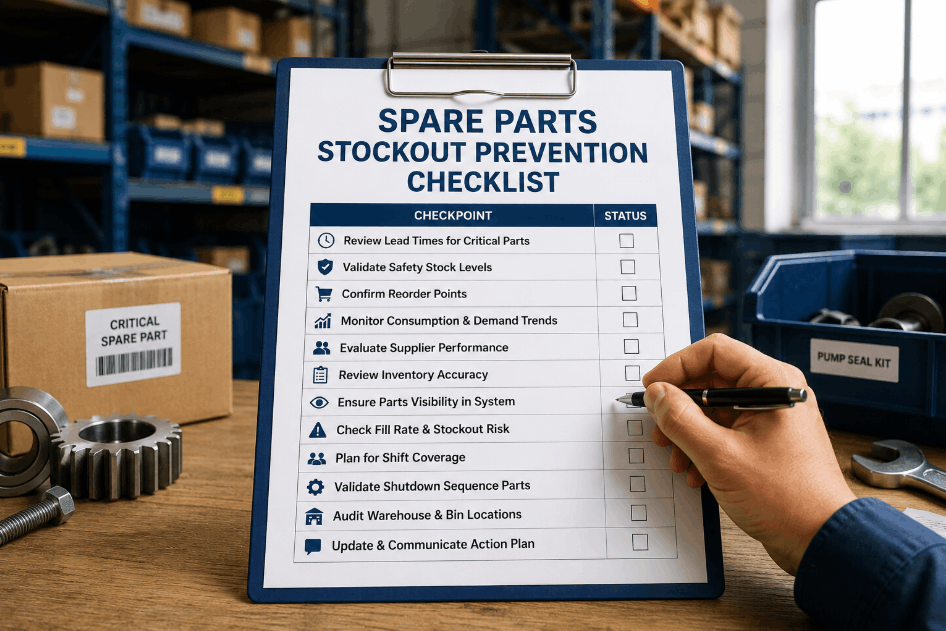
A maintenance program is only as good as the parts crib behind it. The best technician in the plant, the best PM calendar and the best predictive-maintenance program all stall at the same place — a part on a shelf, or not. A single stocked-out gearbox bearing becomes an outage that burns thousands of dollars in production per hour; a single over-stocked slow-mover becomes dead working capital that nobody writes off. Stockout prevention is the balance between those two ledgers. OXMAINT AI is the AI-powered maintenance inventory management software that classifies every part by criticality, calculates its reorder point, tracks lead times, raises risk alerts before the stockout, and keeps the maintenance program and the inventory record on the same screen.
MAINTENANCE SPARE PARTS STOCKOUT PREVENTION · INVENTORY MANAGEMENT · 2026
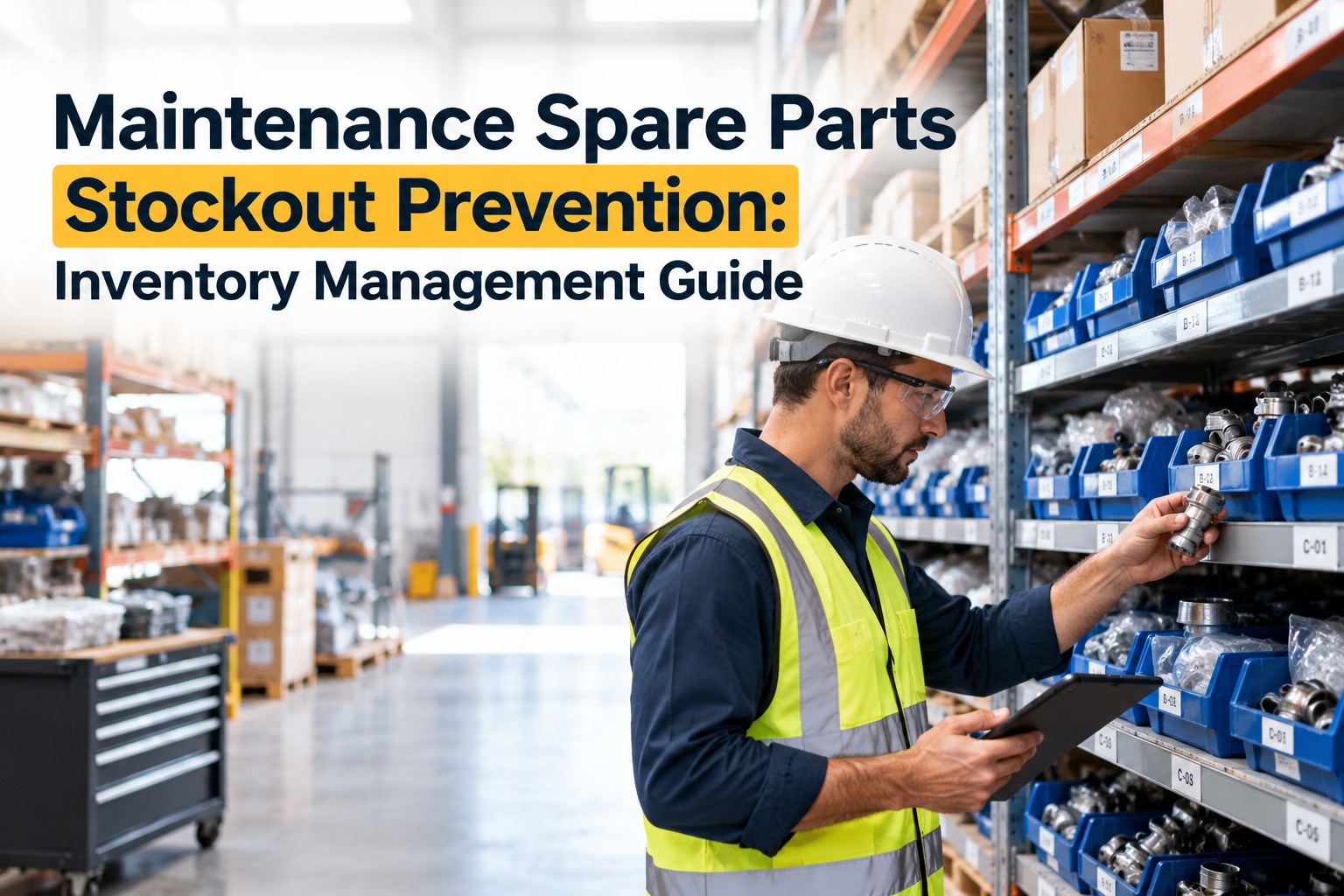
Maintenance Spare Parts Stockout Prevention: Inventory Management Guide
Nine criticality cells, one reorder-point formula, one live stockout-risk board. OXMAINT AI classifies every part, calculates its reorder level from live demand and lead time, and raises a risk alert before the crib goes dry.
9
ABC × VED criticality cells
3
stock levels: safety / reorder / max
1
reorder-point formula, 4 inputs
0
AV / AE stockouts — the only acceptable target
The ABC × VED Criticality Matrix — Not All Parts Are Equal
A parts crib run on uniform safety stock levels either over-invests in slow-movers or stocks out on critical fast-movers. ABC × VED splits every part into one of nine cells so stocking policy follows criticality. OXMAINT AI auto-classifies every part on both axes using usage history and asset tagging — run the classification on your parts crib in OXMAINT AI.
V · Vital
E · Essential
D · Desirable
A
top 70% $
AV
strict stock + 2 suppliers
AE
stock + review quarterly
AD
stock only if lead time long
B
next 20% $
BV
stock, review annually
BE
standard EOQ reorder
BD
standard EOQ reorder
C
last 10% $
CV
stock — cheap insurance
CE
low-watermark bin stock
CD
order on demand
The Reorder-Point Formula — Four Inputs, One Number
A reorder point is not a guess. Four inputs produce one number per part: average daily demand, lead time, demand variability and the service level the plant commits to for that criticality class.
The Three Stock Levels — Safety / Reorder / Max
Every parts record carries three thresholds. Below safety stock is the panic zone; between safety and reorder is the alert zone; between reorder and max is the normal zone. OXMAINT AI colors each inventory row by zone.
Max stock
Full crib — stop ordering
Reorder point
Trigger: raise PO automatically
Safety stock
Floor — cover lead-time variability
Below safety
PANIC — expedite / substitute / cannibalize
The Stockout Cascade — What Really Happens When A Part Isn't There
A stockout isn't one event. It is a cascade of five, each one more expensive than the last. OXMAINT AI pins the cascade to the WO so the next policy review has the real cost of a stockout, not the sticker price.
01
WO parked
Technician on the asset, hands tied; WO moves to parked status. Labor hour spent, work not done.
→
02
Expedite PO
Rush order placed at premium freight; typical premium 2-10× the part's base cost on expedite logistics alone.
→
03
Substitute / cannibalize
Tech pulls the part from another asset, or installs a non-standard substitute. Two assets now carry debt.
→
04
Production hit
Asset down longer than planned; downstream production loss or quality incident lands on the P&L.
→
05
Policy drift
Panic drives over-stocking of this part on the next review; working-capital creep that nobody writes off.
Lead-Time Risk Map — The Supplier Side Of Stockout
Half of stockouts aren't demand misses — they are supplier misses. A single-source part with a 90-day lead time is a landmine regardless of how perfect the reorder point calculation is. The matrix below is the policy response per quadrant.
Short LT × multi-source
7-21 days · 2+ suppliers
The healthy quadrant. Standard EOQ reorder, no supplier concentration risk.
Short LT × single-source
7-21 days · 1 supplier
Qualify a second source as a quarter-end project; monitor supplier health.
Long LT × multi-source
60-180 days · 2+ suppliers
Larger safety stock buffer; raise z-score to 99%+; prefer local supplier for restock cadence.
Long LT × single-source
60-180+ days · 1 supplier · often OEM
The landmine. Carry two of the part, qualify a second source even at higher unit cost, build the capital-insurance case for a rotable spare.
Live Stockout-Risk Board — What A Storesperson Sees
The risk board surfaces parts within one lead-time cycle of running out, sorted by criticality. OXMAINT AI computes it live — the storesperson sees the AV parts bleeding into the alert zone before the WO lands on their desk.
STOCKOUT-RISK BOARD · UNIT 1 CRIB · 17:30
SKF 22220 bearingAV · qty 1 vs SS 2 · LT 42 d single-sourcePANIC · expedite PO
GE buckets S1 setAV · qty 0 vs SS 1 · LT 120 d OEMPANIC · capital review
Grundfos pump sealAE · qty 2 vs ROP 4 · LT 18 dAT RISK · PO raised
Siemens VFD moduleBE · qty 1 vs ROP 2 · LT 28 dAT RISK · PO raised
Filter cartridge FC-304CE · qty 48 vs ROP 15 · LT 5 dNORMAL
The Cheapest Stockout To Prevent Is The One You Classify Properly.
An AV part with wrong classification costs more than a thousand C-parts with perfect classification. OXMAINT AI runs the classification monthly from live usage, re-tiers automatically on demand pattern shift, and keeps the critical-few at a 99% service level.
Six Stockout-Prevention Habits That Actually Work
The plants with the lowest critical stockout rate do six things in common. OXMAINT AI embeds all six as the default workflow.
01
Classify once a quarter, not once a decade
Demand patterns shift; a BV part can become an AV part within six months. Quarterly auto-reclassification keeps the policy honest.
02
Measure actual lead time, not quoted
The purchase order to goods-receipt timestamp is the real lead time. Store it per PO and roll up as the supplier's actual LT.
03
Auto-raise PO at reorder point
A reorder trigger that waits for someone to walk by the shelf is not a trigger. OXMAINT AI raises the PO on the inventory event.
04
Second-source every AV part
Supplier concentration is the single highest-leverage risk on critical parts. Make it a quarterly target.
05
Flag slow-movers above max
A B or C part above max for six months is working capital. Flag it for review — donate, scrap, or re-pool across sites.
06
Pin stockouts back to policy
Every stockout logs a reason tag — classification, lead time, demand spike, supplier miss. The next review sees the pattern.
Service Levels By Criticality Cell
The service level a crib targets is a policy choice. The ranges below are working defaults by cell; OXMAINT AI applies them automatically and lets the plant override per SKU.
Cell
Service level
Z-score
Reorder policy
AV · AE
99 - 99.5%
2.33 - 2.58
Auto PO + supplier watch
AD · BV
97 - 99%
1.88 - 2.33
Auto PO
BE · BD
95%
1.65
EOQ reorder
CV · CE
90 - 95%
1.28 - 1.65
Bin stock, low watermark
How OXMAINT AI Runs The Spare-Parts Program
The ABC × VED classifier, reorder-point calculation, three-level stocking, risk board, lead-time tracker and stockout root-cause pin all live natively in the OXMAINT AI maintenance inventory management software — open an account and bring the parts crib into OXMAINT AI.
Auto ABC × VED
Classification runs monthly from live usage and asset-criticality tagging; cells re-tier automatically.
Live Reorder Point
ROP calculated per SKU from live demand mean, variability and actual supplier lead time — never a static field.
Risk Board
Live stockout-risk view ordered by criticality; AV/AE parts in alert zone escalate to the maintenance manager.
Supplier LT Tracking
Actual lead time per PO stored and averaged; the number used in ROP is history, not the sales quote.
Auto PO Raise
PO raised automatically on reorder-point trigger; expedite flag auto-set when SKU falls into panic zone.
Stockout Root-Cause Pin
Every stockout tagged with its reason — classification, LT, demand spike, supplier miss — so policy improves.
Frequently Asked Questions
How often should classification refresh?
Quarterly for most plants, monthly for high-change environments (new assets, major production shifts). OXMAINT AI runs it monthly in the background and only surfaces the SKUs whose cell actually changed, so the review is 20 items, not 20,000.
What service level is right for AV parts?
99-99.5% is the usual range for AV parts in process industries. Higher than that doubles safety stock for incremental reduction; lower than that leaves the plant exposed to the costliest stockout cascade. OXMAINT AI defaults to 99% and surfaces the trade-off per SKU for override.
Does predictive maintenance change the stocking policy?
Yes — materially. A predictive flag that gives 10-14 days warning means a part can be ordered on signal rather than carried on the shelf, which reduces working capital on predictable-failure parts. OXMAINT AI couples the predictive signal to the inventory record so the policy adjusts automatically.
How do we handle OEM parts with 120-day lead times?
The reorder-point formula handles them — the LT variable just gets larger, pushing both the reorder point and the safety-stock buffer up. The real decision is whether to carry one or two of the part on the shelf; the capital-insurance math usually says two for AV parts with LT past 60 days.
Classify First. Then Set The Policy. Then Let The Software Run It.
Load the parts crib into the OXMAINT AI maintenance inventory management software — auto ABC × VED classification, live reorder point, three-zone stocking, risk board, actual-lead-time tracking and the stockout root-cause pin. The AV stockouts go to zero, and the C-part working capital goes down with them.